HCPCS Code G0163: Skilled nursing observation and assessment
What is HCPCS Code G0163? HCPCS Code G0163 is a deleted Level II code for skille...

Last Updated: Oct 15, 2026
HCPCS code P9047 covers infusion of albumin (human), 25%, 50 ml. Each 50 ml vial administered equals one billable unit, so a 100 ml dose bills as two.
The code sits in the P-series, which CMS maintains for blood products and blood derivatives. Its neighbor P9046 covers the same 25% albumin in a 20 ml vial, and mixing the two drives denials. The record also has to show the volume given, the supporting diagnosis, and a recent serum albumin result.
Let Pabau's smart automation suggest the right codes, reduce claim denials, and keep your practice compliant—effortlessly.
Automate repetitive tasks and focus on what matters most—your patients.
Reduce coding errors and ensure compliance with the latest regulations.
Clean claims, fewer denials, and faster reimbursements.
Powerful insights and reporting to help your practice thrive.
HIPAA compliant SOC 2 certified GDPR-compliant Trusted by 4,000+ clinics worldwide

HCPCS code P9047 covers albumin (human) 25% in a 50 ml vial, billed one unit per vial.
P9046 covers the same 25% albumin in a 20 ml vial, so check the vial size before you bill.
Total volume divided by 50 gives the unit count, so a 200 ml dose bills as four units.
The claim needs a supported ICD-10 diagnosis, a recent serum albumin result, and the product’s NDC.
Medicare prices P9047 from the quarterly ASP file, and many commercial plans require prior authorization.
HCPCS code P9047 bills one unit for every 50 ml vial of albumin (human) 25% administered. The official CMS descriptor reads “infusion, albumin (human), 25%, 50 ml.” Give 100 ml and you bill two units.
The code is active for fiscal year 2026 with no deletion scheduled, according to the AAPC HCPCS Level II code database.
Albuked 25 is the best-known branded product billed under P9047. Other 25% albumin products supplied in a 50 ml vial map to the same code, whoever makes them. So the check is always volume. A 50 ml vial takes P9047, and a 20 ml vial takes P9046.
Payers accept P9047 when the record shows a documented need for oncotic pressure support, volume restoration, or albumin replacement. At 25%, albumin is hyperoncotic relative to plasma. That makes it the choice when fluid restriction matters, and it separates the product from the 5% formulation used for volume expansion.
CMS and most Medicare Administrative Contractor (MAC) Local Coverage Determinations recognize these indications as supportable for P9047 claims:
Each MAC sets its own serum albumin thresholds and clinical criteria. So check the applicable LCD before you bill P9047 for a diagnosis that sits outside the groupings above.
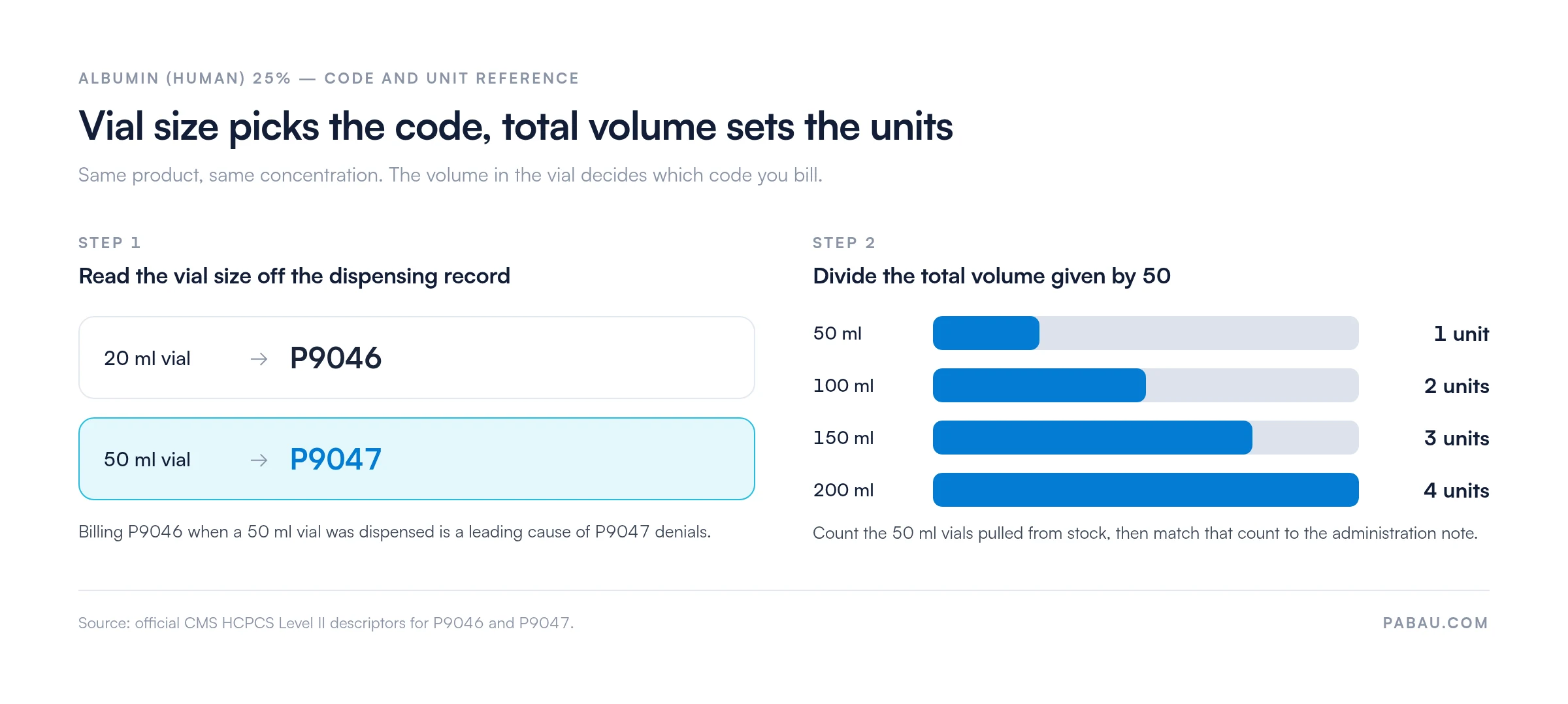
P9046 covers the same 25% albumin, supplied in a 20 ml vial. P9047 covers it in a 50 ml vial. Volume per unit is the difference, and it is a fixed product specification. Submit the wrong code and the claim mismatches the payer’s drug database automatically.
Count units from the 50 ml vials pulled from stock and administered. A 200 ml infusion order equals four units. Cross-referencing the pharmacy dispensing record against the infusion administration note prevents most unit-count mismatches at claims edit. The chart below puts both checks side by side.
A P9047 claim pays only when the diagnosis on it supports the infusion. The supporting code has to reflect the clinical reason for the albumin order. It also has to meet the payer’s medical necessity criteria under the applicable LCD.
The diagnoses below come up most often on albumin claims. Each one is drawn from the ICD-10-CM code set and has to be supported by the treating physician’s own documentation.
ICD-10-CM changes every fiscal year. So verify each code against the current release in the CDC/NCHS ICD-10-CM web tool before you submit. Where a MAC publishes a covered-diagnosis list inside its albumin LCD, that list wins.
P9047 codes the albumin product only. The administration service is captured separately under CPT, and in most outpatient settings both belong on the same claim.
Drop the companion CPT code and you lose the administration revenue. You also invite a medical necessity review on the product, because payers expect to see the service that used it.
Common companion codes, with the context each one fits:
Under hospital outpatient prospective payment system (OPPS) billing, the facility bills the product and the CPT captures the professional administration. Under buy-and-bill, the physician practice reports both P9047 and the companion CPT on the same 1500 claim form.
Pre-mapping the pairings for each clinical scenario helps front-line staff pick the right combination at encounter closure.
Medicare Part B covers P9047 under its physician-administered drug benefit, provided the infusion meets documented medical necessity criteria. Coverage is not automatic.
The claim has to carry a supported ICD-10 diagnosis, and the record has to show a physician order and a Medicare-participating setting.
Key coverage points by payer type:
Practices that infuse across several sites of service carry the most risk here. The same patient can be covered in one setting and denied in another, so confirm coverage per encounter rather than per patient.
Verify the patient’s payer-specific albumin LCD before every P9047 encounter. MAC LCDs vary by jurisdiction. Some require a serum albumin below 2.0 g/dL, while others accept below 2.5 g/dL with additional clinical criteria. Document the lab value and the ordering physician’s attestation of medical necessity in the same encounter note that supports the claim.
CMS pays physician-administered Part B drugs using the Average Sales Price (ASP) methodology. For P9047 in a physician office, the rate is ASP plus 6%, and CMS updates it quarterly.
Hospital outpatient payment runs through Ambulatory Payment Classification (APC) packaging rules, which can bundle the product into the facility APC instead of paying it separately.
Because ASP rates move every quarter, any dollar figure printed in an article is a historical reference point.
Check the current rate in the CMS Physician Fee Schedule lookup tool, or in the quarterly ASP drug pricing file, before you submit. Contracted commercial rates can sit well away from the Medicare rate.
Read the remittance once payment posts. It is the quickest way to see whether the payer paid at the expected ASP rate, or applied a contractual adjustment worth appealing.
Prior authorization (PA) for P9047 depends on the plan. Medicare Part B does not universally require it for albumin infusions. Individual MACs and commercial plans often do, especially for outpatient or home-infusion settings where the clinical urgency is less obvious to a reviewer.
Build a PA check for blood derivatives into the eligibility verification you run before every P9047 encounter. A PA request usually has to carry:
Record the authorization number in the billing record once a PA is granted, and reference it on the claim. A denied PA still has a route forward. Most payers offer an appeals pathway, and peer-to-peer review with the medical director works well when the clinical criteria are documented.
Every element supporting a P9047 claim has to sit in the medical record before you submit. An auditor looks for a complete, contemporaneous infusion record that corroborates each field on the claim form.
The minimum documentation set for a compliant P9047 claim:
Keep that set in a structured, retrievable format. It supports the first submission and any post-payment audit that follows, and it shortens days in accounts receivable on high-cost blood product codes.
The claim form itself is short. Almost all of the work happens before it leaves the practice, across six handoffs:
Claims break at the handoffs, not inside any one step. The pharmacy record, the administration note and the charge line all have to agree on the same vial count.
P9047 denials cluster around a short list of errors, and most are preventable at charge entry. Four checks catch the bulk of them. Verify the code, the unit count, the ICD-10 pairing, and the PA status.
Before you submit, run down this list:
Track denials at the code level rather than in aggregate. The CARC and RARC codes on the remittance show whether a pattern comes from coder error, thin documentation, or a payer policy change. Fix the cause, then resubmit a corrected claim or appeal inside the filing window.
Most of the trouble above comes from information sitting in separate systems. The pharmacy log lives in one place, the infusion note in another, and the charge line in a third. Reconciling three sources by hand, encounter after encounter, is where a vial count quietly goes wrong.
Practice management software like Pabau keeps the order, the treatment note, the lab result and the invoice on one patient record. Charge entry then works from the same record the clinician documented in, so nobody rekeys a vial count off a printout.
Pabau’s claims management software submits through an integrated clearinghouse and supports payer-specific billing workflows. Remittances post back against the same record, so an outstanding P9047 claim stays visible to whoever picks up the follow-up.

Pabau’s claims management software submits claims through an integrated clearinghouse and supports payer-specific billing workflows. See how one patient record keeps HCPCS billing and remittance posting in step.

Accurate P9047 billing comes down to four checks before the claim goes out. Confirm the vial is 50 ml, convert total volume to units, pair a supported ICD-10 diagnosis, and confirm the PA status. Those four steps stop most denials before the payer’s edit system ever sees them.
The trade-off worth remembering is timing. Each check costs a minute before the infusion. After a denial, the same work costs several staff hours, because an appeal reopens what the original verification would have finished. So put the checks in the encounter workflow, where they cost the least.
Book a demo to see how Pabau handles HCPCS claim submission, remittance posting and denial follow-up in one place.

Need a framework for tracking claim denial patterns? Denial management in healthcare covers the end-to-end process for categorizing, tracking, and resolving denied claims by CARC code.
Want to understand how blood product claims move through a clearinghouse? Medical claims clearinghouse explains payer routing, edit checks, and 835 remittance handling for HCPCS drug codes.
Looking for ERA interpretation guidance? Electronic remittance advice breaks down how to read 835 files, identify contractual adjustments, and reconcile ASP-based payments.
Report the 11-digit NDC in the shaded area of the service line on the CMS-1500, prefixed with the N4 qualifier and no spaces or hyphens. Follow it with the unit of measure, which is ML for albumin, and the quantity administered. Payers reject drug lines where the NDC quantity and the HCPCS unit count disagree.
Yes. Where both vial sizes were dispensed for one patient, report each code on its own service line with its own unit count. Never roll a 20 ml vial into the P9047 units. The unit math on each line has to match the vials of that size actually administered.
No. Albumin is a physician-administered drug, so it sits under the Part B benefit rather than the Part D pharmacy benefit. Part D covers drugs a patient takes themselves. A P9047 line sent to a Part D plan gets rejected and has to be rebilled to Part B.
Use the code for the site where the infusion happened. Office infusions take POS 11, on-campus hospital outpatient departments take POS 22, and CMS-defined independent clinics take POS 49. A mismatch between the POS code and the documented site is a common technical denial, and it is straightforward to correct on resubmission.