HCPCS Code P9612: Catheterization for urine specimen collection
HCPCS Code P9612: Definition and code attributes HCPCS Code P9612 is the HCPCS L...

Last Updated: Oct 26, 2026
P9058 is the HCPCS Level II code for red blood cells, leukocytes reduced, CMV-negative, irradiated, each unit.
All three modifications must be present on the unit. A leukoreduced, irradiated unit that is not CMV-negative is P9040, not P9058. A leukoreduced, CMV-negative unit that was not irradiated is P9051.
Let Pabau's smart automation suggest the right codes, reduce claim denials, and keep your practice compliant—effortlessly.
Automate repetitive tasks and focus on what matters most—your patients.
Reduce coding errors and ensure compliance with the latest regulations.
Clean claims, fewer denials, and faster reimbursements.
Powerful insights and reporting to help your practice thrive.
HIPAA compliant SOC 2 certified GDPR-compliant Trusted by 4,000+ clinics worldwide

P9058 covers red blood cells that are leukocyte-reduced, CMV-negative, and irradiated, billed per unit. All three modifications must be documented.
A leukoreduced, irradiated unit that is not CMV-negative is P9040, not P9058. Leukoreduction alone is P9016.
Deglycerolized red blood cells are P9039. P9059 is fresh frozen plasma, so it never stands in for a red cell code.
Report P9058 under revenue code 0381 (packed red cells), and the transfusion itself under CPT 36430.
The CY 2026 Medicare OPPS payment for P9058 is $249.40 per unit, under APC 9533.
HCPCS code P9058 reports one unit of red blood cells that are leukocyte-reduced, CMV-negative, and irradiated. The Centers for Medicare & Medicaid Services (CMS) maintains it in the HCPCS Level II code set. The table below gives the code profile from the current CMS files.
The “each unit” language in the descriptor is the billing anchor. The units you report must match the number of units the blood bank issued and the nurse transfused.
P9058 units are ordered for patients who need protection from CMV infection and transfusion-associated graft-versus-host disease at the same time. Each of the three modifications addresses a different transfusion risk.
Filtration removes most donor white blood cells from the unit. This lowers the risk of febrile reactions, human leukocyte antigen (HLA) alloimmunization, and transmission of viruses carried in white cells.
The unit comes from a donor who tested negative for cytomegalovirus (CMV) antibodies. Clinicians request CMV-negative units for patients in whom a CMV infection could be severe.
Gamma or X-ray irradiation inactivates donor T-lymphocytes. This prevents transfusion-associated graft-versus-host disease (TA-GvHD) in recipients who cannot reject those cells.
Typical recipients include stem cell and bone marrow transplant patients, patients with hematologic malignancies, and fetuses receiving intrauterine transfusions. Neonates and patients with severe congenital immunodeficiency are in the same group. The physician order should name the indication, because it supports medical necessity for all three modifications.
P9058 applies only when one red cell unit carries all three modifications: leukoreduction, CMV-negative status, and irradiation. Drop any one of them and the unit moves to a neighboring code, as the grid below shows.
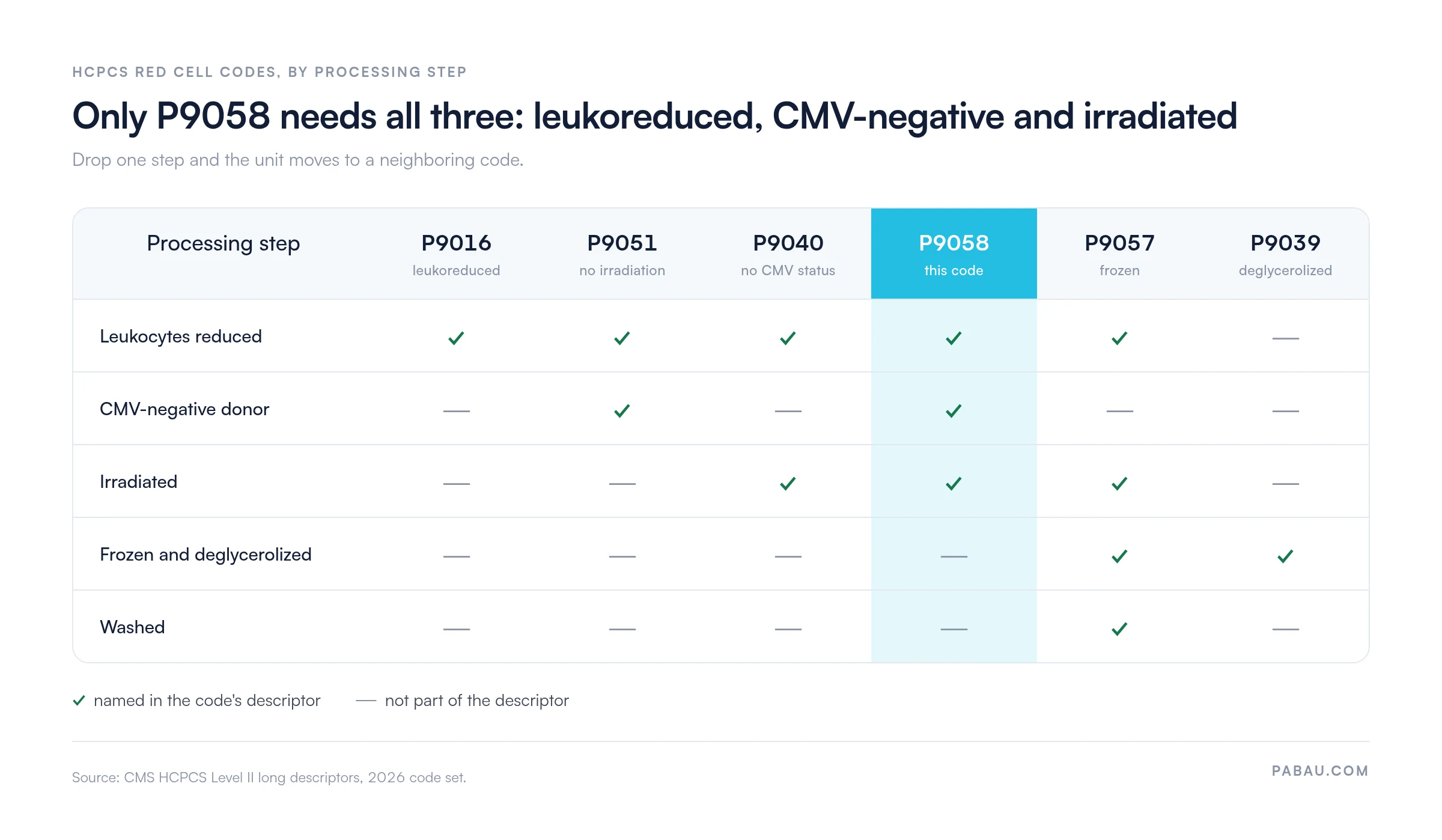
CMV status is the step that decides the code between two otherwise identical units. A leukoreduced, irradiated unit that is not CMV-negative is P9040, even when the patient is immunocompromised. Confirm CMV status on the blood bank tag before you choose between the two codes.
P9058 sits inside a cluster of red cell codes that differ only by which processing steps were applied. The table below compares the codes coders most often confuse with it.
P9040 shares leukoreduction and irradiation with P9058, so the two codes are easy to swap on a claim. The deciding fact is CMV status. If the blood bank tag shows a CMV-negative unit, the code is P9058. If it does not, the code is P9040.
P9057 shares leukoreduction and irradiation with P9058, but its unit was also frozen, deglycerolized, and washed. A unit that went through those frozen-storage steps is never P9058.
Deglycerolized red cells belong to P9039, not P9059. P9059 is fresh frozen plasma between 8-24 hours of collection, each unit, so it sits outside the red cell group entirely.
Before a P9058 claim will survive payer review, the record must link three things. These are the physician order, the blood bank processing record, and a diagnosis that supports the clinical need.
The blood bank processing record carries the most weight in a P9058 audit, because it records how and when each step was done. Check that it names all three modifications explicitly, not only the product code from the blood bank inventory system.
Ask the blood bank for a processing report that confirms each modification on its own line: leukoreduction, CMV-negative donor status, and irradiation dose. A report that says only ‘modified red cells’ will not support P9058 in an audit.
P9058 is billed per unit of red cells transfused. Report the number of units in the units field and match it to the blood bank issue log. Follow your payer’s instruction on whether two units go on one line or two. The transfusion itself goes on its own line as CPT 36430.
When a community blood bank supplies the unit free of charge, the hospital does not bill the product itself. It reports its processing and storage charge under the 039X blood storage and processing series instead.
Inpatient stays work differently. Under the Inpatient Prospective Payment System (IPPS), blood product costs are typically included within the diagnosis-related group (DRG) payment. Outpatient and hospital-based infusion settings are where P9058 drives separate reimbursement.
Medicare pays for P9058 in hospital outpatient departments under the Outpatient Prospective Payment System (OPPS). For CY 2026, CMS set the payment at $249.40 per unit under Ambulatory Payment Classification (APC) 9533. That is up from $222.86 in 2025. The figures come from AABB’s summary of the CMS CY 2026 OPPS final rule.
For comparison, CMS set P9040 at $265.41 per unit for CY 2026. The two codes pay different amounts, so a CMV-status error changes the payment as well as the code.
Prior authorization requirements for P9058 vary by payer and Medicare Administrative Contractor (MAC) jurisdiction. Medicare has no national coverage determination requiring prior authorization for irradiated blood products.
Local Coverage Determinations (LCDs) can still impose conditions, so check the CMS LCD database for the MAC covering the facility.
Some commercial payers maintain outpatient blood product policies that ask for documentation of the clinical indication before payment. The diagnosis codes below are commonly used to support medical necessity for P9058.
When a payer requires prior authorization, submit the diagnosis code and the physician’s statement of medical necessity before the transfusion date. Confirm payer requirements at registration, because retroactive requests are harder to win.
P9058 claims have a distinct denial profile because the code needs three processing steps in the record. The table below covers common denial patterns, the typical CARC (Claim Adjustment Reason Code), and the fix.
Most of the denial reasons above start in the chart, with a document that is missing or incomplete. Denial management in healthcare starts with a pre-billing check that confirms each required document is there. Our guide to medical billing denial codes explains the CARC codes on blood product remittances.
Build a five-point check into claim generation. Confirm the physician order, the processing record naming all three modifications, and the transfusion administration record. Then confirm the supporting diagnosis and units matched to the issue log. Each point maps to a denial reason in the table above, so a failed check is a claim you can fix before it goes out.
In most facilities the physician order, the blood bank record, and the claim live in separate systems. A biller reads the processing record, picks the code by hand, and hopes the CMV status was not missed.
Pabau, the clinical and billing platform we build, keeps the clinical record, the documentation, and the invoice on one patient file. With Pabau’s claims management software, the coded charge sits next to the note that supports it. A reviewer checking a P9058 line has the evidence on the same record.

Reporting then shows which codes get paid and which keep coming back. If P9058 lines are being recoded to P9040, you see the pattern in a report rather than in next quarter’s revenue.

Pabau keeps the order, the processing notes, and the coded charge on one patient record. Billers can check every P9058 line against its evidence before the claim goes out.

P9058 is narrow by design. It is right only when one red cell unit is leukoreduced, CMV-negative, and irradiated, and wrong the moment one of those steps is missing. P9040, P9051, and P9016 are waiting for every unit that falls short.
So the work that pays off sits upstream of the claim. Set up a documentation protocol with the blood bank that names all three steps on every unit. Then the code choice stops being a judgment call, and an auditor can confirm CMV status from the record in seconds.
Book a demo to see how Pabau keeps transfusion documentation and coded charges on the same patient record, so every P9058 line has its proof.

Want to understand how clearinghouses handle HCPCS claims submission? Medical claims clearinghouse guide explains how claims move from billing software to payers and where edits catch errors before they become denials.
Want your outpatient billing to hold up in an audit? Medical billing compliance outlines the documentation and payer policy rules that apply to facility billing.
Billing a CMV-negative unit that was not irradiated? HCPCS code P9051 covers leukoreduced, CMV-negative blood without irradiation.
Was the unit frozen and washed before issue? HCPCS code P9057 covers frozen, deglycerolized, washed, leukoreduced, irradiated red cells.
HCPCS code P9058 covers red blood cells that are leukocyte-reduced, CMV-negative, and irradiated, billed per unit transfused. All three modifications must appear in the blood bank record. The code is used for patients at risk of both CMV infection and transfusion-associated graft-versus-host disease, such as transplant recipients.
Both codes describe leukoreduced, irradiated red blood cells. P9058 adds a third requirement: the unit must come from a CMV-negative donor. A leukoreduced, irradiated unit without CMV-negative status is billed as P9040.
P9057 covers red blood cells that are frozen, deglycerolized, washed, leukoreduced, and irradiated. P9058 covers fresh leukoreduced, CMV-negative, irradiated red cells that never went through frozen storage. A unit that was frozen and deglycerolized is never P9058.
Deglycerolized red blood cells are billed as P9039, red blood cells, deglycerolized, each unit. P9059 is a different product: fresh frozen plasma between 8-24 hours of collection, each unit. Neither code replaces P9058.
Report one unit of P9058 for each red cell unit transfused, under revenue code 0381 on the UB-04. The units billed must match the blood bank issue log. Report the transfusion itself separately with CPT 36430 under revenue code 0391.
Yes, Medicare covers P9058 when medical necessity is documented. Hospital outpatient claims are paid under OPPS, at $249.40 per unit for CY 2026 under APC 9533. Inpatient claims are generally bundled into the DRG and not separately payable.
Most P9058 denials start with a missing or incomplete document. The processing record may not confirm all three modifications, the physician order may be missing, or the diagnosis may not support the indication. Billing P9058 for a unit that was not CMV-negative is the most common coding error.
Five documents support a P9058 claim: a signed order for leukoreduced, CMV-negative, irradiated red cells, and the blood bank processing record confirming all three. The others are the transfusion administration record, a supporting ICD-10-CM diagnosis, and the blood product label.