HCPCS code P9058: Red blood cells, leukocytes reduced, CMV-negative, irradiated
HCPCS code P9058: Official descriptor and key attributes HCPCS code P9058 report...

Last Updated: Oct 26, 2026
P9038 is the HCPCS Level II code for red blood cells, irradiated, each unit.
Irradiation stops donor T-lymphocytes from dividing, which prevents transfusion-associated graft-versus-host disease (TA-GvHD) in at-risk recipients. The code fits a unit that was irradiated but not leukoreduced. A unit that was both leukoreduced and irradiated is billed as P9040, so the blood bank label decides the code.
Let Pabau's smart automation suggest the right codes, reduce claim denials, and keep your practice compliant—effortlessly.
Automate repetitive tasks and focus on what matters most—your patients.
Reduce coding errors and ensure compliance with the latest regulations.
Clean claims, fewer denials, and faster reimbursements.
Powerful insights and reporting to help your practice thrive.
HIPAA compliant SOC 2 certified GDPR-compliant Trusted by 4,000+ clinics worldwide

HCPCS code P9038 bills one unit of red blood cells that has been irradiated but not leukoreduced.
A unit that is both leukoreduced and irradiated is P9040, and most US red cell units are leukoreduced.
Irradiation inactivates donor T-lymphocytes to prevent transfusion-associated graft-versus-host disease in at-risk recipients.
Under the 2026 OPPS, P9038 has status indicator R and pays a separate per-unit rate through APC 9502.
Do not add CPT 86945 for irradiation, because the P9038 charge already includes that step.
HCPCS code P9038 is a permanent Level II code for red blood cells, irradiated, each unit. The Centers for Medicare and Medicaid Services (CMS) maintains it in the P-series blood and blood products range.
The descriptor names one processing step, irradiation. It never mentions leukoreduction, so the code fits only units that skipped that step.
P9038 covers one unit of red blood cells exposed to gamma or X-ray irradiation before transfusion. The blood bank record must show that the unit was irradiated and was not leukoreduced.
Not included:
In practice, P9038 is a low-volume code. The 2019 National Blood Collection and Utilization Survey found that 97% of US whole blood and red cell units were leukoreduced. An irradiated unit from a US blood center is usually P9040, so read the label before choosing P9038.
Irradiation stops donor T-lymphocytes from dividing. Left active, those cells can engraft in a recipient who cannot reject them and cause transfusion-associated graft-versus-host disease (TA-GvHD).
TA-GvHD is rare but usually fatal, and irradiation is the standard way to prevent it. FDA guidance sets a dose of at least 25 Gy at the center of the unit and 15 Gy everywhere else.
Transfusion guidelines, including the British Society for Haematology’s irradiation guideline, recommend irradiated cellular components for these patients:
Irradiation also shortens shelf life. Irradiated red cells expire 28 days after irradiation or on their original date, whichever comes first. Potassium leaks from irradiated cells in storage, which matters for neonates and large-volume transfusions.
The diagnosis codes on the claim should reflect one of these indications. A P9038 line paired with a diagnosis that gives no reason for irradiation invites a medical necessity review.
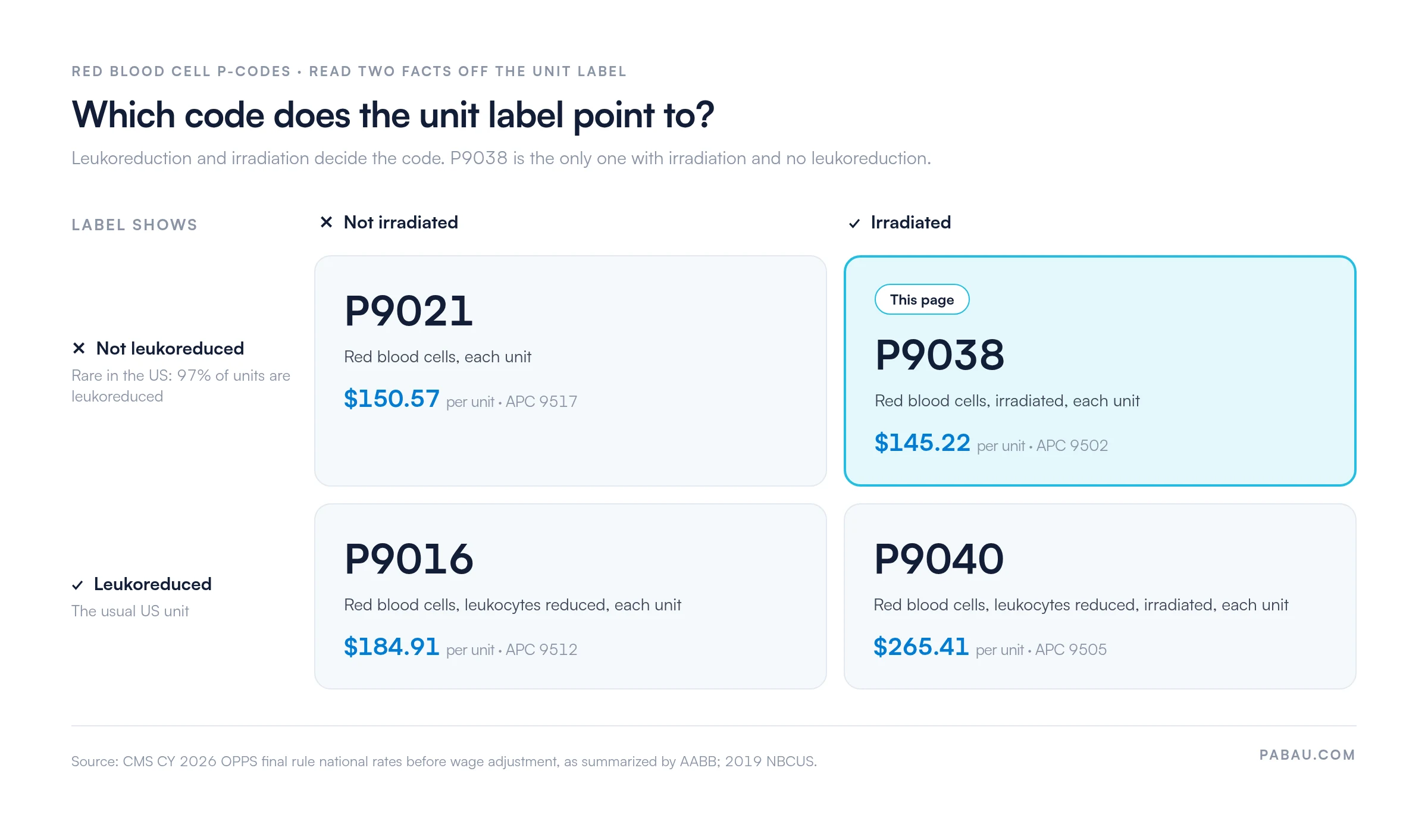
Each red cell P-code describes a processing combination, so the blood bank record decides the code. The table compares P9038 with its closest neighbors.
Rates are the CY 2026 OPPS national rates before wage adjustment, as summarized by AABB from the CMS final rule. P9038 pays slightly less than plain P9021 in 2026, because CMS sets each rate from hospital cost data for that code.
The practical rule is to check the label and the processing record for two attributes, as the grid below shows. Irradiated only is P9038, and irradiated plus leukoreduced is P9040. Leukoreduced only is P9016, and neither step is P9021.
Billing P9038 for a leukoreduced unit understates the product and the payment. Billing P9040 when the record shows no leukoreduction overstates it, which becomes an overcoding finding on audit.
The record must confirm the product attributes before a coder selects P9038. An order that says only “irradiated blood” does not show which red cell product was transfused.
Solid medical billing compliance for P9038 means the blood bank and clinical records cover these points:
A charge capture form that pulls the unit count from the transfusion record keeps the ordered quantity off the claim.
Before each P9038 claim, compare the unit label with the charge line. If the label says leukoreduced, the code is P9040.
Clean claim submission for P9038 turns on four details: units, revenue codes, the BL modifier and the transfusion line.
P9038 is billed per unit transfused. Two units given in one encounter are reported as two units of P9038 on that date of service. Count from the transfusion record, since an ordered unit may never be hung.
The revenue code depends on what the hospital paid for, according to the Medicare Claims Processing Manual, chapter 4, section 231.
Revenue code 0391 covers blood administration, so it belongs with the transfusion service rather than the product. Confirm that your chargemaster maps each pairing the same way.
Modifier BL, special acquisition of blood and blood products, is the modifier specific to this billing. It applies only when the hospital purchased the blood itself and splits the charge across two lines.
Report the transfusion separately with CPT 36430 on the same date. CMS tells hospitals to bill the specific irradiated product code when one exists, so CPT 86945 is not added to P9038.
Blood components are not listed in the FDA NDC Directory, so Medicare does not require an NDC on a P9038 line. Some state Medicaid programs set their own NDC rules, so check each payer’s billing manual.
Under the 2026 OPPS, P9038 carries status indicator R, which marks blood and blood products paid separately. It maps to APC 9502, with a national rate of $145.22 per unit, down from $149.22 in 2025.
CMS sets that rate from hospital claims and blood-specific cost-to-charge ratios, then adjusts it for local wages. The payment is a fixed amount per unit, published in OPPS Addendum B, rather than the hospital’s own cost. CMS resets the rate every January, so check Addendum B again at the start of each year.
Two rules can change the payment. When P9038 sits on a claim with a comprehensive APC service, its cost is packaged into that payment. When the hospital buys the blood, the Medicare blood deductible can also apply. It applies to the first three units of packed red cells in a calendar year.
Outside the OPPS, the HCPCS file lists P9038 with pricing indicator 52, reasonable charge. Your Medicare contractor sets that amount and any special coverage instructions.
Check each one for the billing year against the current ICD-10-CM codes or the CDC browser. A code that was expanded or deleted fails the claim edits before medical review starts.
A P9038 denial starts in one of three places: the code, the record or the claim line. Good denial management workflows trace each one back to its source before the claim is resubmitted.
Integrated claims management software flags missing fields at submission, so unit mismatches and missing modifiers never reach the payer.

Check your chargemaster each quarter. A product code that maps leukoreduced units to P9038 underbills every claim until someone reads the remittance.
Transfusion billing breaks down when the blood bank record and the claim live in separate systems. Someone rebuilds the line by hand, and the code or the unit count drifts from what was transfused.
Pabau opens each insurance claim pre-filled from the patient’s invoice. The claim is validated before it goes to your clearinghouse, so a missing field is caught before the payer sees it.
The claims dashboard follows each claim from Pending to Paid. Claims flagged Needs action show what to fix, so your team corrects a denial while the transfusion record is still easy to find.

Pabau pre-fills each insurance claim from the patient’s invoice and validates it before submission, so your billing team catches missing fields before the payer does.

P9038 is a narrow code. It fits red cells that were irradiated and never leukoreduced, which is a small share of US units. Treat every P9038 charge as a prompt to check the label, because P9040 is the more common answer.
Put the label, the irradiation record and the transfusion count on every claim, and the per-unit OPPS rate follows. Book a demo to see how Pabau helps your team send blood product claims that match the record.

Billing a unit with neither processing step? HCPCS code P9021 covers standard red blood cells and how to report them.
Looking for a full overview of HCPCS Level II code structures? Medical billing fundamentals explains how HCPCS codes fit into the broader claim lifecycle.
HCPCS code P9038 covers one unit of red blood cells that has been irradiated. It applies when the unit was irradiated but not leukoreduced. The transfusion itself is billed separately with CPT 36430.
Both codes cover irradiated red blood cells. P9040 adds leukoreduction, so a unit that was filtered and irradiated is P9040. Use P9038 only when the record shows irradiation without leukoreduction.
Under the 2026 OPPS, P9038 has status indicator R and maps to APC 9502. The national rate is $145.22 per unit before wage adjustment. The cost is packaged when the claim carries a comprehensive APC service.
Medicare does not require one, because blood components are not listed in the FDA NDC Directory. Some state Medicaid programs set their own NDC rules, so check each payer’s billing manual.
No. CMS tells hospitals to bill the specific irradiated product code when one exists, and P9038 already includes irradiation. CPT 86945 is for irradiating a product that has no irradiated code of its own.
Most hospitals bill P9038 under revenue code 0390, 0392 or 0399 for processing and storage. A hospital that buys the red cells also bills the product on revenue code 0381. Both lines then carry modifier BL.
Common pairings include Z94.84 (stem cells transplant status), Z94.81 (bone marrow transplant status), C81.90 (Hodgkin lymphoma) and D81.9 (combined immunodeficiency). The diagnosis must explain why the patient needed irradiated cells.