CPT code 21011: Excision of soft tissue tumor of the face
CPT code 21011: Official descriptor and procedure overview CPT code 21011, as pu...

Last Updated: Oct 8, 2026
P9057 is the HCPCS Level II code for red blood cells, frozen/deglycerolized/washed, leukocytes reduced, irradiated, each unit.
This is the most heavily modified red cell unit a blood bank issues. It goes to patients who cannot safely receive a standard product. When fewer steps are documented, a neighboring code such as P9016, P9056, or P9058 applies instead.
Let Pabau's smart automation suggest the right codes, reduce claim denials, and keep your practice compliant—effortlessly.
Automate repetitive tasks and focus on what matters most—your patients.
Reduce coding errors and ensure compliance with the latest regulations.
Clean claims, fewer denials, and faster reimbursements.
Powerful insights and reporting to help your practice thrive.
HIPAA compliant SOC 2 certified GDPR-compliant Trusted by 4,000+ clinics worldwide

HCPCS Code P9057 describes red blood cells that are frozen, deglycerolized, washed, leukocyte-reduced, and irradiated, billed as each unit.
Five processing steps sit inside one code: freezing, deglycerolization, washing, leukoreduction, and irradiation. Billing a less-processed code such as P9056 when all five apply is the most common error.
P9057 is used for immunocompromised patients, transplant recipients, and people with rare blood types who need the most modified red cell product available.
Practice management software like Pabau keeps the code, the documentation, and the invoice on one record, so billing errors surface before submission.
P9057 sits within the P-series of HCPCS Level II, which CMS designates for blood and blood products (P9010-P9100). The table below captures the key administrative metadata for quick reference.
Each term in the P9057 descriptor represents a distinct laboratory step. Coders unfamiliar with transfusion medicine often undercode because they cannot tell which steps were performed. Only P9057 applies when all five appear in the transfusion record.
All five steps must be documented in the patient’s transfusion record and the facility’s blood bank records to support the P9057 claim. Missing documentation for any single step can result in a claim denial or a downcode to a less-processed product code. The washed-only product code is P9022, a common downcode when the record shows no freeze-thaw cycle.
This product exists because certain patient populations cannot safely receive standard blood products. The combination of leukoreduction and irradiation makes P9057 appropriate for the highest-risk transfusion scenarios.
Clinical necessity criteria for irradiation and leukoreduction are set by treating physicians and institutional transfusion protocols, not by billing staff.
The coder’s role is to confirm the documentation reflects the product’s processing, then match that to P9057. Retaining the supporting transfusion records is what defends the claim in an audit.
Before submitting a P9057 claim, confirm the blood bank issued a unit that was both leukoreduced AND irradiated after the freeze-thaw-deglycerolization cycle. Leukoreduction performed only before freezing may not satisfy the full descriptor. Review the blood bank’s processing documentation, not just the transfusion order.
HCPCS Code P9057 is reimbursed by Medicare and Medicaid as an outpatient hospital blood product. Several billing rules govern how the claim is structured and what documentation is required. Submit one unit of P9057 per processed unit transfused, and never aggregate multiple units into one line item.
Never state a specific dollar reimbursement rate without checking the current CMS fee schedule. Rates change annually with the Outpatient Prospective Payment System (OPPS) update. Mapping each HCPCS code to the right payer rule by hand is slow. Many facilities hand that step to software for billing teams.
P9057 requires a supporting diagnosis code on the claim. Payer policies differ on which ICD-10-CM codes they treat as medically necessary for this product.
The table below lists the diagnosis codes most commonly paired with P9057 in transfusion medicine billing. Confirm payer-specific requirements before submitting, because not all payers accept every code listed here without prior authorization.
Miscoding between adjacent P-series codes is one of the most common errors in blood product billing. The table below shows where HCPCS Code P9057 sits relative to its nearest neighbors. Select the code that reflects the processing steps documented in the blood bank record.
Use the AAPC HCPCS code lookup to verify current code descriptors before billing, since CMS updates effective dates and descriptor language annually. If the unit transfused was platelets rather than red cells, P9033 is the code to check. A unit that was leukoreduced and irradiated but never frozen or deglycerolized bills as P9040.
Blood product billing carries a high denial risk when the documentation and the coded product disagree. Every error below comes down to one question. Which processing steps does the blood bank record document? The matrix answers that for the five codes coders confuse most often.
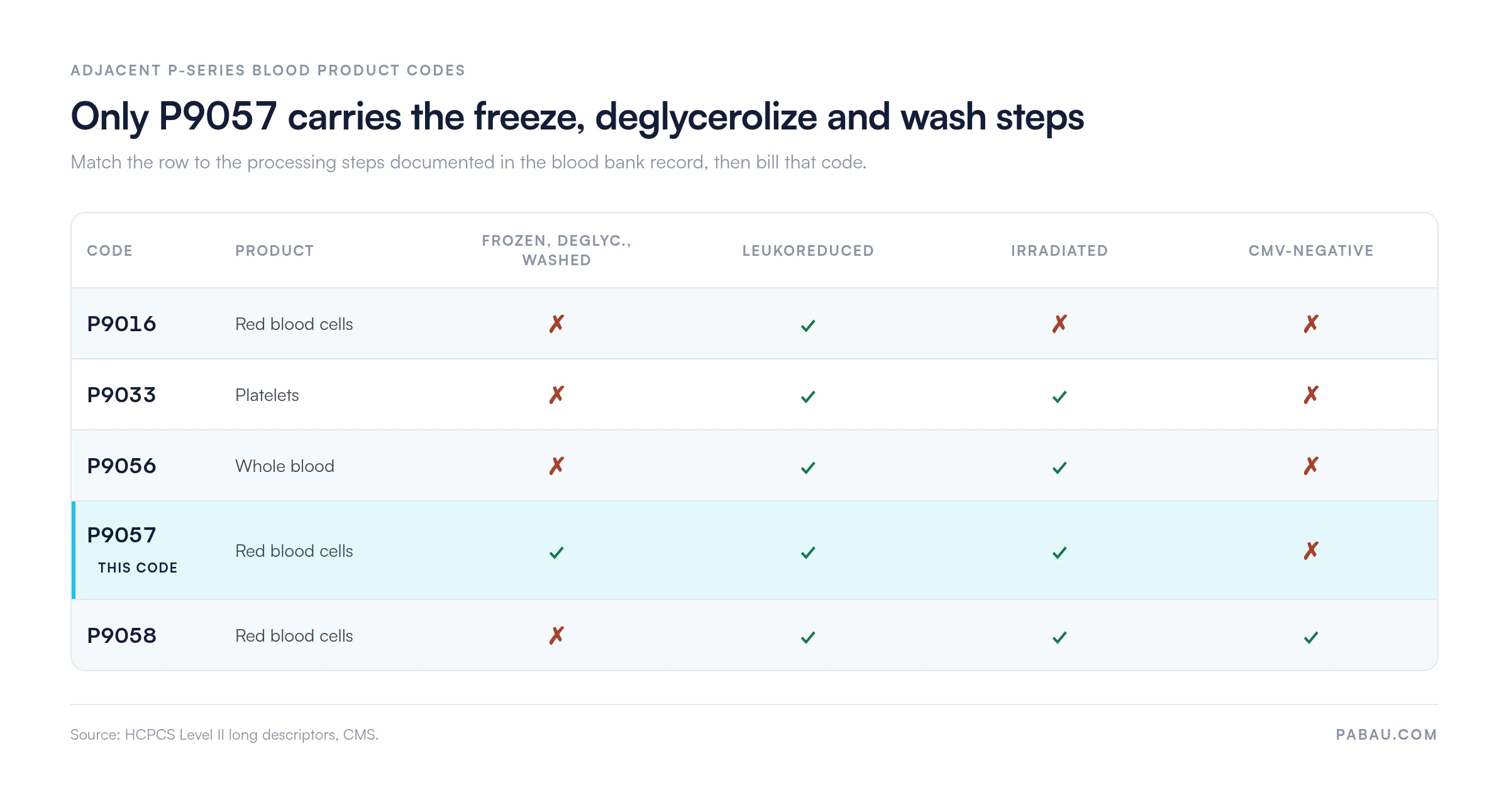
Pre-billing review catches these before a remittance advice does. Working through the denial codes that recur on blood product claims will show you which documentation step keeps failing.
HCPCS Code P9057 is primarily structured for outpatient facility billing. Payer policies from Molina Healthcare and UnitedHealthcare, for example, frame their blood product coverage under “Outpatient Hospital Blood and Blood Products Policy (Facility).” That framing decides where the code can be applied.
The NLM Clinical Table Search API provides programmatic access to HCPCS Level II code descriptors for facilities building automated billing workflows.
Run a quarterly audit of all P-series blood product claims against the blood bank’s processing records. Flag any claim where the billed code doesn’t match the documented processing steps. This reconciliation step catches downcoding and upcoding errors before they surface in a payer audit.
In most facilities the blood bank record, the physician order, and the claim live in three systems. A biller reads the processing record, picks the code by hand, and hopes the two still match at audit.
Practice management software like Pabau keeps the clinical record, the documentation, and the invoice on one patient file. The coded charge sits next to the note that supports it. A reviewer checking a P9057 line has the evidence on the same record.
Reporting then shows which codes get paid and which keep coming back. When P9057 lines are being downcoded, you see the pattern in a report rather than in next quarter’s revenue.

Pabau keeps clinical documentation, coded charges, and invoices on one patient record, so billing teams can evidence a claim without switching systems. See how that reduces rework on complex blood product codes.

P9057 is one of the most specific codes in the P-series, and that specificity is the whole job. The code is right only when the blood bank record shows all five processing steps, and wrong the moment one is missing.
So the work that pays off sits upstream of the claim. Get the blood bank and the billing team onto one documentation protocol, and the code choice stops being a judgment call. Audit the P-series lines quarterly, and downcoding shows up while you can still appeal it.
Book a demo to see how Pabau keeps clinical documentation and coded charges on the same patient record.

Need to understand how clearinghouse submissions work for facility claims? How a medical claims clearinghouse works explains the submission pathway from facility billing to payer adjudication.
Seeing recurring denials on blood product claims? Reading electronic remittance advice (ERA) walks through how to interpret 835 remittance files and identify denial patterns at the CARC/RARC level.
Building a documentation protocol for complex HCPCS products? Revenue cycle management fundamentals covers how documentation, coding, and billing connect across the claim lifecycle.
HCPCS Code P9057 describes red blood cells, frozen/deglycerolized/washed, leukocytes reduced, irradiated, each unit. It is a HCPCS Level II code in the P-series designating a multi-step processed blood product billed per unit transfused.
P9056 covers irradiated whole blood (leukocytes reduced, irradiated), while P9057 covers separated red blood cells that have additionally been frozen, deglycerolized, and washed. They are distinct products: P9056 is whole blood, P9057 is processed RBCs from frozen rare-blood stock.
Five steps are required: (1) freezing with a cryoprotectant, (2) deglycerolization after thawing, (3) washing, (4) leukocyte reduction, and (5) irradiation. All five steps must be documented in the blood bank’s processing record to support a valid P9057 claim.
Medicare sets the reimbursement rate for P9057 annually through the Outpatient Prospective Payment System (OPPS). Verify the current rate against the CMS Physician Fee Schedule for the applicable year. Rates change with each annual update and vary by geographic locality.
Common ICD-10-CM codes paired with P9057 include D61.9 (aplastic anemia), C91.00 (acute lymphoblastic leukemia), and Z94.81 (bone marrow transplant status). D83.9 (common variable immunodeficiency) and D57.1 (sickle-cell disease) also appear. Payer medical necessity requirements vary, so confirm coverage criteria before submitting.
P9057 is primarily structured for outpatient hospital facility billing. Physician office applicability under Medicare depends on the billing pathway and payer policy. For most commercial and Medicare claims, verify with the MAC or payer before billing P9057 on a professional (CMS-1500) claim.