

HCPCS code E0198: Water pressure pad billing guide
HCPCS code E0198 is a water pad for a standard mattress HCPCS code E0198 is the ...

Last Updated: Oct 13, 2026
P9040 is the HCPCS Level II code for red blood cells, leukocytes reduced, irradiated, each unit. Bill one line for every unit transfused.
Denials on this code almost always trace back to the blood bank processing record. When that record does not confirm both leukoreduction and irradiation, payers downcode the claim to P9016 or P9038. A medical necessity review usually follows.
Let Pabau's smart automation suggest the right codes, reduce claim denials, and keep your practice compliant—effortlessly.
Automate repetitive tasks and focus on what matters most—your patients.
Reduce coding errors and ensure compliance with the latest regulations.
Clean claims, fewer denials, and faster reimbursements.
Powerful insights and reporting to help your practice thrive.
HIPAA compliant SOC 2 certified GDPR-compliant Trusted by 4,000+ clinics worldwide

HCPCS code P9040 covers one unit of red blood cells that has been both leukoreduced and irradiated.
Bill one line for every unit transfused, taken from the transfusion record rather than the physician order.
The blood bank processing record confirming both steps is what payers ask for first on a denial.
Pabau’s claims management software pre-fills claims from the patient record, offers code lookup libraries, and validates required fields before submission.
HCPCS code P9040 bills one unit of red blood cells that has been both leukoreduced and irradiated. Neither step on its own qualifies.
The code sits in the P-series blood and blood products section of HCPCS Level II. The Centers for Medicare and Medicaid Services updates that section every year.
Those two words, “each unit”, decide how much the claim is worth. Transfuse three units and P9040 goes on the claim three times, not once.
Billing to the order quantity instead of the transfused count is a common way to underbill blood products. What the two processing steps actually do explains why payers ask for so much proof.
The two steps solve different transfusion risks, so a patient who needs both receives a unit carrying both. That combined product is what P9040 pays for. Each step has to appear in the blood bank record separately.
Not every leukoreduced unit needs irradiating. The indication is patient-specific, and the medical record has to name it. Payers recognize these situations most often.
Check that the blood bank processing record names both steps, filtration and irradiation by gamma or X-ray. A record that says leukoreduced and stops there will not hold up under audit. The claim defaults to P9016.
Three neighboring P-series codes account for most miscoded red cell claims. What separates them is only which processing steps the unit actually received. Read the table across, then match it to the blood bank record in front of you.
P9039 causes the most confusion. Its official descriptor covers deglycerolized red blood cells, and it says nothing about leukoreduction or irradiation. So a deglycerolized unit is reported with P9039, even when the patient looks like a P9040 candidate.
The blood bank record decides the code, never the diagnosis on its own. Once the code is right, the next question is what Medicare pays for it.
Medicare pays for blood products in hospital outpatient departments under the Outpatient Prospective Payment System. Whether P9040 earns a payment of its own depends on the status CMS gives it in that year’s Addendum B.
Two outcomes are possible:
Check the status each fiscal year. The CMS Physician Fee Schedule lookup and OPPS Addendum B both carry it.
Commercial payers set their own rates, and blood product rates often sit outside the standard contract rate file. Ask the contracting department for that schedule by name, once a year.
A P9040 claim rests on a chain of records, and every link has to be there. One weak link hands the payer grounds to deny or downcode. The flow below shows where each document is created and what it has to say.
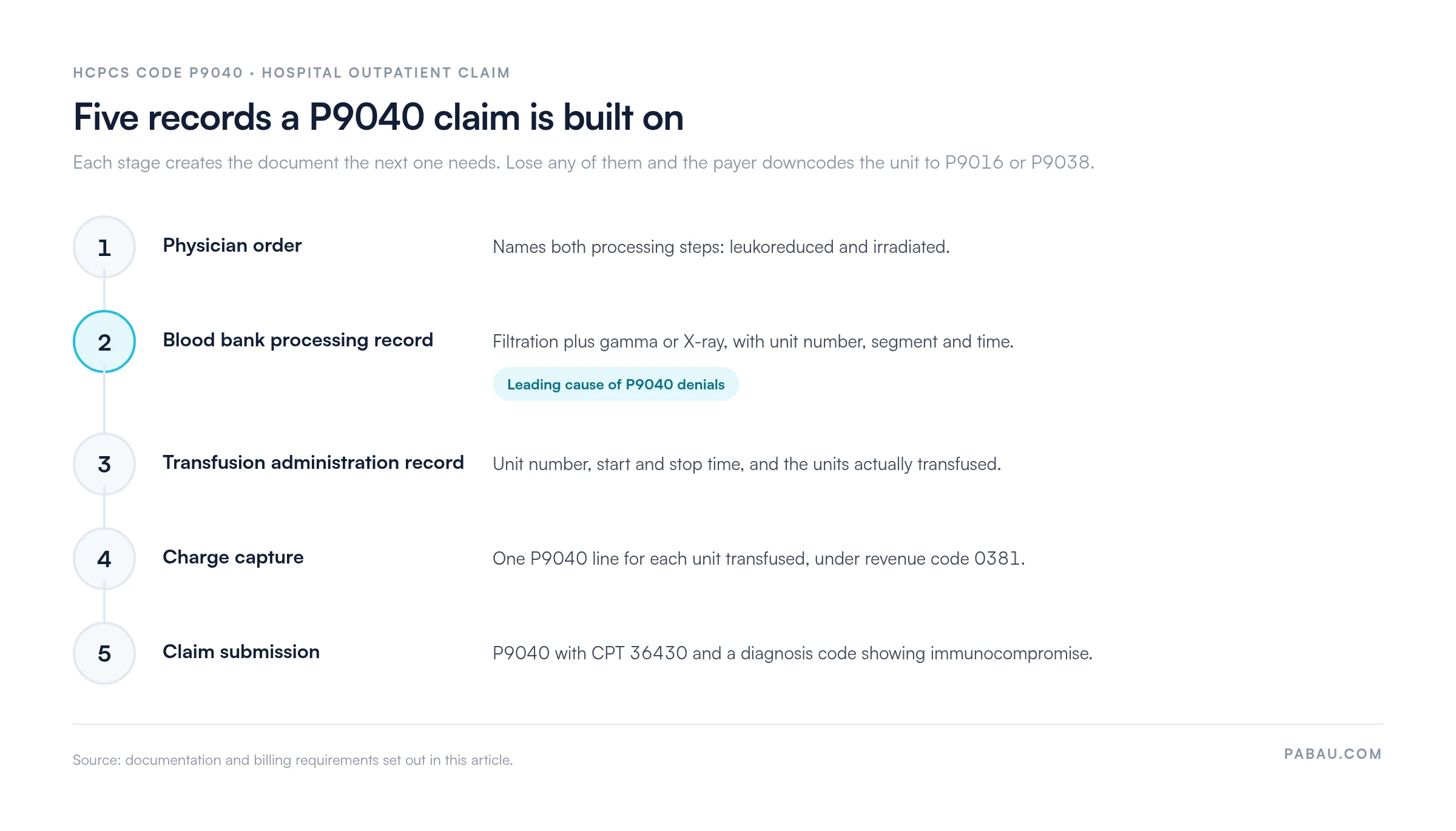
Keep the whole chain on file for at least five years. That is the federal floor under 42 CFR 482.24(b)(1), and several states ask for longer. Audits often land well after the transfusion date, so your storage policy matters as much as your capture policy.
Every P9040 claim carries three moving parts. There is the product, the procedure that delivered it, and the diagnosis that justifies both. Pair them correctly and the rest of the submission is routine. Confirm the current descriptor first with the AAPC HCPCS code lookup.
Run the claim past four questions. Each one maps to a denial reason in the next section.
Facilities that submit electronically can attach the processing record in the PWK segment of loop 2300 before the claim is finalized. Sending the proof with the claim heads off a medical necessity request weeks later.
Most P9040 denials trace back to five root causes, and an upstream control prevents each one. The table pairs the denial with the control that stops it happening again.
When a payer downcodes P9040 to P9016 or P9038, the appeal needs two documents. Send the blood bank processing record showing both steps, plus the physician order naming both products.
Your clearinghouse returns a CARC or RARC on every rejection, and our reference on denial codes explains what each one is telling you. Sorting blood product downcodes as they arrive keeps the appeal window from closing quietly.
Coverage for P9040 is consistent in principle and inconsistent in detail. Every payer publishes its own blood product policy, and those policies get rewritten each plan year.
The table below summarizes where four payers generally stand.
Blood products sit among the most policy-specific line items in hospital outpatient billing. A prior approval sets no precedent, and last year’s authorization number will not carry a new transfusion.
Re-read the policy each plan year. The accepted diagnosis list is the part payers change most often, and that brings us to the codes themselves.
Payers want at least one ICD-10-CM code on the claim that explains why an irradiated product was necessary. Most HCPCS references stop at the descriptor and leave that part out.
The categories below are the ones payers accept most often, though every policy names its own list.
Pair this table with your facility’s approved diagnosis crosswalk for blood products. Codes that do not signal immunocompromised status tend to fail automated policy screening before a person ever reads the claim.
Commercial payers run that screen first, so the diagnosis you choose decides whether the claim is reviewed at all.
Build a charge capture edit that flags any P9040 claim whose diagnosis codes fall outside D80-D89, C91-C95, T86 and Z94. Catching the mismatch in the billing queue costs minutes. Catching it on appeal costs weeks.
Transfusion billing usually lives in three systems that do not speak to each other. The blood bank holds the processing record, the nursing note holds the transfusion times, and the billing system waits for someone to retype both. Every retype is another chance to send the wrong code.
Pabau, practice management software for healthcare teams, keeps patient records and claims in one system. That is what makes cleaner claims management possible, because a claim pulls its details from the record instead of a rekeyed form.
Code lookup libraries put P9040 and its neighbors in front of the coder. Required-field validation holds a claim back when data is missing.
For a transfusion service, the payoff is fewer claims bouncing over data the record already held. Coders spend their time on the ones that genuinely need a decision, and the rest go out on the first pass.

Pabau’s claims management software pre-fills claims straight from the patient record. Built-in code lookups and required-field validation catch problems before submission. See how it fits a transfusion billing workflow.

P9040 rewards a billing team that treats the blood bank record as the source of truth. The physician order tells you what was intended. The processing record tells you what the patient actually received, and that is what the payer pays for.
The costly habit is defaulting to P9016 or P9038 because nobody checked. That default is quiet, it never throws an error, and it gives away the difference on every unit. One pre-submission edit tied to the processing record retires it for good.
Book a demo to see how Pabau builds blood product claims from the patient record your team already keeps.

Want the root-cause view of why blood product claims come back? Healthcare denial management covers appeal strategy and the controls that stop repeat denials.
Still reading remittance files by hand? Electronic remittance advice explains how ERA data can sort denials and prioritize resubmission.
Need the reason code behind a downcoded blood product line? Denial codes in medical billing is a searchable CARC and RARC reference for billing teams.
Billing a thawed unit rather than an irradiated one? HCPCS code P9039 covers deglycerolized red blood cells and where it parts company with P9040.
Want the pre-submission checks that apply to every claim? Clean claim sets out the data elements payers most often reject claims for missing.
Yes. P9040 is active in the 2026 HCPCS Level II code set. CMS republishes the code set every January, so check the annual release before you trust a saved charge master entry. P-series codes are revised less often than drug codes, but the status field is still worth a yearly look.
Not as a separately paid line. Medicare pays for blood products during an inpatient stay through the MS-DRG, so the product cost is already bundled. Hospitals still record the units internally for cost reporting. The question of separate payment for P9040 only arises in the hospital outpatient setting.
The provider that furnishes the unit to the patient bills it. A blood center that ships units to a hospital does not bill the payer directly. Its charge reaches the payer inside the hospital’s claim. That is why the transfusion administration record, and not the delivery invoice, drives the unit count.
No. Leukoreduction often happens at collection and irradiation shortly before issue, and P9040 still applies. What matters is that both steps are documented against the same unit number before transfusion. A record covering only one step supports P9016 or P9038 instead.



