HCPCS code P9058: Red blood cells, leukocytes reduced, CMV-negative, irradiated
HCPCS code P9058: Official descriptor and key attributes HCPCS code P9058 report...

Last Updated: Oct 26, 2026
P9048 is the HCPCS Level II code for infusion, plasma protein fraction (human), 5%, 250 ml. Each 250 ml bag is one billable unit, and the infusion itself is reported separately with a CPT administration code.
Most denials on this code come from two errors. Coders swap it for an albumin code such as P9046, or they bill one unit when two or more bags were given.
Let Pabau's smart automation suggest the right codes, reduce claim denials, and keep your practice compliant—effortlessly.
Automate repetitive tasks and focus on what matters most—your patients.
Reduce coding errors and ensure compliance with the latest regulations.
Clean claims, fewer denials, and faster reimbursements.
Powerful insights and reporting to help your practice thrive.
HIPAA compliant SOC 2 certified GDPR-compliant Trusted by 4,000+ clinics worldwide

HCPCS code P9048 covers plasma protein fraction (human) 5%, billed per 250 ml bag rather than per infusion session.
P9048 is often confused with albumin codes such as P9046, so code from the product label, the order and the administration record.
Billing a 500 ml infusion as one unit is the most common underbilling error, because each 250 ml bag is one unit.
On a UB-04, the product bills under revenue code 038X, while 039X covers blood administration, processing and storage.
Pabau, the practice management platform we build, raises claims from the invoice and validates them before they reach the clearinghouse.
HCPCS Code P9048 describes the infusion of plasma protein fraction, human origin, at 5% concentration, with each unit defined as 250 ml. The code belongs to the P-series of CMS HCPCS Level II blood product codes, which cover blood derivatives given in outpatient and hospital settings.
The table below lists the fields a coder or biller needs before submitting a claim.
P9048 covers one product in one concentration and one bag size: plasma protein fraction (human) at 5%, in 250 ml units. A different product, strength or volume needs a different code, or no code if the product isn’t separately billable under HCPCS.
Covered: FDA-licensed plasma protein fraction (human), 5% concentration, given by IV infusion, 250 ml per unit billed.
Excluded: The following products and scenarios fall outside P9048’s scope.
P9048 (plasma protein fraction 5%, 250 ml) and P9046 (albumin 25%, 20 ml) are both plasma-derived products, which is why billing teams mix them up. They differ in protein purity, concentration and unit size, and each of those changes the claim.
Plasma protein fraction contains at least 83% albumin alongside alpha and beta globulins. Albumin is purified to at least 96% albumin. If the bag reads albumin 5% in 250 ml, the code is P9045, not P9046 or P9048.
The physician order and the product label are the deciding documents, so code what was ordered and given. Swapping one product for the other because they seem interchangeable is a documentation compliance failure. With P9046 it also breaks the unit count, since a 20 ml unit bears no relation to a 250 ml bag.
Before submitting a P9048 claim, confirm the code against its neighbors in the P-series. The table below covers the entries most often confused in the P90xx blood product range.
Notice the P9043 and P9048 pair. Both describe plasma protein fraction at 5%, but P9043 covers 50 ml and P9048 covers 250 ml. A single 250 ml bag bills as one unit of P9048, never as five units of P9043.
Payers price the two codes differently and may deny a claim where the billed unit doesn’t match the documented volume. P9044 sits nearby but describes cryoprecipitate-reduced plasma, a different product altogether. Three facts on the bag label settle the code: product, concentration and volume.
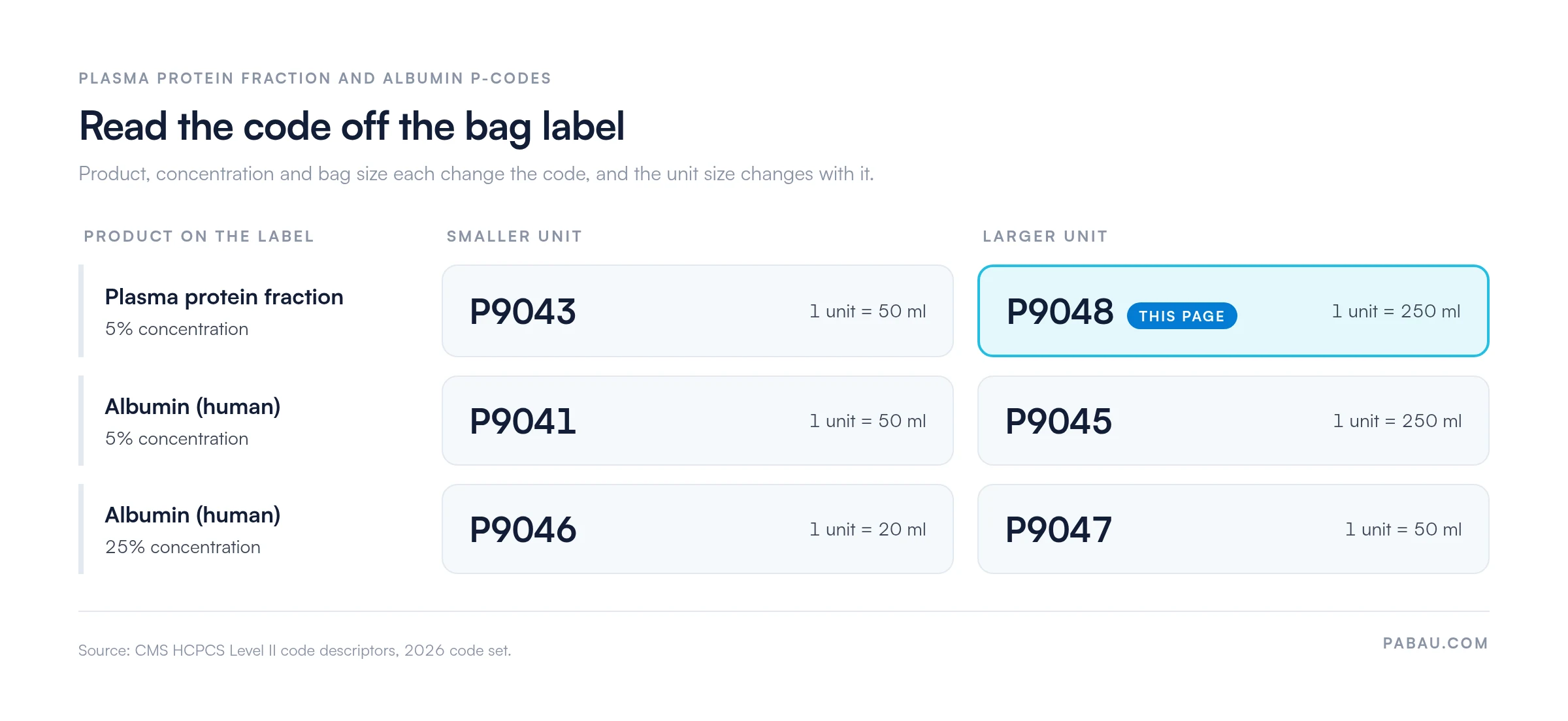
One unit of P9048 equals one 250 ml bag, as the code descriptor states. The most common underbilling error is giving 500 ml, two bags, and billing one unit. That treats the infusion session as the unit instead of the volume.
The counting rule is simple. Bill the volume the nursing record shows, one unit per 250 ml bag, and never round down across bag boundaries.
On hospital outpatient UB-04 claims, the product itself bills under revenue code 038X (blood and blood components), such as 0383 for plasma.
Revenue code 039X covers blood administration, processing and storage, so it isn’t the line for the product. A wrong or missing revenue code is a separate denial reason from a unit error, so confirm the subcode with your facility’s billing team.
Check the nursing administration record, not just the physician order, to confirm the volume given. An order may call for 500 ml, but the patient may tolerate only 250 ml before the infusion is stopped. Bill what was given, document ordered versus given volume, and note why the infusion stopped.
Medicare pays for HCPCS Code P9048 under the Outpatient Prospective Payment System (OPPS) when a hospital outpatient department furnishes it. Plasma protein fraction is a plasma-derived product, and CMS publishes its payment limit each quarter in the Average Sales Price (ASP) pricing files. A clean claim with the right code, units and revenue code avoids most OPPS processing errors.
In physician office settings, P9048 coverage is more limited. Medicare’s physician fee schedule doesn’t pay for blood products the way OPPS does. Confirm your payer’s policy before billing P9048 in a non-facility setting.
P9048 payment limits change each quarter and with the annual OPPS update. Look up the current figure in the CMS ASP pricing files or in OPPS Addendum B for the calendar year. Treat any rate quoted without a year and a CMS source as potentially outdated.
Payers expect specific documentation before they accept a P9048 claim. Thorough medical billing compliance starts with the physician order and runs through to the administration record. A missing element is a leading cause of medical necessity denials on blood product claims.
Build this checklist into the nursing administration record so coders get complete information at charge capture instead of during an appeal. When hypoalbuminemia is the indication, report E88.09 and make sure the lab value supporting it is in the chart.
A pre-submission checklist stops denials before they happen. The items below reflect requirements across Medicare, most commercial payers and Medicaid plans, though individual policies vary. Confirm prior authorization thresholds on your payer’s provider portal before administration.
Effective denial management workflows start with the claim adjustment reason code (CARC) on each P9048 rejection. Each code points to a different root cause and appeal path. For a code missing from the table below, see our guide to decoding denial codes.
Reading the electronic remittance advice (ERA) after each remittance cycle is the fastest way to catch repeat P9048 denials before they turn into large write-offs. A unit-counting error repeated across 20 claims in a month is a recoverable billing problem. The same error left undetected for six months starts to look like an audit pattern.
P9048 covers the blood product itself, and the infusion service is billed separately with a CPT code. The right administration code depends on the setting and on whether it’s the initial service or an add-on hour. Check payer bundling edits before submitting.
Your superbill or charge sheet should capture both the product code and the administration CPT so the claim can be itemized.
In a hospital outpatient (OPPS) setting, NCCI and packaging edits decide whether an administration code pays separately alongside the product. Check how your facility’s OPPS claims handle administration codes, then apply that logic consistently across all blood product claims.
Run a quarterly audit of P9048 claims. Pull every claim with P9048 in the HCPCS field and compare billed units to the nursing administration notes. Flag any claim where the documented volume doesn’t equal units times 250 ml. This one audit step catches both overbilling and underbilling before the next compliance review.
Most P9048 errors start at charge capture. Someone keys an albumin code by mistake, or bills one unit from memory instead of from the nursing record. The mistake then surfaces weeks later as a denial on the remittance.
In Pabau, each insurance claim is raised from the patient’s invoice at checkout, so the code and units start from what was charged. Its error-catching claims management validates the claim before it reaches your clearinghouse, so missing or invalid details get fixed first.
In the US, claims go through Claim.MD, and payments settle straight from ERA files. A rejected claim is flagged as Needs action with the reason attached, so your team corrects the units or code and resubmits. Insurance claiming is included in every Pabau subscription.
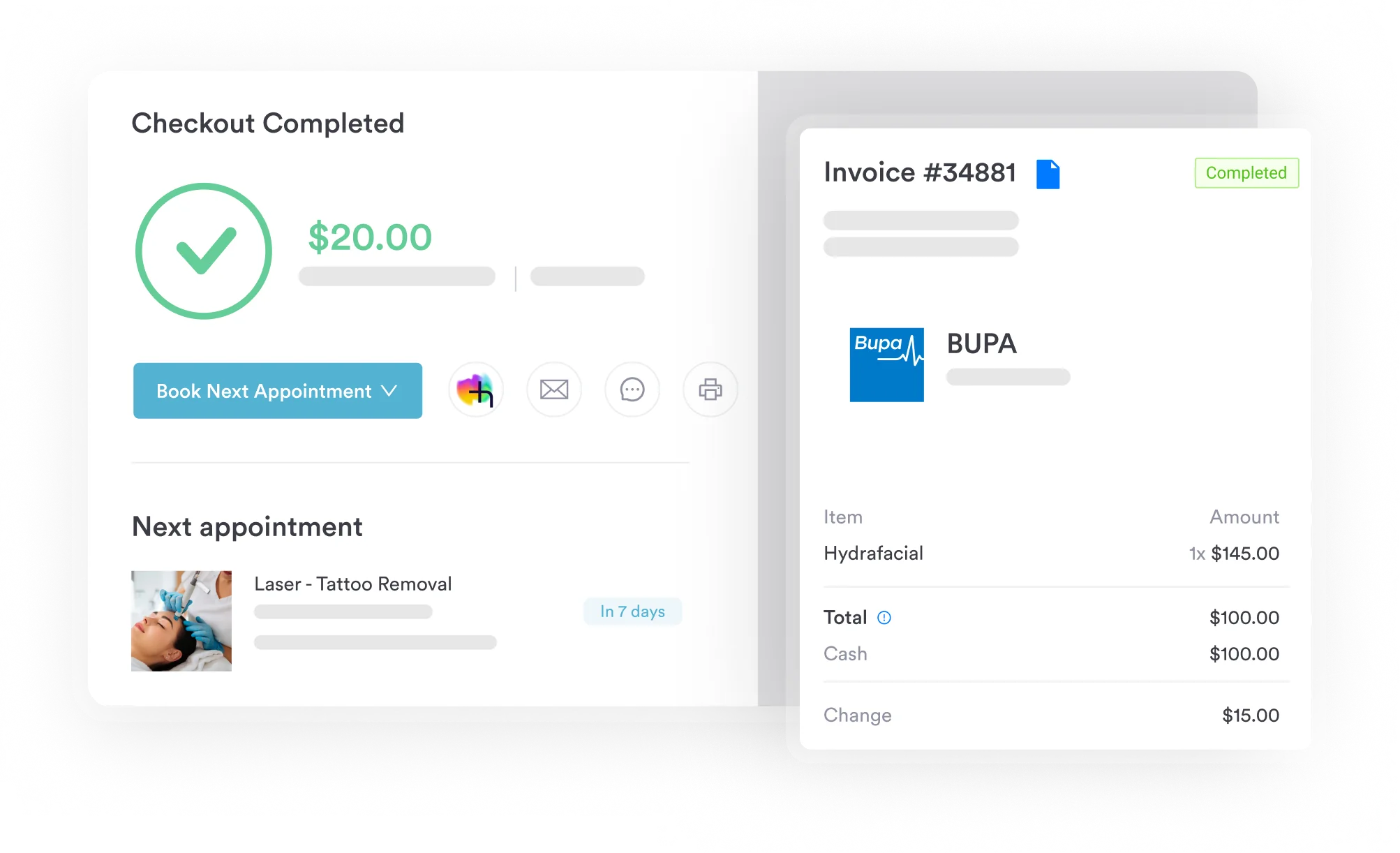

Pabau raises each claim from the patient’s invoice and validates it before it reaches your clearinghouse. Rejected claims show the reason, so your team can fix and resubmit quickly.

Treat the bag label as the source of truth for P9048. When the label, the order and the nursing record agree on plasma protein fraction 5% and the volume given, the code and unit count follow.
The trade-off is a few extra minutes at charge capture. That costs far less than reworking a batch of denied claims after the ERA arrives, or explaining a pattern of unit errors in an audit.
Book a demo to see how Pabau keeps blood product codes, units and claim status in one place for your billing team.

Need a reference for clean claim submission requirements? Clean claim submission checklist walks through the fields a payer checks before processing a blood product claim.
Want to reduce HCPCS denial rates across your billing team? Revenue cycle management fundamentals explains how to build denial prevention into the charge capture workflow.
Looking for HCPCS code lookup resources? Medical billing guide covers the HCPCS Level II system and how blood product codes fit into outpatient claims.
Billing concentrated albumin instead? HCPCS code P9047 covers albumin 25% in 50 ml units, with its own unit and documentation rules.
Coding the administration as a transfusion? CPT code 36430 explains when the transfusion code applies and how to document it.
HCPCS Code P9048 covers the infusion of plasma protein fraction (human) at 5% concentration, billed per 250 ml unit. It does not cover albumin, which bills under P9041, P9045, P9046 or P9047. The 50 ml plasma protein fraction unit bills as P9043 instead. The product must be FDA-licensed, and the physician order must name plasma protein fraction specifically.
Bill one unit of P9048 for each 250 ml bag administered. If 500 ml was given, bill two units, and for 750 ml, bill three. There is no per-session cap, but billed units must match the volume in the nursing administration record. Billing one unit for a 500 ml infusion is the most common underbilling error on P9048 claims.
P9048 is for plasma protein fraction (human), 5%, in 250 ml units. P9046 is for albumin (human), 25%, in 20 ml units. Both are plasma-derived, but plasma protein fraction contains at least 83% albumin alongside globulins, while albumin is at least 96% pure. Code selection follows the product label and physician order, never clinical interchangeability.
Yes. Medicare pays for P9048 under OPPS in hospital outpatient departments when medical necessity is documented. CMS publishes its payment limit each quarter in the Average Sales Price (ASP) pricing files. In a physician office, separate payment is limited, so check the payer’s policy first. Always use the current quarter’s figure, because the rate changes during the year.
You need a physician order specifying plasma protein fraction (human) 5%, plus the product label with lot number and expiration date. The nursing administration record must show the exact volume in ml, with start and stop times. Add the clinical indication with supporting ICD-10 codes and notes on the patient’s response. A missing element puts the claim at risk of a medical necessity denial.
The most common reasons are coding albumin instead of P9048, thin medical necessity documentation, and billing one unit when two bags were given. Others are a wrong or missing 038X revenue code on the UB-04 and no prior authorization where the plan requires it. Each denial carries a CARC on the ERA, which points to the root cause and the right appeal path.