HCPCS Code G0163: Skilled nursing observation and assessment
What is HCPCS Code G0163? HCPCS Code G0163 is a deleted Level II code for skille...

Last Updated: Oct 15, 2026
P9046 is the HCPCS Level II code for infusion, albumin (human), 25%, 20 ml.
The P-series covers blood and blood products from P9010 through P9100. P9046 sits alongside codes for fresh frozen plasma, cryoprecipitate, and other albumin concentrations. Confirm the status of P9046 against the CMS HCPCS annual update file before submitting claims. Code status can change each January.
Let Pabau's smart automation suggest the right codes, reduce claim denials, and keep your practice compliant—effortlessly.
Automate repetitive tasks and focus on what matters most—your patients.
Reduce coding errors and ensure compliance with the latest regulations.
Clean claims, fewer denials, and faster reimbursements.
Powerful insights and reporting to help your practice thrive.
HIPAA compliant SOC 2 certified GDPR-compliant Trusted by 4,000+ clinics worldwide

HCPCS code P9046 describes infusion, albumin (human), 25%, billed per 20 ml unit under Medicare Part B.
One unit equals 20 ml administered, so a 100 ml infusion is reported as five units.
Medicare reimburses P9046 at ASP plus 6%, and CMS refreshes those rates every quarter.
P9046 covers albumin 25%, while P9045 covers albumin 5%, and coding the wrong concentration is a common denial trigger.
Practice management software like Pabau tracks billing units and pairs supporting ICD-10 codes before the claim goes out.
Medical necessity is the single biggest audit risk for HCPCS code P9046 claims. Medicare and commercial payers require documented clinical justification before reimbursing albumin infusion. Without it, the claim fails on review even when the coding is technically correct.
Albumin 25% is a concentrated colloid solution. It is used when rapid volume expansion is needed without a large fluid load, or when serum albumin is critically low. According to FDA labeling for albumin 25% products, approved clinical indications include:
Coverage for specific indications varies by Medicare Administrative Contractor (MAC) Local Coverage Determination (LCD) and by commercial payer policy. Off-label uses may not be covered. Confirm the covered indication list with the relevant MAC before assuming reimbursement for an albumin infusion.
Medicare Part B reimburses HCPCS code P9046 under the Average Sales Price (ASP) methodology at ASP plus 6%. The payment rate equals the manufacturer’s weighted average selling price, net of discounts, plus a 6% add-on. CMS updates ASP pricing quarterly, so any dollar figure published outside official CMS files is likely out of date.
To look up the current reimbursement rate, use the CMS Physician Fee Schedule lookup or download the quarterly ASP drug pricing file. Enter P9046 to retrieve the per-20-ml reimbursement for the applicable quarter. Practices that run this check inside software for billing teams can automate the lookup and flag underpayments at remittance.
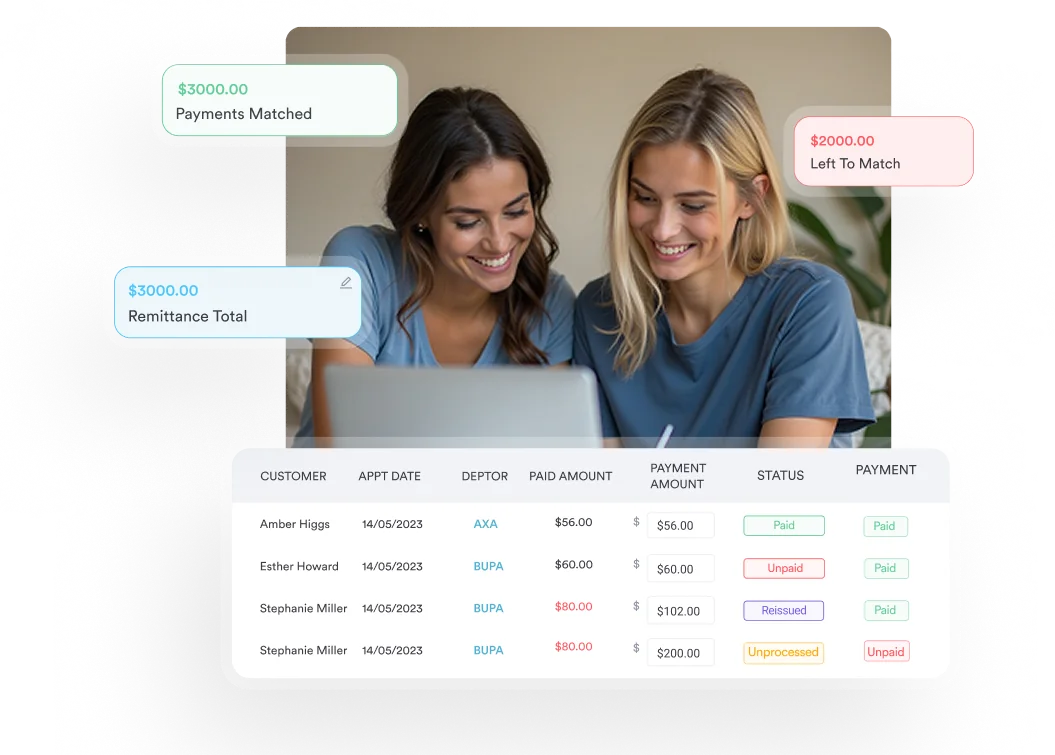
Rates vary by place of service. Hospital outpatient settings may reimburse under the Outpatient Prospective Payment System (OPPS) rather than the Part B drug fee schedule. Always confirm which payment system applies before projecting revenue for an albumin infusion service line.
Billing HCPCS code P9046 correctly requires three things:
Getting any one of these wrong is the fastest path to a denial.
Report one unit of P9046 for each 20 ml of albumin 25% administered. If a patient receives 100 ml, report 5 units. If they receive 60 ml, report 3 units. Partial units are not billable, so round down to the nearest whole 20 ml increment. This per-20-ml convention is set by CMS and applies regardless of package size. Vials typically come in 50 ml and 100 ml sizes.
P9046 is billed in physician office (POS 11), infusion center (POS 22), and hospital outpatient (POS 19/22) settings. The payment rate may differ by POS. Practices that infuse outside a fixed site should confirm the applicable POS code with their MAC. Home infusion (POS 12) carries coverage rules that differ from facility-based administration.
Modifiers are rarely required for P9046 itself. The infusion administration code is typically a CPT code from the 96360-96379 range. It may require modifier JW for discarded drug, or modifier JZ when nothing is discarded. Document the amount administered and the amount wasted to support modifier usage on the administration code. Check with your MAC for the modifier rules that apply to your payer contracts and infusion setting.
Proper claim denial management starts at submission. Confirm the unit count, the place of service, and the ICD-10 pairing before the claim leaves the practice. Rework after a denial costs far more staff time than a pre-submission review.
Calculate P9046 units before generating the claim, not after. Pull the infusion record, read the total ml administered, divide by 20, and enter that exact integer into your billing system. A 100 ml infusion = 5 units on the claim. Build this as a standing workflow check for every albumin infusion encounter.
Every P9046 claim needs at least one ICD-10-CM diagnosis code that demonstrates the medical necessity of albumin infusion. The codes below are commonly paired with P9046, based on clinical indications recognized in FDA labeling and MAC LCD policies. Coverage varies by payer, so verify covered diagnoses against the applicable LCD before submitting.
Serum albumin thresholds that trigger coverage are not universal, because each MAC sets its own LCD criteria. Some LCDs require a documented serum albumin level below 2.0 g/dL or 2.5 g/dL before approving infusion. Include the relevant lab value in the clinical note and check it against the applicable LCD before billing. Confirm each description against our ICD-10-CM code library before the coder locks the claim.
Medical necessity documentation is the most common failure point in albumin infusion audits. Payers routinely request records to verify that the clinical criteria for P9046 were met before payment is finalized. Incomplete documentation leads to post-payment recoupment, which is harder to recover from than a pre-payment denial.
The chart should contain all of the following before a P9046 claim is submitted:
For practices with recurring albumin patients, build the intake and infusion record into an EMR template. Teams that capture this documentation at the point of care see fewer denials than those completing charts retrospectively.
The most frequent coding error in albumin billing is using P9045 and P9046 interchangeably. The two codes describe the same drug class at different concentrations, and that clinical decision matters to payers. Confirm the concentration documented in the order before the billing team selects the code.
When the clinical record shows a 25% solution was administered, P9046 is the correct code. Billing P9045 for a 25% infusion is an upcoding or downcoding error depending on volume. Either way it creates a compliance risk or a revenue loss. The order and the infusion record should specify the concentration explicitly.
P9046 sits within a broader family of P-series blood and blood product codes. Coders working with albumin and plasma products regularly meet adjacent codes during crosswalk and crosscheck work. The table below covers the closest neighbors in the P9041-P9051 range for hospital outpatient and infusion billing teams.
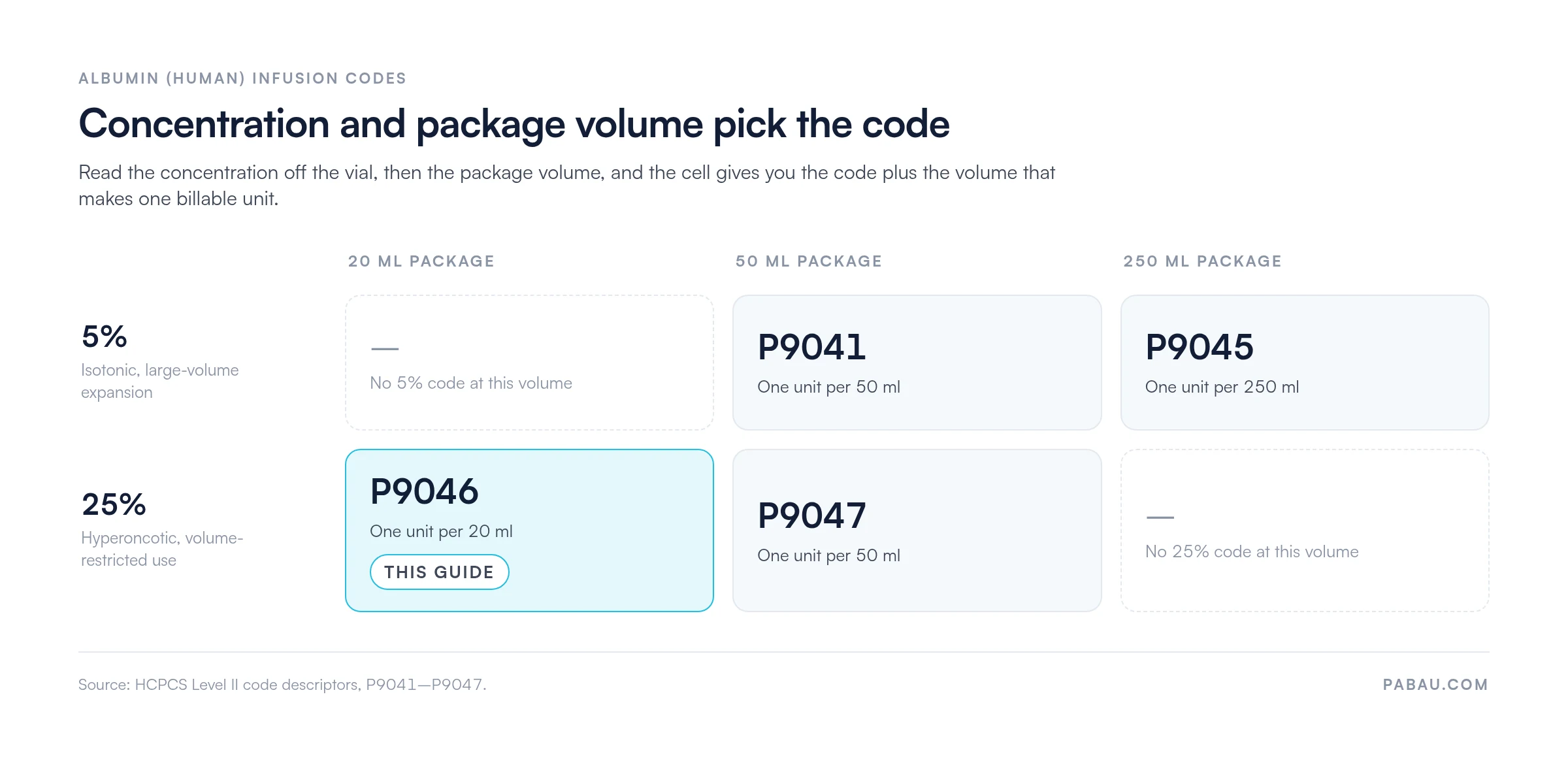
Concentration alone does not settle the code, because package volume splits the albumin products across separate entries. When the product administered is albumin 25% in a 50 ml package, P9047 is the closer match than P9046. Verify the NDC-to-HCPCS mapping against the current CMS quarterly ASP pricing file to confirm which code fits the product dispensed. The four albumin codes sort cleanly on two axes, concentration and package volume.
How a practice acquires albumin 25% determines how it bills P9046 to Medicare. Two main pathways exist, and each has distinct compliance obligations.
Under buy-and-bill, the physician or facility purchases albumin 25% directly from a distributor and administers it to the patient. The practice then bills Medicare Part B for both the drug (P9046) and the administration service (a CPT infusion code). Medicare reimburses at ASP+6% for the drug component. The practice absorbs the acquisition cost and earns the spread between that cost and ASP+6%.
Buy-and-bill carries compliance risk. Acquiring and billing biologics under this model draws anti-kickback statute analysis, and inaccurate billing adds False Claims Act exposure. Review the arrangement with a healthcare attorney before launching a buy-and-bill albumin service. Documentation of acquisition cost, NDC, lot number, and expiration date strengthens the audit trail.
In the supplier pathway, a pharmacy or infusion center acquires and bills for the albumin product separately. The administering provider then bills only for the infusion service, using the CPT administration code. This splits the drug and administration billing between two entities and reduces the physician’s inventory and compliance burden. Hospital outpatient departments typically bill P9046 through the OPPS rather than the Part B drug schedule, which changes the payment rate and bundling rules.
In most infusion practices the P9046 unit count is worked out twice. A nurse records the volume in the infusion note. Days later a biller reads that note, divides by 20, and types the result into the claim. Each handoff is a chance for the number to drift.
Pabau, our practice management software, keeps the infusion record and the charge on the same patient timeline. The volume the clinician documents is the volume the biller works from, and the supporting ICD-10 code stays attached to that encounter. The claim carries the same figure the chart does, with no re-key step in between.
That closes the three failure points this guide keeps returning to:

Pabau ties the infusion record, the supporting diagnosis, and the claim to one encounter. Your billers read the documented volume instead of retyping it.

HCPCS code P9046 is one of the few drug codes where the billing unit and the package size almost never match. Read the volume off the infusion record, divide by 20, and the code stops being difficult.
What is left is the part payers audit hardest: The clinical justification. A correct unit count on a chart with no serum albumin value and no signed order still fails on review. Decide now whether your infusion note captures that lab value, or accept that some P9046 claims will be recouped after payment.
Book a demo to see how Pabau keeps the infusion record, the diagnosis, and the claim on one encounter.

Need a structured billing framework for your infusion service? Understanding revenue cycle management covers the end-to-end process from charge capture to remittance reconciliation.
Managing denials after albumin infusion claims are rejected? Denial codes in medical billing explains the most common remittance advice codes and how to respond to each one.
Building documentation habits that survive an audit? Medical billing compliance covers the records payers ask for and the routines that keep them complete.
HCPCS code P9046 is a Level II HCPCS code describing infusion, albumin (human), 25%, billed per 20 ml administered. It bills Medicare Part B and commercial payers for 25% human albumin infusion. Reimbursement is calculated at ASP+6% of the average sales price.
P9046 is billed per 20 ml administered, not per vial. If a patient receives 100 ml of albumin 25%, report 5 units of P9046 on the claim. Vial size does not determine units; the volume administered does.
P9045 covers albumin (human) at 5% concentration, billed per 250 ml, while P9046 covers albumin at 25% concentration, billed per 20 ml. The 25% solution delivers more protein per milliliter. It is used when volume restriction matters, such as in hepatic failure or post-paracentesis settings.
Yes, P9046 is a Medicare Part B-covered drug when medical necessity is established through appropriate documentation. Coverage depends on the clinical indication meeting the Local Coverage Determination criteria set by the relevant Medicare Administrative Contractor. Prior authorization is not typically required for standard indications under Part B, but commercial plans often require it.
Albuked 25, Albuminar-25, Buminate 25%, and Flexbumin 25% are brand name albumin 25% products that map to HCPCS P9046. Confirm the current NDC-to-HCPCS crosswalk against the CMS quarterly drug pricing file before submitting claims, as NDC mappings can be updated each quarter.
Under the buy-and-bill model, the physician or practice purchases albumin 25% directly and administers it to the patient. The practice then bills Medicare Part B for the drug using P9046, plus a separate CPT code for the administration service. The practice carries the acquisition cost and the compliance obligations, including accurate NDC reporting and documentation of the amount administered and wasted.