

CCSD code G5100: Bypass of duodenum billing guide
CCSD code G5100 bills a bypass that leaves the duodenum in place CCSD code G5100...

Last Updated: Oct 16, 2026
L1070 is the HCPCS Level II code for an addition to a CTLSO or scoliosis orthosis, trapezius sling. The sling is a shoulder strap assembly that adds upper thoracic and cervical support to an existing brace.
It is an add-on code, so it never stands alone on a claim. Submit it with the base orthosis code, and add the KX modifier once the medical necessity documentation is on file.
Let Pabau's smart automation suggest the right codes, reduce claim denials, and keep your practice compliant—effortlessly.
Automate repetitive tasks and focus on what matters most—your patients.
Reduce coding errors and ensure compliance with the latest regulations.
Clean claims, fewer denials, and faster reimbursements.
Powerful insights and reporting to help your practice thrive.
HIPAA compliant SOC 2 certified GDPR-compliant Trusted by 4,000+ clinics worldwide

L1070 is an add-on HCPCS Level II code, so it only pays when the base CTLSO or scoliosis orthosis code sits on the same claim.
A KX modifier tells Medicare the medical necessity documentation is on file, and leaving it off is the top denial trigger.
Certificates of medical necessity ended for dates of service from January 1, 2023, so a standard written order plus clinical notes now carries the claim.
The written order has to name the trapezius sling, because an order for a scoliosis brace alone will not cover it.
Practice management software like Pabau keeps the order, the notes and the delivery record on one patient file, ready for an audit.
HCPCS code L1070 pays for a single component, the trapezius sling added to a CTLSO or scoliosis orthosis. It does not pay for the brace.
The sling is a shoulder strap assembly that carries corrective force through the trapezius muscle. That adds upper thoracic and cervical support the base frame cannot produce on its own.
The code belongs to the HCPCS Level II L-code set, which the Centers for Medicare and Medicaid Services (CMS) maintains. It sits in the L1000-L1120 range covering scoliosis orthotic devices, and it is active for 2026.
Because it describes an addition rather than a device, L1070 cannot stand alone on a claim.
A trapezius sling gets added when the curve needs upper thoracic correction the base frame cannot deliver. It anchors to a CTLSO or scoliosis brace and passes over the shoulder. Milwaukee brace designs are where it turns up most often.
The sling is not a routine part of every CTLSO. Its use has to be supported by notes explaining why the base brace fell short. For orthotists and the billing staff behind them, that note is what turns a component into a payable line.
Take a teenager whose Milwaukee brace is holding the lumbar curve but losing the shoulder line. The physician writes a fresh order naming the trapezius sling, the orthotist fits it, and both codes go out on one claim.
Common scenarios where L1070 is appropriately billed:
Each of these needs documented physician justification. The order must reference the trapezius sling specifically, not the orthosis in general.
Start every L1070 claim with the base code. Submit it on the same claim as the base orthosis the patient received, such as L1000 for a custom-fabricated CTLSO. DMEPOS rules govern the rest, and they differ from standard Part B professional service billing.
Practices that key claims by hand have to check that pairing every time. Practice management software like Pabau closes that loop. Its claims management software submits from the patient record that already holds the order and the delivery proof.
DMEPOS claims for scoliosis orthoses go out on the CMS-1500 form, or its electronic equivalent, the 837P transaction. The supplier has to be enrolled as a DMEPOS supplier, with an active National Provider Identifier and current accreditation.
Modifiers on an L1070 claim report medical necessity status, the purchase or rental condition, and laterality where a payer asks for it. The table covers the ones that show up most often. Check them against your MAC’s current Local Coverage Determination before you submit.
KX carries the most weight. An L1070 line without it usually triggers an automatic medical necessity denial. The modifier does not guarantee payment. It only states that you hold the documentation. If an audit finds that file thin, recoupment follows.
Documentation decides whether an L1070 claim survives. DMEPOS orthotic claims sit inside post-payment audit programs run by Recovery Audit Contractors and CERT. Practices have to produce the file on demand, sometimes years after payment.
One requirement changed recently, and older billing guides still get it wrong. CMS stopped requiring certificates of medical necessity and DME information forms for dates of service on or after January 1, 2023. A standard written order, known as an SWO, and supporting clinical documentation take their place.
Use this checklist before an L1070 claim goes out:
Keep the file for at least seven years. Medicare contractors can reach back several years during a focused medical review. Auditing a sample of DMEPOS claims each quarter catches a thin file before a reviewer does.
PDAC, the Pricing, Data Analysis and Coding contractor, publishes advisory articles on scoliosis orthosis coding, so check the current one for your MAC jurisdiction.
Run a quarterly audit on a random sample of L1070 claims from the previous 90 days. Pull the claim, the standard written order, the clinical note and the proof of delivery. If the order does not name the trapezius sling, fix it before the next claim goes out. One focused medical review can recoup payments across hundreds of claims.
An L1070 claim passes four checkpoints, and a claim that fails one rarely gets paid on appeal. The physician writes the order. The orthotist fits and delivers the component. The biller builds the claim with the base code and L1070 on the same form. The clearinghouse then transmits the 837P to the payer.
Each step has one thing that stops it, and they are worth knowing in that order.
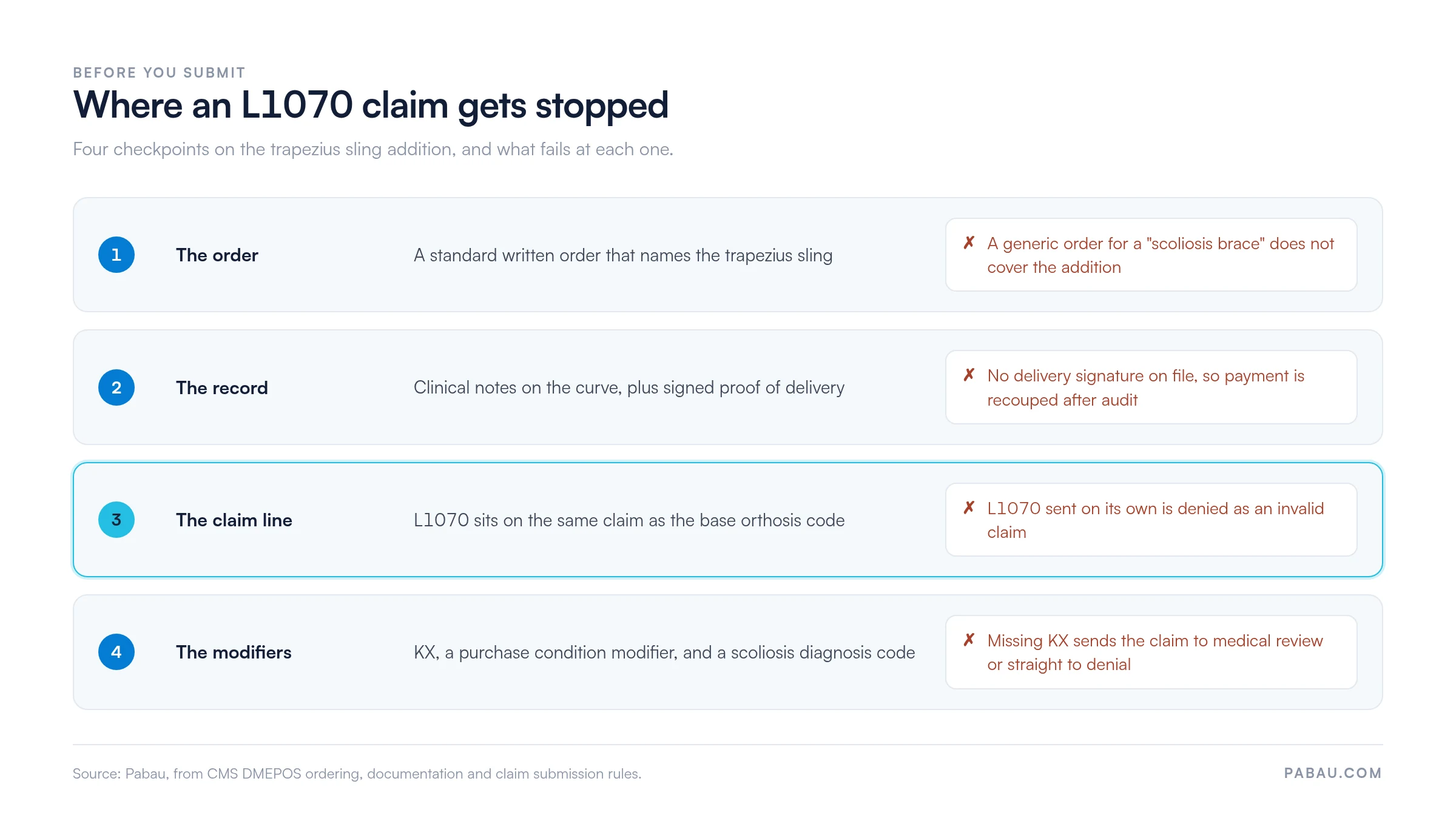
The pattern is worth noticing. Three of the four failures come from the documentation file rather than the code set. A billing system that is perfectly configured still loses the claim if the order is vague.
Medicare covers L1070 under Part B as a DMEPOS benefit, provided the claim meets the Local Coverage Determination for spinal orthotics. Coverage is not automatic. The claim has to show medical necessity, carry the KX modifier, and pair L1070 with a base orthosis code. Miss one of those and the claim is denied.
Criteria and documentation rules vary by jurisdiction, so read the current LCD from your own MAC, the Medicare Administrative Contractor for your region.
Payment comes off the DMEPOS fee schedule, not the physician fee schedule. CMS publishes the files annually, and the allowed amounts change every calendar year. Pull the current figure from the CMS file rather than a prior-year number or a third-party listing.
Prior authorization for L1070 depends on the payer, not on the code. Medicare fee-for-service does not currently require it for most scoliosis orthosis codes. Medicare Advantage plans often do, and so do many state Medicaid programs.
Commercial payers usually want authorization before the orthosis is fabricated, which makes it a pre-delivery step rather than a billing formality.
Verify benefits and authorization for every patient before the device is ordered. Supplying the sling without a required authorization usually means a full denial, with no appeal on the authorization itself.
Knowing the neighbors prevents crosswalk errors. Each code in the L1000-L1120 range is either a complete orthosis or one named addition, and the additions are easy to mix up.
L1060 and L1070 are the pair coders confuse most. L1060 is a thoracic pad, which presses on the rib cage from the front. L1070 is the shoulder assembly above it. Both can go on one claim when both components were supplied and documented separately.
Our HCPCS codes reference lists the rest of the L-range, plus the other Level II families a DMEPOS supplier bills.
The denials on this code repeat. Six mistakes account for most of them, and each one is preventable at the front end. A broader denial management routine starts here, with the errors you can stop before the claim transmits.
Check your billing system or clearinghouse for an edit that flags L-range add-on codes submitted without a base code on the same claim. Most claims management platforms can be configured to catch this before the 837P transmits. Catching the error at the front end removes the appeal cycle.
Most orthotic practices assemble the L1070 file from three systems. The order arrives by fax or portal, the clinical note lives in the EMR, and the delivery receipt sits in a folder. When a reviewer asks for the set two years later, someone spends a morning finding it.
Pabau puts the set on one patient record. The intake forms, the treatment notes and any document you upload sit on that file, including the signed delivery proof. Claims are submitted from the same record, so the supporting paperwork never has to be reassembled.
That matters most at audit. Pull up the patient and you have the order, the notes, the invoice and the claim history on one screen. A records request gets answered the same day. Every Pabau subscription includes the full feature set, so none of this sits behind a higher tier.

Pabau stores the order, the clinical notes and the delivery proof on the patient record, then submits the claim from the same place. Orthotic practices spend less time rebuilding files for an audit.

L1070 is a simple code with an unforgiving file behind it. The sling has to be tied to a base orthosis code and named in the written order. The notes then have to explain why the base brace fell short.
Practices that audit their own DMEPOS claims and keep complete files rarely meet a recoupment cycle. The work sits at the front end, where it costs an hour instead of a quarter’s revenue.
If rebuilding those files is eating your week, book a demo and see how Pabau keeps orthotic documentation and claims on one patient record.

Need the sibling code for the thoracic pad addition? L1060 covers the closest crosswalk risk in the same CTLSO/scoliosis orthosis family.
Billing the axilla sling instead? L1010 walks through the other sling add-on payers mix up with L1070.
Who bills the fitting visit for the orthosis itself? 97763 sets out the separate code for orthotic and prosthetic management encounters.
Need the outrigger addition code? L1080 rounds out the CTLSO/scoliosis orthosis additions in the L1000-L1120 range.
No. CMS discontinued certificates of medical necessity and DME information forms for dates of service on or after January 1, 2023. A standard written order signed by the treating physician, plus clinical notes supporting the sling, is what a payer expects now. Older billing guides still reference the CMN, so check the date on any template you use.
Scoliosis codes in the ICD-10-CM M41 family are the usual support, chosen to match the documented curve. Pick the code for the curve type and region in the clinical notes, not a general back pain code. The diagnosis on the claim has to justify the base orthosis as well as the sling.
The enrolled DMEPOS supplier bills it. The treating physician writes the order, but the claim comes from the supplier who furnished the orthosis and the sling. That supplier needs an active National Provider Identifier and current DMEPOS accreditation before the claim is submitted.
Read the denial reason first, then fix the underlying file rather than resubmitting the same claim. A missing KX modifier or a missing base code gets corrected and resubmitted, so no appeal is needed. Where the payer questions medical necessity, request a redetermination from your MAC within 120 days of the remittance advice, with the order and notes attached.



