HCPCS code L2090 – Hip knee ankle foot orthosis with torsion control
Code Definition
L2090 is the HCPCS Level II code for a custom-fabricated hip knee ankle foot orthosis with torsion control. The device carries a unilateral torsion cable, a ball bearing hip joint, and a pelvic band or belt.
Coders most often confuse L2090 with L2080, which describes the same device with a plain hip joint instead of a ball bearing one. The bilateral counterpart of L2090 is L2060, which carries torsion cables on both sides. Confirming the hip joint type and the cable count is the first check on every claim for this device.
Related Information
Level
Level II
Category
L — Orthotic and prosthetic procedures, devices
Code range
L2040-L2090 Hip knee ankle foot orthosis, torsion control
Billable
No
Code also known as
torsion-cable HKAFO, unilateral HKAFO, hip knee ankle foot brace, rotational control leg orthosis
Save time. Improve accuracy. Get paid faster.
Automate coding with Pabau
Let Pabau's smart automation suggest the right codes, reduce claim denials, and keep your practice compliant—effortlessly.
L2090Hip knee ankle foot orthosis with torsion control
HCPCS Code Suggestion
AI
Suggested code
L2090Hip knee ankle foot orthosis with torsion controlHigh match
Confidence score
98%
Why this code?
Matches patient diagnosis
Supported by clinical notes
Commonly used for this condition
Why practices choose Pabau
Save hours every week
Automate repetitive tasks and focus on what matters most—your patients.
Improve accuracy
Reduce coding errors and ensure compliance with the latest regulations.
Get paid faster
Clean claims, fewer denials, and faster reimbursements.
Grow with confidence
Powerful insights and reporting to help your practice thrive.
HIPAA compliant•SOC 2 certified•GDPR-compliant•Trusted by 4,000+ clinics worldwide
Key takeaways
HCPCS Code L2090 describes a custom-fabricated HKAFO with one torsion cable, a ball bearing hip joint, and a pelvic band or belt.
L2090 differs from L2080 only by hip joint type, and its bilateral counterpart is L2060, not L2080.
An RT or LT modifier is mandatory on every L2090 claim, and missing laterality is the leading denial cause.
Pabau’s claims management software helps DME suppliers track modifiers, documentation, and payer-specific rules across L-code claims.
HCPCS Code L2090: Definition and official descriptor
HCPCS Code L2090 is a Level II HCPCS code for a custom-fabricated hip-knee-ankle-foot orthosis (HKAFO) with torsion control. The device carries a unilateral torsion cable, a ball bearing hip joint, and a pelvic band or belt.
The CMS HCPCS code system places L2090 in the L2040-L2090 torsion-control HKAFO subgroup of the orthotic L-codes. The code is active and billable in the current HCPCS release.
The quick-reference table below captures the core identifiers for this code. The neighboring orthotic L-codes sit in our HCPCS library for suppliers.
Field
Detail
Code
L2090
Official descriptor
Hip knee ankle foot orthosis, torsion control, unilateral torsion cable, ball bearing hip joint, pelvic band/ belt, custom fabricated
Code category
HCPCS Level II, L2040-L2090 hip knee ankle foot orthosis, torsion control
Device type
Custom-fabricated HKAFO with a single torsion cable and a ball bearing hip joint
Laterality
Unilateral torsion cable (one side only); the bilateral counterpart is L2060
Status
Active and billable
What the L2090 descriptor means: Component breakdown
The official descriptor encodes precise construction requirements. Billing L2090 for a device that omits any of these elements creates an audit risk. The DME MAC will request records and check the device specification against the descriptor.
Hip-knee-ankle-foot orthosis (HKAFO): The device spans all four joints from the hip to the foot. AFOs and KAFOs without a hip component do not qualify for L2090.
Torsion control: The orthosis incorporates a mechanism that resists or corrects rotational forces applied to the limb. It addresses tibial or femoral torsion and rotational gait deviations.
Unilateral torsion cable: The control mechanism is a single torsion cable on one side, which applies or resists rotational forces along the limb. A device with torsion cables on both sides belongs to the bilateral codes L2050 or L2060.
Ball bearing hip joint: The hip joint must be a ball bearing joint. The same device with a plain hip joint is coded L2080, and an HKAFO without a hip joint does not meet the descriptor.
Pelvic band/belt: The orthosis attaches to a pelvic band or belt at the hip. A device without one does not match the L2090 descriptor.
Custom fabricated: The device is built for the individual patient from casts or measurements. L2090 has no prefabricated version, so an off-the-shelf HKAFO cannot be billed under this code.
What L2090 covers and what it does not
L2090 applies when a patient receives a custom-fabricated HKAFO with the single torsion cable and ball bearing hip joint described above. Common clinical scenarios include tibial torsion correction in pediatric patients, rotational gait deviation secondary to cerebral palsy, and post-fracture torsional deformity requiring dynamic correction.
Several related devices fall outside L2090’s scope:
Same device with a plain hip joint: Use L2080, not L2090. L2080 shares every other component, so the hip joint type is the deciding check.
Bilateral torsion-cable HKAFO: Use L2060 when the device carries torsion cables on both sides with a ball bearing hip joint. Use L2050 when the hip joint is plain. Billing two units of L2090 for a bilateral-cable device is a coding error and a clean-claim failure.
HKAFO with rotation straps instead of cables: Use L2070 for a unilateral strap or L2040 for bilateral straps. Neither descriptor includes a torsion cable or a hip joint.
KAFO or AFO: Devices that do not extend to the hip are coded separately. The full-plastic KAFOs L2034 and L2036, for example, have no hip joint and are not HKAFOs.
Torsion-cable add-on components billed separately: When torsion-cable components are listed as add-ons to an existing orthosis, applicable add-on L-codes may be more appropriate than L2090.
HCPCS Code L2090 vs. L2080 and adjacent HKAFO codes
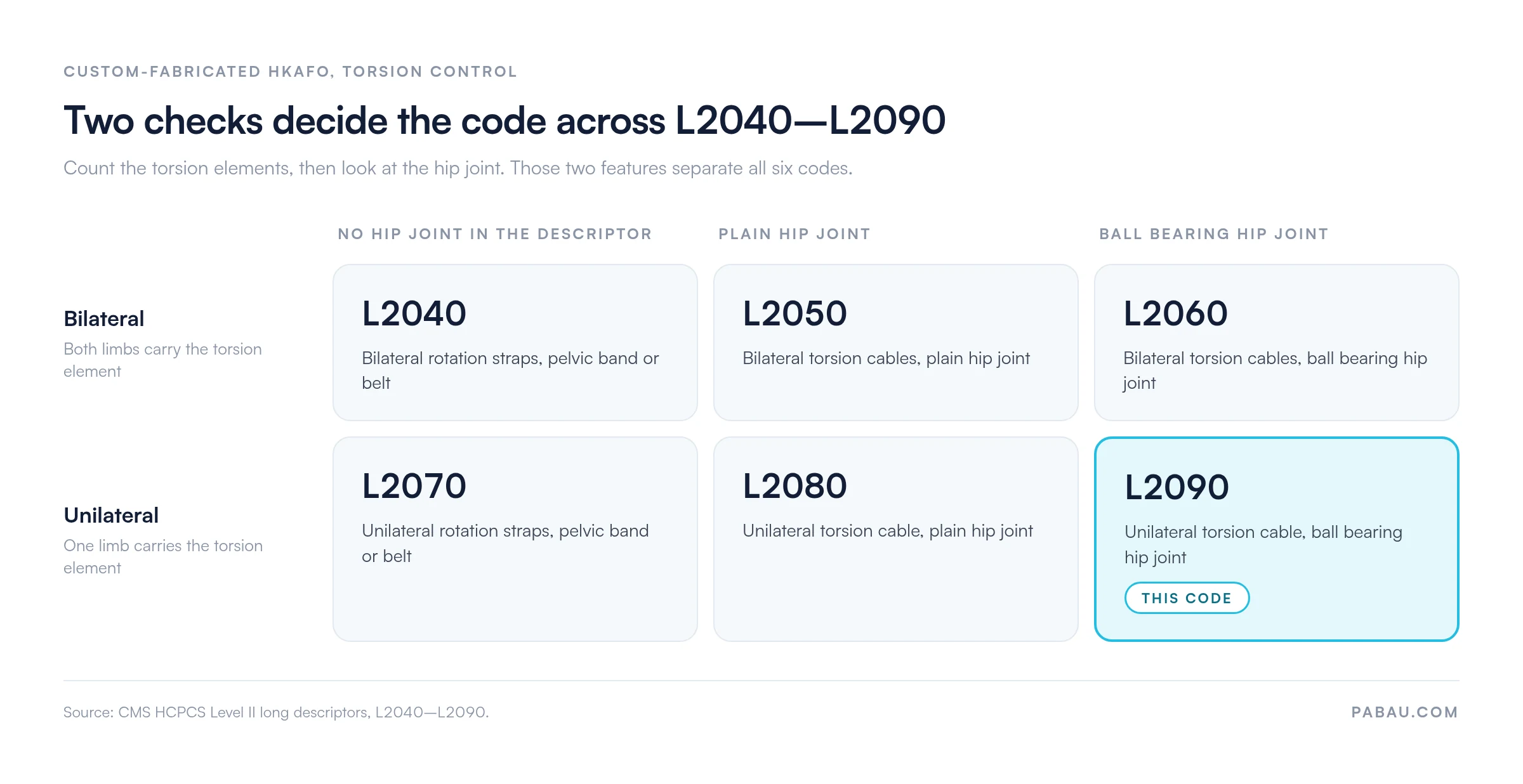
Picking an adjacent code from the L2040-L2090 torsion-control subgroup is the most common miscoding error for this device. Two checks settle it.
First, count the torsion elements: L2040, L2050, and L2060 are bilateral, while L2070, L2080, and L2090 are unilateral. Second, check the hip joint, because a plain joint and a ball bearing joint are separate codes.
L2090 is the only unilateral code in the range with a ball bearing hip joint, and L2060 is its bilateral counterpart. Descriptors come from the CMS HCPCS Level II file.
HKAFO, torsion control, unilateral torsion cable, hip joint, pelvic band/belt
Unilateral torsion cable
Plain hip joint
L2090
HKAFO, torsion control, unilateral torsion cable, ball bearing hip joint, pelvic band/ belt
Unilateral torsion cable
Ball bearing hip joint
L2080 and L2090 share the same single torsion cable and pelvic band, so the hip joint decides the code. A ball bearing hip joint is L2090, and a plain hip joint is L2080. A device with torsion cables on both sides and a ball bearing hip joint is L2060.
Confirm the hip joint type and the cable count in the fabrication notes before assigning any code in this range.
ICD-10 diagnosis codes commonly paired with L2090
The supporting ICD-10 diagnosis must justify a torsion-control HKAFO. DME MAC local coverage determinations (LCDs) specify which diagnosis codes meet medical necessity for HKAFO devices. The list below reflects commonly accepted codes, so verify it against the applicable LCD for your DME MAC jurisdiction before submitting.
Pairings outside the LCD-approved list will generate a denial unless a KX modifier is attached. The KX modifier attests that all LCD criteria are met and documentation is on file.
ICD-10 code
Description
Coverage note
M21.00
Valgus deformity, not elsewhere classified, unspecified site
Commonly LCD-listed
Q66.00, Q66.01, Q66.02
Congenital talipes equinovarus, unspecified foot, right foot, or left foot
Commonly LCD-listed. Code the foot that matches the RT or LT modifier.
G80.0
Spastic quadriplegic cerebral palsy
Commonly LCD-listed; ambulatory status must be documented
G80.1
Spastic diplegic cerebral palsy
Commonly LCD-listed; ambulatory status must be documented
G71.00
Muscular dystrophy, unspecified
LCD-listed; document functional ambulation
M21.851
Other specified acquired deformities of right thigh
Payer-specific; include detailed clinical notes
Always cross-reference the applicable LCD rather than relying on this list as definitive. LCD-approved diagnosis sets differ across DME MAC jurisdictions (A, B, C, D) and are updated periodically.
Medicare coverage and medical necessity criteria for L2090
Medicare covers HCPCS Code L2090 under the DMEPOS benefit when all of the following conditions are met. Run insurance eligibility verification before the fitting appointment, so a lapsed policy or a secondary payer surfaces before the device is built.
Ambulatory beneficiary: The patient must have the ability to ambulate. Medicare does not cover HKAFOs for non-ambulatory beneficiaries under the DMEPOS orthotic benefit.
Physician order: A licensed physician (or authorized treating practitioner) must order the device. The order must include a diagnosis, a detailed product description (DPD), and the treating physician’s signature and date.
Medical necessity documented: Clinical notes must establish why a torsion-control HKAFO is necessary for this patient at this time. Functional limitations and the torsional deformity must be explicitly described.
Custom fabrication documented: L2090 describes a custom-fabricated device, so the orthotist’s evaluation, casting, and fitting notes are required. A prefabricated HKAFO cannot be billed under L2090.
KX modifier: Append the KX modifier to attest that all LCD criteria are fully met and documentation supporting medical necessity is on file. Without KX, many DME MACs will automatically deny the claim pending review.
Medicare’s Prior Authorization Program for certain DMEPOS items does not currently include L2090 as of the 2025 program year, but CMS updates this list annually. Verify the current program scope at cms.gov before assuming no prior auth is needed for a specific patient.
Pro Tip
Check your DME MAC’s applicable LCD for HKAFO devices before every L2090 submission. Each of the four DME MAC jurisdictions (A, B, C, D) maintains its own LCD with jurisdiction-specific ICD-10 code lists. A diagnosis code accepted in one jurisdiction may not appear in another’s covered list.
Documentation requirements for L2090 claims
Insufficient documentation is the primary audit trigger for L-code orthotic claims. Every L2090 claim needs the following on file before submission, and a DMEPOS supplier’s medical billing compliance program should check each item.
Physician order with DPD: The order must name the device type (torsion-control HKAFO), include a detailed product description, and state the diagnosis. It must also bear the prescribing physician’s signature and date. Orders lacking a DPD are a leading cause of DME MAC post-pay audit failures.
Clinical notes establishing medical necessity: Notes must document the patient’s ambulatory status and the specific torsional deformity or rotational gait deviation. They must also explain how the device addresses it. Generic “patient needs HKAFO” language is insufficient.
Certificate of Medical Necessity (CMN): Some commercial payers and Medicaid programs require a CMN. Medicare does not universally require a CMN for orthotic devices, but check your specific LCD for any CMN requirements attached to the covered diagnosis.
Proof of Delivery (POD): Keep a signed and dated delivery receipt confirming the patient or their representative received the device. Missing POD is cited as a top DMEPOS audit finding in OIG Work Plan reports.
Orthotist’s evaluation and fitting notes: These document the casting process, measurements, fabrication specifications, and fitting adjustments. Record the hip joint type and the cable count, since they separate L2090 from L2080 and L2060.
Advance Beneficiary Notice (ABN): If the claim may not meet medical necessity criteria for Medicare, issue an ABN before delivery and retain the signed copy. Without an ABN on file, the supplier absorbs any non-covered cost.
Retain all documentation for a minimum of seven years. CMS supplier standards under 42 CFR 424.57 set retention obligations. Verify current requirements against the regulation directly, as specific timeframes may be updated.
HCPCS modifiers used with L2090
Because L2090 is unilateral by definition, a laterality modifier is mandatory on every claim. Submitting L2090 without RT or LT is an automatic denial at most DME MAC carriers. The table below lists all applicable modifiers for this code.
Modifier
Meaning
When to use
RT
Right side
Device fitted on the right limb. REQUIRED.
LT
Left side
Device fitted on the left limb. REQUIRED.
KX
Medicare LCD criteria met; documentation on file
Add when all medical necessity criteria from the applicable LCD are documented and on file
GA
ABN on file
Waiver of liability applies; signed ABN was obtained before delivery
GY
Item or service statutorily excluded
Claim is being submitted to get a denial for secondary payer purposes
NU
New equipment
Device is purchased new (most common for initial supply)
RR
Rental
Device is being rented rather than purchased
RP
Replacement
Replacement device after loss, irreparable damage, or warranty expiration
Medicare fee schedule and reimbursement for L2090
HCPCS Code L2090 is reimbursed under the Medicare DMEPOS fee schedule as a purchased item (NU modifier) for most beneficiaries. Fee schedule allowables are set annually by CMS and vary by fee schedule area (geographic region). The most current amounts are available through the CMS DMEPOS fee schedule lookup tool.
Hardcoded figures in billing guides become outdated after each annual update, so always pull the live figure before quoting an allowable.
Key reimbursement considerations for L2090:
Purchase vs. rental: L2090 is generally classified as an inexpensive or routinely purchased item rather than a capped rental item. Most claims use the NU modifier and bill for outright purchase.
Regional variation: Allowables differ across fee schedule areas. High-cost urban regions typically reimburse at higher rates than rural areas due to labor and cost adjustments.
Competitive bidding: Certain DMEPOS product categories are subject to Medicare’s competitive bidding program, which sets contract prices below the fee schedule. Verify whether L2090 falls under an active competitive bidding program in the beneficiary’s service area.
Commercial and Medicaid rates: These differ from Medicare and are governed by individual payer contracts or state Medicaid fee schedules. Never apply a Medicare allowable to a commercial or Medicaid claim.
Top L2090 claim denial reasons and how to prevent them
L2090 claims have a predictable denial pattern. The seven causes below account for the majority of rejections seen in DMEPOS denial management workflows. Addressing each one before submission converts most of these into clean claims.
Denial reason
Prevention tip
Missing RT or LT modifier
Set a claim scrubbing rule so L2090 without a laterality modifier cannot be submitted
Insufficient medical necessity documentation
Use a structured documentation checklist before claim submission. Physician notes must specifically describe the torsional deformity.
ICD-10 code not on LCD-approved list
Pull the current LCD for your DME MAC jurisdiction and verify diagnosis code before billing
Billed L2090 for a plain hip joint (L2080) or bilateral cables (L2060)
Confirm the hip joint type and the cable count in the fabrication notes before assigning the code
Missing proof of delivery
Obtain a signed POD at fitting, and hold the claim until that document is in the file
Physician order lacks DPD
Use an order template that prompts for the detailed product description. Return unsigned orders to the prescriber before filling.
Claim filed to wrong DME MAC jurisdiction
Route claims based on the beneficiary’s billing address, not the supplier’s location. Confirm the jurisdiction at the eligibility check.
If a claim is denied, Medicare beneficiaries have redetermination rights. The first-level appeal (redetermination) must be filed within 120 days of the initial denial notice. Tracking denial reason codes and appeal deadlines in DME supplier claims software cuts the time lost to manual follow-up.
Pabau’s claims dashboard flags a rejected L2090 claim as Needs action and shows the reason, so the appeal starts before the 120-day window closes.
Billing L2090 in practice: Step-by-step workflow
A consistent billing workflow prevents most of the denial causes listed above. Use this sequence for every L2090 claim.
Verify the device matches the L2090 descriptor: Confirm the device is a custom-fabricated HKAFO with one torsion cable and a ball bearing hip joint. It must also attach to a pelvic band or belt. A plain hip joint is L2080, and bilateral cables with a ball bearing joint are L2060.
Obtain a compliant physician order: The order must name the device type, include a DPD, and state the diagnosis code. The prescribing physician must sign and date it.
Verify patient eligibility and payer coverage: Check Medicare Part B eligibility and secondary payer status. Then confirm whether a commercial or Medicaid plan requires prior authorization for this device type.
Document medical necessity before fitting: Clinical notes must describe the torsional deformity, functional limitations, and rationale for the torsion-cable HKAFO specifically.
Complete a CMN if required by payer: Medicare generally does not require a CMN for orthotics, but confirm with the applicable LCD. Commercial and Medicaid payers often do.
Check prior authorization requirements: Medicare currently does not require prior auth for L2090, but commercial and Medicaid plans vary. Obtain PA documentation before delivery when required.
Fit and deliver the device; obtain POD: A signed and dated delivery receipt is required. Document the fitting session, any adjustments made, and the patient’s acceptance of the device.
Assign L2090 with RT or LT, plus KX where it applies: Use RT for the right limb and LT for the left. Add KX when all LCD medical necessity criteria are documented. Add GA if an ABN was issued.
Submit to the correct DME MAC jurisdiction: Route based on the beneficiary’s billing address. Confirm jurisdiction at the eligibility verification step to avoid routing errors.
Retain documentation for the required period: Retain all records per CMS supplier standards under 42 CFR 424.57. General industry practice is a minimum of seven years, but verify current regulatory requirements directly.
How Pabau keeps L2090 claims clean from order to payment
Many orthotic suppliers still track an L2090 claim across a paper order, a fabrication sheet, and a billing spreadsheet. The modifier, the KX attestation, and the proof of delivery each live somewhere different, so one missing item stalls the claim.
Pabau, the practice management and billing platform we build, raises the claim from the patient’s invoice and validates it before it leaves for your clearinghouse. In the US, claims go through Claim.MD, which also runs the eligibility check before the fitting. Prior authorization codes are stored as a case and follow the appointment onto the claim.
Once submitted, every claim moves through one dashboard from Pending to Paid. A rejected claim is flagged Needs action with its reason, so your team corrects the laterality or the diagnosis and resubmits the same day.
Keep L2090 claims clean from day one
Pabau raises each claim from the patient’s invoice, validates it before it reaches your clearinghouse, and tracks it to Paid. Your team catches a missing modifier at the desk instead of on a denial.
Treat the hip joint as the first question on every L2090 claim. If the fabrication notes don’t name a ball bearing joint and a single torsion cable, the code isn’t settled. No modifier or diagnosis fixes that later.
Once the device matches the descriptor, the remaining risk is paperwork. Build the RT or LT modifier, an LCD-listed diagnosis, and the signed delivery receipt into intake. Most L2090 denials then never get the chance to happen.
Book a demo to see how Pabau checks orders, modifiers, and delivery records before each orthotic claim leaves your team.
Continue your research
Looking for a clean-claim reference for DMEPOS billing?Clean claim standards outlines the elements every DMEPOS claim needs to pass front-end edits.
Want to see how medical billing software handles orthotic claims?Best medical billing software in the US compares platforms by DMEPOS and orthotic billing capability.
Frequently asked questions
What is HCPCS Code L2090?
HCPCS Code L2090 is the billing code for a custom-fabricated hip-knee-ankle-foot orthosis with torsion control. The device carries a unilateral torsion cable, a ball bearing hip joint, and a pelvic band or belt. Suppliers use it to bill this HKAFO when it is furnished to an ambulatory patient.
What is the difference between L2080 and L2090?
L2080 and L2090 both describe a custom-fabricated torsion-control HKAFO with a unilateral torsion cable and a pelvic band or belt. The only difference is the hip joint: L2080 has a plain hip joint, while L2090 has a ball bearing hip joint. Neither code is the bilateral version of the other. The bilateral counterpart of L2090 is L2060, which carries torsion cables on both sides.
Is prior authorization required for HCPCS Code L2090 under Medicare?
As of the 2025 program year, Medicare does not include L2090 in its Prior Authorization Program for DMEPOS. Prior authorization is therefore not required for Medicare claims. However, CMS updates the program scope annually, and commercial payers and Medicaid programs often do require prior authorization for custom or high-cost HKAFO devices. Always verify PA requirements with the specific payer before delivering the device.
What modifiers are required when billing HCPCS Code L2090?
RT (right side) or LT (left side) is mandatory on every L2090 claim because the code is unilateral by definition. KX should be appended when all LCD medical necessity criteria are fully met and documented. GA is used when a signed ABN is on file. Missing the RT or LT modifier is the single most common L2090 denial cause.
What ICD-10 codes support L2090?
Commonly accepted ICD-10 codes include M21.00 (valgus deformity) and Q66.00 to Q66.02 (congenital talipes equinovarus, by foot). G80.0 and G80.1 (spastic cerebral palsy subtypes) and G71.00 (muscular dystrophy) also appear. The definitive list is set by the applicable DME MAC LCD for your jurisdiction and is updated periodically. Always verify against the current LCD rather than a static crosswalk.
What is a torsion control HKAFO?
A torsion control HKAFO is a hip-knee-ankle-foot orthosis that incorporates a cable-based mechanism to resist or correct rotational forces on the limb. It is prescribed for patients with tibial torsion, femoral torsion, or rotational gait deviations secondary to conditions such as cerebral palsy or congenital foot deformities. On L2090, a single torsion cable and a ball bearing hip joint set the device apart from the other torsion-control codes.