

CCSD code G5100: Bypass of duodenum billing guide
CCSD code G5100 bills a bypass that leaves the duodenum in place CCSD code G5100...

Last Updated: Oct 16, 2026
L1652 is the HCPCS Level II code for hip orthosis, bilateral thigh cuffs with adjustable abductor spreader bar, adult size, prefabricated, includes fitting and adjustment, prefabricated item that has been trimmed, bent, molded, assembled, or otherwise customized to fit a specific patient by an individual with expertise.
Payment runs through the Medicare DMEPOS fee schedule, so the allowable changes every January and varies by locality. Certificates of medical necessity play no part here, and submitting one now gets the claim rejected.
Let Pabau's smart automation suggest the right codes, reduce claim denials, and keep your practice compliant—effortlessly.
Automate repetitive tasks and focus on what matters most—your patients.
Reduce coding errors and ensure compliance with the latest regulations.
Clean claims, fewer denials, and faster reimbursements.
Powerful insights and reporting to help your practice thrive.
HIPAA compliant SOC 2 certified GDPR-compliant Trusted by 4,000+ clinics worldwide

HCPCS code L1652 describes a prefabricated bilateral hip orthosis with adjustable abductor spreader bar, adult size, fitting included.
L1652 is covered under the Medicare DMEPOS benefit and priced on the CMS DMEPOS fee schedule, which varies by locality.
The device billed under L1652 must appear on the PDAC verified product list before submitting any Medicare claim.
Pabau’s claims management software lets DME practices attach L-codes at the point of care and track claim status through to payment.
HCPCS code L1652 covers a specific configuration of prefabricated hip orthosis. The CMS HCPCS Level II code set publishes the full official descriptor. It reads: Hip orthosis, bilateral thigh cuffs with adjustable abductor spreader bar, adult size, prefabricated, includes fitting and adjustment, any type. The short descriptor used on claim forms is: HO bi thighcuffs w sprdr bar.
Three descriptors within that definition carry billing weight. Bilateral means both thighs are cuffed, not just one. Adjustable abductor spreader bar refers to the connecting mechanism that controls hip abduction angle. Prefabricated means the device is manufactured to standard sizes rather than custom-fabricated from a patient impression. Fitting and adjustment are bundled into the code, so billing them separately results in a duplicate-service denial.
HCPCS code L1652 is covered under the Medicare Part B DMEPOS benefit when medical necessity is established and the product meets PDAC approval criteria. Medicare pays 80% of the fee schedule allowable after the deductible. The beneficiary or a secondary insurer covers the remaining 20%. Payment amounts are locality-adjusted using the CMS DMEPOS fee schedule files, which change each January 1 with the annual update.
Verify the allowable for your MAC jurisdiction before the device is ordered, not after it is delivered. A practice that quotes the national average rather than its own jurisdiction rate will misstate what the claim pays.
PDAC approval is a hard prerequisite for billing HCPCS code L1652 to Medicare. The Pricing, Data Analysis and Coding (PDAC) contractor reviews specific products submitted by manufacturers against the code descriptor. It then publishes a verified product list for orthotic HCPCS codes. A product that is not on this list is not billable under L1652, regardless of how closely it matches the physical description.
Confirm the manufacturer’s model number appears on the PDAC verified list before ordering the device for the patient. Confirming after delivery leaves you with a device you cannot bill. The check belongs inside the pre-authorization workflow, not in a pile of post-delivery paperwork.
Run the PDAC product check against the current year’s list, not last year’s. PDAC approval status can change annually when manufacturers fail to resubmit. A product that was PDAC-approved in 2024 may no longer appear on the 2026 verified list.
A standard written order (SWO) is the central documentation requirement for HCPCS code L1652. It is not a certificate of medical necessity. CMS discontinued CMNs and DME information forms for all dates of service on or after January 1, 2023. DME MACs now reject claims that carry one.
CMNs never applied to orthoses in the first place. The form set only ever covered oxygen, pneumatic compression devices, osteogenesis stimulators, TENS units, seat lift mechanisms, external infusion pumps, and enteral or parenteral nutrition. An L-code claim was always evidenced by the order plus the treating practitioner’s clinical record.
The deadline for the SWO depends on which CMS list the code sits on. L1652 does not appear on the CMS face-to-face encounter and written order prior to delivery list. That list covers knee and ankle-foot orthoses, not hip codes. The SWO therefore has to be on file before the claim is submitted, not before the device is handed to the patient.
A complete L1652 documentation package includes the following. Use it as a pre-claim audit checklist. The diagnosis half of that package comes from the ICD-10-CM code set. Pull those codes from the practitioner’s notes, never from the claim form.
The claim form for a DMEPOS line carries the HCPCS code and the PDAC-approved product model. It also carries the ICD-10-CM codes, the place of service, and the rendering provider NPI. Missing any of those fields triggers an automatic edit that delays or denies payment.
L1686 is the code most often confused with HCPCS code L1652. The distinction matters, because selecting the wrong one causes an outright denial rather than a correction request. L1652 covers a bilateral configuration, with an adjustable abductor spreader bar connecting two thigh cuffs. L1686 covers a unilateral postoperative hip abduction orthosis. It uses a waist band, one rigid upright with an adjustable hip joint, and a single thigh cuff, with no spreader bar. If the device cuffs both thighs and links them with a spreader bar, L1652 is the correct code. If it braces one hip after surgery, L1686 applies, and its custom-fabricated equivalent is L1685.
A device marketed as a “hip abduction orthosis” causes confusion regularly. It has bilateral pelvic and thigh components, but the spreader bar is fixed rather than adjustable. If the bar is not adjustable, it may not meet the L1652 descriptor precisely. Review the device’s product specification sheet alongside the PDAC verified product list entry to confirm which code the manufacturer obtained approval under.
Most L1652 denials cluster around five root causes. Fixing them upstream, before claim submission, removes the bulk of the rework. A documented pre-bill review against all five is the cheapest form of denial management available to an orthotic supplier.
The last error is not specific to L1652. HCPCS code L1660 also bundles fitting and adjustment into its descriptor, so a separate fitting line draws the same duplicate-service denial.
Build a pre-submission checklist into your DMEPOS billing workflow. Check the PDAC product listing, the signed standard written order, and the diagnosis codes against the clinical notes. Then confirm the laterality code is right and that no separate fitting line was added. Those five checks prevent the most common L1652 denials.
HCPCS code L1652 sits within a family of L-codes covering hip orthoses and lower extremity devices. Two things separate them. One is laterality, and the other is whether the device is prefabricated or custom fabricated. Work down the descriptor before reaching for a code, because the product name rarely settles it. The branches below trace each descriptor to the code it points at.
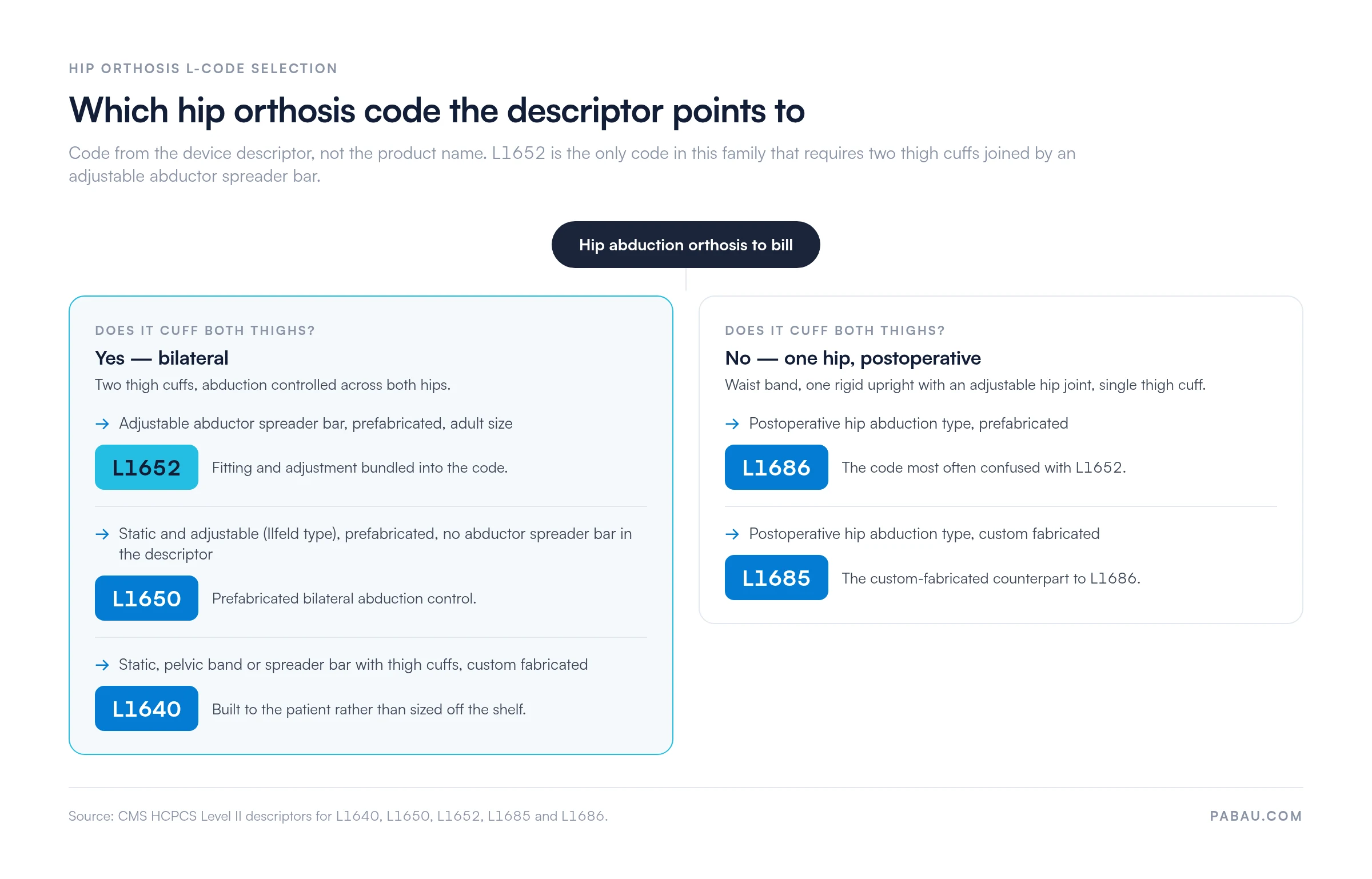
Sizing separates the family further. L1652 is an adult-size code, so a flexible infant Frejka-type device for hip dysplasia is billed under L1600 instead. A Pavlik harness fitted for that same infant indication is billed under L1620.
Billing HCPCS code L1652 requires coordinating at least six data points across the clinical and administrative workflow. Those are the standard written order, the supporting clinical notes, and the PDAC product confirmation. The remaining three are the ICD-10-CM diagnosis codes, the delivery confirmation, and the HCPCS code itself. In practices that use separate systems for clinical documentation and billing, one of those six handoffs becomes the failure point.
Practice management software like Pabau keeps all six on the same patient record. Pabau’s claims management software lets DME and orthotic practices attach L-codes to the patient encounter at the point of care. The biller sees the code, the associated diagnosis codes, and the documentation status without opening a second system.
Fewer handoffs means fewer transcription errors between the clinical record and the claim form. It also shortens the stretch between delivering the device and getting the claim out the door, which is where DMEPOS cash flow is usually lost.

Pabau lets your team attach HCPCS L-codes at the point of care and track written order and delivery status. Submit clean claims without switching between systems. See how it works for DME and orthotic practices.

L1652 is a descriptor-driven code, and its descriptor is narrow. It calls for two thigh cuffs, an adjustable abductor spreader bar, prefabrication, and an adult fit. A device that misses any one of those belongs under a different L-code, however the manufacturer markets it.
The practical consequence is that the coding decision happens before the order is placed. Check the PDAC verified list and read the specification sheet while the patient is still a candidate for the device. A supplier who leaves both until billing has already bought stock that may never be billable.
Pabau supports the DMEPOS documentation and coding workflow end to end, from code entry through claim submission and payment reconciliation. Book a demo to see how it handles orthotic and DME billing for your practice.

Need help managing DMEPOS claim denials? Denial management in healthcare covers the most common reasons claims are rejected and how to build a systematic appeals process.
Want to understand the broader billing framework? Revenue cycle management explained walks through how DMEPOS claims fit into the end-to-end billing lifecycle.
Building a compliant orthotic billing workflow? Medical billing compliance outlines the documentation and audit-readiness standards for Medicare DME claims.
Not sure what belongs on the itemized bill? What is a superbill? sets out the fields a payer expects before it will process the charge.
Chasing first-pass payment? What is a clean claim in medical billing? explains the checks that get a claim paid without rework.
HCPCS code L1652 is the billing code for a prefabricated bilateral hip orthosis with adjustable abductor spreader bar, adult size, including fitting and adjustment. It is used by DME suppliers and orthotists to bill Medicare and other payers for this specific device configuration when medical necessity is documented.
Yes, L1652 is covered under the Medicare Part B DMEPOS benefit. The device must be medically necessary, and the product must be on the PDAC verified product list. A signed standard written order must be on file before the claim is submitted. Certificates of medical necessity were discontinued for dates of service on or after January 1, 2023. Medicare pays 80% of the DMEPOS fee schedule allowable, and the beneficiary is responsible for the 20% coinsurance.
L1652 covers a bilateral hip orthosis with thigh cuffs on both sides and an adjustable abductor spreader bar connecting them. L1686 covers a unilateral postoperative hip abduction orthosis with a single thigh cuff and no spreader bar. If the device cuffs both thighs and links them with a spreader bar, use L1652. If it braces one hip after surgery, use L1686, or L1685 when the device is custom fabricated.
Yes, the specific product billed under L1652 must appear on the PDAC verified product list maintained by the PDAC contractor. PDAC approval is product-specific, not code-specific. Verify the manufacturer’s model number against the current year’s PDAC list before ordering the device for the patient.
A complete L1652 documentation package starts with a standard written order signed by the treating practitioner. It also needs clinical notes supporting the bilateral orthosis configuration and qualifying ICD-10-CM diagnosis codes. Add signed proof of delivery from the beneficiary, plus documentation that the product model is PDAC-approved. Certificates of medical necessity are no longer accepted and never applied to orthosis codes.
L1652 is strictly a prefabricated (off-the-shelf) orthosis code. The official CMS descriptor explicitly states “prefabricated.” Custom-fabricated bilateral hip orthoses with similar configurations require a different L-code; billing a custom device under L1652 misrepresents the product and creates audit risk.



