Inpatient billing cheat sheet
An inpatient billing cheat sheet is a quick reference for the codes and claim ru...

Last Updated: Oct 19, 2026
L0628 is the HCPCS Level II code for a prefabricated, off-the-shelf flexible lumbar-sacral orthosis whose posterior runs from the sacrococcygeal junction to T-9. It compresses the abdomen to reduce load on the intervertebral discs, and it may include stays, shoulder straps and a pendulous abdomen design.
Medicare covers L0628 under LCD L33790 when the brace reduces pain, aids healing after spinal injury or surgery, or supports a weak or deformed spine. Claims need a standard written order, supporting records and proof of delivery, and no KX modifier applies. L0628 is not on the CMS face-to-face list, but DME MAC guidance requires a practitioner visit within six months before the order.
Let Pabau's smart automation suggest the right codes, reduce claim denials, and keep your practice compliant—effortlessly.
Automate repetitive tasks and focus on what matters most—your patients.
Reduce coding errors and ensure compliance with the latest regulations.
Clean claims, fewer denials, and faster reimbursements.
Powerful insights and reporting to help your practice thrive.
HIPAA compliant SOC 2 certified GDPR-compliant Trusted by 4,000+ clinics worldwide

Specifically, HCPCS code L0628 is a flexible, off-the-shelf lumbar-sacral orthosis whose posterior runs from the sacrococcygeal junction to T9.
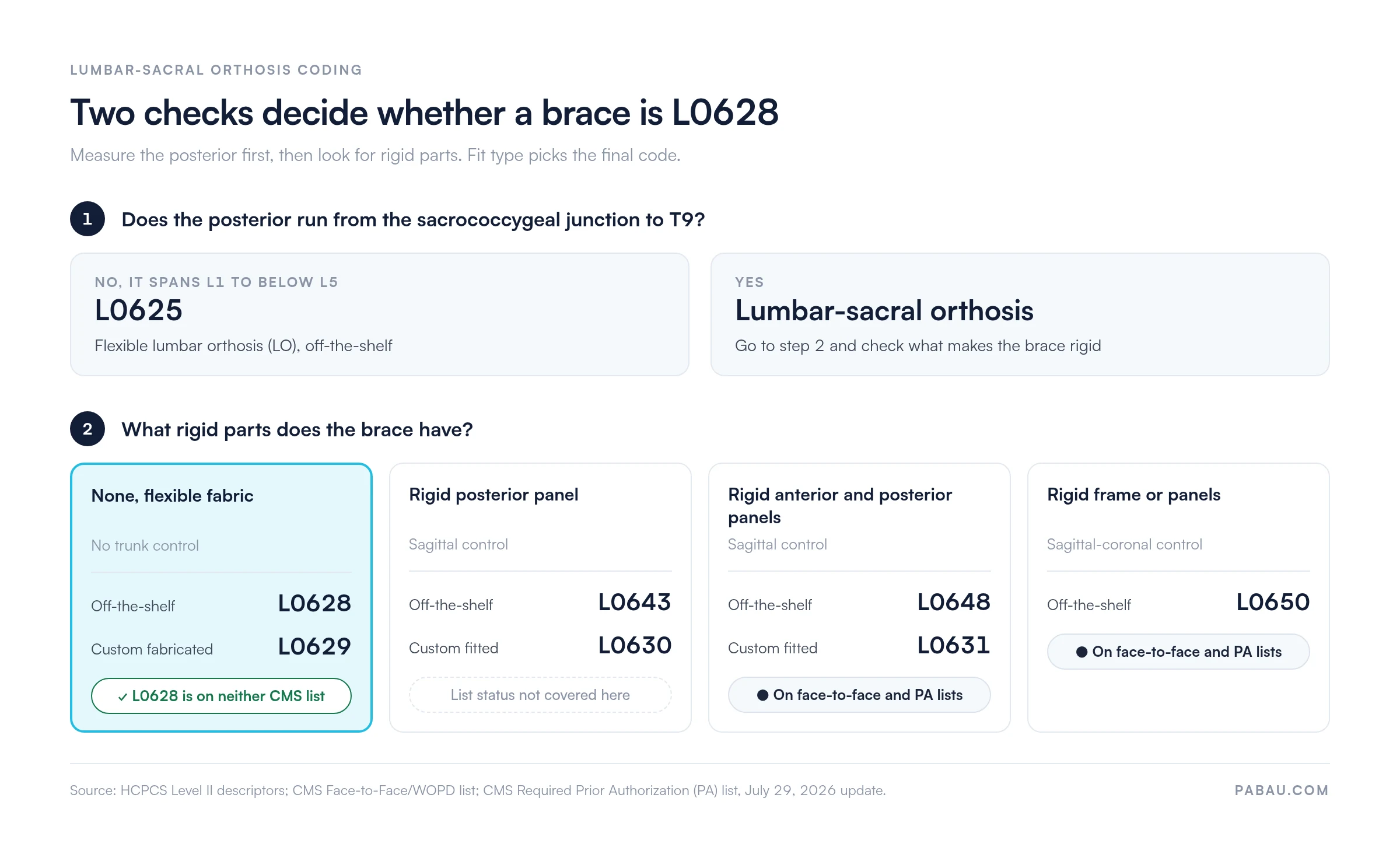
In contrast, a rigid panel moves the brace to a sagittal-control code such as L0643 or L0648, and the custom-fabricated version is L0629.
Overall, Medicare needs a standard written order, records that support one of four LCD L33790 indications, and proof of delivery.
L0628 is not on the CMS face-to-face or prior authorization lists, and no KX modifier applies. Nevertheless, DME MAC guidance still requires a practitioner visit in the six months before the order.
For instance, add the CG modifier only when the brace is made mainly of nonelastic material, such as canvas, cotton or nylon.
HCPCS code L0628 is the Level II code for a prefabricated, off-the-shelf flexible lumbar-sacral orthosis (LSO). The Centers for Medicare and Medicaid Services (CMS) maintains the Level II code set. Specifically, the official descriptor defines a flexible LSO that provides lumbo-sacral support, with a posterior that runs from the sacrococcygeal junction to the T-9 vertebra. In addition, it produces intracavitary pressure to reduce load on the intervertebral discs. It also includes straps and closures, and may include stays, shoulder straps and a pendulous abdomen design. In short, it is prefabricated and off-the-shelf.
Notably, three elements decide whether L0628 fits a device. First, the posterior must run from the sacrococcygeal junction up to the ninth thoracic vertebra (T9). Second, the brace must be flexible, with no rigid panels or frame. Third, it must also be off-the-shelf, which means it needs only minimal self-adjustment to fit.
In fact, the intracavitary pressure clause explains how the brace works. Compressing the abdomen raises intra-abdominal pressure, which takes some load off the lumbar discs. Consequently, flexible LSOs are a common conservative option in physical therapy practices that manage low back pain.
The table below breaks down each part of the official descriptor, so suppliers and prescribers can check a device against it before billing.
L0628 covers a flexible corset-style brace with straps and closures. The descriptor also allows stays, shoulder straps and a pendulous abdomen design, so those extras do not change the code.
In short, rigidity is what moves a brace out of L0628. For instance, a rigid posterior panel adds sagittal control, which points to L0643 off-the-shelf or L0630 custom fitted. In addition, rigid anterior and posterior panels point to L0648 or L0631. A rigid frame that also limits side bending adds coronal control, which belongs to codes such as L0650.
In addition, material matters. Specifically, Policy Article A52500 codes garments made mainly of elastic material, such as neoprene or spandex, as A4467, which Medicare does not cover.
Notably, the LSO codes that share L0628’s sacrococcygeal-to-T9 height differ by rigidity and by how the device is fitted. The table compares L0628 with the codes billers most often confuse with it. In addition, each one has its own entry in our HCPCS code library.
Two checks settle most L0628 decisions. First, measure the posterior height, because a brace that spans only L1 to below L5 is an LO. Second, look for rigid panels, since any rigid panel adds sagittal control and takes the brace out of L0628. Overall, the decision chart below runs both checks in order.
A brace with a rigid posterior frame and rigid lateral panels over that same sacrococcygeal-to-T9 span, supplied off the shelf, is L0649.
L0627 is sometimes paired with L0628 by mistake. It is a custom-fitted lumbar orthosis with rigid anterior and posterior panels, so it has neither L0628’s height nor its flexibility. Instead, confirm the code against the product’s PDAC listing, not its marketing name.
Neither LCD L33790 nor Policy Article A52500 lists covered ICD-10-CM codes for spinal orthoses. Instead, both show N/A under the diagnosis code sections. Coverage turns on whether the medical record supports one of the four LCD indications in the next section.
Nevertheless, the diagnosis on the claim still has to match that indication and be coded to the highest specificity. The table lists codes practices often report with a flexible LSO.
Also, check each code against the current ICD-10-CM release, which updates every October 1.
Medicare Part B covers L0628 as a brace when it meets the reasonable and necessary criteria in LCD L33790. In addition, the LCD pairs with Policy Article A52500, which holds the coding and statutory rules. Suppliers bill the DME Medicare Administrative Contractor (MAC) for their jurisdiction.
LCD L33790 covers a spinal orthosis when it is used for one of these four purposes:
The LCD joins the four with the word or, so the record needs to support only one of them. Specifically, the treating practitioner’s notes should name that purpose in plain terms, next to the diagnosis.
L0628 is not on the CMS Required Face-to-Face Encounter and Written Order Prior to Delivery List, the regulatory list set under 42 CFR 410.38(c)(8). Notably, every LSO code on that list has rigid panels, frames or shells, such as L0631, L0637, L0639, L0648 and L0650. Because L0628 is off the list, the standard written order only has to reach the supplier before the claim is submitted.
However, being off that list does not remove the need for a visit. The CGS Spinal Orthoses Documentation Checklist for DME MAC Jurisdictions B and C names L0628 among its off-the-shelf codes. For those codes, it requires a practitioner visit within six months preceding the order. Notably, the note from that visit must record subjective and objective findings that support the LCD indication.
This six-month rule comes from DME MAC documentation guidance, not from the text of LCD L33790 itself. A telehealth visit can count, as long as it meets Medicare’s telehealth requirements.
L0628 is not on the CMS Required Prior Authorization List either. As of the July 29, 2026 update, that list covers six LSO codes: L0631, L0637, L0639, L0648, L0650 and L0651. Consequently, Original Medicare does not require prior authorization for L0628. Medicare Advantage and commercial plans can set their own rules, so check each plan before delivery.
CMS discontinued the Certificate of Medical Necessity (CMN) and DME Information Form for claims with dates of service on or after January 1, 2023. Instead, the standard written order (SWO) had already replaced the detailed written order in 2020. Overall, an L0628 file today needs these components.
Assemble these documents before the claim goes out, so the file already supports medical necessity if the DME MAC requests records.
CMS expects suppliers to keep proof of delivery for seven years. Also, store those records under the same HIPAA safeguards that protect the rest of the patient file.
Medicare pays for L0628 from the DMEPOS fee schedule, in the prosthetics and orthotics payment category. It is a purchased item, and CMS sets separate rural and non-rural amounts for each state. In the July 2026 file, non-rural amounts in the contiguous states run from $28.70 to $65.17.
Rural amounts run from $82.90 to $84.79, and Alaska and Hawaii carry $95.91. Additionally, former competitive bidding areas have their own amounts, published in a separate CMS file. Pull the figure for your delivery ZIP code from the CMS DMEPOS fee schedule page.
CMS publishes updated files each quarter, so recheck the amount in January, April, July and October.
Pull the L0628 amount for each state you ship to from the quarterly DMEPOS file. Then check whether the delivery ZIP code is rural or in a former competitive bidding area, since both change the rate.
Most L0628 denials trace back to the wrong brace code or a file that cannot show medical necessity. The table covers five patterns to check before each claim goes out.
Indeed, a structured approach to denial management in healthcare cuts the rework cost per denied claim. Each pattern above can be caught at the documentation stage, before an appeal is needed.
Once the code is right, modifiers, place of service and bundling rules decide whether a clean L0628 claim reaches payment.
The superbill from the prescribing encounter should give the supplier what the L0628 claim needs without a follow-up call. Specifically, include the device type, posterior height, flexibility and ICD-10 diagnosis.
An L0628 claim usually fails on an incomplete order, notes that skip the LCD indication, or an unsigned delivery record. Instead, practice management software like Pabau keeps those documents on one patient record. As a result, your team can see what is missing before the claim goes out.
Digital forms capture the patient’s signature at handoff, and treatment notes keep the prescriber’s indication next to the diagnosis. Pabau’s claims management software then pulls that existing record data into a pre-filled claim and tracks its status until it is paid.
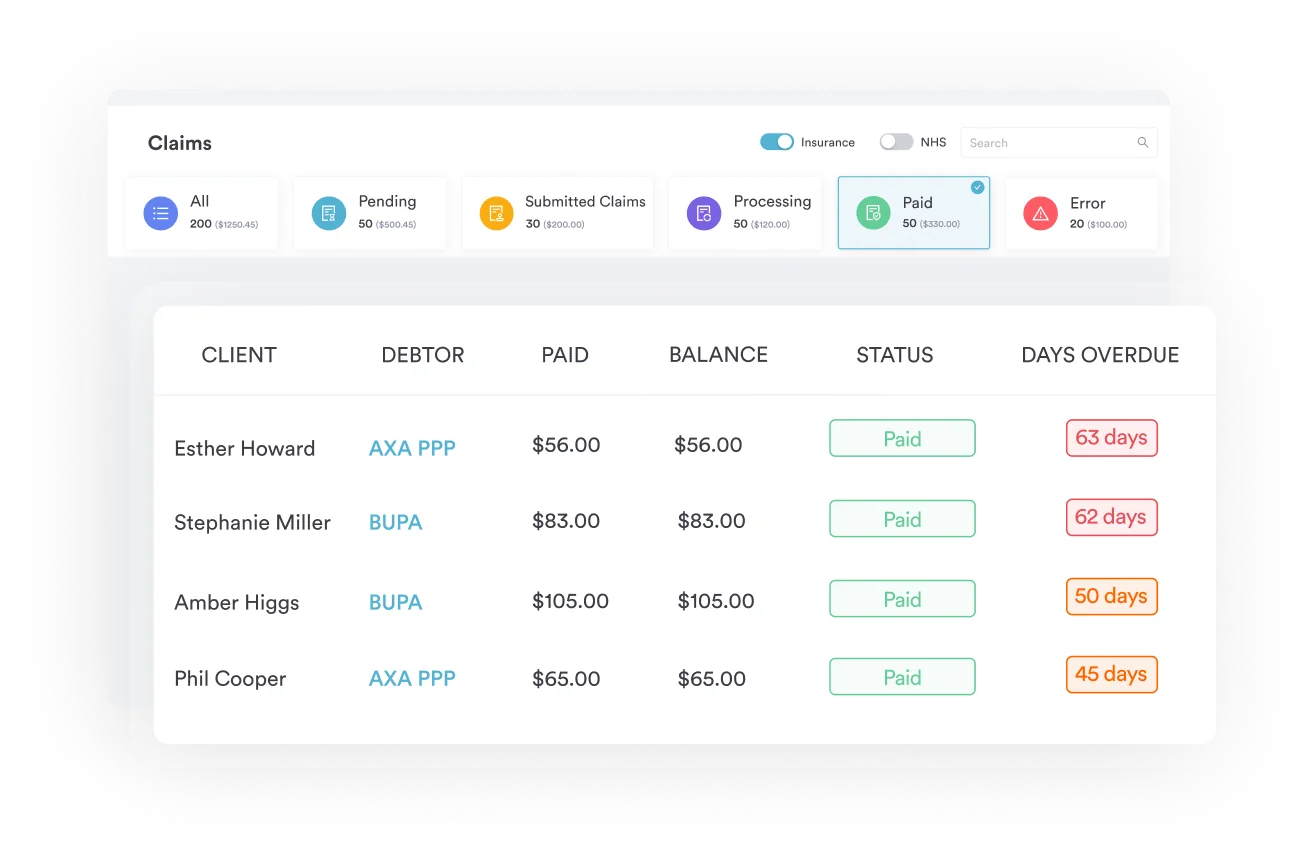

Pabau keeps written orders, treatment notes and signed delivery records together on the patient record. Claims draw on that record, so fewer L0628 claims come back for missing paperwork.

The coding decision on L0628 comes down to two physical checks: a posterior that reaches T9 and no rigid panels. Overall, run both against the PDAC listing at intake, and code selection stops producing denials.
The documentation risk sits elsewhere. Because L0628 is off the face-to-face and prior authorization lists, teams often assume no visit note is needed. The CGS checklist still expects one from the six months before the order, so make that note a standing intake requirement.
Hold each claim until the order, the visit note and the delivery record are on file, and appeals become rare. Book a demo to see how Pabau keeps those records together for every orthotic claim.

Need a framework for managing claim documentation across multiple payers? Specifically, Denial management in healthcare covers the workflow steps that prevent rework before claims go out.
Does the brace stop short of T9? Then, HCPCS code L0625 covers the flexible lumbar orthosis whose posterior spans L1 to below L5.
Does the brace have rigid front and back panels? In contrast, HCPCS code L0648 explains the off-the-shelf sagittal-control LSO and the face-to-face rules it carries.
HCPCS code L0628 covers a prefabricated, off-the-shelf flexible lumbar-sacral orthosis whose posterior runs from the sacrococcygeal junction to T9. Specifically, it works by abdominal compression that reduces load on the lumbar discs. Instead, braces with rigid panels, and custom-fabricated braces, use other codes.
In the July 2026 DMEPOS fee schedule, non-rural amounts for L0628 run from $28.70 to $65.17 in the contiguous states. In contrast, rural amounts run from $82.90 to $84.79. Former competitive bidding areas use a separate file, so check the rate for your delivery ZIP code.
Neither LCD L33790 nor Policy Article A52500 lists covered ICD-10-CM codes for L0628. Coverage depends on records that support one of the four LCD indications. Notably, practices often report codes such as M54.50, M47.816, M51.16 and S33.5XXA, coded to the highest specificity.
L0628 is an off-the-shelf code for a brace that needs only minimal self-adjustment to fit. In contrast, the custom-fabricated version of the same flexible LSO is L0629. Specifically, that code needs records explaining why a prefabricated brace will not work.
No. CMS discontinued CMNs for DMEPOS claims with dates of service on or after January 1, 2023, and L0628 needs a standard written order instead. Additionally, neither LCD L33790 nor Policy Article A52500 calls for a KX modifier on L0628. Nevertheless, per DME MAC documentation guidance, the file still needs a practitioner visit note from the six months before the order.