HCPCS Code K0900: Customized DME billing and coding guide
HCPCS Code K0900: Official descriptor and code overview HCPCS Code K0900 is a CM...

Last Updated: Nov 18, 2026
L0220 is the HCPCS Level II code for thoracic, rib belt, custom fabricated.
It bills a rib belt made for one patient from measurements, a tracing or a cast. Medicare pays it under the braces benefit only when the belt is rigid or semi-rigid. The October 2026 DMEPOS fee schedule sets the allowable at $140.73 to $187.65 in the continental states. An elastic or fabric rib binder is coded A4467 instead.
Let Pabau's smart automation suggest the right codes, reduce claim denials, and keep your practice compliant—effortlessly.
Automate repetitive tasks and focus on what matters most—your patients.
Reduce coding errors and ensure compliance with the latest regulations.
Clean claims, fewer denials, and faster reimbursements.
Powerful insights and reporting to help your practice thrive.
HIPAA compliant SOC 2 certified GDPR-compliant Trusted by 4,000+ clinics worldwide

HCPCS code L0220 bills a thoracic rib belt that is custom fabricated for one patient from measurements, a tracing or a cast
Medicare pays L0220 under the braces benefit only when the belt is rigid or semi-rigid, while a fabric or elastic binder is coded A4467
The October 2026 DMEPOS fee schedule sets the L0220 allowable at $140.73 to $187.65 across the continental states
L0220 is not on the Medicare prior authorization list, but some Medicaid programs, such as Virginia’s, require authorization
Pabau, the practice management and billing platform we build, sends US claims through Claim.MD and posts the remittances back to the patient’s record
HCPCS code L0220 is the Level II code for a thoracic rib belt that is custom fabricated. The official descriptor reads “Thoracic, rib belt, custom fabricated”, as the AAPC code listing for L0220 shows. It has been in the HCPCS code set since 1996.
A rib belt wraps the lower chest to support the ribs and limit painful movement after a rib injury. Custom fabricated means the belt is made for one patient from basic materials. The supplier works from measurements, a tracing or a cast taken from that patient.
Three features decide whether a device belongs on L0220 or on a different code. Check each one against the delivery record before you bill.
L0220 is the only active code in the thoracic rib belt range, so most errors come from codes just outside it. The older rib belt code, L0210, was deleted on January 1, 2010. Claims for a rib belt now go on L0220, or on A4467 when the belt is mostly elastic or fabric.
A device that fits the patient well is not custom fabricated just because it was adjusted at delivery. If the belt started as a ready-made product, it does not belong on L0220. Read about the noncovered fabric alternative in our guide to A4467.
The decision path below runs the three checks in the order a reviewer applies them, with the code each “no” sends the claim to.
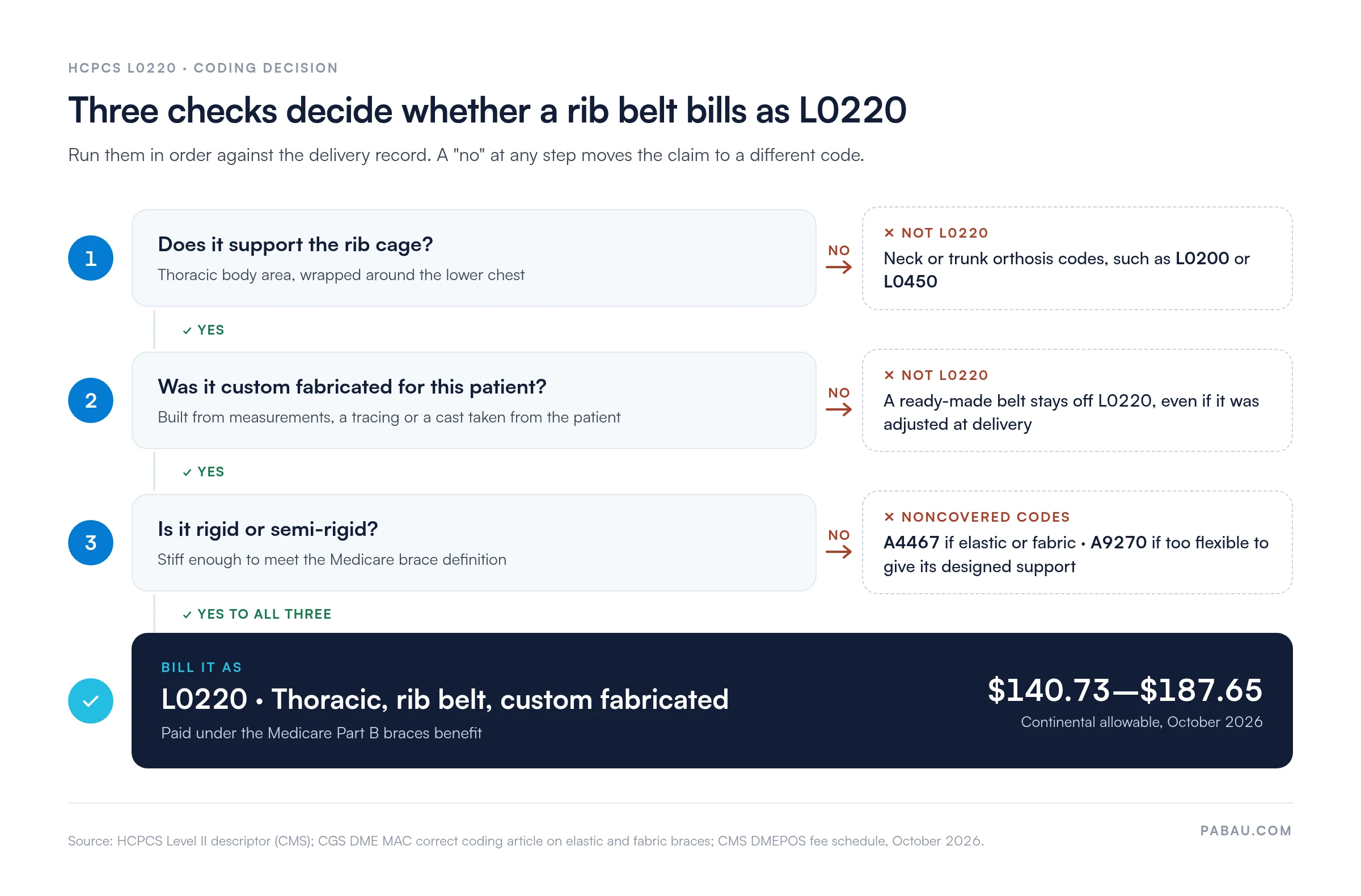
Medicare pays for L0220 under the Part B braces benefit, which applies to rigid and semi-rigid devices only. The Medicare Benefit Policy Manual, chapter 15, section 130 defines a brace as a device that supports a weak or deformed body member. It also covers devices that restrict or eliminate motion in a diseased or injured part.
The DME MACs apply that definition strictly to fabric products. Their correct coding article on elastic and fabric braces says elastic or stretchable items must be coded A4467. Items too flexible to give the support they are designed for must be coded A9270, a noncovered item.
No DME MAC Local Coverage Determination (LCD) is written for rib belts. The spinal orthoses LCD, L33790, covers thoracic-lumbar-sacral and lumbar-sacral orthoses only. That leaves the braces definition, the order and the medical record as the tests an L0220 claim has to pass.
Every L0220 claim needs an ICD-10-CM code that explains why the ribs need support. Because no LCD lists covered diagnoses for rib belts, the medical record carries the weight. Rib fractures and chest wall injuries are the usual reasons a practitioner orders one.
Match the seventh character to the encounter. Use A for active treatment and D for a subsequent encounter during healing. A pain code alone, such as R07.81 (pleurodynia), gives the reviewer little reason to see a custom belt as necessary.
Documentation problems cause more L0220 denials than coding mistakes. The supplier assembles the file, even though the clinical notes come from the ordering practitioner. Keeping medical billing compliance tight means each item below is in the patient file before the claim goes out.
Before you bill an L0220 batch, open the fabrication record for each claim. If the belt was built from a stock product, or is mostly elastic, recode it before the claim goes out.
An L0220 claim often needs no modifier at all. No LCD for rib belts sets a KX requirement, so KX is not part of a routine L0220 claim. The modifiers below apply only when the claim may not be covered.
Medicaid and commercial payers can set their own modifier rules for orthoses. Check the payer’s orthotics policy before you add any modifier to L0220.
No, not for Medicare fee-for-service. L0220 is not on the CMS DMEPOS Required Prior Authorization List, last updated July 29, 2026. The orthoses on that list are spinal and limb braces such as L0631, L0648 and L1833.
Medicaid programs and Medicare Advantage plans set their own rules. Virginia Medicaid’s July 2024 orthotics appendix lists L0220 at $139.64 and flags it for prior authorization. Check the patient’s plan before the belt is fabricated, since a custom item cannot go back on the shelf.
Medicare pays L0220 from the CMS DMEPOS fee schedule. The October 2026 file places it in the prosthetics and orthotics payment category under DME MAC jurisdiction. The allowable is a single purchase amount set by state.
After the Part B deductible, Medicare pays 80% of the allowable and the patient or a secondary payer owes 20%. CMS updates the file each quarter, so check the current quarter before you quote a figure. Good revenue cycle management also means confirming the patient’s deductible before the belt is delivered.
L0220 denials follow a short list of causes. Effective denial management for rib belts starts before the claim is built, with the device and the file.
A clean L0220 claim depends on work done before any field is entered on the CMS-1500 or 837P. Submitting a clean claim means each element is checked upstream. Follow these steps in order.
An L0220 claim depends on three records that are easy to lose track of: the order, the practitioner’s notes and the delivery receipt. Pabau keeps all three in the same patient file.
In the US, Pabau’s claims management software sends CMS-1500 and 837P claims through Claim.MD. It runs eligibility checks before the visit, posts ERA remittances back to the record and handles secondary claims. That way your team sees which L0220 claims have paid without logging in to a separate portal.

Pabau sends US claims through Claim.MD, checks eligibility and posts remittances back to the patient record, so your team can follow each claim to payment.

L0220 fits one device: a rib belt built for one patient and stiff enough to count as a brace. Get that match right and the biggest risk on the claim is gone.
With no LCD to lean on, the order, the practitioner’s notes, the fabrication record and the delivery receipt decide whether the claim pays. Check them before you submit, not after a denial. Book a demo to see how Pabau keeps those records and your claims in one place.

Need to understand how claims move from submission to payment? Medical billing fundamentals explains the full claim lifecycle from patient encounter through collections.
Seeing repeat denials on your orthotic claims? Denial management in healthcare covers the structured workflow for reducing first-pass rejection rates.
Want a reference on clean claim requirements? Clean claim submission guide details every field that must be complete before an 837P reaches the clearinghouse.
Billing a prefabricated thoracic brace instead? HCPCS code L0457 covers flexible TLSO billing, coverage and the fee schedule.
Working with orthoses that need prior authorization? HCPCS code L0631 walks through a lumbar-sacral orthosis on the Medicare prior authorization list.
HCPCS code L0220 is the Level II code for a thoracic rib belt, custom fabricated. It bills a rib belt made for one patient from measurements, a tracing or a cast. Suppliers use it to bill Medicare, Medicaid and commercial payers.
Yes, when the belt is rigid or semi-rigid and meets the braces benefit definition. A practitioner’s order and notes must show why the belt is needed. Medicare treats an elastic or fabric rib binder as A4467, which it does not cover.
The October 2026 DMEPOS fee schedule sets the L0220 allowable at $140.73 to $187.65 in the continental states. After the Part B deductible, Medicare pays 80% and the patient or a secondary payer owes 20%.
Not for Medicare fee-for-service, because L0220 is not on the CMS Required Prior Authorization List. Some Medicaid programs require it, including Virginia’s. Medicare Advantage plans set their own rules, so check the patient’s plan before fabrication.
A routine L0220 claim needs no modifier, because no LCD for rib belts sets a KX requirement. Add GA when an ABN is on file, GZ when a denial is expected without one, and GY for a noncovered item.
L0210 was the older thoracic rib belt code, and CMS deleted it on January 1, 2010. L0220 is the active code for a custom fabricated rib belt. A ready-made elastic rib belt is coded A4467 instead.