HCPCS Code G0163: Skilled nursing observation and assessment
What is HCPCS Code G0163? HCPCS Code G0163 is a deleted Level II code for skille...

Last Updated: Oct 15, 2026
L0140 is the HCPCS Level II code for cervical, semi-rigid, adjustable (plastic collar).
The device is a plastic cervical collar that provides semi-rigid support, with an adjustable feature that lets you modify the height or fit. It does not cover custom-fabricated hard collars, which fall under different L-codes. Soft foam collars are billed under L0120 instead.
Understanding this distinction matters because downcoding or upcoding within the L0112-L0174 range is a common source of DMEPOS claim denials. Precise device identification comes before code selection on every claim.
Let Pabau's smart automation suggest the right codes, reduce claim denials, and keep your practice compliant—effortlessly.
Automate repetitive tasks and focus on what matters most—your patients.
Reduce coding errors and ensure compliance with the latest regulations.
Clean claims, fewer denials, and faster reimbursements.
Powerful insights and reporting to help your practice thrive.
HIPAA compliant SOC 2 certified GDPR-compliant Trusted by 4,000+ clinics worldwide

HCPCS code L0140 describes a cervical, semi-rigid, adjustable plastic collar, classified as DMEPOS within the L-series of orthotic device codes.
Medicare Part B covers L0140 when a physician order and a qualifying ICD-10 diagnosis support medical necessity under the applicable LCD.
Rates come from the annual DMEPOS fee schedule and vary across the four DME MAC jurisdictions, so no single national amount applies.
L0130 is a flexible thermoplastic collar molded to the patient, so a semi-rigid adjustable collar belongs on L0140.
Practice management software like Pabau helps DME suppliers track L0140 claims, attach documentation, and work denials in one place.
Medicare Part B covers L0140 under the DMEPOS benefit when the claim meets medical necessity criteria set by the applicable Medicare Administrative Contractor (MAC). Coverage is not automatic. It requires a valid physician order, a supporting ICD-10 diagnosis, and documentation that the device is medically necessary for the beneficiary’s condition.
Suppliers should verify coverage under the relevant MAC’s Local Coverage Determination (LCD) before billing. Criteria vary by jurisdiction and are updated periodically. Qualifying diagnoses generally involve cervical spine conditions where semi-rigid external stabilization is clinically indicated.
Prior authorization requirements for L0140 vary by payer and MAC. Medicare does not universally mandate prior auth for this code, but some MACs and many commercial payers do require it. Always check the applicable MAC’s coverage article and the individual payer’s policy before dispensing the device.
Medicare reimbursement for L0140 is set through the annual DMEPOS fee schedule published by CMS. Rates vary by jurisdiction, so there is no single national allowed amount.
Four DME MAC jurisdictions administer these claims. Jurisdictions A and D are administered by Noridian, and jurisdictions B and C by CGS. Pull the current allowed amount for your own jurisdiction from the CMS DMEPOS fee schedule file.
Suppliers in Competitive Bidding Areas (CBAs) should confirm whether L0140 falls under the current competitive bidding round for their area. If it does, the CBA contract rate replaces the standard fee schedule amount.
Documentation is the most common barrier to L0140 reimbursement. Medicare and most commercial payers require a specific set of records before approving a claim for a cervical orthosis. Missing one element can trigger a denial, and retroactive documentation is hard to defend on audit.
Keeping medical billing compliance intact on DMEPOS claims means collecting these records at the point of dispensing rather than at billing.
MAC-specific LCDs may impose additional requirements. CGS and Noridian, the two contractors that administer the four DME MAC jurisdictions, update their coverage articles for cervical orthoses periodically. Bookmark the LCD for your jurisdiction and review it whenever policies change. The CGS Medicare coding verification guidance explains how PDAC verification works for orthotic products.
Build a documentation checklist for L0140 claims that mirrors your applicable MAC LCD’s required elements. Run every claim through the checklist before submission. Practices that check completeness at the point of dispensing catch missing paperwork while the patient is still in front of them.
The L-code range L0112 to L0174 covers cervical orthosis types that differ in rigidity, material, and adjustability. Selecting the wrong one is the most common upcoding or downcoding error in cervical orthotic billing. The table below sets out the distinctions billers and orthotists apply when choosing a code.
Three questions settle almost every selection. How rigid is the device, how was it supplied, and how far does its support extend?
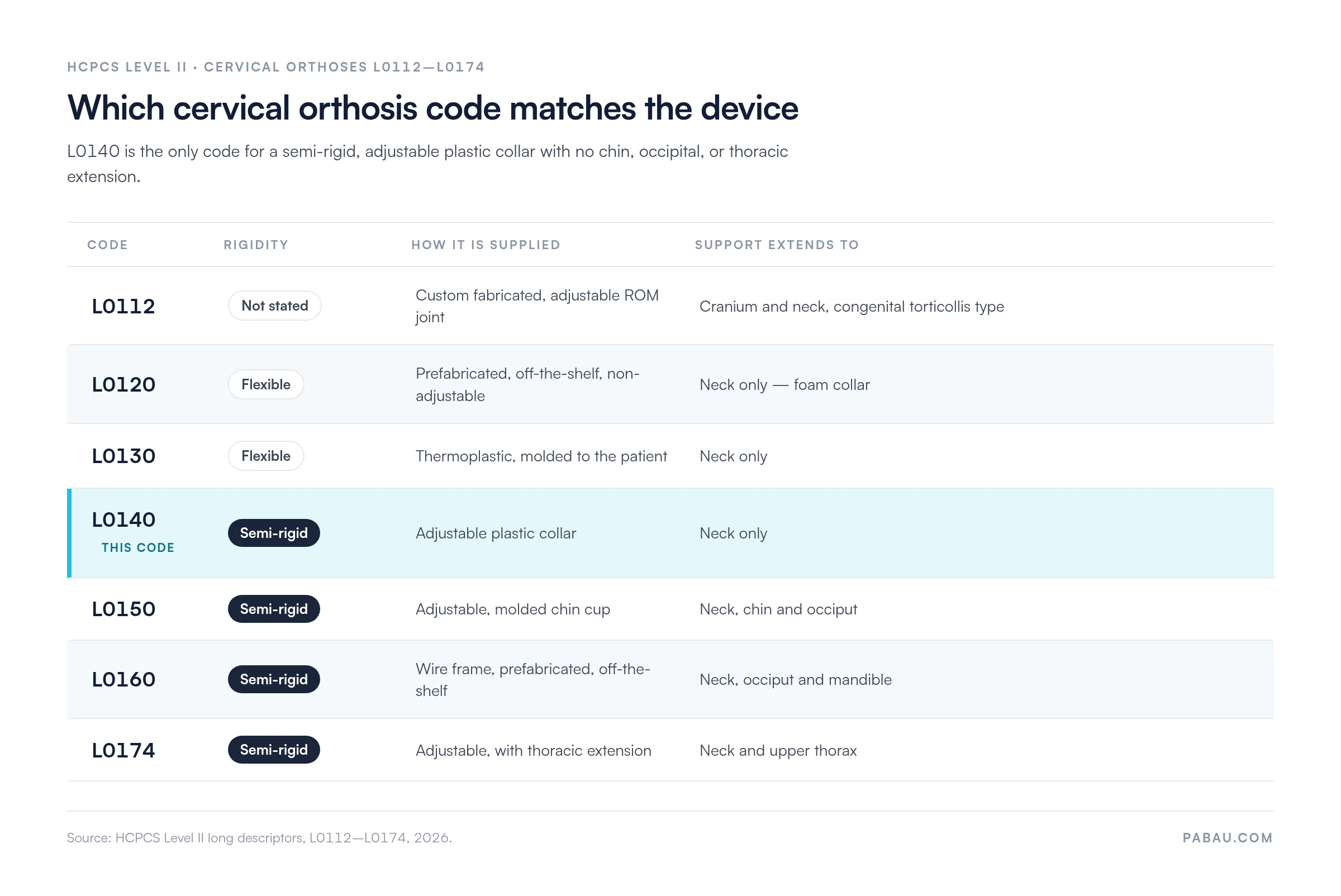
The L0130 and L0140 pairing trips up billers more than any other in this range. L0130 is a flexible thermoplastic collar molded to the individual patient. L0140 is a semi-rigid plastic collar with an adjustable fit, supplied ready to wear.
Match the code to the device’s rigidity and to how it was supplied. Then check the item’s PDAC coding verification status before you bill.
Most L0140 claim denials trace back to a handful of preventable errors. Knowing where billers consistently go wrong lets a practice build checkpoints that catch problems before the claim reaches the payer. The AAPC HCPCS code lookup is a useful cross-reference when validating code selection and modifier use.
Practices that track denial patterns by code improve faster than those reviewing rejections one at a time. Categorize every L0140 denial by the denial codes the payer returned, so a systemic documentation problem surfaces before it reaches a second claim.
Medicare is the most common payer for L0140, but Medicaid, commercial insurers, and workers’ compensation programs also cover cervical orthoses. Each sets its own rules, and coverage for the same device can differ sharply between them.
For a supplier working across payer types, tracking each payer’s rules at the patient level prevents dispensing a device before coverage is confirmed. Build that check into the pre-dispensing routine rather than the billing run.
Create a payer-specific L-code reference sheet for your top five payers. For each one, record the prior auth threshold, the covered ICD-10 diagnoses, the documentation requirements, and the replacement frequency policy. Review and update it each January when fee schedules are refreshed.
A DMEPOS supplier usually assembles an L0140 claim from several places. The order sits in the referring physician’s fax and the fitting note in a paper chart. The proof of delivery waits on a signed receipt someone has to scan.
Pabau is practice management software that holds the patient record, the clinical note, and the claim in one system. Claims software for suppliers attaches the order, the letter of medical necessity, and the delivery receipt to the L0140 line. The documentation then travels with the claim.
Denials come back into the same record. Tagging each one by root cause shows whether a modifier, a diagnosis, or the code itself keeps failing. The fix then lands once, not patient by patient.

Pabau helps orthotic and DME suppliers attach documentation, track L0140 claims by status, and catch denial triggers before submission. Your team spends less time chasing paperwork.

Three things decide whether L0140 claims get paid. The code has to match the device, the documentation has to satisfy your MAC’s LCD, and errors have to be caught before submission.
Most denials on cervical orthotic claims are preventable, and they cluster around the same causes. Incomplete documentation, diagnosis mismatches, and wrong-code selection inside the L0112-L0174 range account for the bulk of them.
Fix the dispensing workflow once and the same claim stops coming back. Book a demo to see how suppliers billing L-codes keep documentation attached to every claim.

Need to understand how claims reach payers? What is medical billing explains the end-to-end workflow from encounter to payment posting.
Want to reduce DMEPOS denials before they happen? Denial management in healthcare covers how to categorize, track, and prevent the most common claim rejection patterns.
Billing across multiple payer types? Medical billing compliance outlines the documentation and regulatory requirements that apply across Medicare, Medicaid, and commercial payers.
HCPCS code L0140 is a Level II DMEPOS code for a cervical, semi-rigid, adjustable plastic collar. It is billed when the patient has a qualifying cervical spine diagnosis and a physician order supporting medical necessity. DMEPOS suppliers and orthotists bill it, not physicians billing professional services.
L0130 is a flexible thermoplastic collar molded to the individual patient. L0140 is a semi-rigid plastic collar with an adjustable fit, supplied ready to wear. The device’s rigidity and how it was supplied decide which code applies. The item’s PDAC coding verification confirms the selection.
Yes, Medicare Part B covers L0140 under the DMEPOS benefit. A physician order, a qualifying ICD-10 diagnosis, and a letter of medical necessity must be on file. The claim also has to meet the applicable MAC Local Coverage Determination criteria, so coverage is never automatic.
Billing L0140 requires a written, signed physician order that predates dispensing. You also need a letter of medical necessity and a qualifying ICD-10 diagnosis matching the LCD coverage list. Dispensing or fitting notes with a date and signature complete the file, alongside a signed proof of delivery. Additional MAC-specific requirements may apply by jurisdiction.
Commonly accepted diagnoses include cervical disc disorders (M50.x), cervical spondylosis without myelopathy or radiculopathy (M47.8x), and cervical sprain or whiplash injury (S13.4xxA/D/S). Post-procedural codes such as Z98.1 apply after cervical spine surgery. The definitive list is set by the applicable MAC LCD and is updated periodically.
Yes, L0140 is classified as a DMEPOS code within the HCPCS Level II system. Enrolled DMEPOS suppliers bill it rather than billing under the physician fee schedule. Suppliers must hold an active Medicare DMEPOS enrollment and accept assignment for Medicare beneficiaries.
The 2026 Medicare allowed amount for L0140 varies across the four DME MAC jurisdictions and is not a single national figure. Rates are published annually in the CMS DMEPOS fee schedule file. Suppliers in Competitive Bidding Areas may receive a different contract rate instead.
No. L0140 should not appear on the same claim as another cervical orthosis code from the L0112-L0174 range. That holds for one patient on one date of service. Billing two cervical collar codes together triggers bundling edits and denies the duplicate. Only the code describing the device actually dispensed belongs on the claim.