HCPCS Code K0900: Customized DME billing and coding guide
HCPCS Code K0900: Official descriptor and code overview HCPCS Code K0900 is a CM...

Last Updated: Nov 18, 2026
K0669 is the HCPCS Level II code for a wheelchair seat or back cushion that falls outside the specific cushion codes. Suppliers bill it when a cushion meets no specific code's criteria or has no written coding verification from the DME PDAC.
Prefabricated and brand-name custom cushions are billed under the E26xx wheelchair seating codes once the PDAC has verified them. A cushion without that verification, or one the PDAC finds does not meet its code, must be billed with K0669. Foam, gel, and contoured cushions can all land on K0669 for that one reason.
Let Pabau's smart automation suggest the right codes, reduce claim denials, and keep your practice compliant—effortlessly.
Automate repetitive tasks and focus on what matters most—your patients.
Reduce coding errors and ensure compliance with the latest regulations.
Clean claims, fewer denials, and faster reimbursements.
Powerful insights and reporting to help your practice thrive.
HIPAA compliant SOC 2 certified GDPR-compliant Trusted by 4,000+ clinics worldwide

HCPCS Code K0669 covers a wheelchair seat or back cushion that meets no specific code’s criteria or has no written PDAC coding verification.
Cushions the PDAC has verified are billed under the E26xx wheelchair seating codes, each with its own coverage criteria in the Wheelchair Seating LCD.
Billing K0669 for an E26xx-listed product, or an E26xx code for an unverified product, is a coding error that leads to denials.
Pabau’s practice management software keeps clinical notes, the signed order, and the billing record in one patient file, and checks each claim before submission.
HCPCS Code K0669 covers a wheelchair seat or back cushion that meets no specific code or lacks written PDAC coding verification. CMS’s wheelchair seating policy article states that such a cushion must be billed with K0669.
Level II is the part of the CMS Healthcare Common Procedure Coding System that covers DME, orthotics, prosthetics, and supplies. The official descriptor reads: “Wheelchair accessory, wheelchair seat or back cushion, does not meet specific code criteria or no written coding verification from DME PDAC.”
In plain terms, K0669 is where a cushion lands when it cannot be billed under one of the specific E26xx wheelchair seating codes. Policy article A52505 sets the rule. A prefabricated cushion, or a brand-name custom fabricated one, needs a written coding verification review (CVR) from the PDAC to use an E26xx code. Without a CVR, or when the PDAC finds the product does not meet a code’s criteria, it must be billed with K0669.
K0669 therefore tracks verification status. A foam seat, a gel seat, and a contoured back can all end up under K0669 when none of them has a CVR.
The table below summarizes the key administrative attributes of HCPCS Code K0669 for quick billing reference.
K0669 covers a seat or back cushion fitted to a manual or power wheelchair that cannot be billed under a specific seating code. That happens in two situations. The product has no written CVR from the PDAC, or the PDAC reviewed it and decided it does not meet the criteria for the code.
Several items fall outside K0669:
The policy article sends unverified cushions to K0669, so E1399 and other miscellaneous codes are no fallback for a seat or back cushion.
Choosing between K0669 and a specific seating code is a PDAC question first and a clinical question second. The table maps K0669 against the cushion codes in the Wheelchair Seating LCD (L33312) and its policy article.
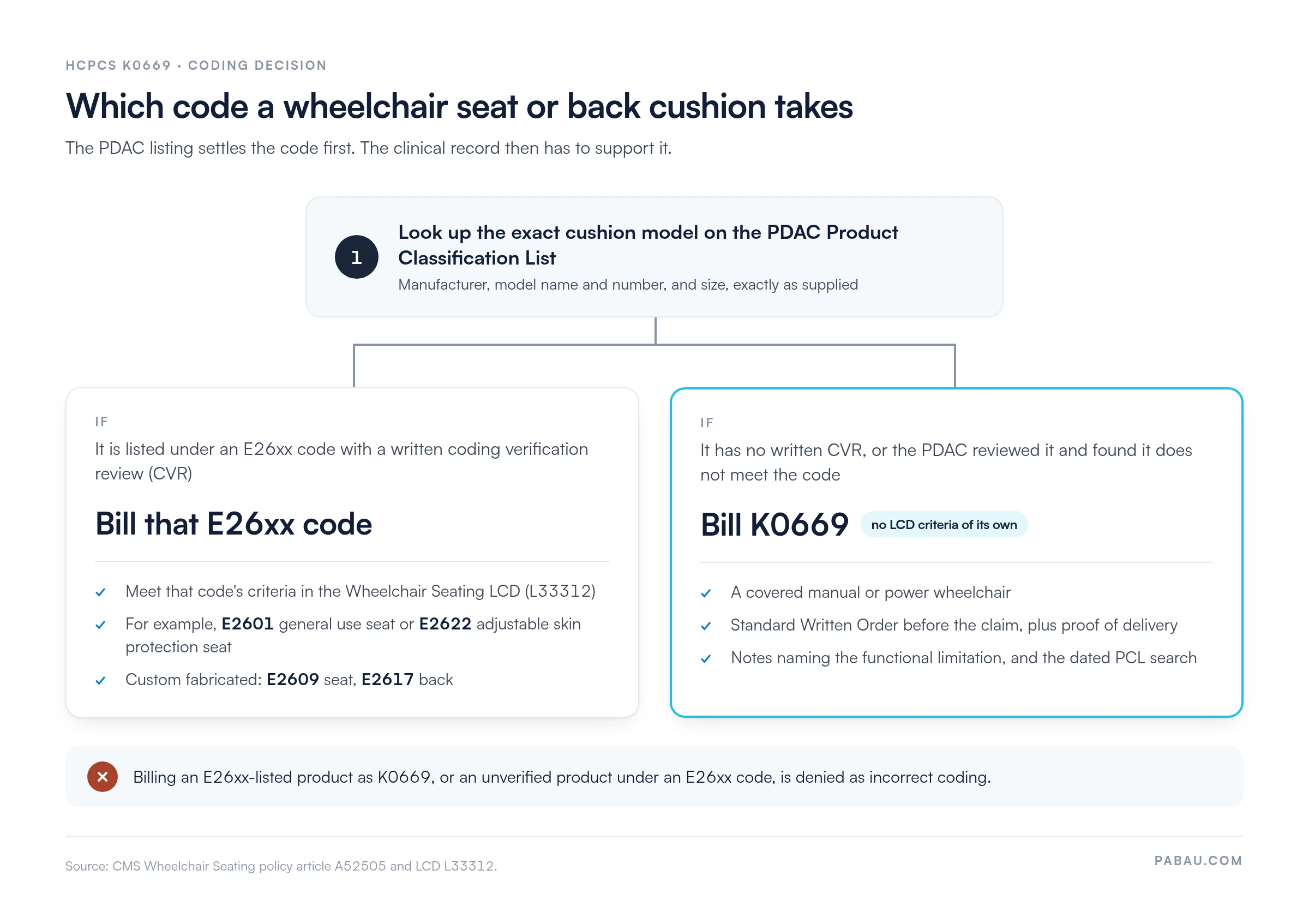
The practical test is a lookup. Find the exact cushion model on the PDAC Product Classification List. If it is listed under an E26xx code, bill that code and document that code’s coverage criteria. If it is not listed, or the PDAC found it does not meet the code, bill K0669.
For example, a verified general use seat cushion narrower than 22 inches goes under E2601. An adjustable skin protection seat of the same width goes under E2622. The diagram below runs the decision from lookup to code.
Medicare Part B handles wheelchair cushions under the DME benefit, using the Wheelchair Seating LCD. That LCD sets criteria for the E26xx codes, not for K0669, so a K0669 claim rests on these basics:
This article covers Medicare Part B, while Medicaid and commercial payers set their own rules by state and plan. Check the current Wheelchair Seating LCD and policy article with your DME MAC before you submit.
The diagnosis codes on the claim must link the beneficiary’s condition to the clinical need for a wheelchair seat or back cushion. The table below lists commonly accepted ICD-10-CM categories, grouped by condition type. Always confirm acceptance under the applicable MAC’s LCD before submitting.
No diagnosis code automatically establishes medical necessity. The clinical notes must still document the specific functional limitation and why this cushion is medically required rather than a convenience item.
K0669 has no LCD criteria of its own, so the file has to make the whole case. In medical billing for K0669, every required element belongs in the file before the item ships. Auditors look for all of the following:
A complete file in a fixed order is the core of medical billing compliance for DME suppliers. It also lowers the risk of a documentation denial at first submission.
Before dispensing, look up the exact cushion model on the PDAC Product Classification List. If it is listed under an E26xx code, bill that code, since K0669 is only for unverified products. If it is not listed, K0669 is correct, so save the dated search in the file. Build this check into intake before the item leaves the warehouse.
CMS has expanded prior authorization requirements across the DMEPOS benefit as part of its prior authorization program for certain high-expenditure items. Whether K0669 requires prior authorization depends on whether CMS has put wheelchair cushion accessories on the current prior authorization list. It can also depend on whether the claim falls within a Competitive Bidding Area (CBA).
Key points to verify before submitting a K0669 claim:
Submitting a K0669 claim without prior authorization when it is required results in a denial. Obtain authorization before dispensing.
Modifiers clarify billing circumstances and are required by Medicare to process K0669 claims correctly. The table below covers the modifiers most applicable to wheelchair cushion DME billing.
Competitive bidding areas introduce additional modifier requirements for contract and non-contract suppliers. Consult the AAPC HCPCS code lookup and your MAC’s billing guidelines for jurisdiction-specific modifier instructions.
Medicare reimbursement for K0669 is set by the DMEPOS fee schedule, which CMS updates annually. Rates vary by MAC jurisdiction and by whether the item is supplied in a Competitive Bidding Area. Because fee schedule amounts change each calendar year, download the DMEPOS fee schedule file and find K0669 by state.
Key factors that affect the K0669 allowable amount:
K0669 claims draw scrutiny because the LCD sets no criteria for them, so the file has to show why no specific code applies. Each denial arrives with a reason code, and our guide to denial codes explains how to read one. The most frequent reasons, based on denial management patterns in DME billing, are:
A K0669 denial is not necessarily final. Medicare provides a five-level appeals process. Documentation-based denials are often overturned at the first or second level when the missing evidence arrives promptly.
The appeal steps for a denied K0669 claim are:
At Level 1 or 2, build the redetermination request the way you would build a clean claim. Every required documentation element should be present, clearly organized, and cross-referenced to the LCD criteria the MAC cited. Vague addenda that do not directly address the denial reason rarely succeed.
Track your K0669 denial reasons by category over a rolling 90-day period. If incorrect-coding denials cluster in one product line, check the PCL, since a new CVR moves that product off K0669. If documentation denials spike, check the clinical note before the written order. Fixing the template for that note resolves the pattern faster than addressing denials one at a time.
Many K0669 denials start before the claim exists. A model nobody checked on the PCL, an order missing an element, or notes that never name the functional limitation all surface later as denials. When records sit in paper files and inboxes, nobody sees the missing piece until the remittance arrives.
Pabau keeps the clinical notes, the signed order, and the billing record in one patient file. Pabau’s claim validation checks every claim for missing or invalid details before it leaves the system.
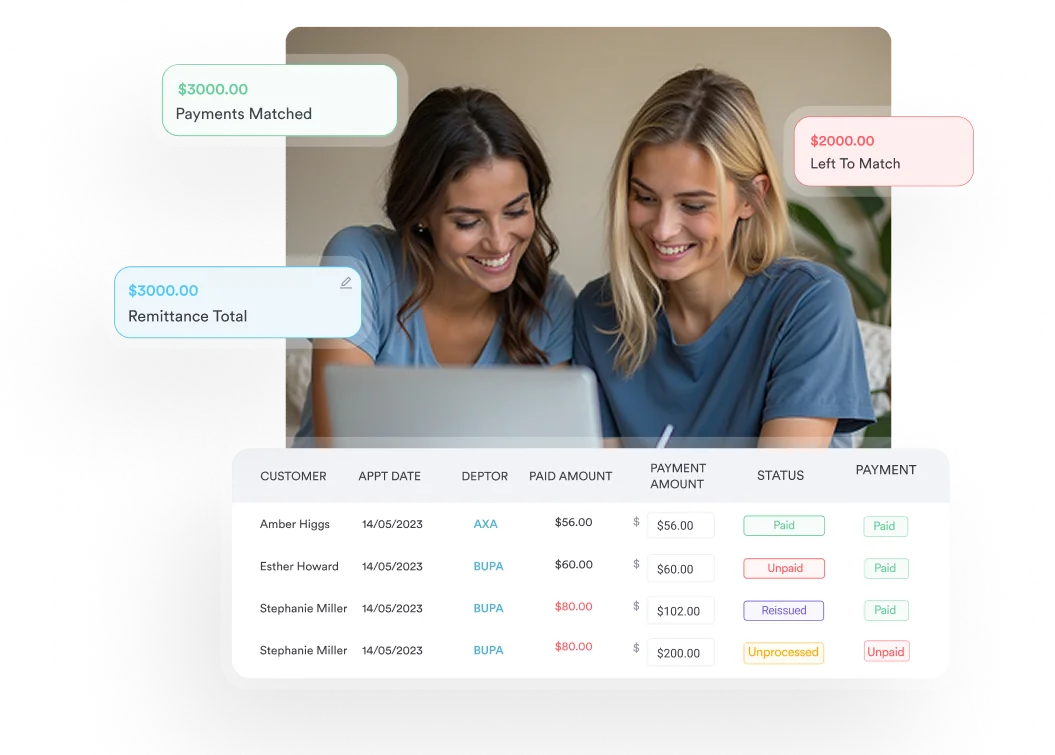
The outcome is fewer first-pass denials and fewer appeals for your team to chase.

Pabau’s claims management tools help DME suppliers and ordering clinicians document, code, and submit HCPCS claims with fewer errors and faster reimbursement cycles.

K0669 is the code a seat or back cushion takes when it has no PDAC coding verification or meets no specific code. Settle that status on the PCL before the item ships, and the rest of the claim becomes a documentation job.
Check the PCL first, keep the SWO and clinical notes complete, and match the modifiers to the billing scenario. Those three habits prevent the most common K0669 denials. Book a demo to see how Pabau keeps the order, notes, and claim for every cushion in one file.

Need a walkthrough of the medical billing process end to end? What is medical billing explains the full revenue cycle from coding through remittance, including DME-specific considerations.
Seeing repeat claim rejections across your HCPCS codes? Denial management in healthcare covers root-cause analysis frameworks and appeal strategies that apply directly to DME billing.
Billing a verified general use seat cushion instead? HCPCS code E2601 covers billing and Medicare coverage for general use seat cushions narrower than 22 inches.
HCPCS Code K0669 covers a wheelchair seat or back cushion that meets no specific code’s criteria or has no written coding verification from the PDAC. Prefabricated and brand-name custom cushions need that verification to use an E26xx code. Without it, the policy article requires K0669. A Medicare claim still needs a covered wheelchair, a Standard Written Order, and records showing medical need.
The E26xx codes describe specific cushion types, such as general use, skin protection, positioning, and custom fabricated cushions. Each has coverage criteria in the Wheelchair Seating LCD, and products need PDAC verification to use them. K0669 is for cushions without that verification, or that the PDAC found do not meet a code. Billing one in place of the other is incorrect coding.
The most common modifiers for K0669 are NU for new equipment on purchase claims and RR for rental. UE marks used equipment, paid at about 75% of the new rate. RA marks a replacement and needs supporting documentation. KU means a DMEPOS item subject to DMEPOS Competitive Bidding Program Number 3, so it applies only under that program. Missing NU on a standard purchase claim is one of the most frequent modifier errors for K0669.
Prior authorization for K0669 depends on whether CMS includes wheelchair cushion accessories in its current DMEPOS prior authorization program. It can also depend on whether the claim falls within a Competitive Bidding Area. The CMS prior authorization list is updated periodically, so verify the current applicability for your MAC jurisdiction before dispensing. Submitting without required prior authorization results in a denial.
Commonly accepted diagnoses include neurological conditions affecting mobility, such as G82.x for paraplegia and G80.x for cerebral palsy. G35.x covers multiple sclerosis, with FY2026 subcodes such as G35.D. Others are musculoskeletal conditions affecting seated posture (M54.5x, M05.x-M06.x, M15-M19), Z99.3 for wheelchair dependency, and acquired limb deficiency (Z89.x). Diagnosis code acceptance varies by MAC LCD. The clinical notes must still document how the specific condition creates the need for the cushion. No code establishes medical necessity automatically.
The most common reasons are incorrect coding and weak documentation. Incorrect coding means a product listed under an E26xx code was billed as K0669, or the reverse. Weak documentation means an incomplete Standard Written Order or notes that never establish medical need. Modifier errors, wrong diagnosis codes, and missing prior authorization cause most of the rest. Checking the PCL and using an order checklist prevents most K0669 denials.