CPT Code 26410: Hand extensor tendon repair billing guide
CPT code 26410: Official descriptor and procedure overview CPT code 26410 report...

Last Updated: Nov 24, 2026
72081 is the CPT code for a one-view radiograph of the entire thoracic and lumbar spine. The skull, cervical spine and sacral spine are included if performed, and the study is usually a scoliosis evaluation.
It is the first of four whole-spine codes that differ only by view count. 72082 covers 2 or 3 views, 72083 covers 4 or 5, and 72084 a minimum of 6. When regional spine films are taken at the same encounter, CMS requires the views to be summed into one whole-spine code.
Let Pabau's smart automation suggest the right codes, reduce claim denials, and keep your practice compliant—effortlessly.
Automate repetitive tasks and focus on what matters most—your patients.
Reduce coding errors and ensure compliance with the latest regulations.
Clean claims, fewer denials, and faster reimbursements.
Powerful insights and reporting to help your practice thrive.
HIPAA compliant SOC 2 certified GDPR-compliant Trusted by 4,000+ clinics worldwide

CPT Code 72081 reports one view of the entire thoracic and lumbar spine, with the skull, cervical and sacral spine included if performed.
The family splits by view count: 72082 covers 2 or 3 views, 72083 covers 4 or 5, and 72084 a minimum of 6.
Regional spine films taken at the same encounter are not billed separately. Under NCCI, the views are summed and one code from 72081 to 72084 is reported.
Scoliosis codes from ICD-10-CM category M41 are the usual pairing, and the site-specific code always beats M41.9.
Modifier 26 covers the interpretation and modifier TC the equipment and staff, so a split-billed study carries one or the other per claim line.
CPT Code 72081 is the code for a single-view radiograph of the entire thoracic and lumbar spine, usually taken to evaluate scoliosis. CMS’s NCCI policy manual for radiology describes codes 72081 to 72084 as entire-spine examinations that differ only by the number of views. The AMA descriptor reads: “Radiologic examination, spine, entire thoracic and lumbar, including skull, cervical and sacral spine if performed (eg, scoliosis evaluation); one view.”
“One view” means one projection of the full spinal column, not one image per spinal region. An anteroposterior (AP) projection from occiput to sacrum is a single view. Add a lateral projection at the same session and the study becomes 72082.
Most upcoding and downcoding errors on this family start with that count. Read the projections in the final report before you pick the code. The AMA’s CPT code set overview explains how the AMA maintains these descriptors.
CPT Code 72081 is ordered when a clinician needs one projection of the full spine to screen for or assess a structural deformity. Scoliosis evaluation is the most common reason. In adolescent idiopathic scoliosis, an AP full-spine film measures the Cobb angle at diagnosis and tracks curve progression between visits.
Payer acceptance depends on a supported ICD-10-CM code and medical necessity documented in the ordering provider’s notes. Where a Medicare Administrative Contractor (MAC) has a Local Coverage Determination (LCD) or billing article for spine imaging, it lists the accepted diagnoses. Check your MAC’s current policy before submitting.
The radiology report decides the code, not the order. A physician may order a two-view study, but the technologist may capture only one projection if the patient cannot hold the position. In that case the claim goes out as 72081.
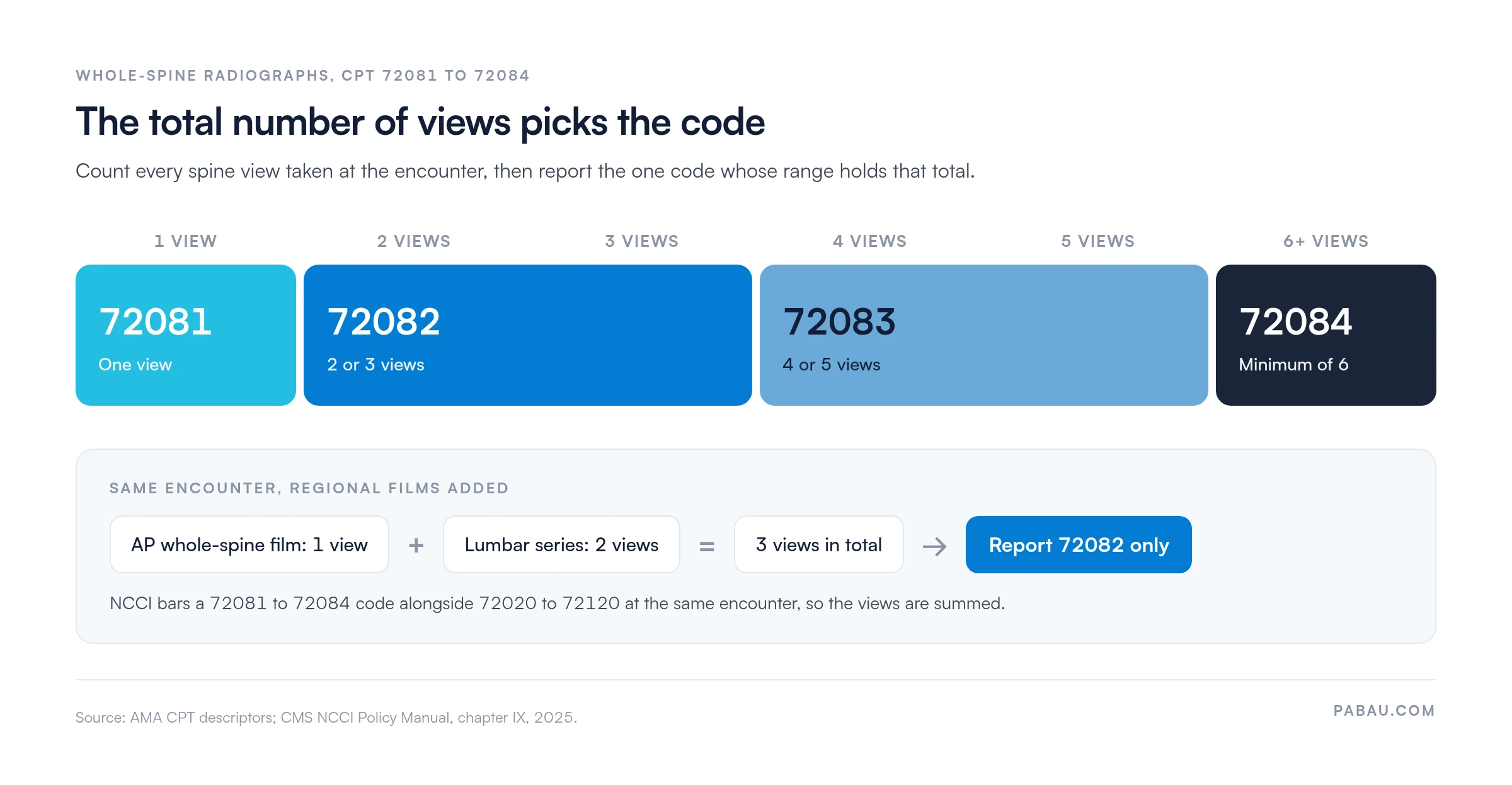
Regional films change the count too. NCCI policy bars reporting a whole-spine code alongside any code from 72020 to 72120 at the same encounter. A lumbar series that would otherwise be 72100 is added to the whole-spine views, and one code from 72081 to 72084 covers the total. The ladder below shows how the total maps to each code.
A study limited to one region is not a whole-spine study at all. When only the thoracic spine is imaged, a regional code such as 72074 applies instead. The AAPC Codify CPT lookup lists all four whole-spine codes with their current descriptors.
A diagnosis the payer doesn’t accept for spine imaging is the most common reason a 72081 claim is denied. The table below lists the ICD-10-CM codes most often linked to 72081. Codes marked “high scrutiny” routinely trigger a medical necessity review under commercial payer policies.
M41.9 is the fallback when the record names no curve type, which is why payers question it. Confirm every code is valid for the current fiscal year in the CDC/NCHS ICD-10-CM web tool, the official annual release.
Before submitting, search the Medicare Coverage Database for any LCD or billing article your MAC applies to spine radiography. Check the commercial payer’s imaging policy too. Where no policy lists covered diagnoses, the ordering note carries medical necessity alone. It should name the curve or symptom being evaluated, or the claim risks a CO-50 denial.
Two modifiers split CPT Code 72081 between the people who perform it. A wrong modifier, or a missing one, triggers an edit that delays or denies payment. Global billing with no modifier applies only when one entity owns the equipment and employs the interpreting physician.
Modifier 59 is not the answer when a regional spine film is taken at the same encounter. The NCCI policy manual tells the physician to sum the views and report one whole-spine code. Appending 59 to bill 72081 and 72100 side by side contradicts that instruction and invites recoupment on audit.
Medicare pays CPT Code 72081 from the CMS Physician Fee Schedule (PFS). The relative value units (RVUs) are multiplied by the annual conversion factor, then adjusted by the Geographic Practice Cost Index (GPCI) for the billing locality. Urban and rural localities produce noticeably different final rates.
A fixed dollar figure goes stale with each annual PFS update. Use the CMS Physician Fee Schedule lookup tool with the current year and your locality to get the exact rate. The table below shows what each RVU component pays for.
The FastRVU lookup tool shows the work, practice expense, and malpractice RVUs for 72081 by modifier. Check its national estimate against the CMS PFS tool for your locality.
Traditional Medicare fee-for-service generally doesn’t require prior authorization for CPT Code 72081. That exemption doesn’t carry over to Medicare Advantage plans or most commercial payers.
Run insurance eligibility verification at scheduling and check the radiology authorization rules in the same step. That way no study is completed and billed before anyone learns authorization was required.
A 72081 claim holds up when the record ties the clinical reason to exactly one view of the whole spine. Payers and auditors look for five elements.
Hold the claim until the final report shows the view count and the signature. A report with all five elements is what turns a 72081 encounter into a clean claim on first submission.
CPT Code 72081 denials cluster around six causes, and each has a prevention step that fits the pre-submission workflow. Denial management in healthcare works best when these checks run before the claim leaves the practice.
Learning the denial codes in medical billing like CO-50 and CO-97 makes it faster to route each denial to the right person. On 72081 remittances, the fix is almost always the report or the code count, not the clinical decision.
Run a weekly report of 72081 denials grouped by adjustment code. If CO-50 leads, the problem is diagnosis selection. If CO-97 leads, same-day regional films are being billed next to the whole-spine code, so retrain on the NCCI summing rule rather than on ICD-10.
A 72081 claim passes through three hands before it is paid. The front desk confirms coverage and authorization, the radiologist signs the report, and the biller picks the code. When those steps live in separate systems, the claim often goes out before the report or the authorization catches up.
Pabau’s claims management software keeps them on one patient record. Claims go to US payers through the Claim.MD clearinghouse, with eligibility checks before the visit and remittances posted when payment arrives. The authorization code, dates, and sessions sit on the case, with a warning when one is missing. The signed radiology report is stored on the same record, ready for an audit or an appeal.

For a practice that bills scoliosis imaging every week, the gain is fewer claims bounced for a missing authorization or report. The biller works from the signed report on the record, not a re-keyed summary.

Pabau sends claims through the Claim.MD clearinghouse, checks eligibility, tracks prior authorizations, and posts remittances against the patient record. See how it fits an imaging-heavy practice.

The one number that decides this code is the total count of spine views taken at the encounter. Count the whole-spine projection and any regional films together, then bill the single code whose range holds that total. Do that from the signed report and most 72081 denials never happen.
The harder habit is resisting modifier 59 when a lumbar or cervical film was added. It looks like extra revenue, but NCCI treats it as one study, and an audit will claw it back. Book a demo to see how Pabau keeps the report, the authorization, and the claim on one record for imaging practices.

Need to track authorization status for imaging orders? Insurance eligibility verification explains how to combine eligibility and authorization checks in one pre-scheduling step.
Billing a lumbar series on its own? CPT code 72100 covers the lumbosacral spine X-ray and its view counts.
Coding scoliosis with no documented curve type? ICD-10 code M41.9 explains when the unspecified scoliosis code applies and why payers question it.
Getting repeat CO-16 rejections on radiology claims? What makes a clean claim walks through the claim elements that clear payer edits on the first pass.
Need a reference for remittance codes? Denial codes in medical billing covers the CARC and RARC codes most often returned on diagnostic imaging claims.
CPT Code 72081 covers one radiographic view of the entire thoracic and lumbar spine, with the skull, cervical and sacral spine included if performed. It does not cover fluoroscopy, CT, or MRI. The “one view” in its descriptor separates it from 72082 (2 or 3 views), 72083 (4 or 5), and 72084 (a minimum of 6).
CPT 72081 covers one projection of the full spine, and 72082 covers 2 or 3. An AP-only full-spine film is 72081, and an AP plus a lateral is 72082. The view count in the final radiology report decides the code, not the order.
Modifier 26 reports the professional component when the radiologist interprets without owning the equipment. Modifier TC reports the technical component billed by the facility. Global billing with no modifier applies only when one entity owns the equipment and employs the interpreting radiologist.
Yes, traditional Medicare covers CPT Code 72081 when the claim carries a supported ICD-10-CM diagnosis and the record shows medical necessity. Traditional fee-for-service does not require prior authorization, though Medicare Advantage plans and commercial payers often do. Payment varies by locality and changes with each annual CMS Physician Fee Schedule update.
No, traditional Medicare fee-for-service does not require prior authorization for CPT 72081. Many Medicare Advantage plans and commercial payers do require it for whole-spine imaging, often through a radiology benefit manager. Verify the plan’s rules at scheduling, before the study is performed.
No, not at the same encounter. CMS NCCI policy bars reporting a code from 72081 to 72084 with any code from 72020 to 72120, such as 72100 (lumbar) or 72040 (cervical). The physician sums all the spine views and reports one whole-spine code for the total. A single AP whole-spine film plus a 2-view lumbar series, for example, is reported as 72082.