CPT Code 26410: Hand extensor tendon repair billing guide
CPT code 26410: Official descriptor and procedure overview CPT code 26410 report...

Last Updated: Nov 24, 2026
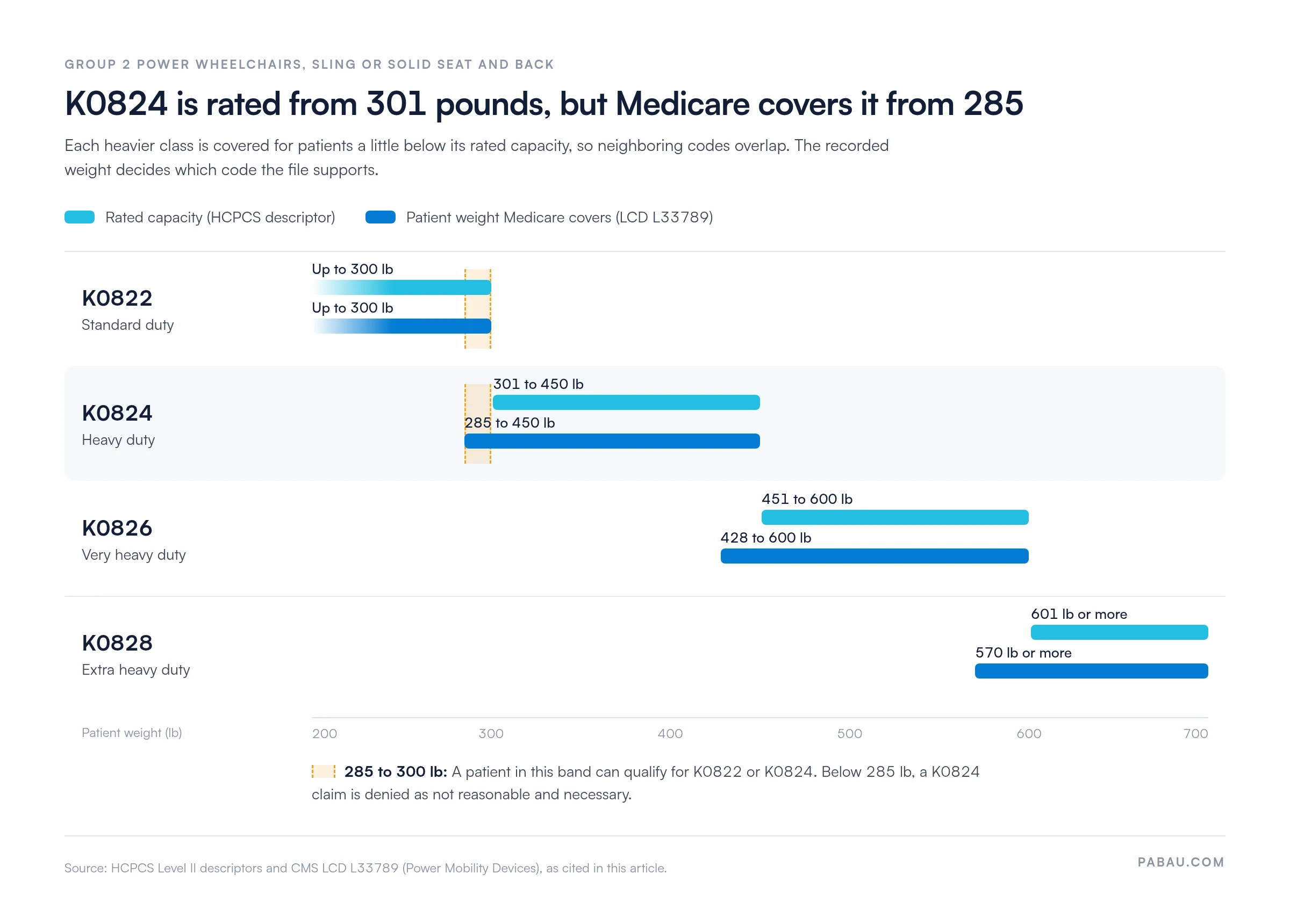
K0824 is the HCPCS Level II code for power wheelchair, group 2 heavy duty, sling/solid seat/back, patient weight capacity 301 to 450 pounds.
Code selection turns on weight class and seat type. Medicare covers a heavy duty chair for a patient weighing 285 to 450 pounds, so the face-to-face note must record the weight. The same chair with a captain's chair seat bills as K0825.
Let Pabau's smart automation suggest the right codes, reduce claim denials, and keep your practice compliant—effortlessly.
Automate repetitive tasks and focus on what matters most—your patients.
Reduce coding errors and ensure compliance with the latest regulations.
Clean claims, fewer denials, and faster reimbursements.
Powerful insights and reporting to help your practice thrive.
HIPAA compliant SOC 2 certified GDPR-compliant Trusted by 4,000+ clinics worldwide

HCPCS code K0824 is a Group 2 heavy duty power wheelchair with a sling or solid seat and back, rated for 301 to 450 pounds.
Its captain’s chair twin is K0825, so the seat on the delivered chair decides between the two codes.
Under LCD L33789, Medicare covers a heavy duty chair for patients weighing 285 to 450 pounds, so the recorded weight must support the code.
K0824 needs a face-to-face encounter, a written order before delivery, and a prior authorization decision, which CMS requires nationwide.
Medicare pays it as a 13-month capped rental, billed with RR, a KH, KI or KJ month modifier, and KX, GA, GY or GZ.
HCPCS code K0824 is the Level II code for a Group 2 heavy duty power wheelchair with a sling or solid seat and back. Its official descriptor on CMS’s medical equipment master list sets a weight capacity of 301 to 450 pounds. Durable medical equipment (DME) suppliers bill it to the DME Medicare Administrative Contractors (DME MACs) under Part B.
The Centers for Medicare and Medicaid Services (CMS) maintains the code set. K0824 is one of the temporary K codes CMS created for the DME MACs, and our HCPCS reference for billers lists its neighbors.
Two words in the descriptor drive code selection. “Heavy duty” describes weight capacity, not speed or power options. “Sling/solid seat/back” separates K0824 from K0825, its captain’s chair twin in the same weight class.
K0824 pays for the base power wheelchair and the basic equipment package that comes with it. Options outside that package carry their own HCPCS codes and their own coverage tests.
A scooter billed as K0824 is a coding error with a long audit history. A patient who can safely use a scooter does not meet the power wheelchair criteria, so the two codes never substitute for each other.
The HCPCS power wheelchair code range lists Group 2 chairs without power options from K0820 to K0829. Each pair splits by seat type, and each step up the range raises the weight class. K0824 is the first step above the standard chairs, which stop at 300 pounds.
K0827 and K0829 are the captain’s chair versions of the very heavy duty and extra heavy duty chairs. Group 1 chairs (K0813-K0816) stop at 300 pounds and have no heavy duty code.
Both codes describe a Group 2 heavy duty chair rated for 301 to 450 pounds, and the seat is the only difference. K0825 has a captain’s chair, a one- or two-piece automotive-style seat with cushioning built in. A chair with an automotive-style back on a solid seat pan still counts as solid seat and back, so it bills as K0824.
K0822 is the standard Group 2 chair with the same sling or solid seat, rated up to 300 pounds. Medicare covers a heavy duty chair from 285 pounds, which is 95% of the standard chair’s capacity. A patient weighing 285 to 300 pounds can qualify for either code.
Below 285 pounds, a K0824 claim is denied as not reasonable and necessary. Each heavier class follows the same pattern, with Medicare coverage starting a little below the rated capacity.
Medicare Part B covers K0824 when the patient meets every power wheelchair criterion in the Power Mobility Devices LCD (L33789). The heavy duty weight criterion applies on top. Each criterion is judged against mobility inside the home.
A chair needed only for mobility outside the home is not covered. That claim takes the GY modifier, as does a claim where the face-to-face requirements were not met.
Ask the ordering practice to record the patient’s weight and height in the face-to-face note. The LCD lists both as part of the mobility exam. Without a recorded weight of at least 285 pounds, the heavy duty code has no support in the file.
Medicare does not tie K0824 to a list of covered diagnoses. The diagnosis has to explain the mobility limitation described in the face-to-face note. On a heavy duty claim, an obesity code and a BMI code back up the weight criterion.
Report a Z68 BMI code only alongside an associated diagnosis such as obesity, and never in the first position. Obesity alone does not justify a power wheelchair, so pair it with the condition that limits mobility.
The documentation chain for K0824 runs in a fixed order, and the dates matter as much as the content. Every item below has to be in the supplier’s file before the first rental claim goes out.
A face-to-face note that only says the patient “has trouble walking” does not meet the LCD. Ask for a note that rules out a cane, walker, manual wheelchair and scooter, in that order, and records the weight.
K0824 is on the CMS Required Prior Authorization List, and the requirement applies nationwide. Medicare’s list of power wheelchairs that need prior authorization names K0824 alongside every other Group 2 base. Prior authorization is a condition of payment, so a claim without an affirmed request is denied.
The process follows these steps:
Every K0824 claim line carries two kinds of modifier. One shows the rental month, and one shows whether the coverage criteria are met. Under policy article A52498, lines without KX, GA, GY or GZ are rejected as missing information.
K0824 never takes NU or UE. Standard power wheelchairs are paid as capped rentals only, so a purchase or used-equipment line is denied.
Medicare pays K0824 as a capped rental. The lump-sum purchase option ended for standard power wheelchairs on January 1, 2011. Complex rehab power wheelchairs keep a purchase option, but K0824 is not one of them.
Look up the current K0824 amounts in the CMS DMEPOS fee schedule for the patient’s state. Track the rental month on every claim, so the KH, KI and KJ modifiers run in sequence. That habit is a core part of revenue cycle management for any supplier on capped rentals.
Most K0824 denials trace back to the order of events or to the weight record. Each reason below maps to a document or a modifier.
Before you request prior authorization, check the model with CGS’s coding verification lookup tool. Good denial management processes then treat each denial as a workflow signal. A run of weight denials points at the face-to-face template, not at the biller.
Run a quarterly audit. Pull every K0824 denial from the past 90 days and group them by reason code. If more than two share a reason, assign an owner to fix the step that produced them, rather than correcting claims one at a time.
Medicare Part B offers five levels of appeal for a denied K0824 claim. Start at level 1 with the document the denial says is missing, because each later level takes longer.
A redetermination letter works best when it walks through each LCD L33789 criterion and points to the page that meets it. On a heavy duty claim, quote the recorded weight and the date it was taken.
The steps below put the requirements above in the order a supplier meets them, from referral to the 13th rental month.
Each step maps to a section above, so a denial is quick to trace back to the step that failed.
For the practice that orders the chair, K0824 work is paperwork with deadlines. The face-to-face note has to record weight and function, and the order has to follow it. The prior authorization then has to land before delivery. Many practices still track those dates across email threads and spreadsheets.
Pabau keeps the encounter note, digital forms and the signed order in the patient’s record. The prior authorization code and its dates sit on the case, and staff see a warning when one is missing. US claims go out as CMS-1500 or 837P files through Claim.MD.
The outcome is a file that answers the reviewer’s questions before they are asked. Your team spends less time chasing signatures and more time with patients waiting for their chair.

Pabau holds the face-to-face note, the order and the prior authorization dates on one patient record, then sends the claim through Claim.MD. Your team sees a missing authorization before the DME MAC does.

K0824 rewards teams that treat weight and sequence as the core of the claim. Code it only when the chair has a sling or solid seat, the patient weighs 285 to 450 pounds, and the PDAC lists the model. Then line up the dates: Encounter, order, affirmation, home check and delivery.
Get those right and the modifiers follow month by month. Get one wrong and no appeal letter can change the order in which events happened.
Pabau’s claims software for practices keeps the encounter note, the order and the authorization dates on one record. To see how it handles HCPCS billing for your team, book a demo.

Billing for a patient over 450 pounds? HCPCS code K0826 covers the very heavy duty Group 2 chair with a sling or solid seat, rated for 451 to 600 pounds.
Ordering for a patient over 600 pounds? HCPCS code K0828 covers the extra heavy duty Group 2 chair, rated for 601 pounds or more.
Need a framework for reducing claim rejections across the revenue cycle? Denial management in healthcare covers root-cause analysis and systematic denial prevention strategies.
Unclear on what a clean claim requires before submission? Clean claim requirements explains every field and formatting check that payers validate before adjudication.
Looking to understand the full billing workflow from encounter to payment? Revenue cycle management explained walks through each stage and common failure points across the billing cycle.
HCPCS code K0824 covers a Group 2 heavy duty power wheelchair with a sling or solid seat and back. It is rated for patients weighing 301 to 450 pounds. The allowance includes the basic equipment package, such as the charger, joystick and standard footrests. Batteries and options outside that package are billed separately.
K0824 and K0825 are both Group 2 heavy duty power wheelchairs rated for 301 to 450 pounds. K0824 has a sling or solid seat and back, while K0825 has a captain’s chair. A chair with an automotive-style back on a solid seat pan still bills as K0824.
Medicare covers a heavy duty power wheelchair for a patient weighing 285 to 450 pounds, under LCD L33789. The lower limit is 95% of the 300-pound standard chair capacity. A patient under 285 pounds qualifies for a standard Group 2 chair such as K0822 instead.
Yes. K0824 is on the CMS Required Prior Authorization List nationwide, and prior authorization is a condition of payment. The supplier sends the request to the DME MAC before delivery, and an affirmation stays valid for six months.
Every K0824 line takes RR plus a rental-month modifier. Use KH for month 1, KI for months 2 and 3, and KJ for months 4 to 13. It also needs KX when the coverage criteria are met, or GA, GZ or GY instead. NU and UE do not apply, because K0824 is paid as a rental only.
Medicare pays K0824 as a capped rental with no purchase option. Months 1 to 3 each pay 15% of the fee schedule purchase price, and months 4 to 13 each pay 6%. Title passes to the patient after month 13. Check current amounts in the CMS DMEPOS fee schedule.
The most common reasons are a missing prior authorization, an order written before the face-to-face encounter, and delivery before the order arrived. Heavy duty claims also fail when the recorded weight is under 285 pounds. A seat that doesn’t match the code, or a model missing from the PDAC list, causes denials too.