CPT Code 26410: Hand extensor tendon repair billing guide
CPT code 26410: Official descriptor and procedure overview CPT code 26410 report...

Last Updated: Nov 24, 2026
J7314 is the HCPCS Level II code for injection, fluocinolone acetonide, intravitreal implant (yutiq), 0.01 mg. It reports YUTIQ, a 0.18 mg non-biodegradable insert for chronic non-infectious uveitis affecting the posterior segment of the eye.
Each unit equals 0.01 mg, so one YUTIQ implant is billed as 18 units. ILUVIEN has its own code, J7313, and Retisert is billed under J7311. Pair J7314 with CPT 67028 for the insertion, and confirm prior authorization with Medicare Advantage and commercial plans before the implant is placed.
Let Pabau's smart automation suggest the right codes, reduce claim denials, and keep your practice compliant—effortlessly.
Automate repetitive tasks and focus on what matters most—your patients.
Reduce coding errors and ensure compliance with the latest regulations.
Clean claims, fewer denials, and faster reimbursements.
Powerful insights and reporting to help your practice thrive.
HIPAA compliant SOC 2 certified GDPR-compliant Trusted by 4,000+ clinics worldwide

HCPCS Code J7314 reports YUTIQ, the 0.18 mg fluocinolone acetonide intravitreal implant for chronic non-infectious uveitis affecting the posterior segment.
Bill 18 units for a 0.18 mg YUTIQ implant (0.01 mg per unit), not one unit per implant.
Medicare Part B pays the drug at ASP+6%, updated quarterly, with no facility or non-facility split. Hospital outpatient departments are paid for it under OPPS.
ILUVIEN is billed under J7313 and Retisert under J7311, so neither product belongs on a J7314 claim line.
Medicaid and many commercial payers require the 11-digit NDC with the N4 qualifier. Medicare Part B does not, as a rule, unless your MAC asks for it.
Practice software such as Pabau keeps the prior authorization code and dates on the patient’s case and submits CMS-1500 or 837P claims through Claim.MD.
HCPCS Code J7314 carries the official CMS descriptor Injection, fluocinolone acetonide, intravitreal implant (yutiq), 0.01 mg. It reports one product, YUTIQ, and Aetna’s Clinical Policy Bulletin 0719 lists it that way. Each unit equals 0.01 mg, and the AAO’s retina coding guidance confirms a 0.18 mg YUTIQ implant is billed as 18 units.
First, that unit structure is the most common source of underpayment on this code. The second is product mix-up, because two other fluocinolone acetonide implants have codes of their own.
YUTIQ is a non-biodegradable intravitreal insert that releases fluocinolone acetonide, a synthetic corticosteroid, into the posterior segment for up to 36 months. So it cuts the need for repeat intravitreal injections and keeps drug levels steady in the vitreous with minimal systemic exposure.
The insert is placed with a preloaded applicator during an in-office or outpatient procedure. So it is a physician-administered drug billed under Medicare Part B, not a pharmacy benefit under Part D.
Do not bill ILUVIEN under J7314. ILUVIEN (0.19 mg) has its own code, J7313, billed as 19 units, and Retisert is billed under J7311. Check the product name on the operative note before you pick the code.
Payers require a supported ICD-10 diagnosis on every J7314 claim, and an unsupported one is the fastest route to a medical necessity denial. In fact, YUTIQ has one FDA-approved indication: chronic non-infectious uveitis affecting the posterior segment. Thus, the posterior-uveitis codes below are the ones payers most often accept.
Other H30 chorioretinal inflammation codes may appear on your payer’s covered list, so check the policy for the patient’s plan. Also, coders confirming laterality can look each one up in our ICD-10-CM code library. By contrast, anterior uveitis codes such as iridocyclitis do not describe the posterior-segment disease YUTIQ treats. Do not code off-label use as a covered indication, and make sure the operative note states the clinical rationale.
Report the insertion on the same claim with CPT 67028, which covers intravitreal injection of a pharmacologic agent. Otherwise, the drug charge is at high risk of an incomplete-claim denial.
The procedure note should record the following:
A clean J7314 claim needs four elements working together. They are the correct unit count, the NDC where the payer requires it, and a matching place-of-service code. The fourth is the companion CPT on the same date.
The unit of service for J7314 is 0.01 mg. So bill 18 units for a YUTIQ implant (0.18 mg), not one unit per implant. Billing one unit pays for a fraction of the drug, and that underpayment is hard to recover once the claim is adjudicated.
Medicaid programs require the National Drug Code (NDC) on physician-administered drug claims under the Deficit Reduction Act, and many commercial payers do too. Also, they expect the 11-digit format (5-4-2) with the N4 qualifier on the CMS-1500 or 837P claim.
Medicare Part B does not, as a rule, require an NDC on J7314, unless your MAC or the payer asks for one. When you do report it, take it from the packaging of the product given that day. In addition, an NDC that does not match the product administered creates a compliance risk on top of the billing error.
Medicare Part B pays for J7314 in the physician office at the Average Sales Price plus 6% (ASP+6%). CMS updates the ASP payment limit every quarter from manufacturer-reported sales data. The per-unit limit is multiplied by the 18 units billed, so a small quarterly change moves the payment for every implant.
Find the current limit in the CMS ASP Drug Pricing Files. So never rely on a figure from a prior quarter. ASP limits change, and billing against a stale figure does not protect the practice on audit.
The drug payment is not split into facility and non-facility rates. Instead, that split applies to the physician’s payment for CPT 67028, not to the implant. When the insertion happens in a hospital outpatient department, the hospital is paid for the drug under the Outpatient Prospective Payment System (OPPS).
Use POS 11 for the office and POS 22 for the outpatient hospital so the claim matches where the service happened. For practices that buy and bill, an accurate unit count is what protects the margin on a high-cost implant like YUTIQ.
Pull the current-quarter ASP payment limit for J7314 from the CMS pricing file before you submit. The limit changes every quarter, and the per-unit change is multiplied 18 times. Put a quarterly reminder in your billing calendar.
Most commercial payers and Medicare Advantage plans require prior authorization for HCPCS Code J7314 before the implant is placed. Because the drug costs far more than a single injection, payers check the clinical justification closely. Original Medicare fee-for-service does not require prior authorization, but Local Coverage Determinations (LCDs) still set the medical necessity criteria.
Commercial and Medicare Advantage payers typically ask for the following:
Prior authorization rules are payer-specific and change, so confirm current criteria with each payer. For example, a claim without an active authorization number, or with one that covers the other eye, is a primary denial trigger. Building billing compliance checkpoints into the authorization workflow stops most of these errors before submission.
Under traditional Medicare fee-for-service, LCDs and billing articles from your Medicare Administrative Contractor (MAC) govern coverage for HCPCS Code J7314. MACs cover distinct regions, so the policy that applies depends on where the service is given, not where the practice is headquartered.
A MAC policy for intravitreal corticosteroid implants lists the covered diagnosis codes and the clinical criteria to document. It may also limit reimplantation. The CMS Medicare Coverage Database is the authoritative source for each MAC’s current policy. Practices billing in several jurisdictions should map each location to its MAC and keep a separate reference for each.
LCD non-compliance is a common audit finding for high-cost ophthalmic implants. So map each coverage criterion to a line in the operative note before the claim is finalized.
Miscoding between the fluocinolone acetonide codes is a frequent error. All three share the 0.01 mg unit, but each one names a different product, dose, and indication. The product name on the operative note decides the code: ILUVIEN goes to J7313 and Retisert to J7311.
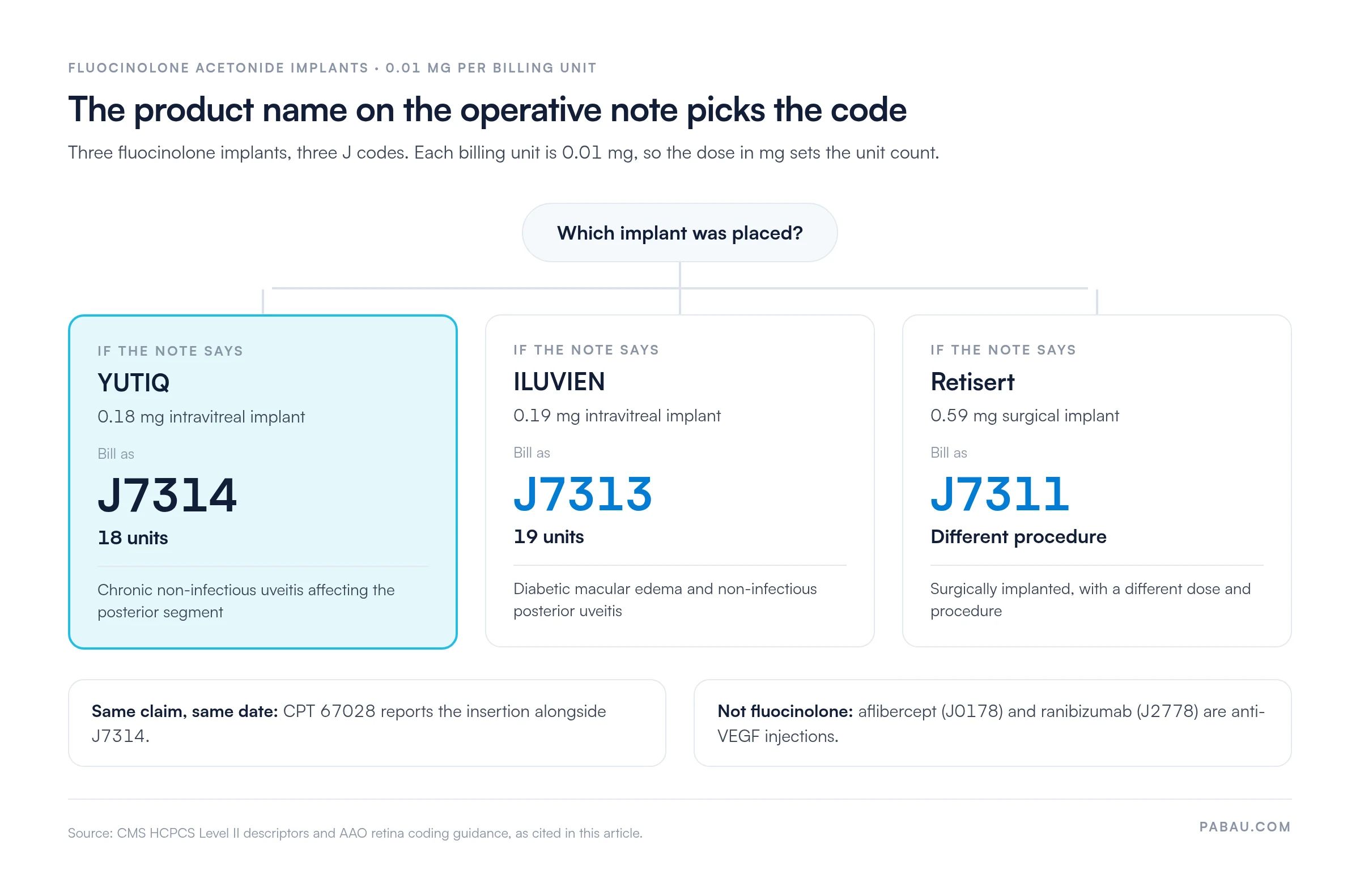
Check the current CMS HCPCS Level II alpha-numeric file for the billing year before coding. CMS revises J codes for similar products, and a code that mapped correctly last year may have changed.
A J7314 claim has to satisfy several rule sets at once. Drug coding, units, NDC rules, prior authorization, and LCD criteria all apply, and a failure in any one denies the line.
Denial management for ophthalmic drug claims starts before submission. Thus, a pre-claim checklist that flags the eight error types above stops these denials before they reach the payer.
Use this checklist on every J7314 claim, and confirm each item before the claim leaves the practice.
Where an NDC is reported, it must match the product given that day, not a default stored from an earlier order. Likewise, clean claim standards for physician-administered drugs require every field to reflect the service delivered, checked against the operative note.
Audit J7314 claims every quarter. Pull the remittance advice for J7314 denials from the past 90 days, sort them by denial reason, and work out your first-pass clean-claim rate. A low rate on this code usually points to one step, such as unit entry, product coding, or authorization intake.
A J7314 claim depends on an authorization obtained weeks before the implant goes in. When that number and its dates sit in an email thread, the claim can go out without them. Pabau keeps the prior authorization code and its start and end dates on the patient’s case, where the biller sees them.
Pabau’s claims software for ophthalmologists then submits the CMS-1500 or 837P claim through Claim.MD. The authorization and the submitted claim sit on the same case. Your team can check the authorization dates against the date of service before the claim leaves.

Pabau keeps the prior authorization code and dates on each patient’s case and submits CMS-1500 and 837P claims through Claim.MD. Your team can check the authorization before a J7314 claim goes out.

In short, J7314 is a YUTIQ-only code, and most errors on it come from treating it as a shared fluocinolone code. Bill 18 units for the 0.18 mg implant, pair it with CPT 67028, and send ILUVIEN to J7313 and Retisert to J7311.
The money on this code is usually lost before submission, not at the payer. A confirmed authorization, a posterior-uveitis diagnosis, and the current quarter’s ASP limit decide whether a high-cost implant gets paid. Check all three before the patient is scheduled.
Book a demo to see how Pabau keeps the authorization and the claim on one patient case.

Need a framework for managing drug claim denials across your practice? Denial management in healthcare covers the core workflows for reducing first-pass denial rates on physician-administered drugs.
Unsure how the claims clearinghouse fits into your J-code workflow? Medical claims clearinghouse explains how clearinghouse validation catches common J-code errors before submission.
Looking to understand the full billing compliance picture for ophthalmic practices? Medical billing compliance outlines the documentation and audit standards that govern high-cost drug claims.
Billing ILUVIEN rather than YUTIQ? HCPCS code J7313 covers the 0.19 mg implant and its 19-unit claim line.
Want to see where drug claims lose money upstream? What is revenue cycle management walks through the checkpoints from authorization to payment posting.
HCPCS Code J7314 reports YUTIQ, the 0.18 mg fluocinolone acetonide intravitreal implant. It treats chronic non-infectious uveitis affecting the posterior segment of the eye. It is a physician-administered drug billed under Medicare Part B, usually through buy-and-bill. ILUVIEN is billed under J7313, not J7314.
Bill 18 units for one YUTIQ implant. The unit of service for J7314 is 0.01 mg, and the implant holds 0.18 mg. Billing one unit instead of 18 is the most common way to get underpaid on this code.
It depends on the payer. Medicaid programs require the 11-digit NDC with the N4 qualifier under the Deficit Reduction Act, and many commercial payers do too. Medicare Part B does not, as a rule, require it unless your MAC asks for it. When you report it, use the NDC from the product given that day.
CPT 67028 (intravitreal injection of a pharmacologic agent) is billed on the same date of service as J7314. Without CPT 67028 on the claim, the drug charge is at high risk of an incomplete-claim denial.
Each code names a different fluocinolone acetonide implant. J7314 is YUTIQ, 0.18 mg, billed as 18 units for chronic non-infectious posterior-segment uveitis. J7313 is ILUVIEN, 0.19 mg, billed as 19 units for diabetic macular edema and non-infectious posterior uveitis. J7311 is Retisert, a 0.59 mg implant placed in surgery.