CPT code 86481: TB IGRA billing guide
CPT code 86481: Official descriptor and procedure description CPT code 86481 des...

Last Updated: Nov 2, 2026
K0052 is the HCPCS Level II code for swingaway, detachable footrests, replacement only, each. It covers a complete footrest that swings aside or lifts off a wheelchair the patient already uses, billed one unit per footrest.
Denials on K0052 usually trace back to documentation. The chart has to show why the patient needs a swing-away footrest. The claim also has to stay distinct from adjacent wheelchair component codes K0050, K0051 and K0053. Coders who attach the right modifiers and match a supporting ICD-10 diagnosis to the applicable Local Coverage Determination see fewer takebacks on these claims.
Let Pabau's smart automation suggest the right codes, reduce claim denials, and keep your practice compliant—effortlessly.
Automate repetitive tasks and focus on what matters most—your patients.
Reduce coding errors and ensure compliance with the latest regulations.
Clean claims, fewer denials, and faster reimbursements.
Powerful insights and reporting to help your practice thrive.
HIPAA compliant SOC 2 certified GDPR-compliant Trusted by 4,000+ clinics worldwide

K0052 covers swingaway, detachable footrests supplied as replacement parts, billed one unit per footrest. Neighboring codes describe other parts: K0050 is a ratchet assembly, and K0053 covers elevating, articulating (telescoping) footrests.
Add modifier KX only where the applicable LCD or policy article requires it, and check the current wheelchair accessories policy article before attesting. Use GA when a signed ABN is on file and denial is likely.
Medical necessity rests on a qualifying ICD-10 diagnosis and a written order that names the functional limitation the footrest addresses.
Pabau, the practice management platform we build, supports insurance billing and claims management, so K0052 claims sit in the same system as the patient record.
HCPCS code K0052 is the Level II code for a swing-away, detachable wheelchair footrest supplied as a replacement part. The Centers for Medicare & Medicaid Services (CMS) maintains it. The official descriptor reads: Swingaway, detachable footrests, replacement only, each.
Coders apply K0052 when a footrest on a chair the patient already uses is replaced with one that swings aside or lifts off the frame. That design clears the way for transfers, car-seat transitions, and leg-positioning changes that a fixed footrest blocks.
K0052 sits within the K-series of HCPCS Level II codes, which CMS uses as temporary codes for durable medical equipment. They cover items the E-series codes don’t fully describe.
According to the CMS HCPCS overview, K-series codes are updated annually and can be revised, deleted, or consolidated when an E-code equivalent is established. Billers should verify K0052 remains active in the current year’s HCPCS release before submitting claims.
K0052 covers a detachable, swing-away footrest that is ordered as a replacement component for a covered wheelchair. Coverage applies when Medicare Part B already covers the patient’s wheelchair base. The footrest must also be medically necessary for the patient’s functional mobility limitations.
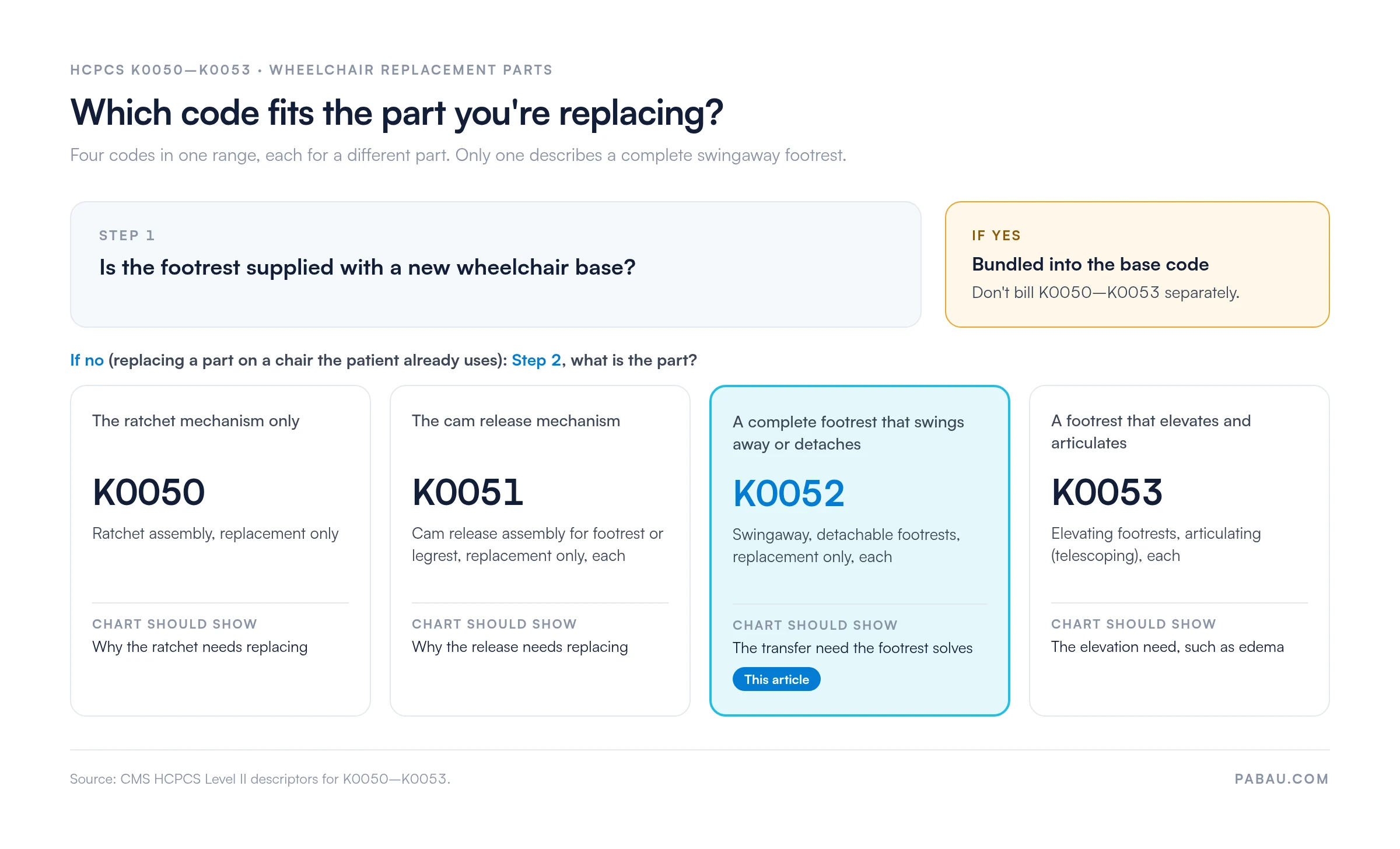
A common bundling error is billing K0052 alongside a new wheelchair base code when the footrest is included in the base purchase. Medicare and most other payers treat footrests supplied with a new chair as part of the base.
Because the descriptor reads “replacement only”, K0052 is billed separately only when it replaces a footrest on a chair the patient already uses. The clinical record should explain why the replacement is needed.
The K0050-K0053 range covers four separate wheelchair replacement parts. Two are mechanisms within the footrest or legrest hardware, and two are complete footrests. Selecting the wrong one invites a denial, because payers cross-reference the code against the wheelchair base and the physician’s functional assessment.
K0053 applies when the clinical documentation specifically calls for elevation of the lower extremity, typically for bilateral leg edema or post-surgical swelling. K0052 applies when the patient needs transfer access without elevation. Auditors look for this alignment between the code and the physician’s functional assessment. The decision path below sorts a replacement part into the right code.
Medical necessity for HCPCS code K0052 requires a documented functional limitation that specifically justifies a swing-away or detachable footrest over the standard fixed configuration. The physician’s written order must reflect this clinical rationale.
The applicable Local Coverage Determination (LCD) for wheelchair accessories in your DME MAC jurisdiction will specify additional criteria. The DME MAC LCDs come from Noridian and CGS Administrators, and they define the exact language required in the prescription. Always cross-reference the active LCD before submitting, because criteria can change at policy review.
The following ICD-10 codes commonly support medical necessity for a detachable swing-away wheelchair footrest. The diagnosis alone does not guarantee coverage. It must align with the LCD’s functional criteria and the physician’s documented assessment.
Documentation for HCPCS code K0052 has to survive both prepayment review and post-payment audit. Following DMEPOS billing compliance standards, the supplier’s file must contain all of the following before the claim drops.
Thin functional assessment language is a common reason auditors recover payment on wheelchair accessory claims. The chart note has to go beyond the diagnosis code. It should explain the functional limitation in the patient’s daily life and why this footrest configuration is necessary.
Modifier selection for K0052 is where many DME claims go wrong. Using the correct modifier signals the transaction type (purchase vs. rental) and confirms documentation status to the payer’s adjudication system.
The KX modifier carries the most compliance risk. Append it to a K0052 claim only where the applicable LCD or policy article calls for it. Check the current wheelchair options and accessories policy article before attesting.
KX tells the payer that the required documentation is in the supplier’s file. Audits that find missing records on KX-coded claims typically end in full recoupment and can lead to fraud review.
Before appending modifier KX to a K0052 claim, have a billing coordinator run a five-point check. Confirm the written order, the face-to-face evaluation, functional limitation language, a covered ICD-10 diagnosis, and signed proof of delivery. If any item is missing, use modifier GA (with a signed ABN) or GZ rather than attest to documentation that does not exist.
Medicare does not require prior authorization for K0052 as a rule. Review programs change, though, and requirements vary by DME MAC, so check the current rules for your jurisdiction before the footrest is delivered.
When prior authorization is required, submit the written order, clinical chart notes supporting medical necessity, and the proposed HCPCS code K0052 with applicable modifier. Keep the authorization number and expiration date in the patient’s DME file and reference it on the claim form.
Billing K0052 accurately means populating the CMS-1500 or 837P with the correct field values from the start. Errors at the claim level are among the easiest to prevent and the most expensive when left uncorrected.
For electronic claims, the 837P transaction uses Loop 2400 (Service Line) for the K0052 line item, with the modifier appended in segment SV1. Pabau’s claims management software supports insurance billing and claims management, so the claim is built in the same system as the patient record.
Submitting a clean claim on the first pass avoids the rework cost of corrected claims and resubmissions.
Medicare reimbursement for K0052 is set through the DMEPOS fee schedule published annually by CMS. Rates vary by jurisdiction, competitive bidding area (CBA) status, and whether the beneficiary is in a rural or non-rural zip code.
To look up the current K0052 payment amount, use the CMS DMEPOS fee schedule files. The AAPC’s HCPCS code lookup tool and PGM Billing’s free HCPCS lookup also surface current fee schedule data using CMS source files.
Cross-reference the billed amount against the fee schedule before submitting to avoid billing above the allowed amount. Saving the lookup date with your superbill documentation gives your team a timestamped record for audit defense.
Pull the DMEPOS fee schedule lookup at least once per quarter and at every January 1 update. Save a dated screenshot of the K0052 national non-CBA rate to your billing policy folder. When a payer disputes your allowed amount, a timestamped fee schedule record closes the conversation quickly.
K0052 denials tend to fall into five categories. Solid denial management workflows catch these before the claim goes out, which saves working them after a remittance rejection. The table below maps each denial reason to its root cause and the fix.
For denied K0052 claims, file a redetermination request within 120 days of the remittance advice date. Include the written order, relevant chart notes, the signed proof of delivery, and a cover letter citing the specific LCD criteria your documentation meets. Second-level appeals (reconsideration) go to a Qualified Independent Contractor (QIC) and allow additional documentation submission.
A K0052 claim leans on several documents at once. The written order, chart note, proof of delivery and claim often sit in different places. A missing piece then tends to surface only after a denial.
Pabau raises the invoice to the patient’s insurer and pre-fills the claim from it. Each claim is scrubbed for missing or invalid details before it goes to the clearinghouse. In the US, claims go through Claim.MD, and eligibility can be verified before the visit.
After submission, the claims dashboard tracks every claim from Pending to Paid and flags rejected ones as Needs action. Your team sees which K0052 claims need a corrected modifier or an extra document while the appeal window is still open.
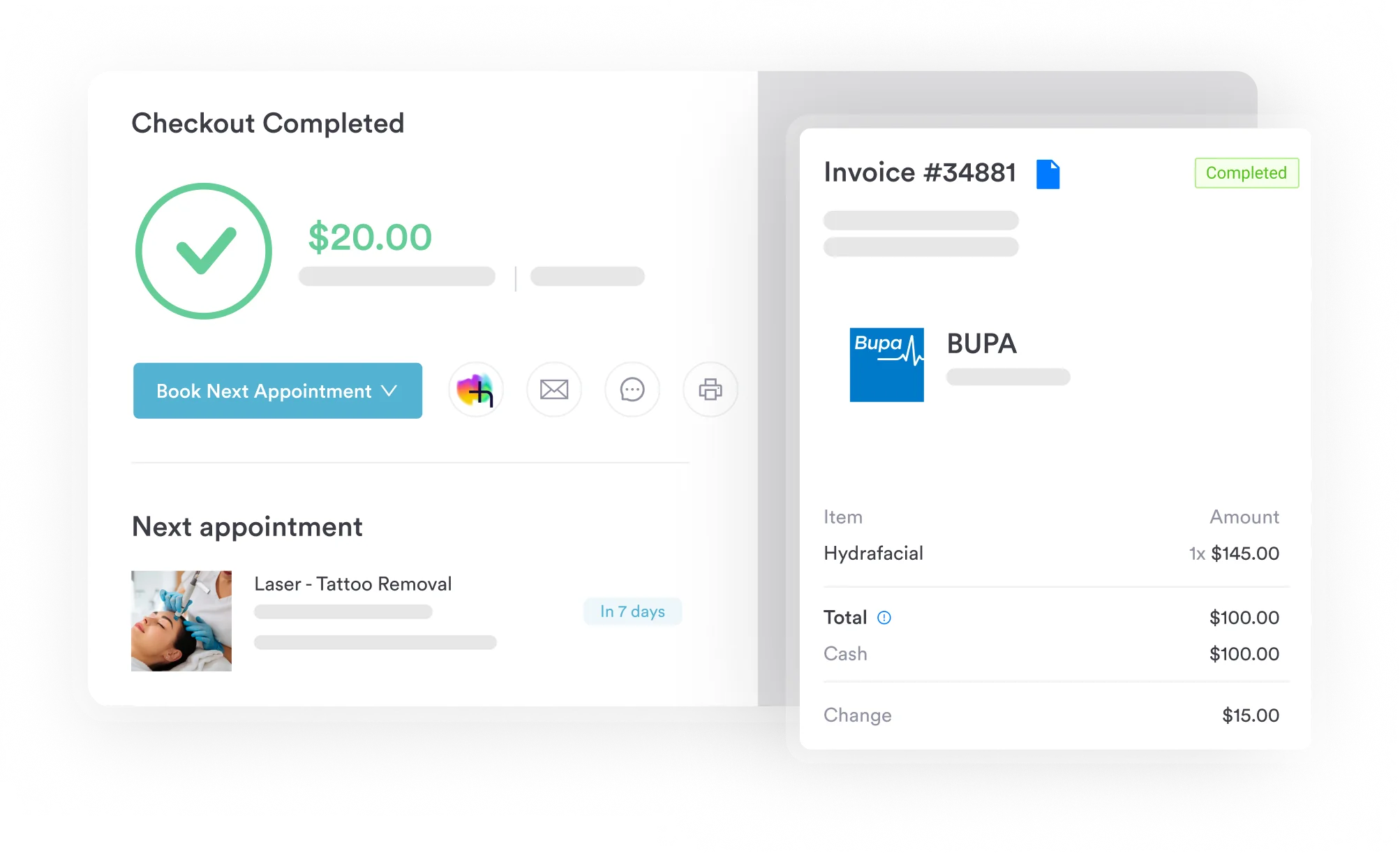

Pabau supports insurance billing and claims management, so your DME billing team builds and tracks each K0052 claim alongside the patient record. See how it works for your team.

K0052 is one of the easier wheelchair codes to choose and one of the easier ones to lose on paperwork. The coding question is narrow: Is this a complete swingaway footrest replacing one on a chair the patient already uses?
The work that protects payment happens before the claim is built. Get the chart note to name the transfer problem the footrest solves, and check whether the current policy article calls for KX. Those two checks carry more weight than the code choice itself.
Book a demo to see how Pabau tracks each K0052 claim from pending to paid. Your team spots a missing document before the payer does.

Need to understand how claims clearinghouses process DMEPOS submissions? Medical claims clearinghouse guide explains how 837P files move from biller to payer and where HCPCS accessories get flagged.
Want to reduce the number of K0052 claims that reach the denial stage? Denial codes in medical billing maps the most common CARC codes to their root causes and resolution steps.
Looking for guidance on the 837P electronic claim format for DME? 837 file billing guide covers loop structure, segment requirements, and how to submit HCPCS codes correctly in the 5010 transaction.
Replacing the ratchet rather than the whole footrest? HCPCS code K0050 covers the ratchet assembly replacement and the documentation it needs.
HCPCS code K0052 covers swingaway, detachable wheelchair footrests supplied as replacement parts, billed one unit per footrest under the DMEPOS benefit. It applies when the patient needs a footrest that moves out of the way for transfers or lower-leg access. The clinical documentation has to support that need.
K0052 covers swingaway, detachable footrests that move out of the way for transfers. K0053 covers elevating, articulating (telescoping) footrests that raise the lower leg, typically for edema or post-surgical positioning. Each code answers a different clinical need, so the chart note and the supporting diagnoses should match the code billed.
Most K0052 purchase claims carry NU for new equipment, or UE for used or refurbished equipment. Add KX only where the applicable LCD or policy article requires it and its criteria are documented. Use GA when a signed Advance Beneficiary Notice is on file and denial is likely. Use GZ when denial is expected and no ABN exists.
Yes, Medicare Part B covers K0052 under the DMEPOS benefit when a treating practitioner orders it and an enrolled DMEPOS supplier delivers it. The medical necessity documentation must meet the Local Coverage Determination criteria for the patient’s DME MAC jurisdiction.
Medicare does not require prior authorization for K0052 as a rule, but review programs change, so check your DME MAC’s current requirements. Commercial payers often require prior authorization for DME above a dollar threshold. Verify the specific payer’s rules before ordering and delivering the footrest.
Bill a replacement footrest with K0052 and modifier NU for new equipment. The record should explain why replacement is needed, such as wear, damage, or a change in the patient’s condition. A footrest supplied with a new wheelchair base is bundled into the base code and not billed separately.