

CCSD code G5100: Bypass of duodenum billing guide
CCSD code G5100 bills a bypass that leaves the duodenum in place CCSD code G5100...

Last Updated: Oct 16, 2026
Billable Code
K0045 is the HCPCS Level II code for a footrest, complete assembly, replacement only, each. It covers the whole footrest unit supplied to replace a broken or worn footrest on a wheelchair the patient already owns.
The code does not apply to a footrest included in a new wheelchair purchase, and it does not cover a single component. Medicare pays it under the Part B DMEPOS benefit, and only enrolled DMEPOS suppliers may bill it.
Let Pabau's smart automation suggest the right codes, reduce claim denials, and keep your practice compliant—effortlessly.
Automate repetitive tasks and focus on what matters most—your patients.
Reduce coding errors and ensure compliance with the latest regulations.
Clean claims, fewer denials, and faster reimbursements.
Powerful insights and reporting to help your practice thrive.
HIPAA compliant SOC 2 certified GDPR-compliant Trusted by 4,000+ clinics worldwide

HCPCS code K0045 covers a footrest, complete assembly, replacement only, each, billed under Medicare Part B DMEPOS rules.
K0045 is active for 2026, and only enrolled DMEPOS suppliers may bill it to Medicare.
The KX modifier is required on K0045 claims to attest that coverage criteria are met, and omitting it is the most common denial trigger.
Medicare expects a replacement no sooner than five years unless the record justifies an earlier one.
Practice management software like Pabau helps DME billing teams track modifier and documentation rules across the K-code range.
HCPCS code K0045 describes a footrest, complete assembly, replacement only, each. The “replacement only” designation carries the weight here. K0045 applies when an existing wheelchair footrest assembly is replaced, not when a footrest is supplied as part of a new wheelchair purchase. A footrest on a new wheelchair belongs to the base wheelchair code instead.
K0045 is a HCPCS Level II code, so CMS maintains it rather than the American Medical Association. It covers the complete footrest assembly as a single unit, including the hanger, the footplate, and any integral locking mechanism. Billing individual components under K0045 is incorrect. If only the footplate is replaced, K0042 applies instead.
Medicare reimburses HCPCS code K0045 as a purchased item under the DMEPOS fee schedule. CMS sets the payment amount annually, and it varies by geographic payment locality. Suppliers confirm the current allowable rate from the CMS DMEPOS fee schedule file published each January, or from their DME MAC pricing files. The Physician Fee Schedule does not price this code, so a lookup there returns nothing useful.
DMEPOS competitive bidding may change the allowed amount in certain contract areas. Inside a competitive bidding area, the program rate replaces the standard fee schedule amount for K0045. Suppliers working in one of those areas must hold a contract before they bill Medicare for the code. The CMS Competitive Bidding Implementation Contractor (CBIC) database confirms the status of your service area.
Medicare covers HCPCS code K0045 under the DMEPOS benefit when the footrest replacement is medically necessary and supported by documentation in the patient’s medical record. CMS Policy Article A52504 governs wheelchair options and accessories, including K0045.
Coverage requires all of the following:
Local Coverage Determinations issued by the four DME Medicare Administrative Contractors may add criteria beyond CMS Policy Article A52504. The four jurisdictions are A, B, C and D. Review the applicable LCD for your jurisdiction before submitting K0045 claims.
Modifiers tell Medicare and other payers how to read a K0045 claim. Using the wrong one, or omitting a required one, is a leading cause of denial. The table below summarizes the modifiers most commonly applied to HCPCS code K0045.
Critical modifier rule: KX and GY are mutually exclusive. Appending KX attests that coverage criteria are met, so GY cannot sit on the same line indicating the item is excluded. Dual application triggers an automatic edit and a claim rejection. Verify your modifier logic before submission.
Billing HCPCS code K0045 correctly means following CMS DMEPOS claim submission rules from the point of order through delivery and payment posting. The guidance below reflects standard DME MAC claim submission requirements. Confirm any local edits with the DME MAC for your jurisdiction.
Working toward submitting a clean claim on the first pass is the fastest way to get K0045 paid. A clean claim has no missing fields, correct modifiers, matching dates of service, and complete documentation on file before submission. Practices using structured claims management software to automate pre-submission checks see fewer field-level rejections.
Thorough documentation is the primary defense against K0045 post-payment audits and medical review. DME MACs routinely request records for wheelchair accessory claims, so the paperwork has to be in place before the item ships. The key documents required for a K0045 claim are:
A superbill that captures the order and delivery details at the point of dispensing makes an audit response much simpler. Documentation created after the date of service cannot be reconstructed to satisfy a DME MAC records request.
Run a documentation checklist before you ship any K0045 item. Confirm the written order is signed and dated, the physician note carries medical necessity language, and the KX modifier applies. Decide how you will capture delivery confirmation. Catching a missing signature before delivery beats chasing paperwork during a post-payment audit.
K0045 sits within a cluster of HCPCS codes covering wheelchair footrest and legrest components. CMS requires the most specific code for the item actually supplied. The table below covers the codes most frequently confused with HCPCS code K0045, along with what separates them.
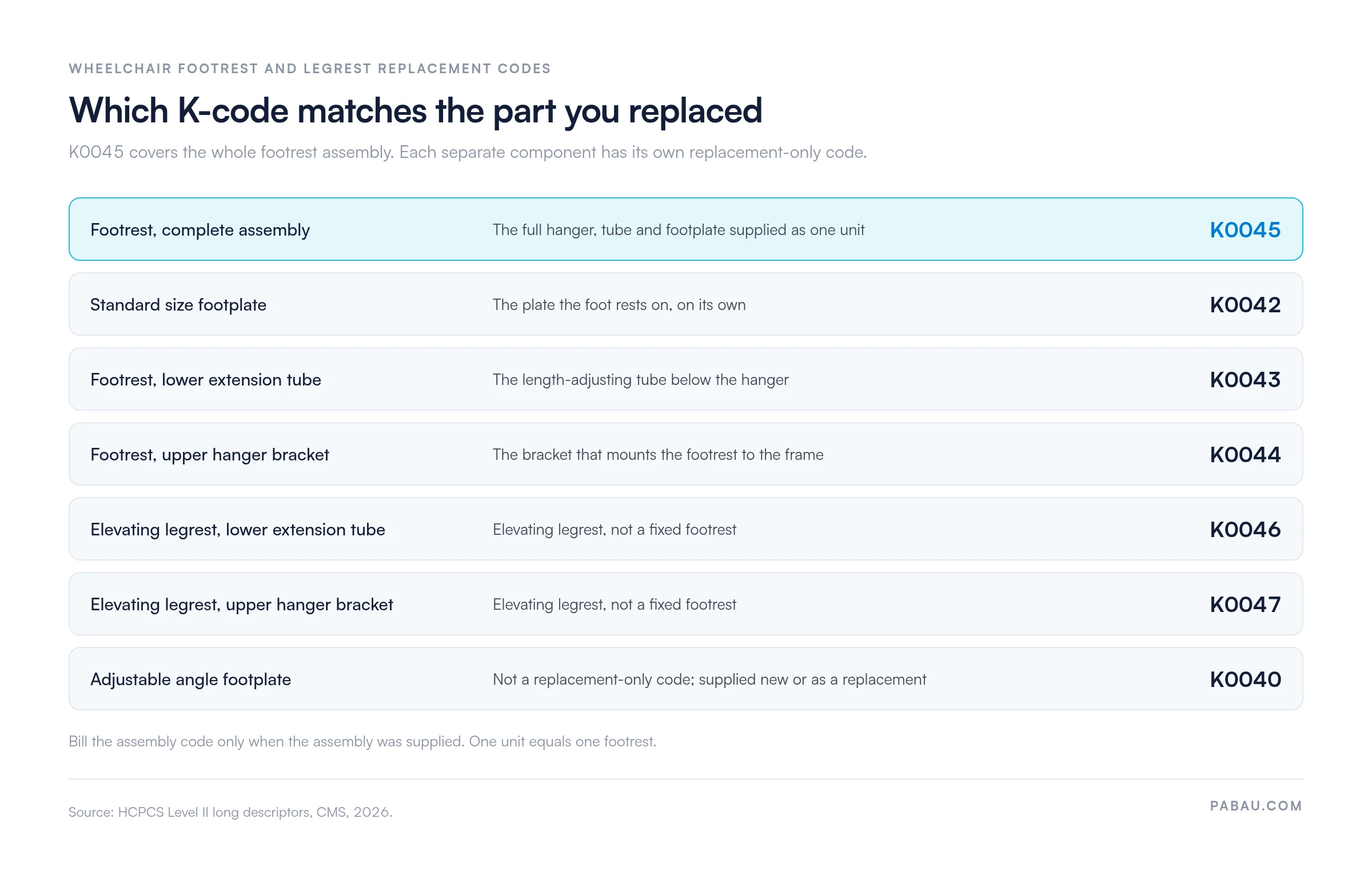
The most common coding error in this range is billing K0045 when only one part was replaced. A standard footplate is K0042, the lower extension tube is K0043, and the upper hanger bracket is K0044. The complete assembly code applies only where the whole footrest was supplied. Elevating legrest components carry their own codes, K0046 and K0047, so check what the technician actually fitted. The AAPC HCPCS code lookup confirms the current descriptor for each code before you bill.
The map below matches each part of a footrest or an elevating legrest to the code that covers it.
Most K0045 denials are preventable. These are the triggers DME MAC reviewers flag most often on wheelchair accessory claims. Compare them against your own denial data to see which costs the most in write-offs.
K0045 rejections usually carry CO-4, CO-50 or CO-97. Reading the denial codes in medical billing behind each one helps billing teams fix root causes rather than resubmit the same claim.
Most DME billing teams keep the pieces of a K0045 claim in separate places. The written order sits in one folder, the delivery receipt in another, and the modifier rule lives in somebody’s head. An audit request months later means reassembling all of it by hand.
Pabau, practice management software for healthcare practices, keeps the order, the clinical note, the delivery confirmation and the claim on one patient record. Billing staff can see whether the supporting documents exist before the claim is submitted, rather than after a denial arrives.
That matters most on the repeat rules. A replacement inside the five-year lifetime needs a documented reason, and the record shows when the previous footrest was supplied. Fewer K0045 claims then leave the practice missing a modifier or a signature.

Pabau’s claims management tools help DMEPOS suppliers track modifier requirements, store delivery confirmations, and submit cleaner HCPCS claims from a single workflow.

HCPCS code K0045 covers a narrow but frequently billed scenario, replacing a wheelchair footrest assembly for an existing Medicare beneficiary. Getting it right means pairing the KX modifier with medical necessity documentation, a pre-delivery written order, and a signed proof of delivery. Miss any one of those and the claim denies.
The trade-off worth remembering is that this paperwork is cheap before delivery and expensive afterward. Build the checklist into the dispensing step, and K0045 stops behaving like a denial risk. Book a demo to see how Pabau keeps DME claim documentation on one record.

Need to understand how denials flow through the revenue cycle? Revenue cycle management for DME practices explains how HCPCS claims move from order through final payment posting.
Want a reference for the denial codes that appear on K0045 ERAs? Electronic remittance advice explained walks through how to read adjustment reason codes on Medicare remittances.
Looking for a structured approach to reducing wheelchair accessory denials? Denial management strategies covers root-cause analysis, appeal timelines, and resubmission workflows for DME claims.
HCPCS code K0045 is the billing code for a footrest, complete assembly, replacement only, each. It applies when a wheelchair footrest assembly is being replaced for an existing user, not when a footrest is included in a new wheelchair purchase. The code is a HCPCS Level II (K-code) maintained by CMS under the DMEPOS benefit.
Medicare reimburses K0045 as a purchased item under the DMEPOS fee schedule, with the beneficiary responsible for 20% coinsurance after meeting the Part B deductible. Confirm the exact 2026 national rate from the CMS DMEPOS fee schedule file published each January. Rates update annually and adjust by geographic locality. Suppliers in competitive bidding areas should confirm their rate through the CBIC.
Yes, HCPCS code K0045 is covered under Medicare Part B as a DMEPOS item. Medical necessity must be documented, and an enrolled DMEPOS supplier must submit the claim. Coverage is governed by CMS Policy Article A52504 and applicable DME MAC Local Coverage Determinations.
Submit K0045 on a CMS-1500 or 837P electronic claim with the KX modifier. Report Place of Service 12 for a home delivery, and use the delivery date as the date of service. Ensure a valid written order, medical necessity documentation, and signed proof of delivery are on file before submitting. Only enrolled DMEPOS suppliers may bill this code to Medicare.



