HCPCS Code Q4185: Cellesta flowable amnion billing guide
HCPCS Code Q4185: definition and official descriptor HCPCS Code Q4185 is the Lev...

Last Updated: Nov 20, 2026
K0047 is the HCPCS Level II code for elevating legrest, upper hanger bracket, replacement only, each.
Suppliers bill it per bracket when the upper hanger bracket on a patient-owned elevating legrest breaks or wears out. Wheelchair bases have separate codes, and Medicare includes the bracket in the allowance when it ships with a new base or legrest.
Let Pabau's smart automation suggest the right codes, reduce claim denials, and keep your practice compliant—effortlessly.
Automate repetitive tasks and focus on what matters most—your patients.
Reduce coding errors and ensure compliance with the latest regulations.
Clean claims, fewer denials, and faster reimbursements.
Powerful insights and reporting to help your practice thrive.
HIPAA compliant SOC 2 certified GDPR-compliant Trusted by 4,000+ clinics worldwide

HCPCS code K0047 bills one replacement upper hanger bracket for an elevating legrest, per unit, on a wheelchair the patient already owns.
K0047 bills a single wheelchair component. Manual wheelchair bases carry their own codes, K0001-K0009.
Medicare bundles K0047 into the allowance for a new wheelchair base or elevating legrest. Only a stand-alone replacement is paid separately.
The patient must still meet the elevating legrest criteria in LCD L33792. The RB modifier marks the bracket as a part replaced during a repair.
Pabau’s claims management software keeps the replacement reason, modifiers and delivery proof on the claim, so K0047 lines go out complete.
HCPCS code K0047 is the HCPCS Level II code for an elevating legrest upper hanger bracket supplied as a replacement part. Its official CMS descriptor is Elevating legrest, upper hanger bracket, replacement only, each. The CMS Wheelchair Options/Accessories LCD lists K0047 among its elevating legrest codes.
One unit equals one bracket. A DMEPOS supplier bills it to the DME Medicare Administrative Contractor (DME MAC) when the bracket on a patient’s existing legrest breaks or wears out.
Confirm the current descriptor in the CMS HCPCS overview and the coverage rules in the Wheelchair Options/Accessories LCD (L33792). The AAPC HCPCS code lookup lists the neighboring codes in the same range.
The upper hanger bracket is the mounting hardware that hangs an elevating legrest on the front of the wheelchair frame. It holds the legrest in place while the patient raises or lowers the leg.
Brackets crack, bend or wear loose with daily transfers and swing-away use. When that happens, the supplier replaces the bracket alone instead of the whole legrest, and K0047 is the code for that part.
K0047 covers one replacement upper hanger bracket for an elevating legrest. Every other part of the legrest, and the wheelchair itself, has its own code.
K0044 through K0047 are four replacement-only parts for the front rigging of a wheelchair. Pick the code by which assembly the part belongs to, and whether it is the bracket or the tube.
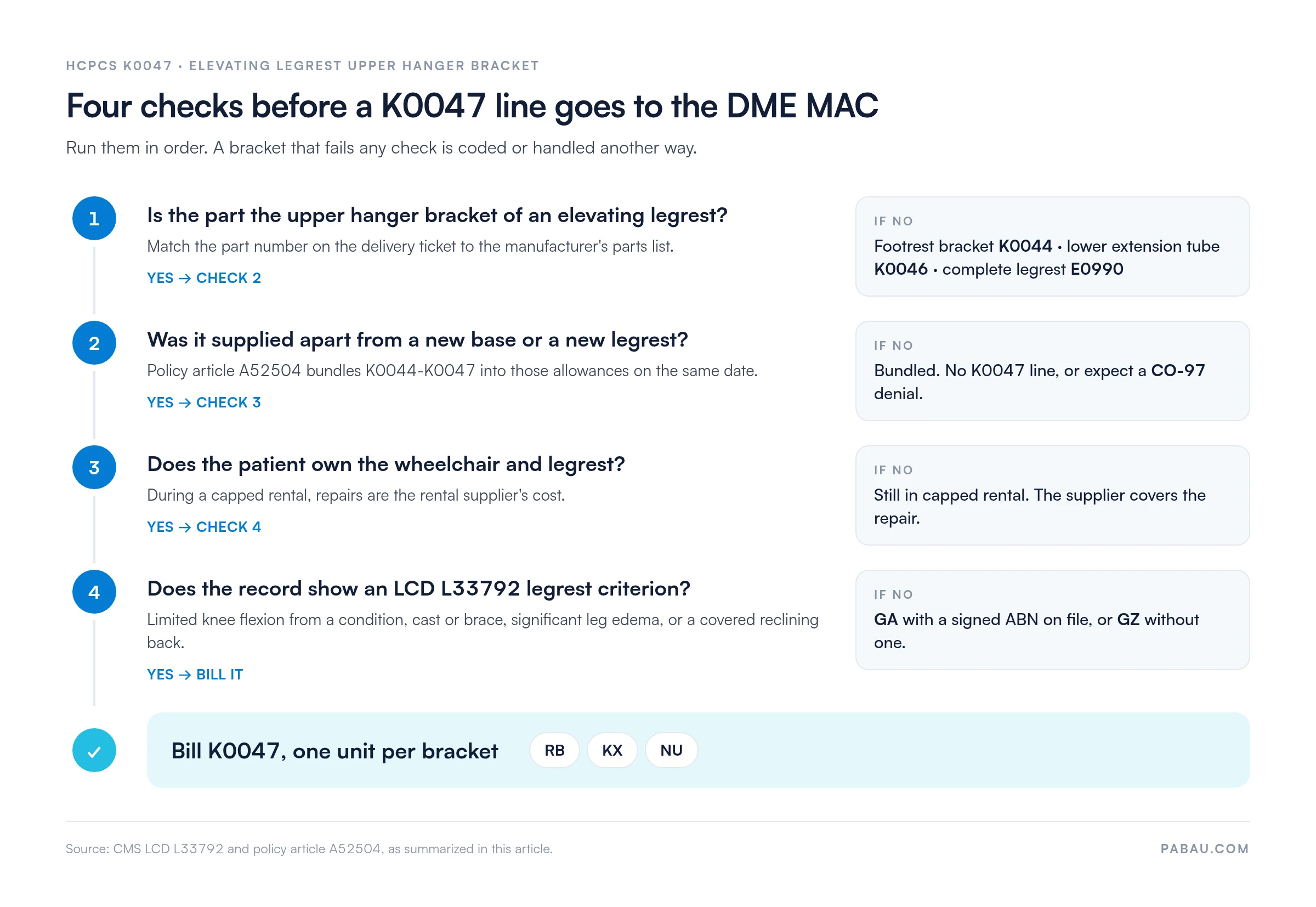
Practical rule: Check the part number on the delivery ticket against the manufacturer’s parts list. A footrest bracket belongs under K0044, and a legrest lower extension tube under K0046. Billing either one as K0047 is a coding error.
Medicare Part B pays for K0047 when the patient’s wheelchair meets Medicare coverage criteria and the elevating legrest itself is medically necessary. Both conditions come from the Wheelchair Options/Accessories LCD.
Under LCD L33792, an elevating legrest is covered when the patient meets one of these criteria:
If none of these is documented, the legrest and its replacement parts are denied as not reasonable and necessary.
The bundling rules matter as much as the criteria. Policy article A52504 includes K0044-K0047 in the allowance for manual and power wheelchair bases, E0990, K0195 and K0053 when supplied at the same time. Adjustable arms are treated differently, because K0020 may be billed separately with a base when the arm height criteria are met.
K0047 is therefore payable only as a stand-alone replacement on equipment the patient owns. While a wheelchair is still in a capped rental, the supplier that owns it covers repairs, so no K0047 line is billed.
Four checks, run in order before the claim goes out, settle whether a bracket belongs on a K0047 line at all.
The records behind each check fall under the medical billing compliance rules that apply to every DMEPOS claim.
A K0047 claim needs proof that the legrest is still medically necessary and proof that the bracket needed replacing. Build a clean claim submission checklist around these records.
Two older requirements no longer apply. CMS stopped using certificates of medical necessity for claims with dates of service from January 1, 2023.
K0047 is also absent from the required face-to-face and written order prior to delivery list. That list names manual bases such as K0002-K0007, not their replacement parts.
Modifiers on a K0047 line tell the DME MAC why the part was replaced, whether coverage criteria are met, and how it was supplied.
The DMEPOS fee schedule also lists K0047 amounts with the KE and KU modifiers, which apply in specific competitive bidding situations. Check your DME MAC’s instructions before you add either one.
Check the delivery date of the patient’s wheelchair before you bill K0047. If the base or legrest was supplied on the same date, the bracket is bundled. If the chair is still in a capped rental, the repair is the supplier’s cost.
Medicare does not require prior authorization for K0047. The Required Prior Authorization List updated on July 29, 2026 names K0005 among wheelchair codes, but no replacement legrest parts.
Medicare pays 80% of the K0047 fee schedule amount after the Part B deductible, and the patient owes the remaining 20%. Payment is per bracket, so two brackets are billed as two units.
Look up the current amount in the CMS DMEPOS fee schedule for the patient’s state before you quote a price. Effective revenue cycle management ties each K0047 line to the right rate and modifier.
K0047 denials usually come from bundling, missing legrest criteria, or a modifier that does not match the repair. The guide to CARC denial codes explains each remittance code.
Structured denial management workflows track these reasons over time. Repeated CO-97 denials point to a delivery-date check missing from intake.
A Medicare redetermination is the first formal appeal step. Follow this sequence for a K0047 denial.
Billing rules for K0047 shift by payer. Most payers recognize HCPCS Level II codes, but each sets its own repair rules.
Medicaid: State programs set their own coverage, fee schedules and approval rules for wheelchair repairs. Check the state fee schedule before billing, and use the PGM Billing HCPCS lookup to cross-reference allowable amounts.
Commercial insurers: Plans may cover the bracket under a repair benefit rather than a DME purchase benefit. Confirm the benefit and any approval step before you deliver the part.
Workers’ compensation: Each jurisdiction sets its own DME fee schedule. Confirm that the wheelchair is tied to the accepted work injury before billing a replacement part.
Teams that bill K0047 often track the replacement reason, the wheelchair’s ownership and the delivery proof in separate places. Pabau’s claims management software keeps them on one claim record.
The result is a K0047 line that reaches the DME MAC with its proof already attached, instead of a denial your team reworks weeks later.

Pabau’s claims management software keeps the replacement reason, modifiers and proof of delivery on the claim, so wheelchair part claims go out ready to pay.

K0047 is a small part with a narrow rule set. It pays only when it replaces a worn bracket on a legrest the patient owns and still needs.
Get the bundling check, the legrest criterion and the RB modifier right, and the claim has little left to deny. To see Pabau run the bundling check before a claim is submitted, book a demo.

Need a denial resolution framework for DME claims? Denial management in healthcare covers the end-to-end workflow for tracking, appealing, and preventing claim denials across payer types.
Want to understand how claims flow from submission to payment? Revenue cycle management explained breaks down each stage of the billing lifecycle from patient encounter through final payment posting.
Looking for a clean claim checklist for DMEPOS submissions? Clean claim submission guide covers the fields, edits, and common errors that determine whether a claim clears or stalls at the clearinghouse.
HCPCS code K0047 is the HCPCS Level II code for one elevating legrest upper hanger bracket, supplied as a replacement part. Its official descriptor is “Elevating legrest, upper hanger bracket, replacement only, each.” DMEPOS suppliers bill it per bracket to the DME MAC.
No. K0047 is a replacement wheelchair component, the bracket that mounts an elevating legrest to the frame. Manual wheelchair bases are K0001-K0009, and power wheelchair bases have their own codes.
K0044 is a footrest upper hanger bracket, and K0047 is the same bracket for an elevating legrest. K0046 is the elevating legrest’s lower extension tube. All three are replacement-only parts billed per unit.
Yes, when the patient’s wheelchair meets Medicare coverage criteria and the elevating legrest is medically necessary under LCD L33792. When the bracket ships with a new base or legrest, it is bundled and Medicare makes no separate payment.
Use RB when the bracket replaces the same worn part during a repair. Add KX only when base and elevating legrest criteria are met, or GA or GZ when they may not be. Add the NU, UE or RR pricing modifier as the claim requires.
Medicare does not require either for K0047. It is not on the Required Prior Authorization List or the face-to-face and written order prior to delivery list. Medicaid and commercial plans may still require approval.