HCPCS Code Q4185: Cellesta flowable amnion billing guide
HCPCS Code Q4185: definition and official descriptor HCPCS Code Q4185 is the Lev...

Last Updated: Nov 20, 2026
Billable Code Specific Code
K0019 is the HCPCS Level II code for arm pad, replacement only, each. It covers one wheelchair arm pad supplied to replace a worn or damaged pad on a wheelchair the beneficiary already has.
Because the descriptor says "replacement only," K0019 is not billed for a pad supplied with a new wheelchair or a complete armrest assembly. Coders who miss that restriction can generate denials.
Let Pabau's smart automation suggest the right codes, reduce claim denials, and keep your practice compliant—effortlessly.
Automate repetitive tasks and focus on what matters most—your patients.
Reduce coding errors and ensure compliance with the latest regulations.
Clean claims, fewer denials, and faster reimbursements.
Powerful insights and reporting to help your practice thrive.
HIPAA compliant SOC 2 certified GDPR-compliant Trusted by 4,000+ clinics worldwide

HCPCS code K0019 bills one replacement wheelchair arm pad per unit, for a wheelchair the beneficiary already has.
K0019 is not paid for a pad supplied with a new wheelchair or a complete armrest assembly (E0973), which include the pad.
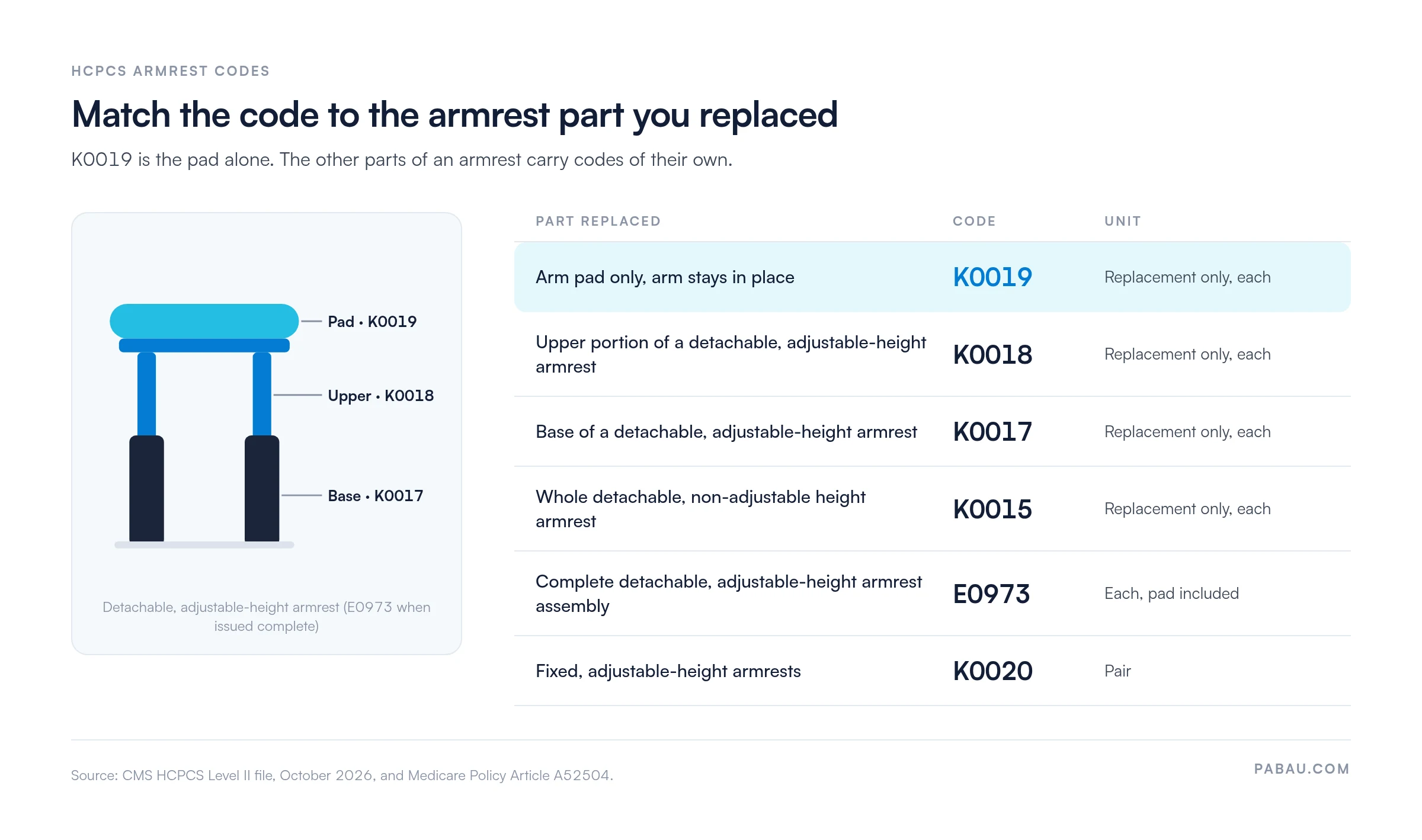
The armrest base (K0017), upper portion (K0018), and fixed armrest pair (K0020) have their own codes, so code the part replaced.
A replacement K0019 line takes RB plus one of KX, GA, GY, or GZ, and Medicare rejects a line without one of those four.
Practice software such as Pabau keeps the order, the replacement note, and the CMS-1500/837P claim on one patient record.
HCPCS code K0019 is the Level II code for a single wheelchair arm pad supplied as a replacement component. CMS’s October 2026 HCPCS file lists its official descriptor as Arm pad, replacement only, each.
Each part of that descriptor matters for billing. “Replacement only” limits the code to a worn or damaged pad on a wheelchair the beneficiary already has. “Each” sets the unit of service, so two pads go on the claim as two units of K0019.
K0019 sits in the K0001-K0195 range of wheelchair codes, part of the temporary K series in the HCPCS Level II code set. The table below summarizes the reference facts to confirm before you bill it.
K0019 covers a replacement arm pad for a manual or power wheelchair that Medicare already recognizes as covered DME. The pad must be designed for wheelchair armrest use. The record must also state why it is being replaced, whether from wear, damage, or a change in medical need.
Several items fall outside K0019’s scope and generate denials when billed under it:
Medicare Part B covers K0019 under the DME benefit when three conditions are met:
CMS Policy Article A52504 is the governing document for wheelchair options and accessories coverage.
MAC (Medicare Administrative Contractor) jurisdictions administer local coverage determinations (LCDs) that can impose additional criteria. Check the relevant MAC LCD before billing, because documentation standards can vary by region. Sound medical billing compliance means tracking MAC policy updates, since LCDs and policy articles are revised during the year.
Non-Medicare payers (Medicaid, commercial) typically crosswalk coverage to Medicare policy. Verify individual plan benefit documents before assuming coverage mirrors Medicare exactly.
Documentation failures are a frequent reason K0019 claims are rejected. The file must support the medical necessity of the replacement and show that it replaces an existing pad rather than supplying a first one. Consistent medical billing documentation habits catch these problems before the claim leaves the supplier.
The “replacement only” language means the clinical notes must explain what happened to the original pad. Phrases like “patient requires new arm pad” do not establish replacement. Phrases like “existing arm pad is cracked and no longer provides adequate positioning support” do.
Correct modifier selection is essential for submitting a clean claim on K0019. A missing or wrong modifier triggers an edit at the MAC and delays payment, however complete the documentation file is.
The table below lists the modifiers that apply to K0019 and when each one is used.
For a standard Medicare purchase of a replacement pad, the line usually pairs NU with RB and one of KX, GA, GY, or GZ. Policy Article A52504 states that claim lines billed without GA, GY, GZ, or KX are rejected as missing information. Add GA only when a signed ABN is on file.
On the CMS-1500 form, bill K0019 on its own line with its modifiers in Box 24D. Place of service is 12 (home) for most DME claims. Box 33 carries the billing provider’s name, address, and phone number, and Box 33a carries the billing provider’s NPI.
Medicare pays K0019 from the DMEPOS fee schedule, which CMS publishes each year with quarterly updates. Rates vary by state. Competitive bidding prices apply only while a bidding round is in effect.
Key facts about 2026 K0019 reimbursement:
Because fee schedule amounts change each calendar year, don’t rely on rate figures cached in billing software that has not been updated. Pull the current allowable before quoting a beneficiary their cost share. The CMS fee schedule file has it, and so does the AAPC HCPCS code lookup.
Competitive bidding is due to return with Round 2028. If a future round covers wheelchair accessories in your area, only contract suppliers can bill Medicare for them there. Check your contract status for that area before you bill K0019.
The armrest codes K0015 and K0017-K0020 each describe a different part or assembly, and miscoding between them is a consistent audit finding. Picking a code from a close descriptor match, rather than from the part replaced, leads to a technical denial that usually needs a corrected claim.
The practical test: If only the cushioned pad is replaced and the armrest itself stays, K0019 is the code. A worn base on a detachable, adjustable-height armrest is K0017, and a worn upper portion is K0018. Fixed, adjustable-height armrests are K0020, which is billed per pair. The map below lines up each armrest part with its code.
For a broader reference, the CMS HCPCS overview lists annual updates and code deletions. The PGM Billing HCPCS lookup tool is a quick third-party code lookup for checking a descriptor before you submit.
K0019 denials follow predictable patterns. Effective denial management workflows treat each denial type as a process failure rather than a one-off error. They add pre-submission checks that catch each one before the claim leaves the billing queue.
Run a quarterly audit of all K0019 claims submitted in the prior 90 days. Filter for denials by denial reason code, then map each reason to the prevention steps in this reference. Patterns in denial reasons reveal which workflow check is missing or inconsistently applied.
A K0019 claim depends on three documents that are often kept in different places. They are the note on the old pad’s condition, the signed order and, where needed, the ABN. The biller has to gather all three before choosing modifiers.
Pabau keeps those documents on the patient record through digital forms and treatment notes. In the US, Pabau’s streamlined claims management software sends CMS-1500/837P claims through Claim.MD, with eligibility checks, ERA remittances, and secondary claims.
Prior authorization codes, dates, and sessions are tracked on the patient’s case, with a warning when one is missing. Your team checks eligibility, sends the claim, and posts the remittance from the same record. Fewer K0019 claims then come back for a document nobody attached.

Pabau holds the order, the replacement note, and the claim on one patient record. US claims go out as CMS-1500/837P through Claim.MD, with eligibility checks and ERA remittances.

K0019 comes down to one question before anything else: Was only the pad replaced? If it was, bill it per pad with RB and the right coverage modifier. If the base, the upper portion, or a whole armrest was replaced, that part belongs under its own code.
The trade-off is time at intake. Recording the old pad’s condition and the signed order before delivery takes minutes. A rejected replacement line means a corrected claim and a second wait for payment.
To see how Pabau keeps the order, the replacement note, and the claim on one record, book a demo with our team.

Need to understand how claims move from submission to payment? What is revenue cycle management explains the end-to-end billing cycle for DME and clinical practices.
Dealing with high denial rates across multiple codes? Denial codes in medical billing breaks down CARC and RARC codes so your team can act on remittances faster.
Replacing a wheelchair cushion instead of an arm pad? HCPCS code K0669 covers seat and back cushions that do not meet a specific code’s criteria.
Looking for a structured reference on billing documents? Superbill guide explains the itemized form practices use to bill services and support claims.
HCPCS code K0019 covers a wheelchair arm pad supplied as a replacement component, billed per unit. It applies only when an existing arm pad on a covered wheelchair base is worn, damaged, or no longer meets the beneficiary’s clinical needs. It does not cover new wheelchair builds or full armrest assemblies.
A K0019 line usually carries NU for a new pad, or UE for a used one, plus RB for replacing a worn or damaged part. Add KX when coverage criteria are met, or GA, GY, or GZ when they are not. Medicare rejects a line that carries none of those four.
Yes, Medicare Part B covers K0019 when the beneficiary owns or is renting a covered wheelchair base and the replacement meets medical necessity criteria. The claim must come from a Medicare-enrolled DMEPOS supplier. CMS Policy Article A52504 governs coverage for wheelchair options and accessories, including arm pads.
Common denial reasons are missing proof that the original pad is worn or damaged, and billing K0019 with a new wheelchair base or E0973. Others are a missing RB or KX modifier, or GA without a signed ABN. Billing K0019 for an armrest base (K0017) or upper portion (K0018) causes denials too. Each one has a pre-submission check that prevents it.
The 2026 allowable amount for K0019 comes from the CMS DMEPOS fee schedule and varies by state. No competitive bidding contracts are in effect in 2026, so competitive bid prices do not apply until a new round starts. Check the current rate in the CMS DMEPOS fee schedule file for the beneficiary’s state.
Yes, K0019 can sit on the same claim as other wheelchair accessory codes, provided each item is a separate replacement with its own documentation. It cannot be billed alongside a new wheelchair base or a complete armrest assembly (E0973), because the pad is included in those.