HCPCS Code E0272: Foam rubber mattress billing guide
HCPCS Code E0272: official descriptor and code overview HCPCS Code E0272 is the ...

Last Updated: Nov 6, 2026
K0018 is the HCPCS Level II code for detachable, adjustable height armrest, upper portion, replacement only, each.
HCPCS code K0018 bills the replacement upper section of a height-adjustable wheelchair arm, one unit per part. K0017 covers the base and K0019 the arm pad. A first armrest belongs to E0973. Medicare covers K0018 when the patient needs a non-standard arm height and uses the wheelchair at least two hours a day.
Let Pabau's smart automation suggest the right codes, reduce claim denials, and keep your practice compliant—effortlessly.
Automate repetitive tasks and focus on what matters most—your patients.
Reduce coding errors and ensure compliance with the latest regulations.
Clean claims, fewer denials, and faster reimbursements.
Powerful insights and reporting to help your practice thrive.
HIPAA compliant SOC 2 certified GDPR-compliant Trusted by 4,000+ clinics worldwide

HCPCS code K0018 bills the upper portion of a detachable, adjustable height wheelchair armrest, as a replacement part only, one unit each.
K0017 is the armrest base and K0019 is the arm pad, so the component you replace decides the code.
Medicare covers it when the patient needs an arm height fixed arms cannot give and uses the wheelchair at least two hours a day.
A first armrest is never K0018, because K0017, K0018, and K0019 are parts of the complete E0973 assembly.
Add RB for a worn or damaged part, and put one of KX, GA, GY, or GZ on the line, or it is rejected.
HCPCS code K0018 is the CMS HCPCS Level II code for the upper portion of a detachable, adjustable height wheelchair armrest. It is billed only as a replacement part, one unit per armrest upper portion.
The official long descriptor reads “Detachable, adjustable height armrest, upper portion, replacement only, each.” The upper portion is the section of the arm that moves up and down, above the base that stays fixed to the frame.
Each phrase in that descriptor narrows the claim. “Upper portion” rules out the base and the pad. “Replacement only” rules out a first issue. “Each” means a left and a right part are two units.
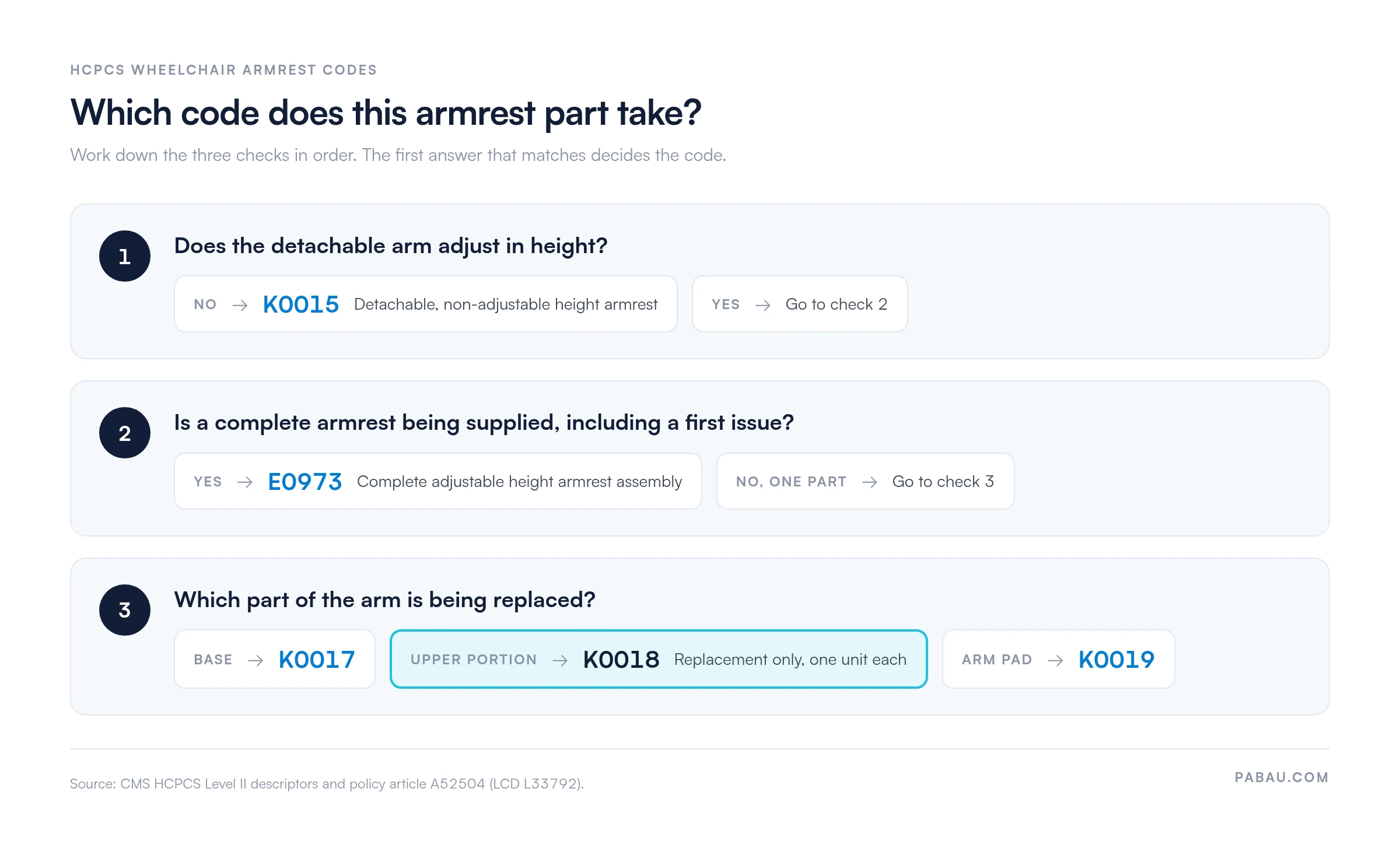
The component you replace decides the code. K0017 is the base, K0018 is the upper portion, and K0019 is the arm pad. A complete armrest is a different code again.
Decision rule: Start with the part in your hand, not the product name. If the arm does not adjust in height, K0018 is out. If the whole arm is being supplied, use E0973. If only the moving upper section has failed, K0018 is the code. The flow below runs the same three checks in order.
Parts from different manufacturers look alike, so check the product listing with the PDAC contractor when the code is unclear. A PDAC coding verification names the code for that model and holds up under audit.
Coverage comes from LCD L33792, Wheelchair Options and Accessories, applied by your DME MAC. The LCD groups K0018 with E0973, K0017, and K0020 as adjustable arm height options. All four share one coverage test.
Both conditions belong in the medical record before delivery. A note saying “patient needs adjustable arms” does not meet the first one. It should say what arm height the patient needs and why a fixed arm misses it.
The general conditions for any wheelchair accessory still apply on top of that test:
K0018 never covers the first armrest on a chair. The policy article A52504 treats K0017, K0018, and K0019 as parts of the complete E0973 assembly. They are included in its allowance, so they are not billed alongside it.
The same article lists detachable non-adjustable arms with a pad under K0015. Those get no separate payment at initial issue. Adjustable height armrests (E0973, K0020) may be billed separately when the coverage test is met.
The diagnosis on a K0018 claim has to support the wheelchair itself. The notes then explain why the patient needs a non-standard arm height. The categories below are common on wheelchair claims, but your DME MAC LCD sets the rules.
A diagnosis that supports the base wheelchair does not prove the arm height need on its own. The clinical note carries that part of the case.
A reviewer judges a replacement part by the file behind it. The medical billing compliance standards for DME claims expect the file to support the claim at the time of supply. Build these records before the part goes out.
Keep the full file for at least seven years. Audits often open long after payment, and a missing document then means repaying the claim.
K0018 goes out on a CMS-1500, or the 837P electronic equivalent, to your DME MAC. Each step below leaves something the next one needs.
Policy article A52504 sets the rule for KX. Add it only when the base wheelchair coverage criteria and the accessory criteria are both met. A line with none of KX, GA, GY, or GZ is rejected as missing information.
RB has limits too. It is not used for an upgrade after the base was supplied, or when the part is supplied with a new wheelchair base.
KX is an attestation that the file already proves both coverage criteria. Check the arm height note and the daily wheelchair hours before the modifier goes on the line, not after a records request.
Medicare prices K0018 from the CMS DMEPOS fee schedule. CMS publishes allowed amounts by state, updates them each January, and revises them during the year when needed.
This guide does not quote a dollar figure, because the amount depends on the patient’s state and the date of service. Pull the current figure from the CMS DMEPOS fee schedule file or your DME MAC’s lookup tool. The Physician Fee Schedule search does not list K-codes.
A participating supplier accepts the Medicare allowed amount as payment in full. A secondary insurer may then pick up some or all of the 20% coinsurance.
The table below pairs each common K0018 denial or rejection with its fix, based on LCD L33792 and its policy article. Reading the reason code on the remittance against the denial codes in medical billing reference shortens the denial management cycle.
A K0018 claim fails when the order, the clinical note, and the claim live in separate systems. The biller picks the code without seeing the note, and a missing delivery record surfaces only after a rejection.
Pabau, the practice management platform we build, keeps those records on one patient file. Its claims management software opens each claim pre-filled from the invoice. It then scrubs the claim for missing or invalid details before it goes to the clearinghouse as a CMS-1500.
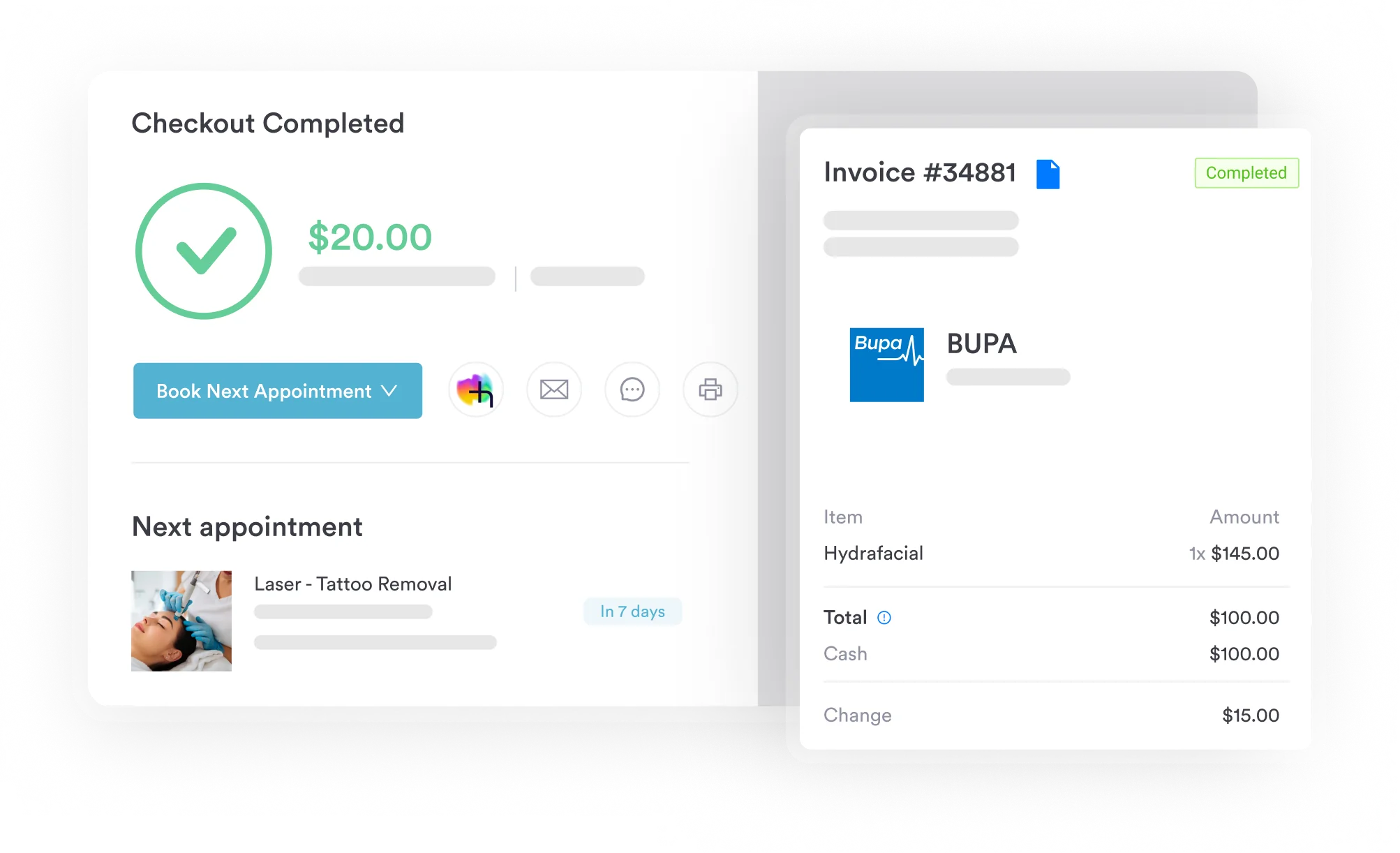
A claim that comes back with an error is flagged Needs action. One click opens the field that needs correcting, so a missing KX or RB modifier is fixed before resubmission. Understanding medical billing workflows helps your team decide where those checks sit.

Pabau’s claims management scrubs each claim for missing or invalid details before submission. Rejections are flagged with a link to the field to fix, so replacement-part claims go back out fast.

Bill K0018 only when the part in hand is the moving upper section of an adjustable arm on a chair Medicare already covers. Any other part, or a first issue, takes a different code.
The claim is won or lost before delivery. If the note names the arm height the patient needs and records two hours of daily use, KX simply states a fact. If it can’t, have the patient sign an ABN before delivery and bill with GA.
Checking those two facts by hand on every replacement part slows a billing team down. Book a demo to see how Pabau scrubs each claim against the patient record before it goes out.

Need a structured approach to reducing claim rejections? Denial management in healthcare covers the end-to-end process for tracking, appealing, and preventing claim denials across coding categories.
Want to understand how CARC codes map to corrective actions? Denial codes in medical billing provides a reference guide to Claim Adjustment Reason Codes and what each one requires from the billing team.
Replacing the base instead of the upper portion? HCPCS code K0017 covers the adjustable armrest base, with its own coverage and documentation checks.
Billing another wheelchair accessory on the same claim? HCPCS code K0038 explains how the wheelchair leg strap is coded and documented.
Looking for a structured billing document for each visit? What is a superbill? explains how a superbill lists codes and charges, and how it supports a clean claim.
HCPCS code K0018 is the Level II code for the upper portion of a detachable, adjustable height wheelchair armrest. It is billed only as a replacement part, one unit per armrest upper portion, under Medicare Part B.
They cover different parts of the same armrest. K0017 is the base, K0018 is the upper portion, and K0019 is the arm pad. All three are replacement-only codes, so bill the part that failed.
Yes, when the patient needs an arm height that nonadjustable arms cannot provide and spends at least two hours a day in the wheelchair. The base wheelchair must also be covered, per LCD L33792.
No. K0017, K0018, and K0019 are parts of the complete E0973 armrest assembly and are included in its allowance. A first adjustable height armrest is billed as E0973 when the coverage test is met.
Use RB when the upper portion replaces the same part after wear or damage. Every line also needs one of KX, GA, GY, or GZ, or it is rejected as missing information.
Keep a dated practitioner order and a note recording the arm height need and daily wheelchair hours. Add a description of the failed part, the base wheelchair record, and signed proof of delivery.
Medicare pays from the CMS DMEPOS fee schedule amount for the patient’s state, or your charge if lower. It pays 80% after the Part B deductible. Check the current fee schedule file before billing.