HCPCS Code V5095: Semi-implantable middle ear hearing prosthesis
HCPCS Code V5095: Definition and clinical descriptor HCPCS Code V5095 is the Lev...

Last Updated: Nov 25, 2026
82951 is the CPT code for a glucose tolerance test (GTT) with three timed blood specimens, the glucose itself included. Each specimen drawn after the third is reported with add-on code 82952.
82950 covers a single post-dose specimen, so it is not billed with 82951 for the same session. Before the claim goes out, check two fields: the unit count and the diagnosis code.
Let Pabau's smart automation suggest the right codes, reduce claim denials, and keep your practice compliant—effortlessly.
Automate repetitive tasks and focus on what matters most—your patients.
Reduce coding errors and ensure compliance with the latest regulations.
Clean claims, fewer denials, and faster reimbursements.
Powerful insights and reporting to help your practice thrive.
HIPAA compliant SOC 2 certified GDPR-compliant Trusted by 4,000+ clinics worldwide

CPT code 82951 covers a glucose tolerance test with three timed blood specimens and is billed as one unit per test session.
Each specimen drawn after the third is reported with add-on code 82952, so a 3-hour OGTT bills 82951 plus one unit of 82952.
82950 and 82951 are not billed together for the same session, and a bundling denial on that pair comes back as CARC CO-97.
Common ICD-10-CM pairings include Z13.1, O24.419, O24.429, R73.09 and E11.65, and Medicare’s diabetes screening benefit accepts only Z13.1.
Pabau’s claims management software submits claims through the Claim.MD clearinghouse, checks eligibility before the test, and posts remittances against the patient record.
CPT code 82951 reports a glucose tolerance test (GTT) with three timed blood glucose specimens, collected after a standard oral glucose load.
CMS Transmittal 12694 quotes the full descriptor as Glucose; tolerance test (GTT), three specimens (includes glucose). Each specimen beyond the third is billed with add-on code 82952. A single post-dose specimen is 82950, and a single quantitative glucose is 82947.
The oral glucose tolerance test (OGTT) follows a standardized sequence. The specimen timeline matters to coders because the timed draws on the lab report decide which codes, and how many units, go on the claim.
The performing laboratory needs CLIA certification, because the oral glucose tolerance test is a non-waived test under the Clinical Laboratory Improvement Amendments (CLIA).
CPT 82950 covers a single post-glucose-dose blood specimen, while CPT code 82951 covers the multi-specimen tolerance test with three timed draws. Draws beyond the third move to add-on code 82952 rather than changing the 82951 unit count.
When a patient fails the 82950 screen and returns for the full diagnostic OGTT, bill 82951 for that later visit. Do not bill 82950 on the same claim as 82951 for the diagnostic test.
The chart below turns the specimen count into the claim lines, from the 1-hour screen to protocols longer than three hours.
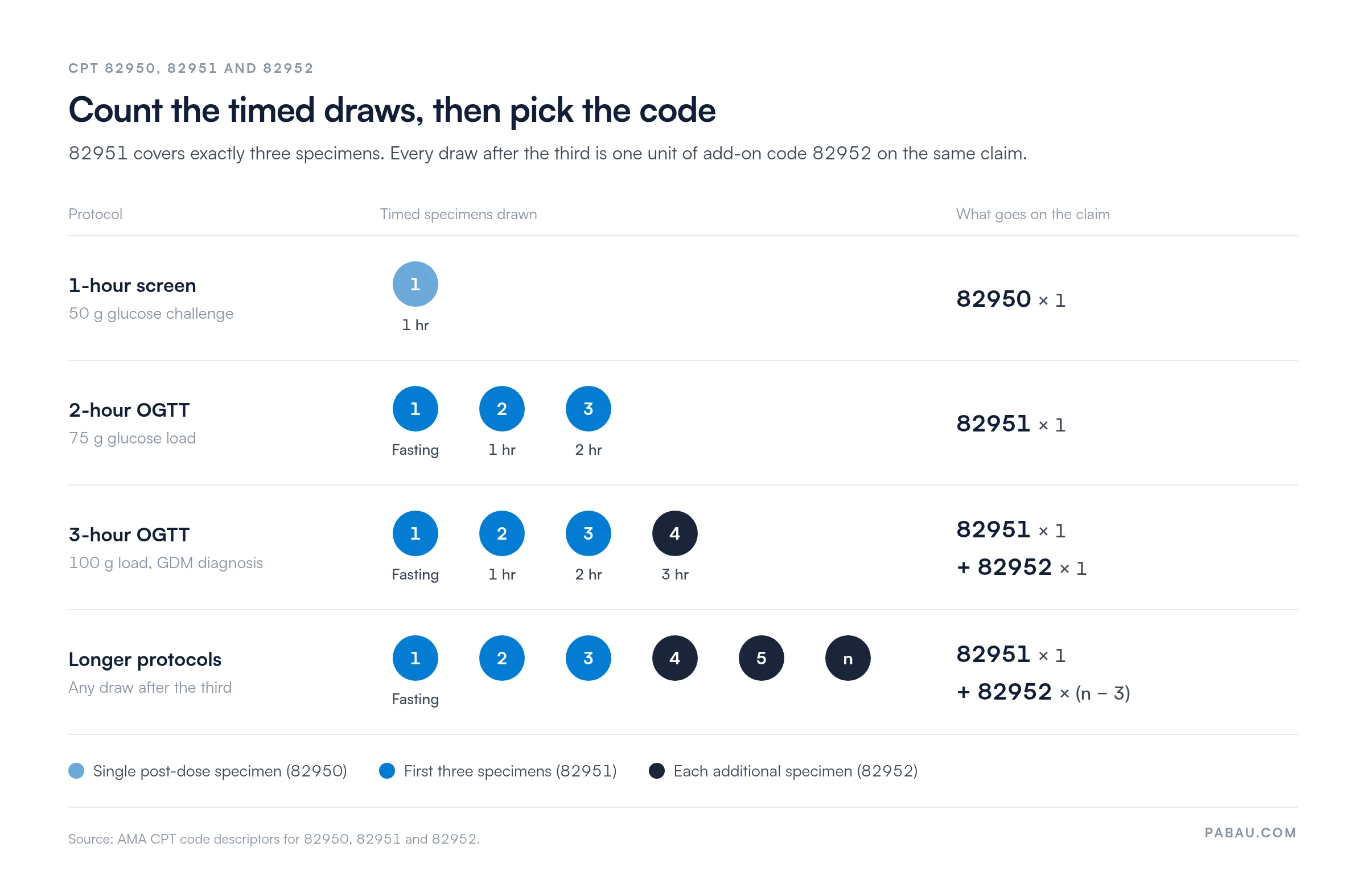
CPT code 82951 is reported once per test session and covers the first three specimens. Any specimen beyond the third is reported with add-on code 82952, never with extra units of 82951.
Submit 1 unit of 82951 for each GTT session. A four-specimen test (fasting, 1-hour, 2-hour, 3-hour) bills as 1 unit of 82951 plus 1 unit of 82952 for the fourth specimen. Submitting more than 1 unit of 82951 will draw an overpayment flag or a denial from most payers.
Modifier 91 applies when the same lab test is repeated on the same day for the same patient. The repeat has to be clinically necessary, not run to confirm an initial result. For CPT code 82951, it fits only when a full GTT is ordered twice on the same calendar day for a documented clinical reason. Misused modifier 91 is an audit risk, so record the clinical justification before appending it.
Before submitting a claim for CPT 82951, check that the lab report lists each specimen’s collection time and glucose result. Count the timed results: three means 82951 alone, and every result after the third is one unit of 82952.
The diagnosis code on the claim has to establish medical necessity for the multi-specimen glucose tolerance test. The codes below are common pairings, subject to the active Local Coverage Determination (LCD) in your MAC jurisdiction.
Screening claims follow a narrower rule than diagnostic ones. Under CMS Transmittal 12694, Medicare’s diabetes screening benefit covers 82951 only with Z13.1 on the claim. Verify diagnostic pairings against your MAC’s active LCD before submitting, because contractors update those lists periodically.
Medical necessity for CPT code 82951 rests on a documented clinical indication. The ordering provider’s note must connect the indication to the test, not just list a diagnosis code on the claim.
Medicare covers CPT code 82951 under Part B and pays it from the Clinical Laboratory Fee Schedule (CLFS). CMS publishes the CLFS rates as quarterly files. Lab codes like 82951 carry a flat payment amount rather than relative value units.
Coverage for Medicare beneficiaries depends on meeting the medical-necessity criteria in the applicable MAC Local Coverage Determination. Key requirements include the following.
Several chemistry codes appear on the same encounter as CPT code 82951. Some are appropriate to co-bill, and others are mutually exclusive.
Denials for CPT code 82951 cluster around five root causes. Each one has a fix when it is caught early in the revenue cycle.
Reviewing electronic remittance advice on denied 82951 claims shows the specific denial reason. Our guide to denial codes pairs each code with its corrective action.
A complete medical record for CPT code 82951 contains each of the following elements. A missing item is grounds for a denial on audit or appeal.
Run a quarterly audit of 82951 claims using your practice management system’s denial report. Filter for CO-97 (payment included in another service) and CO-11 (diagnosis inconsistent with procedure). Most of those denials trace back to a claim edit rule or a documentation checklist that needs updating.
Most 82951 denials start with a detail that never reached the claim form. The third or fourth timestamp sits in the lab system, the screening diagnosis sits in the visit note, and billing works from a re-keyed summary.
Pabau, a practice management platform, keeps the clinical record and the claim in one system. Its claims management software handles submission, eligibility checks, claim status and remittance posting against the same patient record.
Claims route out through the Claim.MD clearinghouse. An eligibility check before the test date tells the front desk whether an ABN is needed. The remittance then posts back to the patient’s account, so a CO-97 or CO-11 surfaces the day it arrives.

Pabau’s claims management software submits claims through the Claim.MD clearinghouse, checks patient eligibility before the test, and posts remittances against the patient record. See how it handles lab billing for glucose tolerance testing.

An 82951 claim is only as good as the lab report behind it. Count the timed results before anyone touches the claim: three means 82951 alone, and each one after that is a unit of 82952.
The trade-off sits with the 3-hour gestational diabetes test. Leaving 82952 off loses the fourth specimen’s payment, while adding units to 82951 instead invites a denial. Settle the diagnosis code before the test date too, since a Medicare screening claim needs Z13.1. Book a demo to see how Pabau keeps lab results, eligibility checks and claims in one place.

Need a clearinghouse for lab claim submission? Pabau’s Claim.MD clearinghouse guide explains how the integration handles 837P claim files, real-time eligibility, and ERA remittances for US practices.
Billing insulin alongside a GTT? Superbill guide covers how to structure a superbill for multi-code lab encounters, including co-billed insulin and glucose codes.
CPT code 82951 is the billing code for a glucose tolerance test (GTT) with three timed blood specimens. It is ordered to screen for or diagnose gestational diabetes, impaired glucose tolerance, or insulin resistance. It is reported once per session, and each specimen after the third is billed with add-on code 82952.
CPT 82950 covers a single post-glucose-dose blood specimen, usually the 1-hour 50 g challenge screen. CPT 82951 covers the multi-specimen diagnostic test with three timed draws. Billing both on the same date of service is unbundling, and the payer denies it with CARC CO-97.
One unit per test session. Specimens after the third are not added as units of 82951. Each one is billed as 1 unit of add-on code 82952, so a 4-specimen, 3-hour test bills 82951 plus 1 unit of 82952.
Yes, Medicare Part B covers CPT 82951 under the Clinical Laboratory Fee Schedule. Medical necessity must be established through a supported ICD-10 diagnosis code, and the performing lab must hold a valid CLIA certificate. Coverage is subject to the applicable MAC Local Coverage Determination, so verify the active LCD for your jurisdiction before submitting.
Yes, for the diagnostic step. The 3-hour 100 g OGTT follows a failed 1-hour 50 g challenge, which is billed as 82950. It is reported with 82951, plus 1 unit of 82952 for the fourth draw. It pairs with ICD-10 codes O24.419 or O24.429 for gestational diabetes. Confirm MAC LCD coverage requirements for your payer and jurisdiction.
The most common reasons are an unsupported ICD-10 diagnosis code (CO-11) and a wrong unit count. Others are 82950 billed with 82951 on the same encounter (CO-97), missing specimen timestamps, and no signed ABN when Medicare coverage is conditional. Pre-submission claim edits and a documentation checklist prevent each of them.