HCPCS Code V5095: Semi-implantable middle ear hearing prosthesis
HCPCS Code V5095: Definition and clinical descriptor HCPCS Code V5095 is the Lev...

Last Updated: Nov 25, 2026
81225 is the CPT code for CYP2C19 gene analysis of common variants (eg, *2, *3, *4, *8, *17), used to predict drug metabolism. CYP2C19 is cytochrome P450, family 2, subfamily C, polypeptide 19.
It is a Tier 1 molecular pathology code for a single-gene test. The result sorts the patient into a metabolizer phenotype, from poor to ultrarapid. Prescribers use it to guide clopidogrel, antidepressant, PPI, and voriconazole therapy. Medicare pays it under the Clinical Laboratory Fee Schedule, with coverage set by MolDx LCDs.
Let Pabau's smart automation suggest the right codes, reduce claim denials, and keep your practice compliant—effortlessly.
Automate repetitive tasks and focus on what matters most—your patients.
Reduce coding errors and ensure compliance with the latest regulations.
Clean claims, fewer denials, and faster reimbursements.
Powerful insights and reporting to help your practice thrive.
HIPAA compliant SOC 2 certified GDPR-compliant Trusted by 4,000+ clinics worldwide

CPT Code 81225 covers CYP2C19 gene analysis for common variants, which sets it apart from CPT 81226 (CYP2D6) and CPT 81227 (CYP2C9).
Medicare covers 81225 under MolDx LCDs only for specific indications, such as clopidogrel or antidepressant therapy. Blanket PGx panels are often non-covered.
Most denials trace back to a missing clinical rationale, a non-covered ICD-10 pairing, or an unbundling error on same-day gene codes.
Pabau’s claims management software submits claims through Claim.MD, tracks claim status, and surfaces denial patterns before they repeat.
CPT Code 81225 is the Tier 1 molecular pathology code for CYP2C19 gene analysis, covering the common variants that influence drug metabolism.
AAPC’s CPT code reference files it under Tier 1 molecular pathology procedures, within the pathology and laboratory section. CYP2C19 stands for cytochrome P450, family 2, subfamily C, polypeptide 19.
The official descriptor lists the common variants as *2, *3, *4, *8, and *17, and the AMA CPT Editorial Panel can revise that set. The result assigns the patient a metabolizer phenotype: poor, intermediate, normal (extensive), or ultrarapid. That phenotype guides prescribing for drugs that rely on CYP2C19 for activation or clearance.
CYP2C19 testing is clinically indicated whenever a patient’s response to a CYP2C19-metabolized drug carries meaningful safety or efficacy consequences. The FDA’s table of pharmacogenomic biomarkers shows which drugs carry CYP2C19 prescribing language in their approved labels.
The most common ordering scenarios, and the ones most likely to pass payer medical necessity review, are:
Documentation must connect the specific drug, the clinical scenario, and the patient’s current or planned therapy. Most LCDs reject orders placed for general wellness screening or population health programs.
CPT 81225, CPT 81226, and CPT 81227 are three separate Tier 1 molecular pathology codes analyzing different cytochrome P450 genes. Coders and ordering physicians frequently confuse them because all three appear in pharmacogenomic testing panels.
Each code targets a distinct gene. Billing the wrong one is a common, preventable denial, and so is billing all three where NCCI edits restrict same-day billing.
When a laboratory runs all three gene analyses on the same date of service, the NCCI edit tables decide how they are billed. They set whether the codes go out separately or under a panel code. Check the current NCCI edit table at cms.gov before billing 81225 with 81226 or 81227 on the same DOS. CMS revises these edit pairs periodically.
Medicare coverage for CPT Code 81225 runs through the MolDx (Molecular Diagnostic Services) program. MolDx manages the Local Coverage Determinations for molecular pathology codes in several MAC jurisdictions, including Palmetto GBA and Noridian.
Coverage depends on the clinical indication and the LCD in effect in that jurisdiction, and MolDx contractors do not all apply identical rules.
Coverage is generally limited to scenarios where CYP2C19 genotyping directly guides a treatment decision for a covered drug. The strongest covered indications are:
Routine pharmacogenomic screening without a drug-specific clinical rationale is typically non-covered. Outside MolDx jurisdictions coverage policies differ, so verify the applicable LCD number on cms.gov before submitting claims.
Payment comes from the Clinical Laboratory Fee Schedule (CLFS), which CMS updates each year. Under the Protecting Access to Medicare Act (PAMA), CLFS rates rest on private payer rate surveys run every three years. Check the current-year rate on the CMS Clinical Laboratory Fee Schedule page.
Before submitting a CPT 81225 claim to Medicare, confirm the MAC jurisdiction for the billing laboratory. MolDx LCDs apply in Palmetto GBA, Noridian, and the other MolDx territories. Claims outside those jurisdictions fall under separate contractor policies that may differ significantly. Document the specific drug therapy and clinical rationale in the ordering note, not just the test order.
Prior authorization for CPT 81225 depends entirely on the payer and plan. Medicare fee-for-service does not require prior authorization for laboratory tests, but LCD compliance is mandatory. Medicare Advantage plans, however, can and do impose prior authorization requirements that differ from traditional Medicare rules.
Among major commercial payers, prior authorization policies vary by plan tier and state:
Always verify the prior authorization requirement directly with the payer before the test is performed. Retroactive prior authorization is rarely granted for laboratory tests. Document the payer response, the authorization number if issued, and the date of the authorization check in the patient record.
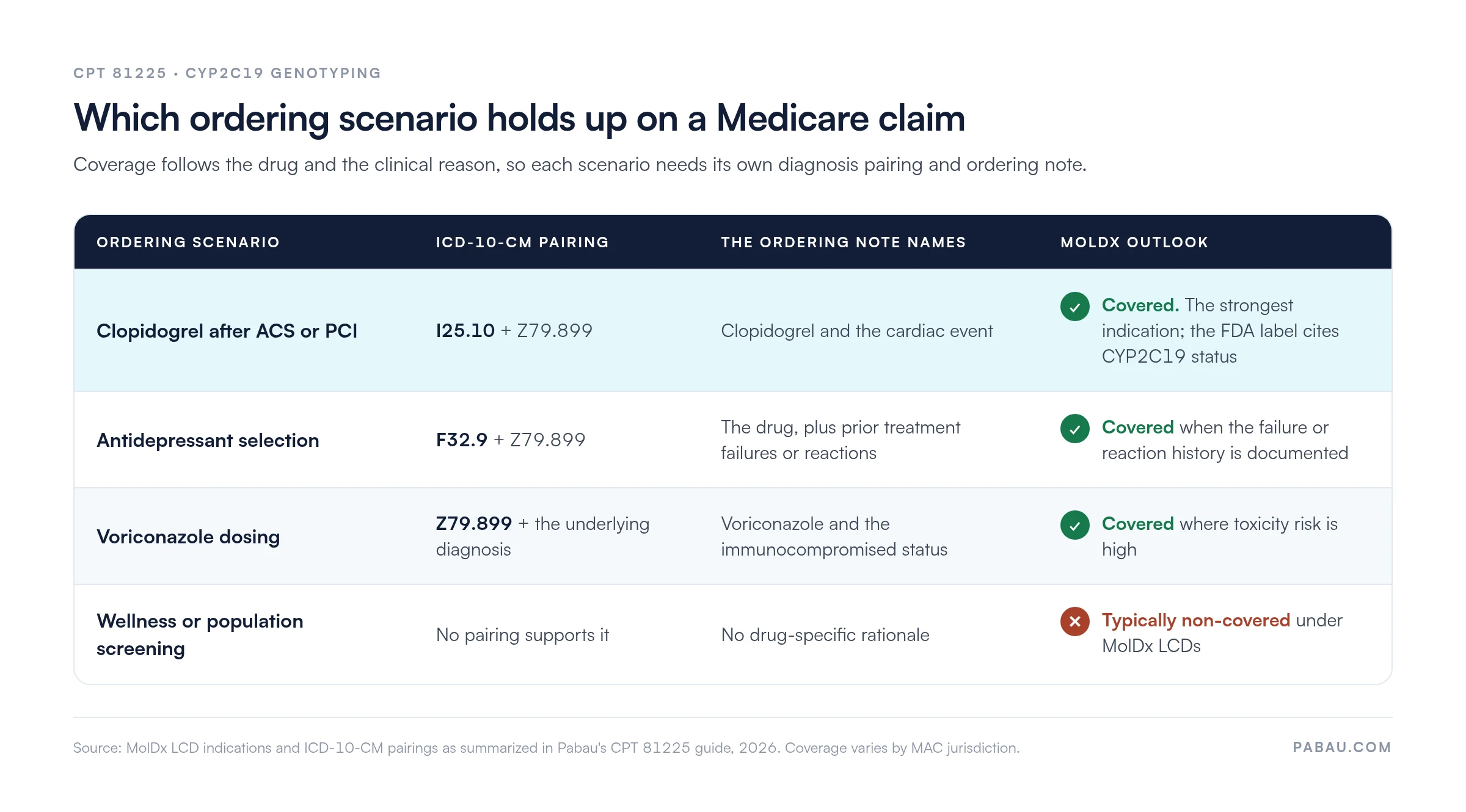
The ICD-10-CM diagnosis code paired with CPT 81225 must justify the medical necessity of CYP2C19 genotyping. A mismatch between the diagnosis code and the clinical indication is one of the most common denial reasons for this code. The table below shows the most accepted ICD-10 pairings by clinical scenario.
Z79.899 is widely accepted and flexible, but it must be paired with supporting documentation that names the specific drug and clinical rationale. Using Z79.899 alone without an accompanying diagnosis that explains why genotyping is needed will not satisfy medical necessity review at many payers.
Use the AAPC code lookup to cross-reference CPT-to-ICD-10 medical necessity crosswalks for 81225 before claim submission.
For post-PCI clopidogrel planning, I25.10 records the coronary disease that makes the test relevant. The matrix below lines up each ordering scenario with its pairing and its MolDx outlook.
CPT Code 81225 is reimbursed under the Clinical Laboratory Fee Schedule, not the Physician Fee Schedule. The CLFS rate is set by CMS through the PAMA market survey mechanism. Under PAMA, CMS periodically surveys private payer rates for laboratory tests and sets the CLFS rate at their weighted median. Rate cuts are then phased in over several years.
CLFS rates for molecular pathology codes have seen significant reductions under PAMA. Verify the current-year rate for CPT 81225 against the CMS CLFS annual update files, and attribute any cited rate to its year.
Commercial payer rates for 81225 vary considerably. Some payers carve laboratory benefits out to specialty lab benefit managers, which adds a separate fee schedule and contracting requirement.
A clean CPT 81225 claim requires documentation that confirms medical necessity at the time of ordering, not retrospectively. Missing or vague documentation is the leading cause of post-payment audit exposure for molecular pathology claims. The medical billing fundamentals that apply to all lab claims apply here, with added specificity requirements driven by LCD policy.
The medical record must contain:
Confirm your medical billing compliance practices cover lab orders before submission. The ordering note, the test report, and the claim must link to each other. The medical claims clearinghouse guide covers the submission workflow from clean-claim formatting through ERA receipt.
CPT Code 81225 denials follow predictable patterns. The denial reason code tells you which corrective action to take. Most of the common denials are preventable with front-end documentation controls.
Understanding denial codes in medical billing and denial management strategies helps labs and ordering practices run appeals as one workflow instead of case by case.
Run a quarterly audit of every 81225 denial from the past 90 days, sorted by denial reason code. When more than 30% share one root cause, fix the front-end check that should have caught it before submission. Most CPT 81225 denial patterns respond to a single ordering-note template update.
CPT Code 81225 can be billed alone or within a panel. It depends on what the laboratory performs and what the NCCI edit table says for those codes. AMA and CMS guidance on molecular panel coding has been revised several times, so check it again before a new panel goes live.
The general framework:
The practical rule is to read the modifier indicator on each column 1/column 2 edit pair. An indicator of 0 means the two codes cannot be paid together on the same DOS, whatever modifier is attached.
An indicator of 1 lets an appropriate modifier bypass the edit when the services are distinct. Without that modifier, the column 2 code is denied. Check the current edit table at cms.gov before billing any combination of 81225, 81226, and 81227.
Most 81225 denials start before the claim exists, in an ordering note that names the test but not the drug. The billing team then meets the problem weeks later, on a remittance.
Pabau, a practice management platform with built-in claims management software, keeps the ordering note, the test result, and the claim in one patient record. The coder builds the claim from the documented drug and indication, not from a re-keyed order.
Claims go out through Pabau’s Claim.MD integration, which reaches thousands of US payers. Real-time eligibility checks cover over 400 payers, and electronic remittance advice posts back against the expected fee schedule amount. A CLFS rate change then surfaces on the first remittance that reflects it.

Pabau connects to Claim.MD for real-time eligibility checks, electronic claim submission, and automated ERA posting. See how your lab billing team can reduce claim lag and denial rates.

A covered CPT 81225 claim is decided when the test is ordered. A note that names the drug, the clinical scenario, and the LCD indication usually gets paid. A note that names only the test rarely survives an appeal.
The trade-off is a slower order, and it is worth it. A minute on the ordering template saves a denial, a resubmission, and a CLFS reconciliation later. Start with clopidogrel orders, where coverage is strongest and the documentation rules are clearest. Book a demo to see how Pabau ties the ordering note to the claim in your molecular pathology billing.

Seeing recurring claim denials across your lab billing? Revenue cycle management fundamentals explains how to structure a denial tracking and appeals workflow that scales.
Looking for a primer on clean-claim formatting before submission? Clean claim requirements covers the field-level checks that prevent technical rejections on molecular pathology codes.
Billing another Tier 1 gene test? CPT code 81206 walks through BCR/ABL1 translocation analysis, a Tier 1 code billed under the same molecular pathology rules.
CPT Code 81225 is the billing code for CYP2C19 gene analysis of common variants, including *2, *3, *4, *8, and *17. The result classifies the patient as a poor, intermediate, normal, or ultrarapid CYP2C19 metabolizer. Prescribers use that phenotype to choose and dose drugs such as clopidogrel.
CPT 81225 analyzes the CYP2C19 gene, primarily relevant for clopidogrel, SSRIs, and PPIs. CPT 81226 analyzes the CYP2D6 gene, relevant for codeine, tamoxifen, and antidepressants. They are distinct codes for different genes and cannot be used interchangeably.
Medicare covers CPT 81225 for specific, documented indications under MolDx Local Coverage Determinations. These apply in Palmetto GBA, Noridian, and the other MolDx jurisdictions. Clopidogrel therapy planning after PCI and certain antidepressant selection scenarios are among the stronger covered indications. Routine wellness-based PGx screening is typically non-covered. Coverage rules differ by MAC jurisdiction, so verify the applicable LCD before submitting.
The most commonly billed Tier 1 molecular pathology codes in PGx testing are CPT 81225 (CYP2C19), CPT 81226 (CYP2D6), and CPT 81227 (CYP2C9). Multi-gene panels may require a single panel code rather than individual codes, depending on NCCI edit restrictions and the panel’s composition.
Traditional Medicare fee-for-service does not require prior authorization for CPT 81225. Medicare Advantage plans and commercial payers may require it, depending on the plan, including UnitedHealthcare, Aetna, Cigna, and BCBS affiliates. Verify the requirement with the payer before the test is performed, because retroactive authorization is rarely granted for lab tests.
Same-date billing of CPT 81225 with 81226 or 81227 is subject to NCCI edit restrictions. Whether all three are billed separately, or need a panel code, depends on the current NCCI edit table and the panel’s composition. Always check the current CMS NCCI edit table before billing several molecular pathology codes on the same DOS.