

CCSD code XR940: Foreign body retrieval billing guide
CCSD code XR940 is the UK private healthcare code for retrieval of a foreign bod...

Last Updated: Nov 26, 2026
J7188 is the HCPCS Level II code for injection, factor VIII (antihemophilic factor, recombinant), (Obizur), per i.u. It covers one product, Obizur, a recombinant porcine-sequence factor VIII for bleeding episodes in adults with acquired hemophilia A.
One billing unit equals one international unit administered. Medicare Part B pays the code from the quarterly ASP file, and the primary diagnosis is D68.311, acquired hemophilia, not D66.
Let Pabau's smart automation suggest the right codes, reduce claim denials, and keep your practice compliant—effortlessly.
Automate repetitive tasks and focus on what matters most—your patients.
Reduce coding errors and ensure compliance with the latest regulations.
Clean claims, fewer denials, and faster reimbursements.
Powerful insights and reporting to help your practice thrive.
HIPAA compliant SOC 2 certified GDPR-compliant Trusted by 4,000+ clinics worldwide

HCPCS Code J7188 covers one product, Obizur, a recombinant porcine-sequence factor VIII billed per international unit administered.
Obizur is indicated only for bleeding episodes in adults with acquired hemophilia A, so D68.311 is the primary diagnosis on the claim.
Congenital hemophilia A and von Willebrand disease bill under other codes, such as J7190, J7192, J7186, J7187 or J7183.
Medicare Part B pays J7188 from the quarterly ASP file at ASP plus 6%, not from the Physician Fee Schedule.
Obizur comes in single-dose vials, so every separately payable Medicare Part B claim line needs JW for discarded units or JZ for none. Packaged OPPS drug lines and inpatient IPPS claims fall outside that policy.
HCPCS Code J7188 is the Level II code for injection, factor VIII (antihemophilic factor, recombinant), (Obizur), per i.u. It covers a single branded product. According to the Obizur prescribing information, Obizur treats and controls bleeding episodes in adults with acquired hemophilia A.
CMS made the code effective on January 1, 2016, and it remains active in 2026. One billing unit equals one international unit (IU) of Obizur administered. Baxalta US Inc., a Takeda company, makes the product.
The descriptor names one product, so J7188 is a brand-specific code. If the vial in hand is not Obizur, J7188 is the wrong code.
Acquired hemophilia A happens when a patient with no bleeding history develops autoantibodies against their own factor VIII. Obizur follows the porcine factor VIII sequence. That matters because the antibodies were raised against human factor VIII.
The label sets clear limits on where the code applies:
Congenital hemophilia A bills under the human or recombinant factor VIII codes instead. The next section maps those neighbors.
Factor VIII codes split by product and source. Plasma-derived human factor VIII bills under J7190, not J7188. Check each descriptor against the current CMS HCPCS quarterly file before you choose.
Two checks settle the choice. Confirm the brand on the vial label, then confirm the diagnosis matches that product’s indication. An Obizur vial paired with a D66 diagnosis needs a query to the prescriber before anyone codes it.
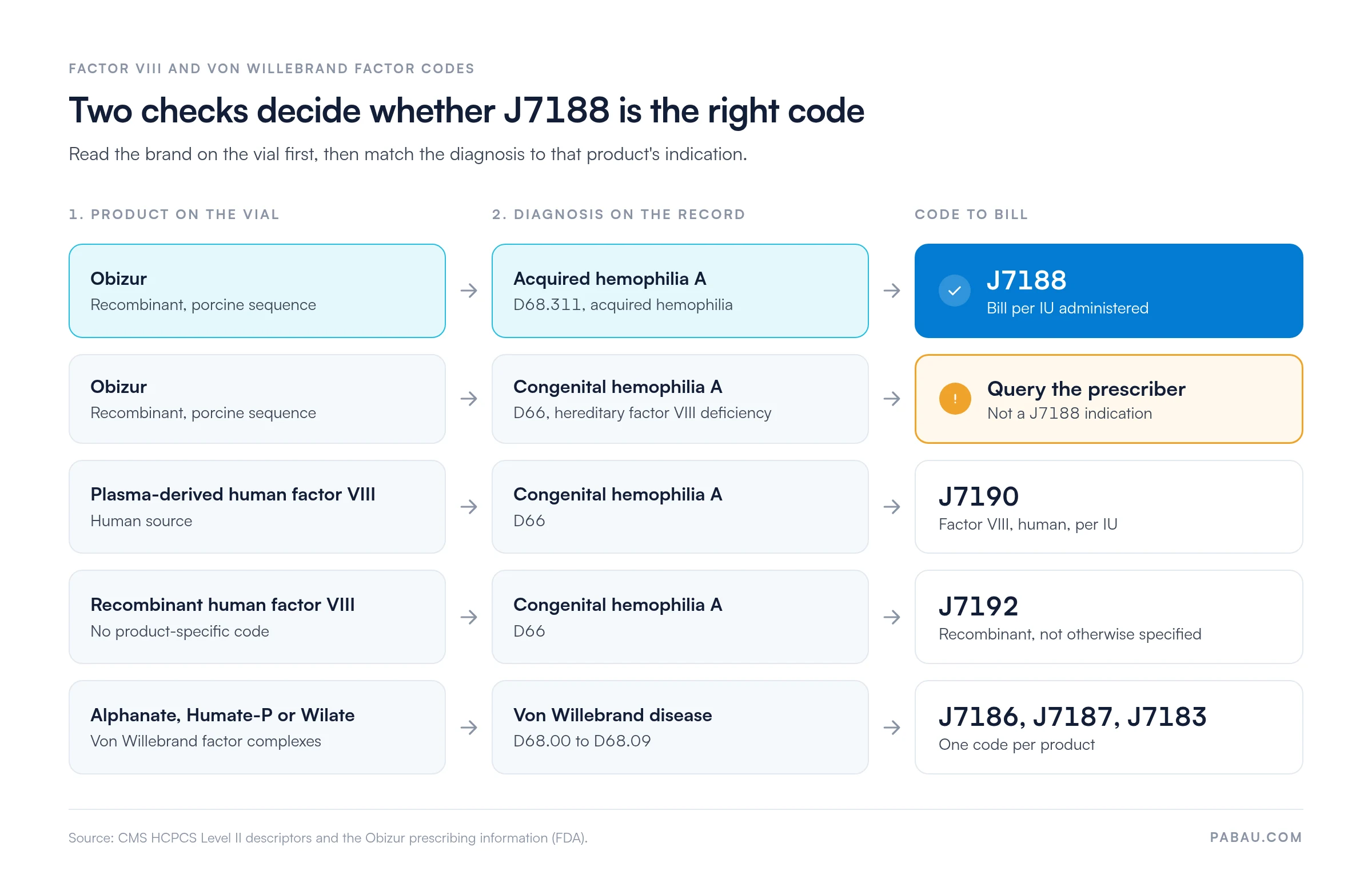
The von Willebrand factor complex codes have their own billing guides, including J7186 and J7187.
Bill one unit for each international unit of Obizur administered. Each single-dose vial holds nominally 500 units, and the exact potency is printed on the vial label.
Dosing is weight-based. The label sets an initial dose of 200 units per kg, then titrates by factor VIII recovery and clinical response. Total the units from the potency on each vial, not from the nominal 500.
Report the administered and discarded amounts on separate lines. Never bill the nominal vial total when the documented dose differs from it.
Medicare Part B pays J7188 under the Average Sales Price method in section 1847A of the Social Security Act. The payment limit is ASP plus 6% per unit, published in the quarterly CMS ASP pricing files. The Physician Fee Schedule does not price J7188.
Clotting factors also carry a furnishing fee. For 2026, CMS set it at $0.265 per unit, and it is included in the published payment limit for clotting factor codes.
Several adjustments sit between that limit and the payment you receive:
One acquired hemophilia A bleed can need tens of thousands of units of Obizur. A small change in the quarterly ASP limit moves the claim total sharply. Load each new ASP file into your fee schedule before the quarter starts.
State Medicaid programs and many commercial payers require the 11-digit NDC alongside J7188. Medicare Part B generally does not, but secondary payers often do.
The FDA label lists Obizur kit NDCs 0944-5001-01, 0944-5001-05 and 0944-5001-10, for 1-, 5- and 10-vial packages. Copy the NDC from the package you dispensed. Then convert it to the 5-4-2 format, so 0944-5001-01 becomes 00944-5001-01.
On a CMS-1500, the NDC goes in the shaded area of item 24A with the N4 qualifier. On an 837P, it goes in loop 2410, with the quantity and unit of measure beside it.
Obizur comes in single-dose vials, so J7188 falls under the CMS JW and JZ modifier policy. Every separately payable Medicare Part B claim line for the drug carries one of the two modifiers. The policy does not reach packaged OPPS drug lines or inpatient claims paid under IPPS.
Record the vial potency, the units given and the units discarded in the administration note. Reviewers compare those figures with the JW line. Commercial adoption of JZ varies, so check each payer’s policy.
D68.311, acquired hemophilia, is the primary diagnosis on a J7188 claim. It matches the only indication on the Obizur label. Confirm current code status in the CDC/NCHS ICD-10-CM files before you submit.
Code the underlying condition too when the record documents one. Acquired hemophilia A often appears alongside autoimmune disease, cancer or a recent pregnancy, and payers read those codes as context.
Acquired hemophilia A bleeds are often severe, so most Obizur doses are given in a hospital. The place of service decides who bills the drug and on which form.
Medicare Part B fee-for-service does not require prior authorization for J7188. Most commercial plans, Medicare Advantage plans and Medicaid managed care plans do. Ask each plan whether it accepts a retrospective request after an emergency dose.
A request, and the record behind the claim, usually needs these items:
A clean claim depends on those details being in the record before billing. Medical billing compliance reviews check the same match between the record and the claim line.
Denials on J7188 cluster around a few avoidable errors. The table maps each one to its cause and fix, drawing on denial management strategies that apply across specialty drug billing.
The denial codes guide lists the CARC and RARC codes these errors return.
Obizur claims fail on details recorded at the bedside: vial potency, units given, units discarded and the inhibitor results behind each dose. Pabau, a practice management platform with built-in claims tools, keeps those details on the patient record the claim is built from.
Pabau’s claims management software submits the codes, units, modifiers and NDC your team has documented. It then tracks each claim’s status, so a returned J7188 line shows up the day it comes back.
Your coders still choose the code and the diagnosis. Pabau keeps the documentation behind those choices on one record, so it flows to the claim line without retyping.

Pabau keeps dose, wastage and NDC details on the patient record, then submits the claim your team has coded and tracks it to payment. Fewer J7188 lines come back for missing data.

J7188 is a narrow code. It bills Obizur alone, and only for acquired hemophilia A bleeds in adults. Treat it as a plasma-derived factor VIII code and the claim fails on the product, the diagnosis and the units at once.
Start each claim from the vial label and the hematology note. If the vial says Obizur and the diagnosis is D68.311, bill the units given from the printed potency. Then add JW or JZ, and price the line from the current ASP file.
Book a demo to see how Pabau keeps hemophilia drug documentation and claims on one record.

Billing plasma-derived factor VIII instead? HCPCS code J7190 covers human factor VIII for congenital hemophilia A, with units and payment rules.
Need a full framework for submitting drug claims without errors? Medical billing fundamentals explains the end-to-end claims process from encounter to payment posting.
Seeing recurring denials you cannot resolve? Denial management in healthcare covers root-cause analysis and appeal workflows for specialty drug denials.
Want to understand the clearinghouse role in HCPCS drug claims? Medical claims clearinghouse explains how 837P transactions reach payers and where NDC validation happens.
HCPCS Code J7188 covers injection of Obizur, antihemophilic factor (recombinant), porcine sequence, billed per international unit. Obizur is indicated for acquired hemophilia A bleeding episodes in adults. It is not indicated for congenital hemophilia A or von Willebrand disease, which bill under other factor codes.
Report one unit per international unit administered, based on the potency printed on each vial. Obizur vials hold nominally 500 units. If 14,000 units are given from vials holding 14,560, bill 14,000 units. Report the 560 discarded units on a separate JW line.
J7188 is product-specific and covers Obizur, a recombinant porcine-sequence factor VIII used in acquired hemophilia A cases. J7190 covers plasma-derived human factor VIII, used mainly when congenital hemophilia A is the diagnosis. Recombinant human factor VIII without its own code bills under J7192.
D68.311, acquired hemophilia, is the primary diagnosis. It matches the only indication on the Obizur label. D66 and the von Willebrand disease codes do not support J7188, because Obizur is not indicated for those conditions.
The most common causes are billing a non-Obizur product under J7188, reporting D66 instead of D68.311, and billing the nominal vial size. Leaving JW or JZ off a Medicare line is another. Missing prior authorization and invalid NDC formats cause most of the rest.



