ICD-10 Code V28.01XD: E-bike driver noncollision accident, nontraffic, subsequent encounter
ICD-10 Code V28.01XD: Definition and billable status ICD-10 Code V28.01XD is the...

Last Updated: Oct 20, 2026
Billable Code Specific Code
S35.492S is the billable ICD-10-CM code for other specified injury of left renal artery, sequela.
The 7th character S marks that phase of care, and it also fixes where the code sits on the claim. A sequela code never leads. Code descriptors follow the CMS ICD-10-CM code set.
Let Pabau's smart automation suggest the right codes, reduce claim denials, and keep your practice compliant—effortlessly.
Automate repetitive tasks and focus on what matters most—your patients.
Reduce coding errors and ensure compliance with the latest regulations.
Clean claims, fewer denials, and faster reimbursements.
Powerful insights and reporting to help your practice thrive.
HIPAA compliant SOC 2 certified GDPR-compliant Trusted by 4,000+ clinics worldwide

ICD-10 code S35.492S covers other specified injury of the left renal artery, sequela.
It is billable for FY2026, effective October 1, 2025, on both inpatient and outpatient claims.
The 7th character S marks a sequela encounter, so the code is never sequenced first on a claim.
When the record names the left renal artery, use S35.492S rather than S35.491S or S35.493S.
Practice management software like Pabau keeps the trauma note and every follow-up visit on one record, so coders can trace causality.
S35.492S is a billable, specific ICD-10-CM code in the FY2026 edition, effective October 1, 2025. The official description is other specified injury of left renal artery, sequela. It supports a diagnosis for reimbursement on both inpatient and outpatient claims.
The code belongs to the American ICD-10-CM version of the classification and is distinct from the international ICD-10 maintained by the World Health Organization. For US payers and Medicare, always reference the CMS/NCHS ICD-10-CM tabular list rather than the WHO browser.
Clinical documentation may phrase this diagnosis differently. Coders meet these variants in discharge summaries and operative notes when working the alphabetic index.
The parent code S35.492 needs a 7th character to be complete and billable. Three extensions are available, and each one reflects a different phase of the encounter. Picking the wrong character is a common error in trauma claims, especially at the handover from acute to follow-up care.
The 7th character does not describe the injury. It describes the phase of care at the current encounter. A patient whose left renal artery injury has healed, and who now presents with renovascular hypertension, is coded S35.492S rather than S35.492D.
Sequela coding follows Section I.C.19.a of the ICD-10-CM Official Guidelines. Those rules apply directly to S35.492S.
The physician’s note has to identify the current condition as a consequence of the prior injury. Wording such as “history of renal artery injury”, with nothing linking it to the current problem, will not support S35.492S. A medical chart audit is usually where that missing link surfaces.
Run a three-code check before the sequela claim goes out. The nature-of-sequela code comes first, S35.492S second, and the external cause code with its S character third. Miss one, or sequence them wrongly, and the claim is incomplete under Section I.C.19.a.
The hierarchy shows where the code sits in the tabular list, and which parent levels are not billable. S35.492S is the most specific billable code in its branch.
The parent code S35.492 is not billable on its own, and a claim carrying it will be rejected. Verify all seven characters before submission. The AAPC Codify ICD-10-CM lookup lets you walk the full S35 hierarchy when you need to confirm a neighboring code.
Coders working left renal artery injuries need the whole S35.49 family, plus the wider renal vessel set. Picking the wrong laterality, or the wrong specificity level, is a common audit trigger. Neighboring vessels in the same category carry their own codes.
Laterality matters. An auditor will flag a claim where the notes describe the left renal artery but the code names the right. The same happens when the code falls back on the unspecified variant. Where the report names the left renal artery, S35.492S is correct rather than S35.491S or S35.493S.
Keeping the operative report, the imaging.
The left renal artery branches directly off the abdominal aorta and supplies the left kidney. It is vulnerable to blunt trauma, penetrating injury, and iatrogenic damage during retroperitoneal procedures. Knowing which sequelae are common helps coders check that the nature-of-sequela code is specific enough.
Documentation that traces these late presentations back to the original vascular injury is what makes S35.492S defensible. Without that documented chain, the code cannot be sustained on review. Sports medicine practices tend to see the blunt-trauma cases first. Longer-term blood pressure and kidney function follow-up often lands with metabolic health teams instead. Billing compliance asks a narrower question than coding accuracy: can the practice defend this claim on review.
For inpatient admissions, S35.492S falls under Major Diagnostic Category (MDC) 21, Injuries, Poisonings and Toxic Effects of Drugs. FY2026 claims group through MS-DRG grouper version 43.0, which CMS updated to version 43.1 effective April 1, 2026. The specific DRG depends on documented complications and comorbidities (CC/MCC).
Sequela encounters are usually outpatient, such as a follow-up visit to manage renovascular hypertension. DRG assignment therefore matters less here than it does for the S35.492A initial encounter.
It does matter when a late complication drives an admission, such as endovascular repair of a post-traumatic pseudoaneurysm. Always pull the current CMS IPPS tables for FY2026 relative weights, since weights change every year.
The sequela character generates more coder queries than the initial or subsequent characters, simply because vascular trauma reaches this phase less often. These are the patterns that produce claim problems.
ICD-10-CM guidelines put the nature-of-sequela code first, such as renovascular hypertension I15.0. S35.492S follows it as the cause code. Leading with S35.492S reverses that order, which can trigger a rejection or a medical necessity denial. Code the condition being treated today first.
A patient who returns six months after left renal artery repair for a wound check is still in subsequent encounter territory. That visit takes S35.492D. The S character applies only once the original injury has resolved and a new complication drives the encounter. Defaulting to S for any late visit misapplies the guideline.
Submitting S35.493S for an unspecified renal artery, when the record clearly names the left side, is an avoidable specificity error. Payers score claims on diagnosis specificity, and an unspecified code can flag the claim for review. Check laterality against the operative report or imaging before you reach for S35.493S.
When you code the sequela of a traumatic injury, the external cause code should also carry the S character. Omitting it, or using it without the S extension, leaves the claim record incomplete. Earlier in the episode the same rule produces a D character instead, giving a cause code like W16.722D.
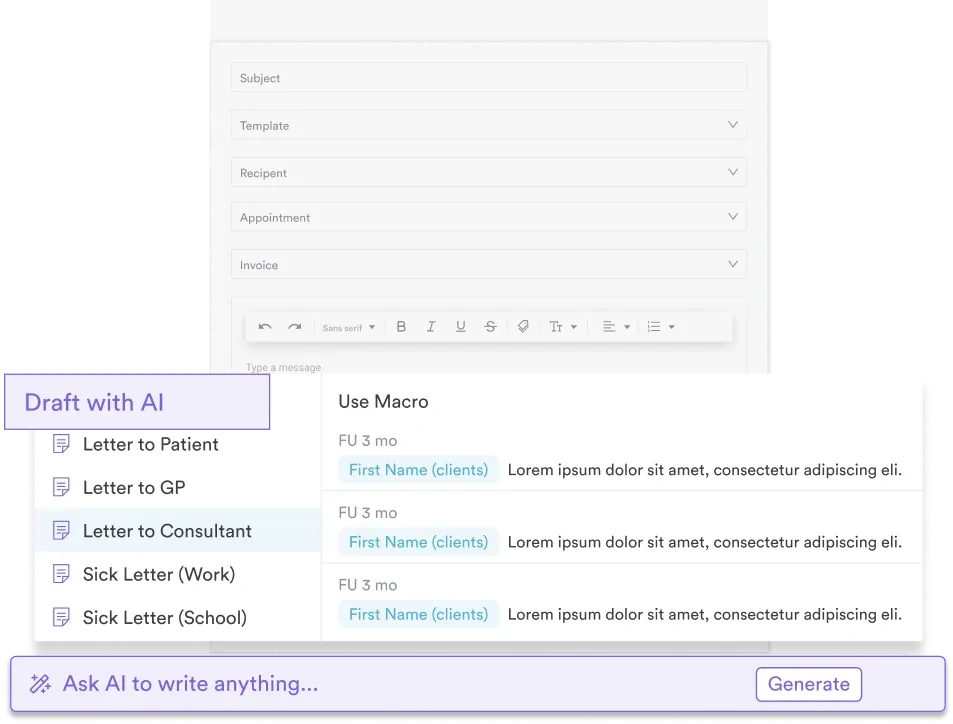
Generating the follow-up patient letter from the visit note keeps the mechanism of injury visible in the record.
Before submitting a sequela claim, run a three-code checklist: (1) nature-of-sequela code first, (2) S35.492S second, (3) external cause code with ‘S’ extension third. If any of the three is missing or sequenced incorrectly, the claim is incomplete under ICD-10-CM Section I.C.19.a guidelines.
In many practices the evidence for a sequela code sits in three places. The operative note is in one system and the follow-up visit is in another. The coder then works from a discharge summary that never states the link.
Practice management software like Pabau keeps that chain on a single patient record. The trauma note, the imaging report, and every follow-up visit stay attached to the same timeline.
Pabau Scribe. The causal sentence an auditor looks for gets written while the clinician is still with the patient.
The result is a chart that supports S35.492S on its own, without a retrospective query to the physician weeks after the visit.

Pabau holds the trauma note, the imaging, and every follow-up visit on one patient record. Coders can trace the causal link behind a sequela code without chasing paperwork.

The hard part of S35.492S is rarely the code itself. What decides the claim is whether the note says the current problem came from the old injury. Seven correct characters will not rescue a chart that never makes the connection.
So raise the query before the claim goes out, not after the denial lands. One sentence naming the original injury and its date turns a contested code into a defensible one. Across a year of follow-up visits, that habit is worth more than any code lookup.
Structured records are what make the habit stick. Book a demo to see how Pabau links follow-up visits back to the original injury for cleaner ICD-10 documentation.

Coding a sequela in another abdominal organ? S36.590S applies the same 7th character rules to an ascending colon injury.
Working through an abdominal wall injury? S31.142S shows how the sequela character works on an open wound code.
Coding a vessel injury in the chest? S25.509A covers an intercostal blood vessel injury at the initial encounter.
Coding anesthesia for a total shoulder replacement? Total shoulder replacement billing guide explains why the anesthesia carries 10 base units, not 8.
Billing anesthesia for a shoulder artery procedure? Shoulder and axilla artery anesthesia code covers the 6 base units and how a 90-minute case bills 12 units.
ICD-10 code S35.492S is a billable diagnosis code for other specified injury of the left renal artery, sequela. It means the patient has a late complication of a left renal artery injury that has already resolved. The 7th character S marks the encounter as a sequela visit rather than active treatment or routine aftercare.
Yes. S35.492S is a billable, specific ICD-10-CM code valid for FY2026, effective October 1, 2025. It can be submitted on both inpatient and outpatient claims. The parent code S35.492 carries no 7th character, so it is not billable and must not be submitted alone.
S35.492S groups under MDC 21, Injuries, Poisonings and Toxic Effects of Drugs. FY2026 claims run through MS-DRG grouper version 43.0, which CMS updated to version 43.1 on April 1, 2026. The final DRG depends on documented complications and comorbidities. Check the current CMS IPPS tables for relative weights, which change every year.
Under ICD-10-CM Official Guidelines Section I.C.19.a, a sequela is a late effect. It is a condition that arises as a direct result of a previous injury, after the acute phase has ended. Sequela coding needs two codes. Assign the nature of the sequela first, then the injury code carrying the S character.