HCPCS Code Q4185: Cellesta flowable amnion billing guide
HCPCS Code Q4185: definition and official descriptor HCPCS Code Q4185 is the Lev...

Last Updated: Nov 20, 2026
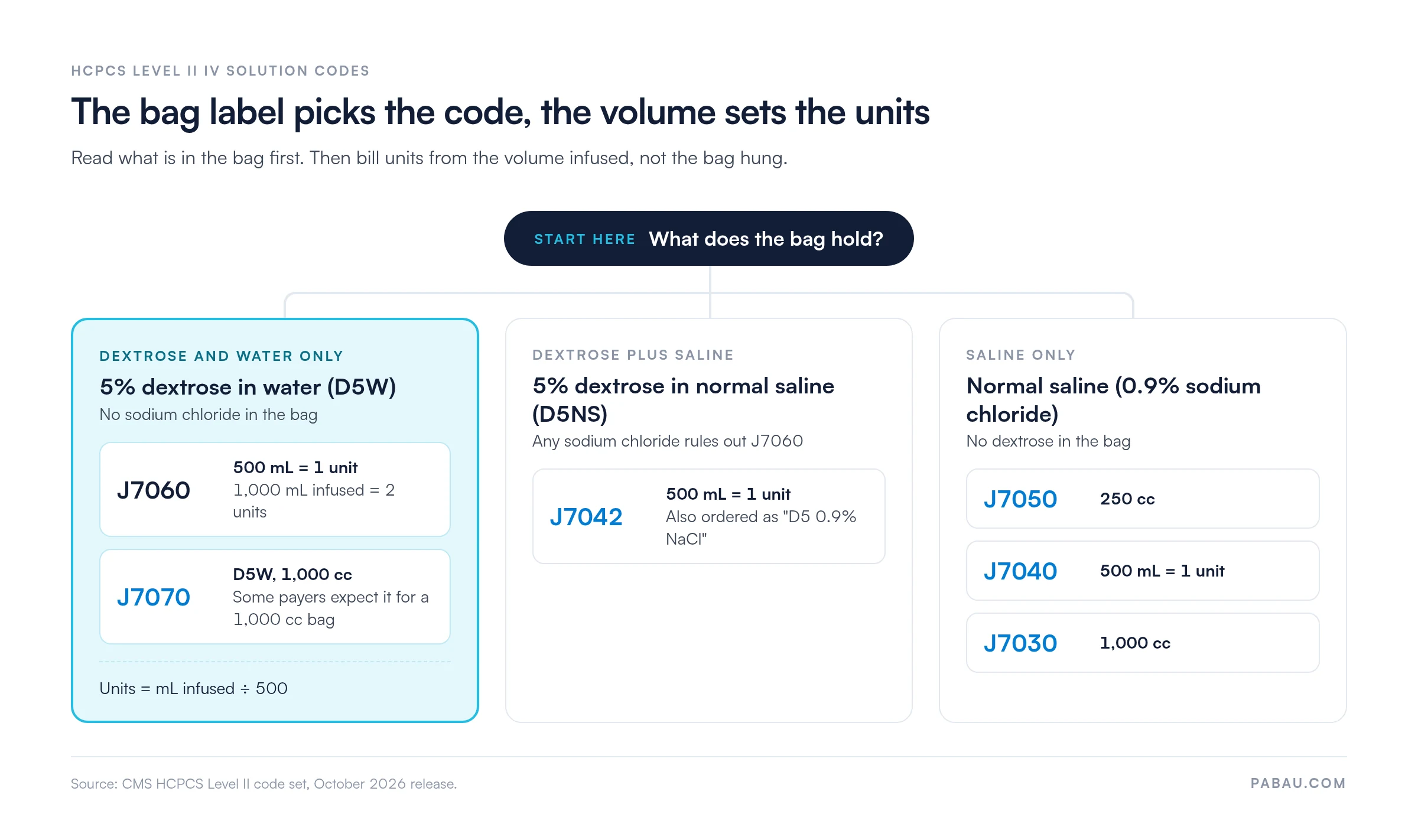
J7060 is the HCPCS Level II code for 5% dextrose/water (500 ml = 1 unit). Each 500 mL of D5W infused is one unit, so a 1,000 mL infusion bills 2 units.
J7060 is easily confused with J7042, which bills 5% dextrose in normal saline, and with J7070, the 1,000 cc D5W code. The wrong code or unit count overbills or underbills the claim.
Let Pabau's smart automation suggest the right codes, reduce claim denials, and keep your practice compliant—effortlessly.
Automate repetitive tasks and focus on what matters most—your patients.
Reduce coding errors and ensure compliance with the latest regulations.
Clean claims, fewer denials, and faster reimbursements.
Powerful insights and reporting to help your practice thrive.
HIPAA compliant SOC 2 certified GDPR-compliant Trusted by 4,000+ clinics worldwide

HCPCS Code J7060 bills 5% dextrose in water (D5W), with one unit for every 500 mL administered.
5% dextrose in normal saline (D5NS) is a different code, J7042, and the 1,000 cc D5W code is J7070.
Units follow the infused volume, so a full 1,000 mL infusion under J7060 bills 2 units.
Pabau’s claims management software keeps the infusion record and the claim together, so the unit count matches the chart.
HCPCS Code J7060 is the Level II code for 5% dextrose in water (D5W), with one unit equal to 500 mL of solution. Its official descriptor in CMS’s October 2026 HCPCS file reads “5% dextrose/water (500 ml = 1 unit).” D5W is plain dextrose in sterile water, with no sodium chloride in the bag.
CMS maintains the HCPCS Level II code set, and J7060 sits with the other IV solution codes in the J7000 range. It is not a CPT code, so the AMA Editorial Panel does not revise it. The CMS HCPCS Level II code set is updated each year, so check the descriptor against the current file before billing.
Use this table as a quick billing reference before you submit a J7060 claim:
J7060 covers one solution only: 5% dextrose in water, given intravenously. The substance, the concentration and the route all decide whether the code applies. For IV therapy practices that run hydration protocols, the chart has to name the exact solution given at each visit.
The bag label and the order decide the code. If the bag holds any sodium chloride, it is not D5W, and J7060 is a miscode. Check the administered formulation against the physician order before you assign the code.
Units for J7060 follow the administered volume, not the size of the bag hung. One unit equals 500 mL. Billing the bag size, not the infused volume, is the most common unit error on J7060 claims.
Divide the administered milliliters by 500 to get the unit count. Payers differ on partial units, so confirm the rounding rule in the payer policy or the MAC’s guidance. Always record the infused volume in the infusion record. Auditors check the billed units against the infusion start and stop times.
J7060 is a supply code for the solution only. The work of giving the infusion goes on the same claim under a separate CPT administration code.
When D5W only carries another drug, CPT treats that fluid as incidental hydration, so 96360 is not reported for it. The drug’s own HCPCS code goes on the claim with 96365.
Many payers also treat the carrier fluid as part of the drug administration and will not pay J7060 on top. Check the AAPC HCPCS Level II code reference for the drug code of the infused agent.
The IV solution codes look alike, but each one names one fluid at one unit size. Billing the wrong one means billing for a solution the patient did not receive. That is a miscoding error, and it can trigger a payer audit.
The sodium chloride is what separates J7060 from J7042. If the order says D5W, bill J7060. If it says D5NS, or “D5 0.9% NaCl,” bill J7042. Saline without dextrose belongs to J7030, J7040 or J7050, never to J7060.
Bag size can change the code as well. Some payers expect a 1,000 cc D5W bag on J7070 rather than as 2 units of J7060. The chart below sorts each code by what the bag holds, then by volume.
Medicare Part B covers J7060 when the infusion is medically necessary and ordered by a physician. Coverage depends on a record showing that the patient needed IV fluid. Payment comes from the Physician Fee Schedule or OPPS Addendum B, depending on the place of service.
Traditional Medicare Part B does not generally require prior authorization for J7060. Many commercial plans and Medicare Advantage plans do, mainly for recurring or home infusion therapy. Rules change with contract renewals, so review your medical billing compliance checks for each payer at the start of each plan year.
A typical authorization request includes the physician order naming D5W, the supporting ICD-10-CM code, and the planned volume and duration. It also carries the treating provider’s NPI. A denied request does not bar the infusion, but the claim will not be paid unless an appeal succeeds.
Auditors reviewing J7060 claims look for one unbroken chain, from the physician order to the end of the infusion. The basics of medical billing apply in full. The record must justify the charge, the charge must match the record, and the record must be available on request.
These are the documentation elements an auditor expects to find:
Weak documentation is the root cause of retrospective denials, where J7060 pays at first and is recouped at audit. To submit a clean claim, complete each element above before the claim goes out.
Most J7060 denials fall into a few repeating categories. The denial code tells you what went wrong, and the corrective action gets the claim paid.
Tracking denials across J7060 and related IV codes shows the patterns that drive revenue leakage. A guide to common denial codes helps you build appeal workflows. A structured denial management workflow turns avoidable write-offs into recovered revenue.
Before you resubmit a denied J7060 claim, pull the infusion record and recalculate units from the volume given. Then check the bag label: D5W bills J7060, D5NS bills J7042. Fix the code or the count, attach the record, and resubmit within the timely filing window.
Most J7060 errors start between the chair and the claim form. A nurse records “D5” in the chart, and a biller has to guess whether the bag held saline. A 1,000 mL bag is hung, 750 mL runs in, and the claim bills the bag.
In Pabau’s practice management system, the infusion record and the claim live in one place. Pabau’s claims management software builds the claim from the documented solution and volume. Submission, eligibility checks and claim status sit in the same place.
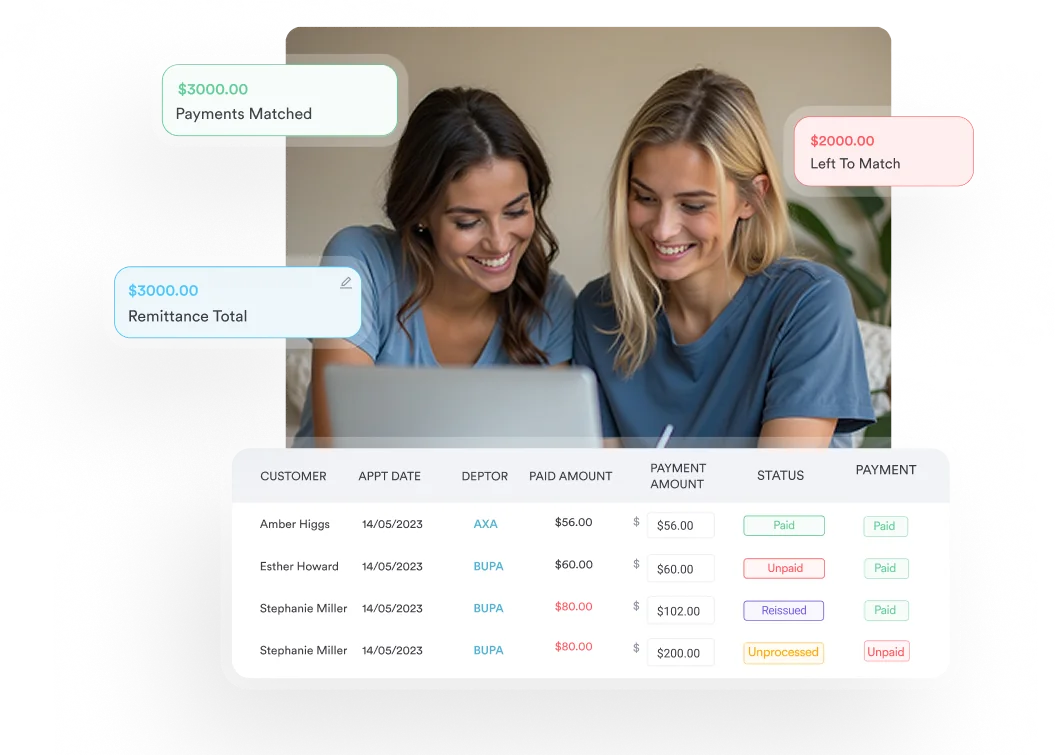
The result is a claim that matches the chart before it leaves the practice. Unit and code errors surface at the point of entry, not weeks later on a remittance.

Pabau’s claims management software ties solution type, administered volume and payer rules to the patient record. Your J7060 claims go out right the first time.

J7060 rests on two facts in the chart: the bag held 5% dextrose in water, and a set volume of it ran in. Get the solution wrong and the claim belongs to J7042 or J7070. Get the volume wrong and the units are off.
Both facts are recorded at the chair, long before a biller sees the claim. Practices that capture solution and volume in a structured field stop arguing with payers over them. To see how Pabau carries infusion documentation through to the claim, book a demo.

Billing D5W given on its own for hydration? CPT code 96360 covers the first hour of IV hydration that goes on the claim beside J7060.
Looking to understand how clearinghouse submissions work for drug codes? Medical claims clearinghouse guide explains EDI submission, 837P claim formats, and how drug codes like J7060 route through payer systems.
Want to reduce claim rejection rates across all billing codes? Revenue cycle management guide covers the end-to-end process from encounter documentation to payment posting.
HCPCS Code J7060 covers intravenous infusion of 5% dextrose in water (D5W), with one billing unit for each 500 mL administered. It does not cover 5% dextrose in normal saline, which is J7042, or plain normal saline.
One unit equals 500 mL of D5W administered. Divide the total administered volume in mL by 500 to get the unit count. Bill from the infusion record, not the bag size, so 1,000 mL infused bills 2 units.
J7060 is 5% dextrose in water (D5W), while J7042 is 5% dextrose in normal saline (D5NS). Both bill per 500 mL. If the bag contains sodium chloride, J7042 applies; if it holds dextrose and water only, J7060 applies.
Traditional Medicare Part B does not generally require prior authorization for J7060, but Medicare Advantage plans often do. Commercial payers vary, so check the plan’s policy and your MAC’s LCD. Requirements can change with annual plan renewals.
The top reasons are a unit count based on bag size, the wrong solution code, missing medical necessity, absent prior authorization and an uncovered diagnosis. Unit errors are the easiest to fix: pull the infusion record and recalculate.
For D5W given on its own for hydration, bill CPT 96360 for the first hour and 96361 for each additional hour. When D5W only carries a therapeutic drug, bill 96365 and 96366, and do not report the fluid as separate hydration.