CCSD code L5910: Femorofemoral bypass billing guide
CCSD code L5910: What the code covers CCSD code L5910 is the billing code for a ...

Last Updated: Nov 12, 2026
J1956 is the HCPCS Level II code for injection, levofloxacin, 250 mg. It reports the drug supply only, so one unit equals 250 mg of IV levofloxacin. The infusion is billed with a separate CPT administration code.
A 500 mg dose is billed as 2 units and a 750 mg dose as 3 units. Medicaid claims also need the 11-digit NDC of the product given, and Medicare Part B expects modifier JW or JZ.
Let Pabau's smart automation suggest the right codes, reduce claim denials, and keep your practice compliant—effortlessly.
Automate repetitive tasks and focus on what matters most—your patients.
Reduce coding errors and ensure compliance with the latest regulations.
Clean claims, fewer denials, and faster reimbursements.
Powerful insights and reporting to help your practice thrive.
HIPAA compliant SOC 2 certified GDPR-compliant Trusted by 4,000+ clinics worldwide

HCPCS Code J1956 describes injection, levofloxacin, 250 mg, so one unit equals 250 mg of the drug given.
Bill units for the dose given: 500 mg is 2 units and 750 mg is 3 units. Rounding up without documentation is an audit risk.
The infusion is billed separately with CPT 96365 for the first hour or 96366 for each extra hour. J1956 covers only the drug.
Medicaid claims need the 11-digit NDC with qualifier N4, and Medicare Part B expects modifier JW or JZ on this single-dose drug.
Claims software such as Pabau keeps drug units, NDC numbers, and administration codes in one workflow, which cuts J1956 denials.
HCPCS Code J1956 is the Level II HCPCS code for injection, levofloxacin, 250 mg, and it reports the drug supply for an IV levofloxacin dose. CMS lists the code with that exact descriptor in its JW and JZ modifier code list. One billable unit equals 250 mg of the drug.
The Centers for Medicare & Medicaid Services maintains the HCPCS Level II code set. J-codes describe the drug itself, while CPT codes describe the act of giving it. That split drives the most common billing error on this code, covered in the companion CPT section below.
Levofloxacin is a broad-spectrum fluoroquinolone antibiotic approved by the FDA for a range of serious bacterial infections. When oral therapy is not enough, or the patient cannot absorb it, the intravenous formulation is used instead. That IV route is what puts the drug on a J1956 claim rather than a pharmacy claim.
FDA-approved indications commonly billed under J1956 include the following conditions.
Off-label use falls outside the FDA-approved indications listed above. Payers may deny a claim whose ICD-10 diagnosis does not map to an approved indication.
The diagnosis code on the claim has to match what the drug’s label covers. The original brand, Levaquin, has been discontinued in the US, so infusion centers stock generic levofloxacin.
One unit of HCPCS Code J1956 equals exactly 250 mg of levofloxacin. Bill the number of units that matches the dose actually administered, not the vial size purchased.
Partial vials and waste: When only part of a single-dose vial or bag is given, bill the units for the dose administered. Medicare Part B then expects the discarded amount on its own line with modifier JW. When nothing is discarded, modifier JZ goes on the drug line instead. CMS explains both in its discarded drug policy.
HCPCS Code J1956 covers the drug cost only. It does not include the act of infusing it, the IV supplies used, or the nursing time involved in administration. Each element is billed separately, and the chart below shows how the lines of one claim fit together.
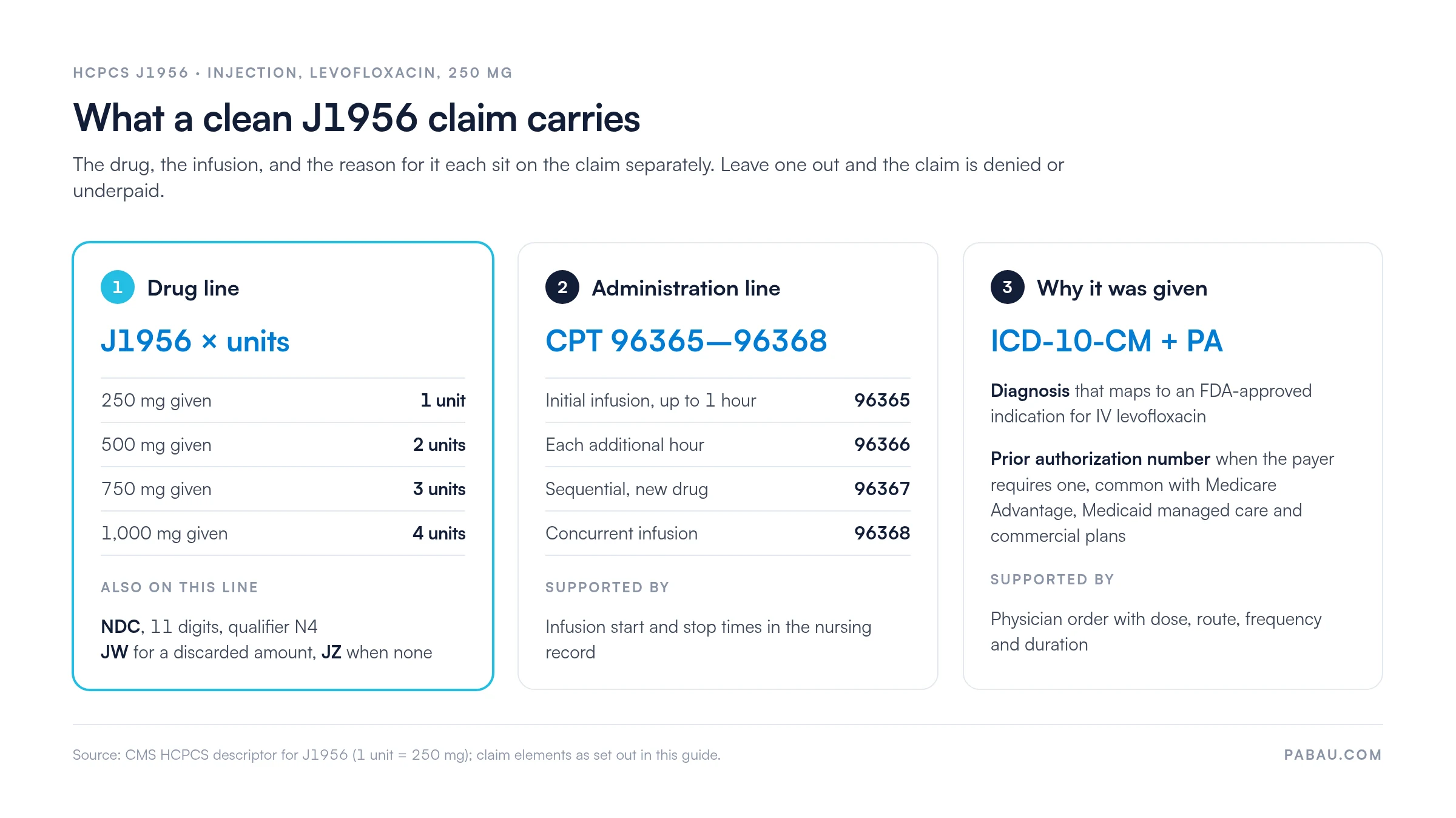
Included: The cost of levofloxacin injection, in units of 250 mg, as the drug itself.
Excluded and billed separately:
Every J1956 claim for an outpatient infusion should include at least one CPT administration code, most often 96365. A drug line with no service to deliver it looks incomplete to a payer’s claim edits, and it may be denied.
Place of service matters: In a hospital outpatient department (POS 19 or 22), the hospital bills both the drug and the administration code. In a physician office (POS 11), the practice bills both on the CMS-1500. Confirm which party bills each line before submitting, so nothing is billed twice.
Medicare Part B pays J1956 at average sales price plus 6% (ASP+6%), the standard method for separately payable Part B drugs. CMS updates the payment limit every quarter in its ASP pricing files. Check the current file before quoting a reimbursement figure to a provider or patient.
Key reimbursement variables for J1956:
Before billing J1956 in a new quarter, download the current ASP pricing file from cms.gov. The payment limit for levofloxacin changes every quarter and can fall below your acquisition cost. Update your charge master each quarter so a shortfall shows up before you bill.
Medicaid requires a National Drug Code on every drug claim, including J1956. Without a valid NDC, a Medicaid claim will be rejected at the front end before it ever reaches a clinical review. The NDC identifies the specific levofloxacin product administered, the manufacturer, and the package size.
Key NDC submission rules for J1956:
An incorrectly formatted or missing NDC is one of the most frequent front-end rejection reasons on J1956 Medicaid claims. A crosswalk of levofloxacin NDCs to J1956 in the billing system prevents it.
In Pabau, the practice management platform we build, the claims management workflow captures the NDC when the dose is given. The number is then already on the claim at submission.
Incomplete documentation is a common audit trigger for J-code claims. Each element below must be in the medical record to support a J1956 claim. Auditors judge them against the standards in our guide to medical billing compliance.
Several neighboring codes cause confusion in practices that give more than one antibiotic, or that have switched between fluoroquinolones. Even within one drug class, the wrong code means the claim denies for a drug mismatch or pays at the wrong rate.
The ciprofloxacin mix-up with J0744 deserves its own warning. Both drugs treat similar infections, some practices stock both, and the codes look alike.
A coder who defaults to J1956 for a ciprofloxacin infusion creates denials that are slow to overturn. The payer’s drug data will not match the code. Check the drug given against the nursing record before choosing the J-code.
Traditional Medicare does not require prior authorization for J1956 in most jurisdictions. Medicare Advantage plans, Medicaid managed care organizations and commercial insurers often do, especially for outpatient IV antibiotic therapy. Assuming that a traditional Medicare approval carries over to a Medicare Advantage plan is an expensive mistake for an infusion practice.
Clinical criteria commonly required to obtain PA for IV levofloxacin include the following.
If PA is obtained after the date of service, most payers will not apply it retroactively. Practices should verify authorization status at the time of scheduling, not on the day of the infusion. Maintaining a record of the PA number, approval date, and covered date range is a documentation requirement if the claim is later audited.
J1956 denial patterns are predictable. The same five or six problems appear repeatedly across practices. Recognizing them before submission is cheaper than chasing them in denial management after the fact.
The CARC column lists the claim adjustment reason codes that usually come back on the remittance for each problem. For any other code on a J1956 remittance, use our denial code reference.
Check every J1956 claim before it leaves the billing queue. Confirm the units match the nursing record and the NDC sits in the correct field. Then check the administration code against the infusion start and stop times. Those three checks cover most of the denial reasons in the table above.
J1956 errors often start when the billing team re-keys the dose, the NDC and the infusion times from the chart into a claim form. Each re-keyed field is a chance to bill 2 units for a 750 mg dose, or to drop the NDC altogether.
Pabau keeps the infusion record and the claim in one system. The dose, route and infusion times recorded at the chair carry into the claim. In the US, Pabau submits claims through the Claim.MD clearinghouse, runs eligibility checks and posts remittances against the patient record.
The result is that a unit or NDC error shows up while the claim is still in the queue. Without that link, the same error often surfaces weeks later as a denial on a remittance.

Pabau’s claims management workflow tracks J-code units, NDC numbers, and companion administration codes in one place. See how practices running IV infusion services use Pabau to submit cleaner claims and catch unit errors before they reach the payer.

J1956 is one of the easier J-codes to get right, because its unit math never changes. Divide the dose by 250 and the drug line is done. The denials come from the lines around it, which are the NDC, the JW or JZ modifier, the administration code and the payer’s authorization.
That puts the fix at the infusion chair rather than in the billing office. A practice that records the dose, NDC and infusion times when the drug is given can send a clean claim on the first pass. Book a demo to see how Pabau carries those details from the infusion record straight into the claim.

Building a revenue cycle from the ground up? What is revenue cycle management explains the end-to-end process from eligibility verification through payment posting.
Running a second drug in the same visit? CPT code 96367 covers a sequential infusion of a new drug, up to one hour.
HCPCS Code J1956 covers injection, levofloxacin, 250 mg. It is a Level II J-code for the drug cost only. The IV administration is billed separately with CPT 96365 or another companion administration code.
Bill 2 units. One unit of J1956 equals 250 mg, so a 500 mg dose requires 2 units (500 ÷ 250 = 2). A 750 mg dose requires 3 units, and a 1,000 mg dose requires 4 units.
The primary administration code is CPT 96365, for the initial IV infusion up to 1 hour. Add CPT 96366 for each additional hour. Use CPT 96367 if levofloxacin follows a different drug, or CPT 96368 if it runs alongside another IV drug.
Traditional Medicare does not require prior authorization for J1956 in most jurisdictions. Medicare Advantage plans, Medicaid managed care organizations and many commercial insurers often do require it for outpatient IV antibiotic infusions. Check the requirement plan by plan.
Report the NDC printed on the levofloxacin vial or prefilled bag the patient received. Use the 11-digit format with qualifier N4 in the shaded area of CMS-1500 Box 24A, or in Loop 2410 of the 837P. NDC numbers vary by manufacturer and package size, so never reuse one reference NDC across claims.
The most common reasons are incorrect units and a missing or invalid NDC on Medicaid claims. Others are a missing prior authorization from a managed care payer and a diagnosis that does not support IV levofloxacin. A place-of-service code that does not match the service location also denies.