

HCPCS Code Q4185: Cellesta flowable amnion billing guide
HCPCS Code Q4185: definition and official descriptor HCPCS Code Q4185 is the Lev...

Last Updated: Nov 20, 2026
J2507 is the HCPCS Level II code for injection, pegloticase, 1 mg. It reports the drug only, at one unit per milligram, so a standard 8 mg Krystexxa infusion bills as 8 units.
Pegloticase is sold as Krystexxa, manufactured by Horizon Therapeutics, a wholly owned Amgen subsidiary since October 2023. It treats chronic gout in adults that has not responded to conventional therapy, and the infusion itself is billed separately with CPT 96365 and 96366.
Let Pabau's smart automation suggest the right codes, reduce claim denials, and keep your practice compliant—effortlessly.
Automate repetitive tasks and focus on what matters most—your patients.
Reduce coding errors and ensure compliance with the latest regulations.
Clean claims, fewer denials, and faster reimbursements.
Powerful insights and reporting to help your practice thrive.
HIPAA compliant SOC 2 certified GDPR-compliant Trusted by 4,000+ clinics worldwide

HCPCS code J2507 reports pegloticase (Krystexxa) per 1 mg, for chronic gout in adults that has not responded to conventional therapy.
The standard 8 mg dose bills as 8 units of J2507, and the 120-minute infusion adds CPT 96365 and 96366 on their own lines.
Medicare has required the JW or JZ modifier on J2507 since July 1, 2023, and returns claims without one as unprocessable.
Most payers require prior authorization, usually with documented failure of both allopurinol and febuxostat.
Pabau, our practice management platform, tracks each authorization’s code, dates and sessions, and sends claims through the Claim.MD clearinghouse.
HCPCS code J2507 is the Level II J-code for injection, pegloticase, 1 mg. It replaced the temporary code C9281 on January 1, 2012, as CMS Transmittal 2378 records. The code identifies the drug itself, not the administration service.
Pegloticase is a recombinant uricase enzyme that converts uric acid to allantoin, which the kidneys excrete easily. The FDA approves it only for chronic gout in adults that is refractory to conventional therapy.
In practice, the disease has not responded to xanthine oxidase inhibitors such as allopurinol and febuxostat. That narrow indication shapes the medical necessity documentation and the prior authorization request.
J2507 is billed per 1 mg of pegloticase. The FDA-approved dose for Krystexxa is 8 mg administered as an IV infusion every two weeks. Each infusion therefore requires 8 units of J2507 on the claim line.
Under- or over-reporting units is one of the top audit triggers for J-code biologics. Billing 1 unit instead of 8 recovers only 12.5% of the drug cost. Billing 9 or more units for a standard dose doesn’t match the 8 mg vial, and payers flag that mismatch for overpayment review.
Most Medicaid programs and many commercial payers require the 11-digit National Drug Code (NDC) reported alongside J2507. Failure to include a valid NDC is among the leading denial reasons for this code.
The NDC must be submitted in the correct 5-4-2 format (manufacturer-product-package), using the N4 qualifier on the claim. Report the actual NDC from the vial dispensed, not a generic crosswalk number. The unit of measure and quantity fields must be completed too.
For Krystexxa, the unit of measure is ML, and the quantity is the volume used from the vial. Krystexxa now ships in two single-dose vials, 8 mg/mL and a ready-to-use 8 mg/50 mL, so the quantity depends on which one you opened.
Medicare does not require NDC reporting for Part B claims submitted on the CMS-1500. Medicaid state plans and commercial payers set their own rules, so check each one before submission.
J2507 covers only the drug. The infusion administration service is billed separately using CPT codes from the therapeutic infusion series. Submit each code on its own claim line.
Krystexxa is infused over no less than 120 minutes, according to its prescribing information. A standard visit with no IV pre-medication therefore bills J2507 × 8 units on line 1 and 96365 × 1 unit on line 2.
CPT 96366 × 1 unit follows on line 3 for the second hour. The chart below lays out those three lines and what each one needs before submission.
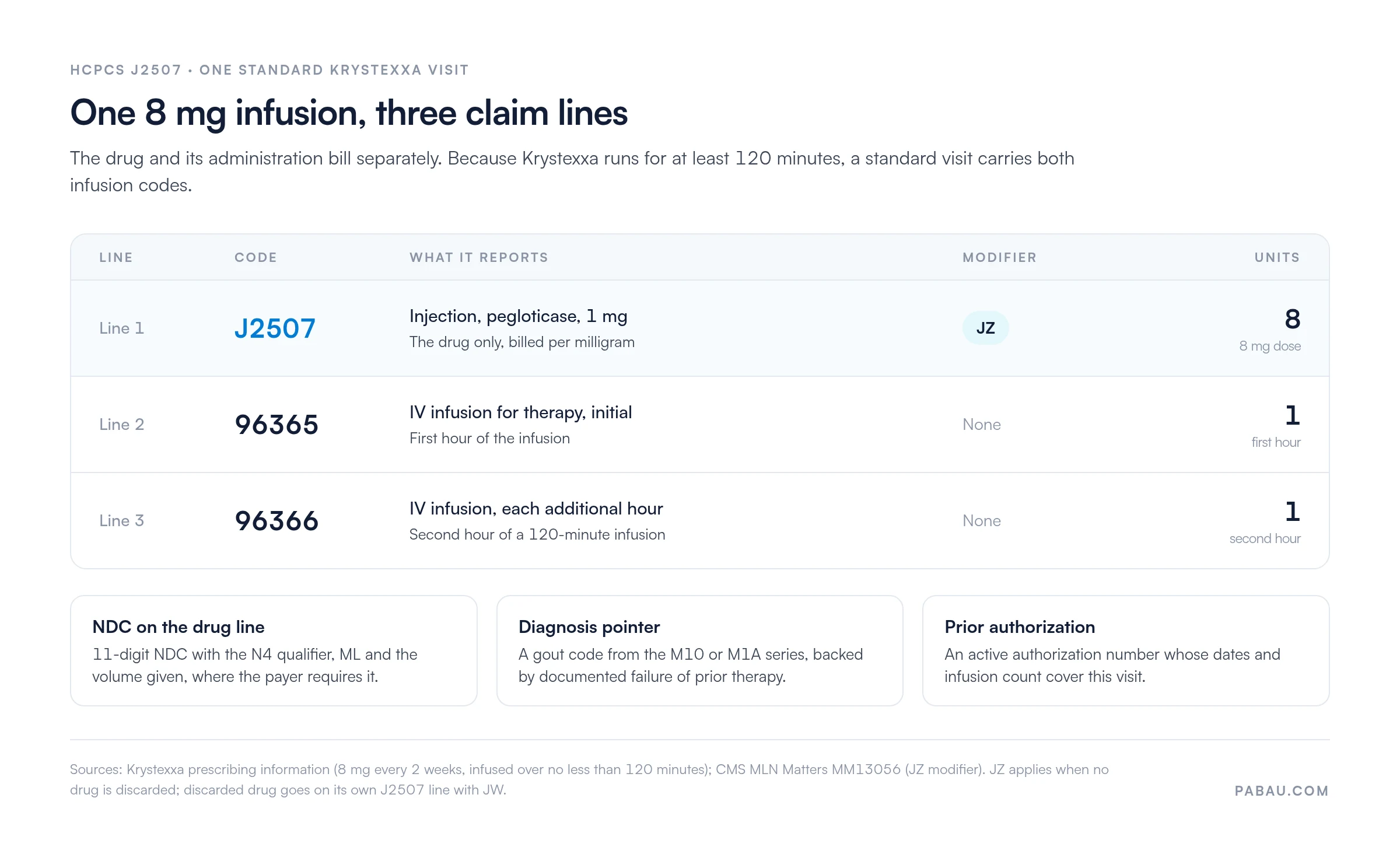
Always verify that J2507 and the administration CPT code are on separate claim lines with separate revenue codes in facility billing. Combining them into a single line is a common formatting error that triggers an automatic edit rejection before the claim even reaches a human reviewer.
J2507 requires a supported ICD-10 diagnosis code on every claim. The diagnosis must reflect the indication for pegloticase, which is chronic refractory gout in an adult who has failed conventional therapy. Linking J2507 to an unsupported code triggers an automatic medical necessity denial.
Many payers also want chart notes showing that allopurinol and febuxostat each failed at the maximum tolerated dose, for at least three months. Those notes should point back to the diagnosis code, because the chart carries the medical necessity case as much as the code does. A claim coded to M10.9 is supportable, but the chart then has to supply the detail the code leaves out.
Medicare Part B reimburses J2507 at the drug’s Average Sales Price plus 6% (ASP+6%), as established under the Medicare Prescription Drug, Improvement, and Modernization Act.
CMS publishes updated ASP-based allowables each quarter, so the per-unit rate for J2507 changes four times a year. Check the current quarter’s rate in the CMS ASP pricing files before quoting expected reimbursement.
Site of service affects the actual payment a practice receives. In a physician office, Medicare pays ASP+6% directly to the billing provider under the buy-and-bill model. In a hospital outpatient department, the drug is reimbursed under the outpatient prospective payment system (OPPS) at a different rate. Ambulatory surgical centers may not cover J2507 at all, depending on their carve-out status.
Prior authorization for J2507 is required by Medicare Advantage plans, all Medicaid managed care programs, and virtually every major commercial payer. Traditional Medicare fee-for-service does not require prior authorization for J2507, but Medicare Advantage plans operate under their own criteria.
Typical prior authorization criteria across major payers include:
Payer criteria for J2507 change often. Check each payer’s current clinical policy bulletin before you submit, then work through these steps.
J2507 has an above-average denial rate among biologic J-codes, and most of those denials are preventable. The table below maps the most frequent denial reasons to their remark codes and corrective actions.
Effective denial management workflows for J2507 start at scheduling. Build a pre-claim checklist into infusion booking, so the PA number, NDC, unit count and modifier are settled well before billing day. Our guide to remittance advice denial codes defines each CARC in the table above.
Run a pre-submission eligibility check the day before each Krystexxa infusion. Verify that the PA is active, the authorization number on file matches the payer’s system, and the remaining authorized dose count covers the upcoming infusion. Catching a lapsed PA the day before saves a denial, a retro-auth request, and a potential delayed treatment.
CMS requires the JW or JZ modifier on every J2507 claim line for dates of service on or after July 1, 2023. Voluntary JZ reporting began on January 1, 2023, and the July date made it mandatory. Since October 1, 2023, Medicare has returned claims that lack either modifier as unprocessable. Many commercial payers have adopted the same policy.
Incorrect modifier application carries compliance risk. Billing JW for wastage that did not occur can trigger an Office of Inspector General audit, and so can a missing JZ attestation. Document the vial configuration and actual volume administered in the administration record on every infusion date.
This checklist pulls every required element into one pre-submission review for each J2507 claim. Run it as part of your medical billing compliance routine. New billing staff can start with how medical billing works before taking on infusion claims.
A clean claim for J2507 is one where every item on this list was verified before the claim left the practice.
Many J2507 denials begin before the claim exists. An authorization lapses between infusions, or its infusion count runs out, and nobody sees it until the remittance comes back.
Pabau is the practice management platform we build. Its claims management software holds the authorization code, dates and sessions on the patient’s case. Staff get a warning when an authorization is missing, so the lapse surfaces at booking.
Claims then go out through the Claim.MD clearinghouse as CMS-1500/837P claims, with eligibility checked before the visit. ERA remittances post back to the same record, so a missing JZ rejection shows up against the visit it belongs to. IV sessions record the drug’s lot number against the patient and the appointment as well.
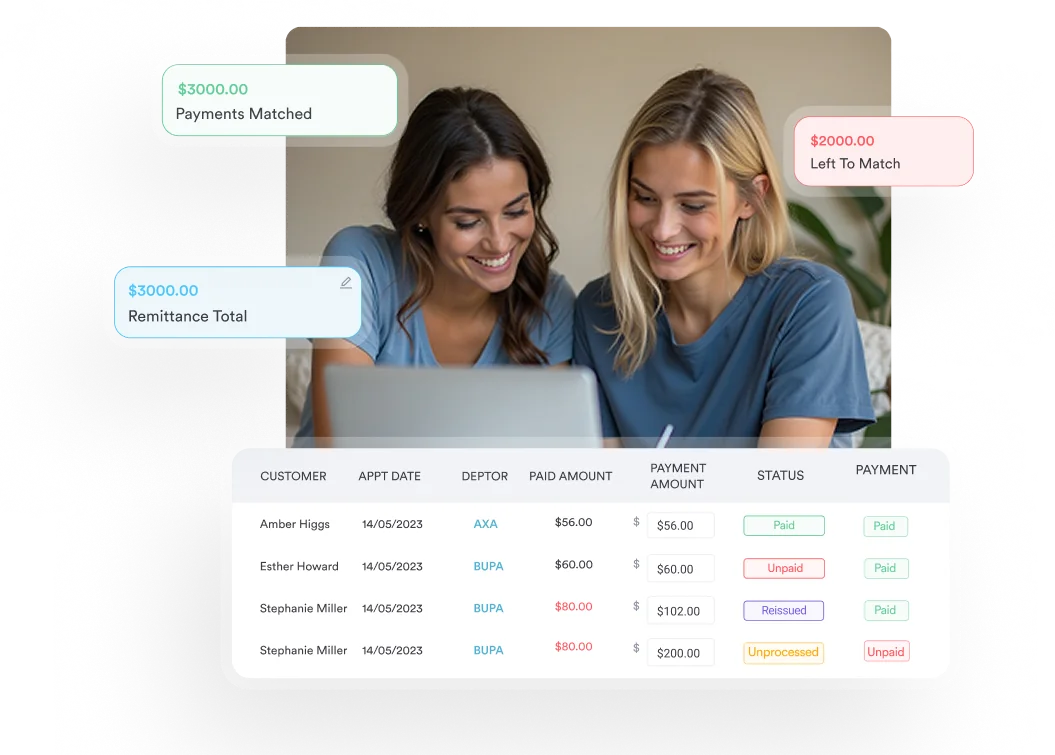

Pabau tracks each prior authorization’s code, dates and sessions on the patient’s case, and submits claims through the Claim.MD clearinghouse. See how it handles a biologic infusion claim from booking to remittance.

J2507 claims are won or lost at the booking desk. Confirm the authorization window, the vial and its NDC, and the modifier when the infusion goes on the calendar. Then check them once more at billing.
Krystexxa repeats every two weeks, so one lapsed authorization can put several infusions at risk before anyone notices. Book a demo to see how Pabau tracks authorizations and sends infusion claims from the same patient record.

Need a clearinghouse that handles HCPCS J-code claims? Medical claims clearinghouse guide explains how clearinghouses validate HCPCS codes before claims reach payers.
Looking to understand remittance advice better? Electronic remittance advice (ERA) explained covers how to read ERAs and match denial codes to J2507 rejections.
Want to benchmark your billing performance? Best medical billing software for US practices compares platforms that support specialty drug billing workflows.
Building the prior authorization request? The prior authorization process walks through each step from payer criteria to approval.
Need a form for the payer submission? Medical prior authorization form gives you a ready template for the clinical details payers ask for.
HCPCS code J2507 covers pegloticase injection, billed per 1 mg. Pegloticase treats chronic gout in adults that has not responded to conventional uric acid-lowering therapy such as allopurinol or febuxostat. It identifies the drug only; infusion administration is billed separately using CPT 96365 and 96366.
Bill 8 units of J2507 for each standard Krystexxa infusion, because the FDA-approved dose is 8 mg and J2507 is billed per 1 mg. If the administered dose differs from 8 mg, bill the actual number of milligrams administered.
Medicare Part B reimburses J2507 at ASP+6% (Average Sales Price plus 6%), updated quarterly by CMS. The per-unit rate changes each quarter; check the current CMS quarterly drug pricing file before quoting expected reimbursement, as the figures shift with market pricing.
Yes, prior authorization is required by Medicare Advantage plans, Medicaid managed care programs, and virtually all major commercial payers for J2507. Traditional Medicare fee-for-service does not require prior authorization, but most patients receiving Krystexxa are covered under plans that do.
Report the 11-digit NDC from the Krystexxa vial dispensed on the date of service, with the N4 qualifier. Use ML as the unit of measure and the volume administered as the quantity. Do not use a generic crosswalk NDC; always pull the number from the specific vial label used for that patient encounter.
The most frequent J2507 denials are a missing or invalid NDC (CO-4, N382) and an absent or expired prior authorization (CO-15, CO-197). Unestablished medical necessity (CO-50), an incorrect unit count (CO-11) and a missing JW or JZ modifier follow. Missing NDC and lapsed prior authorizations together account for the majority of preventable denials on this code.





