HCPCS Code G0163: Skilled nursing observation and assessment
What is HCPCS Code G0163? HCPCS Code G0163 is a deleted Level II code for skille...

Last Updated: Oct 15, 2026
J2440 is the HCPCS Level II code for injection, papaverine hcl, up to 60 mg.
Physicians, outpatient facilities, and billing teams use it to report the drug itself, separately from the code for administering it. J codes exist because a CPT code alone cannot carry the drug, its strength, and the billable quantity.
Let Pabau's smart automation suggest the right codes, reduce claim denials, and keep your practice compliant—effortlessly.
Automate repetitive tasks and focus on what matters most—your patients.
Reduce coding errors and ensure compliance with the latest regulations.
Clean claims, fewer denials, and faster reimbursements.
Powerful insights and reporting to help your practice thrive.
HIPAA compliant SOC 2 certified GDPR-compliant Trusted by 4,000+ clinics worldwide

HCPCS code J2440 covers an injection of papaverine hydrochloride, up to 60 mg per billing unit.
Medicare Part B covers J2440 when a clinician administers it and papaverine is absent from the current self-administered drug (SAD) exclusion list.
Each unit covers up to 60 mg, so a 90 mg dose bills as two units. A 30 mg dose still bills as one.
The 11-digit NDC must accompany J2440 on the claim, in Box 24A on a CMS-1500 or the revenue code 636 line on a UB-04.
Pabau’s claims management tools track J code submissions, NDC data, and unit counts for practices administering injectable drugs.
Papaverine hydrochloride is a vasodilator and antispasmodic agent derived from opium alkaloids, though it lacks narcotic activity. Its primary clinical role is relaxing smooth muscle in blood vessels and other hollow organs.
Its labeled and clinical uses fall into four groups. Verify the specific labeled indications against current FDA drug labeling before you document medical necessity.
The 60 mg per-unit descriptor is the maximum billable dose per unit, not the typical clinical dose. Many administrations fall below 60 mg, which is a frequent source of overbilling errors.
Medicare Part B covers injectable drugs, including J codes, when a practice bills them incident-to a physician’s service. That applies in a non-facility office, place of service 11. Incident-to billing does not apply in a hospital outpatient department (place of service 22).
In that setting, the facility bills the drug under the Outpatient Prospective Payment System, and payment runs through the relevant APC. Coverage for HCPCS code J2440 depends on three conditions being met at once.
Reimbursement for J2440 under Medicare Part B uses the Average Sales Price (ASP) methodology. CMS publishes updated ASP drug pricing files quarterly, and the payment rate equals ASP plus 6% in a physician office.
Rates change every quarter. Verify the current one with the CMS Physician Fee Schedule lookup tool before you quote expected reimbursement to patients or practice leadership.
When the payment on a papaverine line comes in short, read the remittance advice codes before rebilling. They separate a payer-driven adjustment from a documentation problem or a change in SAD list status.
The self-administered drug (SAD) exclusion list is the most important coverage hurdle for any J code biller. CMS maintains this list under Medicare Coverage Database Article A53032. It names the injectable drugs excluded from Part B coverage because patients typically self-administer them outside a clinical setting.
Papaverine injection is generally administered by a clinician in an office or outpatient setting, which supports coverage eligibility. Billing teams should still check SAD list status before each submission, because CMS updates the list without a prominent announcement.
Absence from the SAD list does not guarantee coverage on its own. Medical necessity documentation is a separate requirement, and a payer can deny the line on that basis alone.
Accurate J2440 billing depends on four checks before the claim leaves the practice. Those are the unit calculation, the place of service code, the NDC, and the supporting documentation. A payer checks each one separately, so a single error is enough to stop the line.
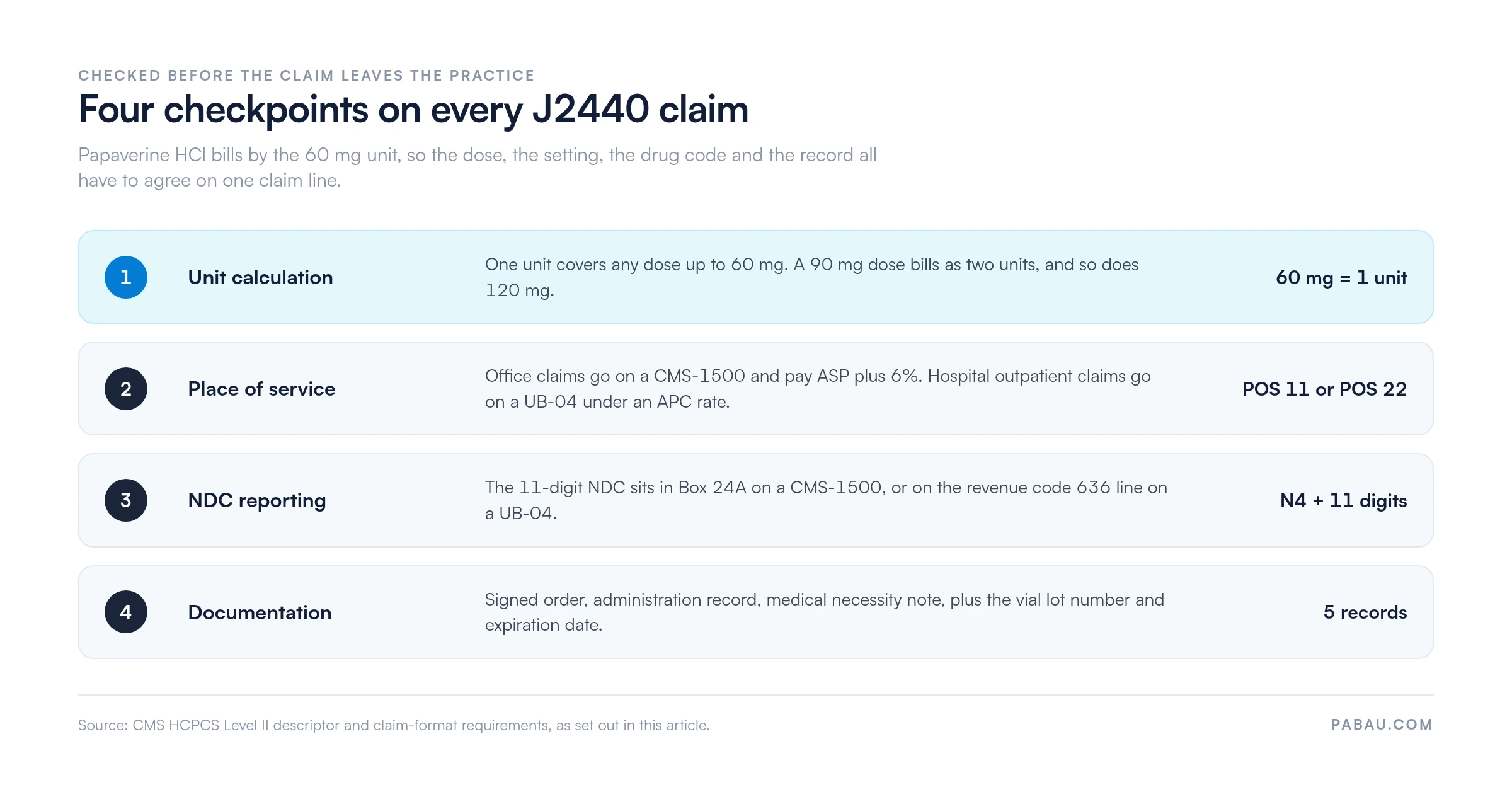
Each unit of J2440 covers up to 60 mg of papaverine HCl. Bill one unit for any dose up to 60 mg. For doses exceeding 60 mg, bill additional units based on the total administered dose.
Modifiers for J2440 depend on the payer, place of service, and route of administration. The following modifiers are the most frequently applicable.
Confirm modifier requirements against your MAC’s local coverage articles and the payer’s billing guidelines, since J code rules vary by jurisdiction. On HCPCS code J2550, modifier JB never applies at all, because subcutaneous promethazine is contraindicated. Claims management software with built-in modifier validation catches the claim that passes front-end edits and then fails at the payer.
Run a pre-submission edit check on every J2440 claim that carries a route modifier. Payers send JA and JB lines through different edits. A missing or wrong route modifier is one of the top denial triggers on papaverine claims.
Pairing J2440 with the correct ICD-10-CM diagnosis code is a medical necessity requirement, not a formality. Payers read the diagnosis code to decide whether the drug administration suits the documented clinical condition.
A mismatch between the drug’s documented use and the submitted code is a straightforward denial reason. Build the pairing into your charge capture template, and check each candidate against the current ICD-10-CM codes before the claim goes out.
These pairings reflect common clinical use cases. Select the diagnosis code from the documented findings in the patient’s record, not from a pre-built list. Then check that the payer accepts it under its current local coverage determination (LCD).
Incomplete documentation is the second most common reason J code claims are denied, after SAD list issues. An injectable drug needs records that go beyond a standard visit note. Each element below is reviewable on its own at audit.
For Medicare claims, the documentation must be retained and producible on request for at least seven years. A well-built superbill captures the drug, dose, route, NDC, and ordering physician at the point of care. That is what prevents the scramble for missing records once an auditor asks.
Medicare and most Medicaid programs require the 11-digit NDC to be reported alongside J2440 on drug claims. The NDC identifies the exact manufacturer, product, and package size of the papaverine vial administered. Reporting a J code without the required NDC is a claim edit that results in rejection at the clearinghouse or denial at the payer.
NDC requirements vary by MAC jurisdiction and payer, so confirm the current reporting rules before you finalize a claim template. A wrong digit count or a missing N4 qualifier comes back as a format error, not a coverage denial. That distinction matters, because the fix is a corrected claim rather than an appeal.
Where the drug is administered determines how J2440 is paid, not just which claim form is used. The billing rules, the payment methodology, and the documentation requirements all differ between a physician office (POS 11) and a hospital outpatient department (POS 22).
Outpatient hospital billing teams should confirm whether papaverine is packaged into the relevant APC before building J2440 into charge capture. A packaged drug still needs the NDC and the unit count on the line, even where it earns no separate payment. Physician practices administering papaverine in an office setting have a cleaner path to separate reimbursement.
Audit your J2440 claims quarterly. Check that the POS code on each claim matches the place where the drug was given. POS errors on injectable drug claims are a routine finding in Medicare RAC audits. One wrong default can trigger repayment demands across months of claims.
A papaverine claim is usually assembled from three places. The dose sits in the clinical note. The NDC sits on the vial or the supplier invoice. The unit count is worked out later by whoever raises the charge.
Pabau, practice management software for private practices, keeps those pieces in one patient record. The clinician charts the drug, dose, and route at the point of administration. The charge is raised from that entry rather than rebuilt from memory.
Claims then go out from the same system. A J2440 line missing its NDC, or carrying a unit count the note does not support, is caught before submission. Your billers spend their time on the claims that genuinely need a decision.

Pabau’s claims management tools help practices track HCPCS J code submissions, flag modifier errors, and keep NDC reporting accurate across every injectable drug claim.

J2440 rarely carries much money on a single claim, which is why its errors survive so long. A wrong unit count or a stale NDC gets copied forward from a claim template until a payer stops paying. By then the same mistake sits on months of submitted lines.
So treat the unit math, the NDC, and the place of service as claim-level checks rather than a coding habit. Re-check SAD list status each quarter, and papaverine stops appearing in your denial reports.
Pabau keeps drug administration, NDC data, and claim submission in one record, so the J2440 line matches the note behind it. Book a demo to see how it handles injectable drug billing from administration through to payment.

Need to understand how clearinghouses process J code claims? Medical claims clearinghouse explained covers how claim routing, edits, and rejections work before a claim reaches the payer.
Want to know which data elements payers validate? Understanding the 837 electronic claim file walks through the fields that carry your drug code, units, and NDC.
Seeing repeat denials on injectable drug claims? Denial management in healthcare shows how to work a denial back to its cause instead of resubmitting blind.
Preparing for an audit of your J code claims? Medical billing compliance sets out the records a payer expects to find on a drug administration.
Building a tighter billing workflow for your practice? Revenue cycle management guide walks through how to structure billing from charge capture to payment posting.
HCPCS code J2440 is the billing code for an injection of papaverine hydrochloride, up to 60 mg. Practices use it to report the drug to Medicare, Medicaid, and commercial payers when a clinician administers it. Its clinical uses include intracavernosal injection for erectile dysfunction diagnostics and vasospasm management during vascular surgery.
J2440 represents papaverine hydrochloride (papaverine HCl), a vasodilator and antispasmodic drug derived from opium alkaloids. It relaxes smooth muscle in blood vessels and is used clinically in vascular surgery, erectile dysfunction diagnosis, and vasospasm management. It is not a narcotic despite its alkaloid origin.
Medicare Part B covers papaverine injection when a clinician administers it in a physician office or outpatient facility. The indication must be documented as medically necessary. The drug must also be absent from the current self-administered drug (SAD) exclusion list. Coverage is not automatic, so check SAD status against the current version of CMS Article A53032 before billing.
Each unit of J2440 covers up to 60 mg of papaverine HCl. Bill one unit for any dose up to 60 mg. A 90 mg dose bills as two units, and so does a 120 mg dose. Document the exact dose administered to support the unit count billed.
Medicare reimburses J2440 at ASP (Average Sales Price) plus 6% for physician office claims. CMS updates ASP drug pricing files each quarter, so the specific rate changes. Check the current quarter’s ASP file on the CMS Physician Fee Schedule lookup before quoting reimbursement amounts to practice leadership or patients.
In a hospital outpatient setting (POS 22), J2440 is billed on a UB-04 claim form under the facility’s outpatient billing structure. Payment follows the Ambulatory Payment Classification (APC) methodology, where the drug may be packaged into the relevant APC rather than paid separately. Confirm whether papaverine injection is separately payable under the applicable APC grouper before including J2440 as a separately billed line item.
J2440 is a specific HCPCS code for papaverine HCl injection up to 60 mg. J3490 is an unclassified drug code, used when no specific J code exists for the drug administered. Use J2440 whenever you bill papaverine HCl injection. J3490 triggers extra documentation requirements and usually a manual review or a denial.