

CCSD code G5100: Bypass of duodenum billing guide
CCSD code G5100 bills a bypass that leaves the duodenum in place CCSD code G5100...

Last Updated: Oct 16, 2026
J1265 is the HCPCS Level II code for injection, dopamine HCl, 40 mg. Dopamine is a vasopressor given by IV infusion to raise blood pressure and cardiac output in shock.
One billing unit equals 40 mg, so convert the weight-based infusion rate into total milligrams and divide by 40. Medicare rounds any partial unit up. The most common errors are miscounted units and billing dobutamine, J1250, under this code.
Let Pabau's smart automation suggest the right codes, reduce claim denials, and keep your practice compliant—effortlessly.
Automate repetitive tasks and focus on what matters most—your patients.
Reduce coding errors and ensure compliance with the latest regulations.
Clean claims, fewer denials, and faster reimbursements.
Powerful insights and reporting to help your practice thrive.
HIPAA compliant SOC 2 certified GDPR-compliant Trusted by 4,000+ clinics worldwide

HCPCS code J1265 reports dopamine hydrochloride injection, and one billing unit equals 40 mg of drug.
Dopamine runs as a weight-based infusion, so convert the mcg/kg/min rate and run time into total milligrams before dividing by 40.
When the total is not a multiple of 40 mg, Medicare rounds up to the next whole unit.
Hospital outpatient and ASC claims package J1265 into the APC payment, so the line still gets reported but pays nothing separately.
Pabau’s claim validation flags missing units, NDCs, and modifiers before a drug claim leaves your practice.
HCPCS code J1265 is the Healthcare Common Procedure Coding System (HCPCS) Level II code for injection, dopamine hydrochloride (HCl), 40 mg. Each billing unit stands for 40 mg of dopamine given by intravenous infusion.
Dopamine is a catecholamine vasopressor used to raise blood pressure and cardiac output in shock. The code sits in the J-series of the HCPCS code set, which covers drugs administered other than by mouth. It has been active since January 1, 2006.
Check the descriptor against the current quarterly CMS HCPCS file before you bill, because CMS can revise or delete J-codes in any update. The AAPC entry for J1265 is a quick way to cross-check it.
J1265 covers dopamine hydrochloride in any injectable form, whoever made it. The code is tied to the drug and the 40 mg unit, not to a brand, a vial size, or a concentration.
Dopamine and dobutamine sit next to each other in most infusion pumps and drug libraries. Mixing up J1265 and J1250 is an easy product error to make. Match the code to the drug name on the medication administration record.
To calculate J1265 units, divide the total milligrams of dopamine given by 40. The hard part is getting to that total, because dopamine is ordered as a weight-based rate in micrograms per kilogram per minute (mcg/kg/min).
Use this sequence for every infusion:
Worked through one step at a time, the third row of that table shows where the 3.6 comes from. It also shows why the claim carries 4 units.
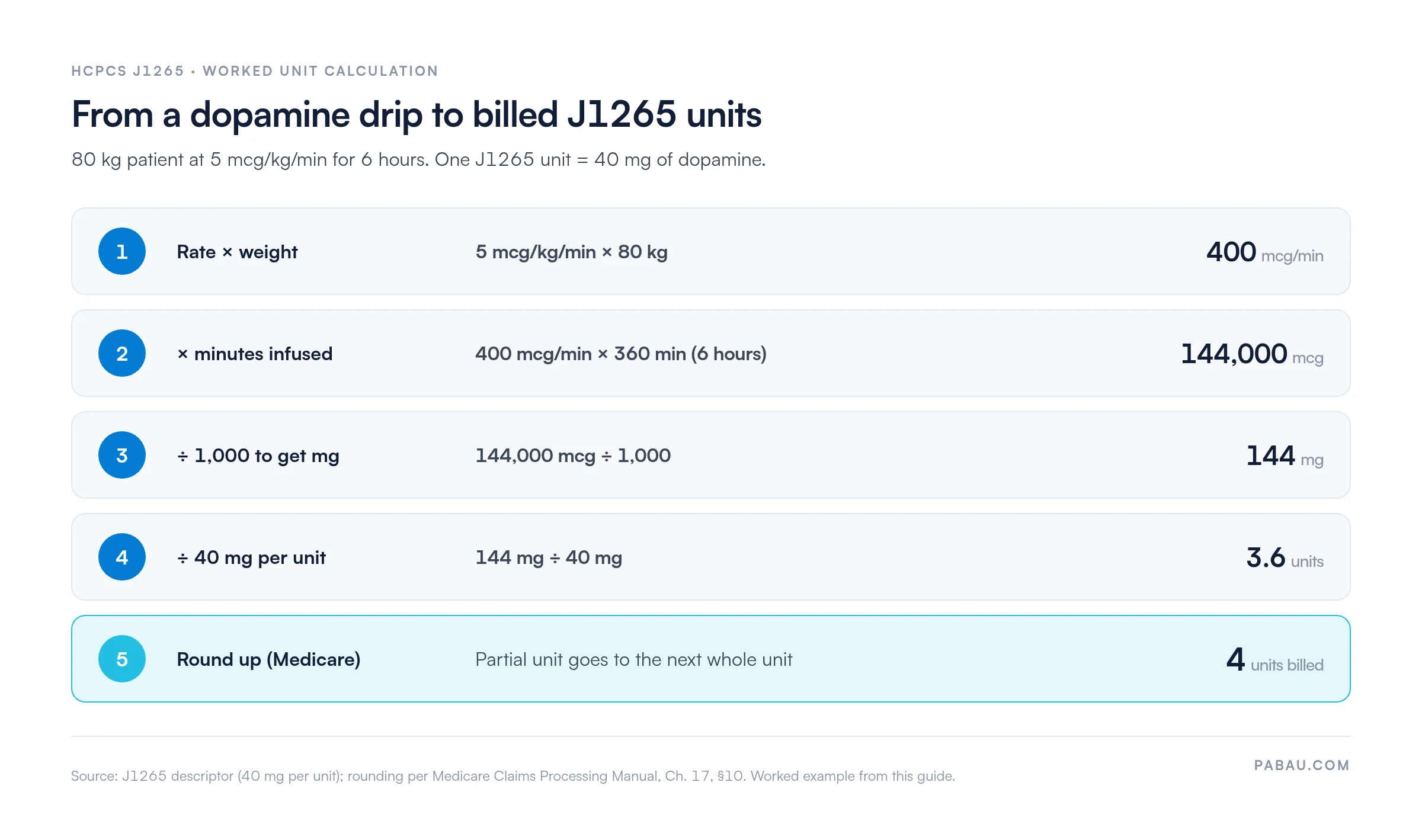
Medicare tells providers to round up to the next whole unit when the dose is not a multiple of the HCPCS dosage descriptor. That rule sits in the Medicare Claims Processing Manual, Chapter 17, Section 10. Commercial payers may set their own rounding policy, so check the contract.
Count units from the amount infused, not from the bag hung or the mL on the pump. Billing per mL or per bag is the fastest way to send a J1265 line to review. Report the infusion service on its own line with a drug administration code, such as 96365 for the first hour.
J1265 pays separately in only one setting, the non-facility office. Dopamine is mostly given in emergency departments, intensive care units, and operating rooms, where its cost folds into a bundled payment.
A packaged J1265 line that pays $0 has not been denied, so there is nothing to appeal. Hospitals should still report it with the correct units. CMS uses those packaged drug lines to set future APC payment rates.
For office claims, take the current payment limit from the CMS ASP pricing files. The limit changes every January, April, July, and October, so any figure older than one quarter is out of date.
A J1265 claim needs a diagnosis that shows hemodynamic instability. The FDA labeling covers shock linked to myocardial infarction, trauma, septicemia, open heart surgery, renal failure, and chronic cardiac decompensation. These ICD-10-CM codes are the usual pairings.
Code to the highest specificity the record supports. Septic shock goes to R65.21, not R57.8, because septic shock is excluded from category R57. Solid habits around medical billing compliance keep diagnosis pairing consistent across the team.
The record must let an auditor rebuild the unit count from scratch. For a dopamine infusion, that means the rate, the weight, and the timing, not only the drug name.
Medicaid requires NDCs on physician-administered drug claims, and many commercial plans ask for them too. A superbill with a drug administration section prompts staff for the dose, units, and NDC at the time of service.
The JW and JZ modifiers apply only where J1265 pays separately under Medicare Part B, which in practice means the office setting. They do not apply to packaged drugs on OPPS or ASC claims.
CMS has required JZ on qualifying Part B claims since July 1, 2023. Record the discarded amount in the chart whenever you report JW.
The codes below are the ones most often confused with J1265 on vasopressor and inotrope claims. Check each against the current CMS HCPCS file before billing.
J1265 has never described doxorubicin. Do not bill J3490 for dopamine either, because J1265 already describes the drug.
Most J1265 problems start in the infusion record, not on the claim form. Strong denial management traces each one back to the step that caused it.
Catching these before submission is cheaper than working them afterward. A routine for clean claim submission covers the unit check, the NDC, and the modifier in one pass.
Most J1265 denials trace back to one wrong detail on the claim line. It might be the code, the units, the NDC, or the modifier. Today that detail is usually spotted after the payer rejects the claim, days after the infusion.
Pabau, our practice management and billing platform, includes claims management software that checks each claim before it goes out. Its claim validation scrubs every claim for missing or invalid details, so you can fix a J1265 line while the infusion record is still open.
Validation works best when the claim starts complete. Recording the rate, weight, and run time in the patient record gives your billing team the total milligrams without chasing the care team.

Pabau’s claim validation flags missing or invalid details before a claim leaves your practice. Claim tracking then shows which drug claims need action, from Pending to Paid.

Bill J1265 from the infusion record, not the bag label. Turn the mcg/kg/min rate, the weight, and the run time into total milligrams, divide by 40, and round up.
Then check where the drug was given. In the office it pays at ASP plus 6% and needs JZ or JW. In the hospital outpatient department it is packaged, so a $0 line is expected and needs no appeal.
Pabau’s claim validation flags missing or invalid details before submission, and claim tracking shows which claims need action. Book a demo to see how Pabau checks injectable drug claims like J1265 before they reach the payer.

Need guidance on what makes a drug claim payable? Medical billing fundamentals walks through the end-to-end claim lifecycle for outpatient drug administration.
Managing remittance advice and ERA workflows? Electronic remittance advice explained covers 835 transaction processing and CARC denial code interpretation.
Looking for a structured denial workflow? Denial codes in medical billing provides a reference guide for CARC and RARC codes used in drug claim remittances.
HCPCS code J1265 covers injection, dopamine hydrochloride, 40 mg. It applies to any injectable dopamine HCl product, including concentrate vials and premixed bags in 5% dextrose. Dobutamine, epinephrine, and vasopressin each have their own codes.
Bill one unit per 40 mg of dopamine infused. Work out the total milligrams from the rate in mcg/kg/min, the weight, and the run time, then divide by 40. Round up to the next whole unit for Medicare.
No. J1265 has always described dopamine HCl, 40 mg. Conventional doxorubicin HCl is billed under J9000, per 10 mg, and the two drugs are unrelated.
Medicare pays J1265 separately only in the physician office, at ASP plus 6% per unit. Under the hospital outpatient and ASC payment systems the drug is packaged, and inpatient use is covered by the MS-DRG payment.
Only when J1265 pays separately under Part B, which usually means the office setting. Use JZ when nothing was discarded and JW for the discarded amount. Packaged OPPS and ASC lines do not take either modifier.
Shock codes are the usual pairing, such as R57.0 cardiogenic shock, R57.1 hypovolemic shock, and R65.21 severe sepsis with septic shock. Heart failure and hypotension codes also appear, with documentation of the need for a vasopressor.



