CPT code 86481: TB IGRA billing guide
CPT code 86481: Official descriptor and procedure description CPT code 86481 des...

Last Updated: Nov 2, 2026
Billable Code Specific Code
J0850 is the HCPCS Level II code for injection, cytomegalovirus immune globulin intravenous (human), per vial. It covers CytoGam, the CMV-specific immune globulin now marketed by Kamada. Practices give it by IV infusion to prevent CMV disease in solid organ transplant recipients.
Claims report one unit per vial administered, not per milligram. Medicaid and many commercial payers also require the 11-digit NDC on the claim line, and commercial plans often require prior authorization before the infusion.
Let Pabau's smart automation suggest the right codes, reduce claim denials, and keep your practice compliant—effortlessly.
Automate repetitive tasks and focus on what matters most—your patients.
Reduce coding errors and ensure compliance with the latest regulations.
Clean claims, fewer denials, and faster reimbursements.
Powerful insights and reporting to help your practice thrive.
HIPAA compliant SOC 2 certified GDPR-compliant Trusted by 4,000+ clinics worldwide

HCPCS code J0850 covers cytomegalovirus immune globulin intravenous (human) and is billed per vial, not per milligram or dose weight.
CytoGam is the drug billed under J0850, while general IVIG products carry their own codes, such as J1459, J1561 and J1568.
Medicare Part B pays J0850 at average sales price plus 6%, and Medicaid and many commercial payers require an 11-digit NDC on the claim.
Pabau, the practice management platform we build, stores each prior authorization as a case and flags claims that go out without one.
HCPCS code J0850 is the Level II drug code assigned to cytomegalovirus immune globulin intravenous (human), with a billing unit of per vial. The CMS HCPCS Level II code set designates J-codes for drugs that are not self-administered. A physician or qualified healthcare professional typically gives them in a clinical setting.
CytoGam, now marketed by Kamada, is the commercially available preparation billed under J0850. The drug is a purified human immunoglobulin G product with high CMV antibody titers, distinct from general-purpose IVIG formulations.
HCPCS code J0850 covers cytomegalovirus immune globulin intravenous (human) when administered for FDA-approved indications. The FDA labeling for CytoGam identifies prophylaxis of CMV disease in kidney, lung, liver, pancreas, and heart transplant recipients as the approved uses.
The list below separates the uses J0850 covers from the ones that bill under another code or need extra approval.
Payers check a J0850 claim against the clinical record, because the drug is tied to transplant status. Document these elements before the claim goes out, as part of routine medical billing compliance, rather than during an appeal.
HCPCS code J0850 is billed per vial, not per milligram, gram, or dose weight. The CytoGam prescribing information doses in mg/kg, so the ordered dose has to be converted into a vial count using the vial size. Teams that know the wider medical billing workflow catch unit errors before payers return them as CO-16 denials.
CytoGam is supplied as a 50 mL vial containing 2,500 mg (2.5 g) of immune globulin. A patient weighing 70 kg prescribed 150 mg/kg receives 10,500 mg total. That requires five full vials (5 × 2,500 mg = 12,500 mg) to cover the dose. The claim reports 5 units of J0850.
The drug code J0850 covers only the drug itself. The infusion service requires a separate CPT administration code reported on the same claim when billing in the physician office or non-facility setting. The first hour of a CytoGam infusion goes on the claim as 96365, with 96366 added for each additional hour.
In the hospital outpatient setting (POS 22), the facility bills the administration CPT codes under OPPS. The physician’s professional claim typically does not separately bill infusion administration there. Confirm with your MAC billing articles for the applicable setting.
Report CPT 96365 and J0850 on the same claim for an office infusion. Some payer edits look for a valid administration code alongside the drug line before they pay it.
A claim that bills the wrong immune globulin code no longer matches the drug in the chart, and payers deny or recoup it. HCPCS code J0850 is specific to cytomegalovirus immune globulin intravenous (human). General IVIG products carry their own codes by brand and route, such as J1459 for Privigen and J1568 for Octagam. Check the AAPC Codify HCPCS lookup when a brand name you do not recognize appears on a drug order.
Medicare Part B reimburses J0850 as a physician-administered drug at average sales price (ASP) plus 6%, per the CMS buy-and-bill reimbursement methodology. CMS updates the ASP payment limits every quarter. Check the current limit in the CMS ASP pricing files before billing each quarter. Medicare pays the lower of the billed charge and the payment limit, so a charge set from an old quarter’s file can leave money unpaid.
Reimbursement varies by setting. Non-facility (physician office, POS 11) and facility (hospital outpatient, POS 22) rates differ because facility overhead is captured separately under OPPS. In the hospital outpatient setting, J0850 may be subject to OPPS packaging rules, depending on the annual rulemaking threshold. Verify the current year’s packaging status with your MAC. Tracking each J0850 claim from submission to payment shows quickly when a quarterly rate change has left a claim short-paid.
Prior authorization requirements for HCPCS code J0850 vary by payer and plan year. No universal rule applies across commercial, Medicare, and Medicaid programs. Medicare fee-for-service generally does not require PA for J0850 when the indication matches LCD criteria, but Medicare Advantage plans impose their own PA requirements. Commercial plans frequently require PA, and Medicaid programs vary by state.
Medicaid and many commercial payers require an 11-digit National Drug Code (NDC) on claims for J0850. The NDC identifies the CytoGam product and package administered, in 5-4-2 format on the claim. Kamada’s current CytoGam listing is 49591-0532-51. An incorrect or missing NDC is a common cause of CO-16 denials.
J0850 denials usually trace back to one of five claim fields, shown below with the denial each one triggers. Pairing these checks with denial management in healthcare helps billing teams fix claims before submission rather than chasing appeals. For full code definitions, see the guide to denial codes in medical billing.
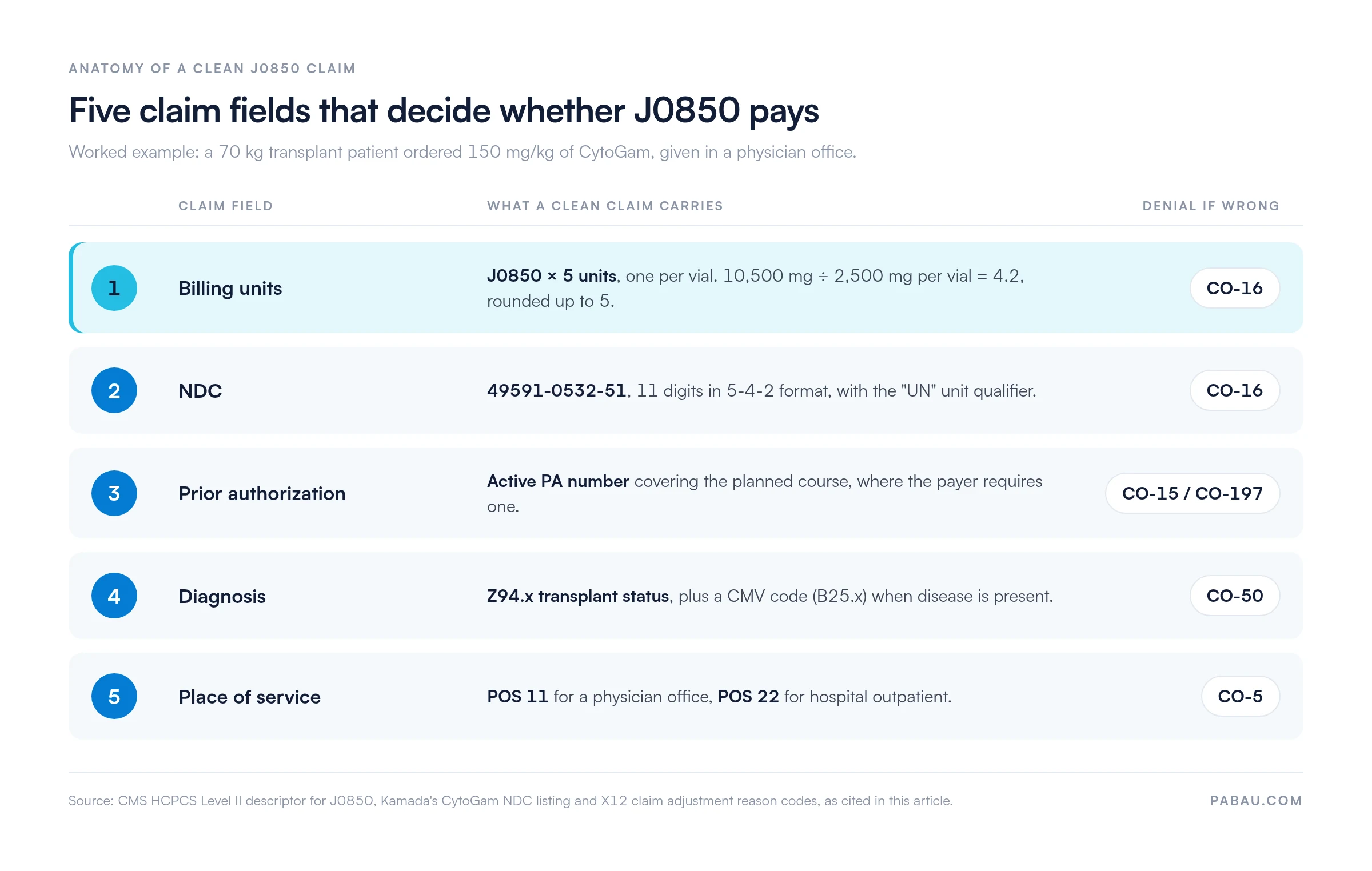
The table below gives the fix for each denial.
Where the infusion occurs changes both the reimbursement rate and which administration codes are billable. Infusion centers and transplant programs administering CytoGam should confirm the correct place-of-service (POS) code with each encounter.
Transplant programs bill J0850 as a course of infusions rather than a single dose. That changes how diagnosis codes, authorizations and doses are documented across the course.
Flag J0850 claims for a pre-submission review whenever the vial count exceeds six units in a single encounter. High-unit claims draw more scrutiny and require the dose calculation, patient weight, and vial size to be clearly documented before the claim leaves the practice.
A J0850 claim draws on three sources: The infusion record, the payer portal holding the authorization, and the billing system. When those sit apart, a missing PA number or NDC only surfaces once the remittance comes back.
In Pabau, each claim is raised from the patient’s invoice and checked for missing or invalid details before it goes to your clearinghouse. Prior authorizations are stored as cases, and the code follows the appointment onto the claim. A claim with no authorization code is flagged before it leaves.
Pabau’s infusion practice claims software then tracks each claim from pending to paid and settles US payments from ERA files. Your team spends less time reworking CO-15 and CO-16 denials across a patient’s infusion course.

Pabau checks each claim for missing details before it reaches your clearinghouse and ties prior authorization codes to the appointment. Your J0850 claims go out complete.

J0850 pays reliably when the claim is assembled before the infusion, not after the denial. Confirm the authorization, the vial count and the current Kamada NDC while the order is still being scheduled.
The cost is a few minutes of checking per encounter. It is repaid on every repeat infusion in a transplant patient’s course, because the same clean claim template carries forward.
Book a demo to see how Pabau tracks prior authorizations and flags incomplete claims before they reach the payer.

Need to verify which denial codes are affecting your J0850 claims? Denial codes in medical billing covers the full CARC/RARC reference so you can map remittance denials to corrective actions.
Want a clearinghouse that handles specialty drug claim submissions? Medical claims clearinghouse guide explains how clearinghouses validate J-code claims before they reach the payer.
Looking to strengthen your broader billing compliance program? Medical billing compliance covers the documentation and audit-readiness steps practices need across all claim types.
HCPCS code J0850 covers cytomegalovirus immune globulin intravenous (human), sold as CytoGam and now marketed by Kamada. Its FDA-approved use is prophylaxis of CMV disease in kidney, lung, liver, pancreas and heart transplant recipients.
J0850 is billed per vial. Report the number of vials opened and administered, not the dose weight in milligrams or grams. Divide the total ordered dose by the vial size, which is 2,500 mg per 50 mL vial for CytoGam. Then round up to the nearest whole vial.
Medicare fee-for-service generally does not require prior authorization for J0850 when the claim meets LCD coverage criteria. Medicare Advantage plans, Medicaid programs, and commercial insurers typically do require PA. Verify the requirement with each plan before scheduling the infusion.
Report the 11-digit NDC from the CytoGam vial or carton administered, in 5-4-2 format. Kamada’s current listing is 49591-0532-51. NDC numbers can change with packaging updates, so record the NDC from the vial at each encounter rather than a stored code.
J0850 denials usually come from five errors. The first three are a missing or misformatted NDC (CO-16), no prior authorization on file (CO-15 or CO-197), and an unsupported diagnosis (CO-50). The other two are units billed by dose weight instead of vials (CO-16) and a wrong place-of-service code (CO-5). The denial table in this article gives the fix for each.
Yes. HCPCS code J0850 is active for cytomegalovirus immune globulin intravenous (human) in the current CMS HCPCS file. Check the CMS HCPCS quarterly update before billing to confirm the code and its descriptor have not changed.