HCPCS Code J1560: Gamma globulin IM injection billing guide
HCPCS Code J1560: Official descriptor and covered services HCPCS Code J1560 carr...

Last Updated: Nov 11, 2026
J1455 is the HCPCS Level II code for injection, foscarnet sodium, per 1000 mg. It reports the drug portion of an intravenous foscarnet infusion, billed alongside a separate infusion administration code.
One unit equals 1,000 mg administered, so the unit count is the mg dose divided by 1,000. A 4,200 mg dose is 4.2 units, not the 175 mL infused. The mL volume belongs only in the NDC quantity.
Let Pabau's smart automation suggest the right codes, reduce claim denials, and keep your practice compliant—effortlessly.
Automate repetitive tasks and focus on what matters most—your patients.
Reduce coding errors and ensure compliance with the latest regulations.
Clean claims, fewer denials, and faster reimbursements.
Powerful insights and reporting to help your practice thrive.
HIPAA compliant SOC 2 certified GDPR-compliant Trusted by 4,000+ clinics worldwide

HCPCS Code J1455 describes injection, foscarnet sodium, per 1000 mg, so billable units equal the milligrams administered divided by 1,000.
Foscarnet is FDA-approved for CMV retinitis in patients with AIDS and acyclovir-resistant HSV in immunocompromised patients. Other uses need documented medical necessity.
A 4,200 mg infusion is 4.2 units of J1455, not 175. The 175 mL volume belongs in the NDC quantity, never in the HCPCS unit count.
Pabau’s claims management software keeps the drug, administration and NDC details on one claim and tracks it through the Claim.MD clearinghouse.
HCPCS Code J1455 is the Level II code for injection, foscarnet sodium, per 1000 mg. It is published in the Centers for Medicare and Medicaid Services (CMS) HCPCS Level II code set. It sits in the J-code range for drugs administered other than by mouth. Practices use it when a physician office, hospital outpatient department or infusion center gives the drug.
Foscarnet sodium (brand name Foscavir) is a pyrophosphate analog antiviral that inhibits viral DNA polymerase. It is given by intravenous infusion only. In an office or outpatient setting, Medicare pays for it under Part B as a physician-administered drug.
Payers cover HCPCS Code J1455 only when the medical record supports a recognized indication. A claim without a supporting ICD-10-CM code is one of the most common reasons it comes back. For a patient with AIDS, that means B20 goes on the claim beside the viral diagnosis code.
The Foscavir prescribing information lists two FDA-approved indications. The first is cytomegalovirus (CMV) retinitis in patients with AIDS. The second is acyclovir-resistant mucocutaneous herpes simplex virus (HSV) in immunocompromised patients.
Foscarnet for acyclovir-resistant varicella-zoster virus (VZV) is off-label, so its coverage depends on payer policy. Most patients receiving foscarnet have HIV/AIDS or have had a solid-organ or bone marrow transplant.
Always include both the viral diagnosis code and the underlying immunocompromise code (such as B20 for HIV disease) on J1455 claims. Payers use the combination to establish medical necessity. A single-code submission for CMV retinitis without the immunocompromise context is a common reason for medical-necessity denials.
J1455 bills per 1,000 mg of foscarnet sodium administered. Divide the milligrams given by 1,000 to get the unit count. The infused volume in mL plays no part in this calculation.
The label gives two CMV induction regimens: 60 mg/kg every 8 hours or 90 mg/kg every 12 hours. Maintenance runs 90 to 120 mg/kg once daily. For a 70 kg patient, one 60 mg/kg dose is 4,200 mg, which is 4.2 units of J1455.
At the 24 mg/mL concentration, that same dose is 175 mL of solution. The 175 mL is a clinical volume for the infusion record and the NDC quantity. Billed as HCPCS units, it would overstate the claim about fortyfold.
Claims take whole units, and many Medicare contractors tell billers to round a partial unit up. Under that rule, a 4.2-unit dose goes on the claim as 5 units. Confirm each payer’s rounding rule before you build it into a billing template.
Foscarnet comes in a 6,000 mg single-dose bottle, so a 4,200 mg dose leaves 1,800 mg unused. Medicare asks for the discarded amount on its own line with the JW modifier. When nothing is discarded, the administered line carries the JZ modifier instead.
Followed through to the claim, that single 4,200 mg dose produces three separate figures, and only one of them belongs in the units field.
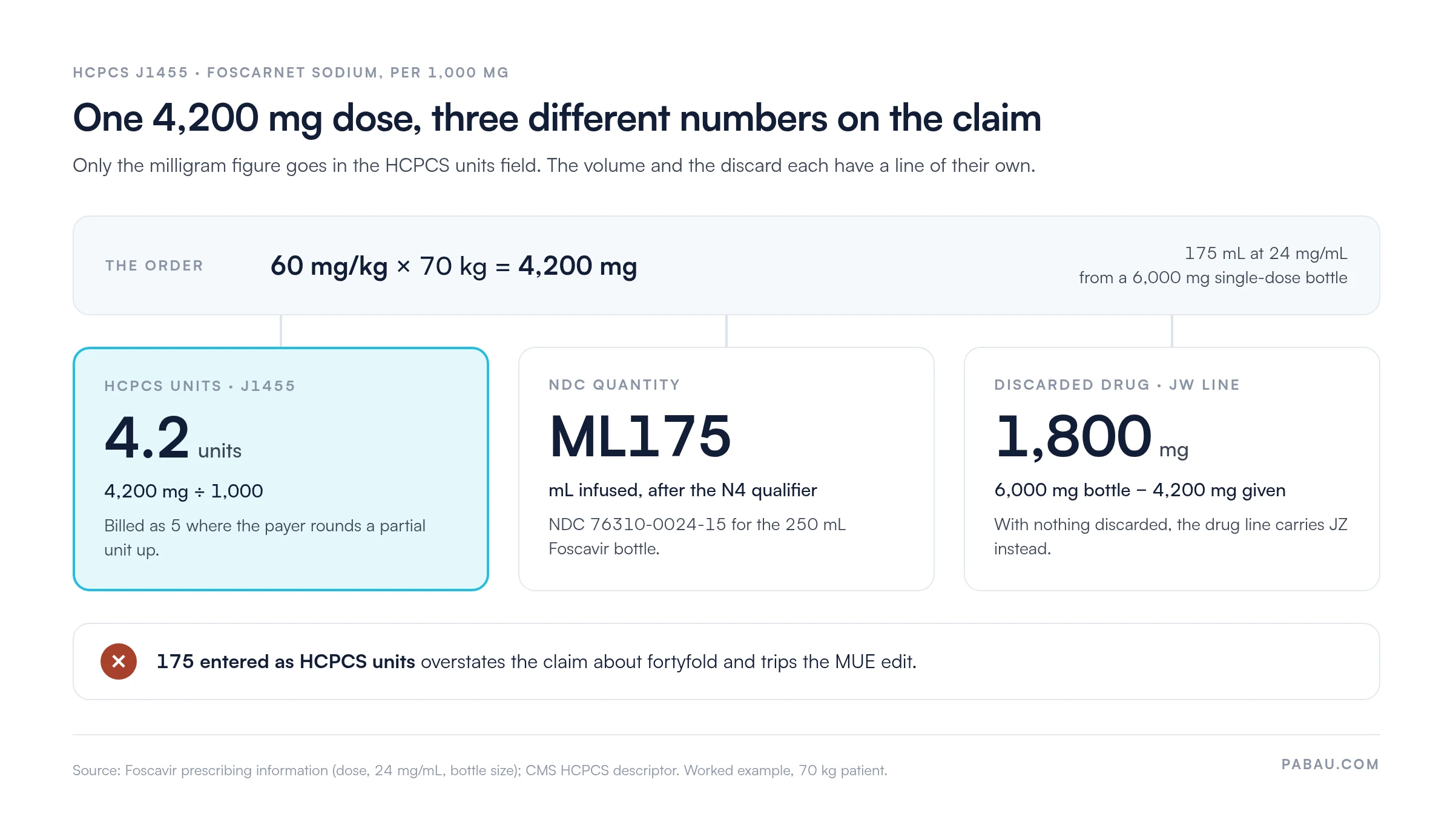
The physician order and the infusion record should both show the dose in mg and the volume infused. The mg figure supports the HCPCS units, and the mL figure supports the NDC quantity.
HCPCS Code J1455 covers the drug only. The intravenous infusion service needs its own CPT administration code on the same claim, starting with 96365 for the first hour. Without it, the claim shows a drug with no service to deliver it, and many payers reject or bundle the drug line.
Place of service matters. In a physician office (POS 11), the physician bills both J1455 and the administration code on a CMS-1500. In a hospital outpatient department (POS 22), the facility bills the drug and the administration service on its own claim.
The physician’s Part B claim then covers the professional service only. Confirm the site of care before choosing the billing pathway, because J1455 is paid differently in each. Superbill documentation that pre-maps J1455 to its companion CPT codes cuts the risk of a missing administration code.
Medicare Part B pays for physician-administered drugs, including HCPCS Code J1455, at Average Sales Price (ASP) plus 6%. CMS prices J1455 per 1,000 mg, matching the HCPCS unit, and updates the rate each quarter. Pull the current figure from the CMS ASP pricing files rather than carrying an old one forward.
ASP is the average price manufacturers sell the drug at, net of rebates and discounts. For a low-volume specialty antiviral like foscarnet, it can move noticeably from one quarter to the next. Payment equals the per-unit limit times the units billed, so the mg-based unit count drives the amount paid.
In a physician office, Medicare pays foscarnet at the ASP plus 6% rate. In a hospital outpatient department, the Outpatient Prospective Payment System (OPPS) decides whether the drug is paid separately or packaged into the administration payment.
Its OPPS status indicator for the quarter tells you which. Knowing the setting before the claim is built prevents both underpayment and a wrongly structured claim.
Traditional Medicare fee-for-service (FFS) generally does not require prior authorization for Part B physician-administered drugs, J1455 included. Medicare Advantage plans, Medicaid managed care plans and commercial payers set their own policies, and many do require it.
When a payer requires prior authorization for foscarnet, the clinical package usually holds four pieces of evidence. The first is a confirmed CMV retinitis or resistant viral infection diagnosis.
The second is failure of, or a contraindication to, first-line therapy (ganciclovir for CMV, acyclovir for HSV or VZV). The last two are viral culture or resistance results and the prescribing physician’s attestation. An incomplete package often leads to a claim denial later, even when the authorization itself was approved.
Medicaid requires the National Drug Code (NDC) on claims for physician-administered drugs such as J1455. Many commercial and Medicare Advantage payers ask for it too. A missing or mismatched NDC is one of the most frequent reasons these claims deny.
The NDC carries its own unit of measure, separate from the HCPCS unit. J1455 counts in units of 1,000 mg, while the NDC quantity for foscarnet solution counts in mL. For a 4,200 mg dose, that means 4.2 HCPCS units (5 if the payer rounds up) and an NDC quantity of ML175.
An NDC that does not match the drug J1455 describes will trigger a denial. Check the bottle label against the NDC-to-HCPCS crosswalk before each submission. Verify the NDC at the time of administration instead of relying on a billing template saved in a prior quarter.
CMS publishes Medically Unlikely Edit (MUE) values for J-codes, including J1455, in its quarterly MUE tables. An MUE caps the units CMS considers reasonable for one patient on one date of service. Check the current value before submission, because CMS can revise it.
Because each J1455 unit is 1,000 mg, a correct daily count is small. A 70 kg patient on induction every 8 hours needs about 13 units. A line showing 175 or 350 units points to the mL error, and the MUE will catch it. Recheck the unit math against the mg dose before you appeal an MUE denial.
When a correctly counted dose still exceeds the MUE, check the MUE adjudication indicator (MAI). A line-level edit (MAI 1) allows correctly split lines with modifiers.
A date-of-service edit (MAI 2 or 3) cannot be bypassed that way, so the claim goes to appeal. The appeal packet should hold the weight-based order, the infusion record and a letter of medical necessity.
The two codes most often entered in place of J1455 are J1453 and J1456. Both describe fosaprepitant, an NK1 receptor antagonist for chemotherapy-induced nausea and vomiting.
Fosaprepitant and foscarnet share their first three letters, but the drugs differ in mechanism, indication and dosing. Billing either code for a foscarnet infusion is a wrong-drug error that will deny and can draw an audit.
J1455 denials follow predictable patterns. Knowing the most frequent causes and their fixes cuts rework on a drug whose per-dose cost makes prompt payment matter. Applying denial management strategies consistently stops the same errors from recurring.
For repeated denials on the same code, review the medical billing denial codes on the payer’s remittance advice. The CARC codes on the ERA name the edit that fired, which makes the root cause faster to find than a full claim review.
A pre-submission review against this checklist prevents the most common J1455 denials. Building a clean claim submission process around these elements lowers the first-pass denial rate for foscarnet infusions.
Each checklist item maps to a denial category, so a failed item points straight to the fix. Our guide to medical billing workflows shows where J1455 documentation fits in the cycle from order to remittance.
A J1455 claim needs three numbers to agree: the mg dose on the order, the HCPCS units and the NDC quantity in mL. Most J1455 rework starts when one of them is keyed in by hand from a different source.
In Pabau, the practice software we build, the clinical record and the claim sit in one system. Pabau’s claims management software captures place of service at the encounter, and it flows through to the claim. The drug line and its administration code leave together, with the NDC fields filled from the same record.
Claims go out through the Claim.MD clearinghouse. Eligibility responses, claim status and electronic remittance advice come back against the same patient record. A unit or NDC rejection shows up the day it happens, not at month-end reconciliation.

Pabau tracks J-code submissions, NDC fields, and claim status in one workflow so your team catches errors before they reach the payer. See how practices reduce HCPCS claim denials with smarter claim management.

J1455 is billed in thousands of milligrams, and that one fact decides whether the claim is right. Divide the mg dose by 1,000, apply the payer’s rounding rule, and keep the mL volume for the NDC quantity. A claim built that way clears the MUE, matches the ASP payment basis and holds up on audit.
The rest is routine discipline: the right drug code, both diagnoses, the administration code and a verified NDC. Book a demo to see how Pabau keeps the order, the infusion record and the claim in one workflow.

Want to understand how drug claims fit into the broader billing cycle? Revenue cycle management explained outlines how drug claims move from order through payment posting.
Looking for guidance on clean claim requirements? Medical billing compliance details the documentation standards payers audit most frequently on J-code claims.
HCPCS Code J1455 covers injection, foscarnet sodium, per 1000 mg. It bills the drug given by intravenous infusion, not the infusion service. The service needs its own CPT code: 96365 for the first hour and 96366 for each additional hour.
Divide the milligrams of foscarnet administered by 1,000. A 4,200 mg dose is 4.2 units, which many payers round up to 5. The infused volume in mL is reported only as the NDC quantity, never as J1455 units.
Traditional Medicare fee-for-service does not require prior authorization for J1455. Medicare Advantage plans, Medicaid managed care plans and commercial payers may require it. Check the payer’s current coverage policy before each course of therapy begins.
CMS publishes the MUE for J1455 in its quarterly MUE tables, and the value can change. Check the current table for the billing period. Recheck the unit math against the mg dose first, since mL-based counts are a common cause of MUE denials.
Foscarnet infused in a physician office or hospital outpatient department is covered under Medicare Part B as a physician-administered drug. A claim for that setting sent to Part D will deny. Rebill it to Part B with the administration CPT code.
Payers that require the NDC want the 11-digit code in 5-4-2 format, the N4 qualifier, the ML unit of measure and the mL quantity. That quantity is separate from the HCPCS units. Verify the NDC on the bottle used at each encounter, because NDCs change when packaging does.