CCSD code L6530: Revision femoral bypass graft
CCSD code L6530: Definition and clinical scope CCSD code L6530 carries the offic...

Last Updated: Nov 13, 2026
L5910 is the CCSD code for femoro-femoral bypass. UK private medical insurers use it for surgery that carries blood from one groin to the other. The graft is tunneled under the skin of the lower abdomen.
The code sits in chapter 9.5.0 Ileo-femoral Vessels of the CCSD Schedule, under 9.0.0 Vascular System. It needs a healthy donor iliac artery, so bilateral iliac disease points to an axillo-femoral code instead. The operative note should name the donor side.
Let Pabau's smart automation suggest the right codes, reduce claim denials, and keep your practice compliant—effortlessly.
Automate repetitive tasks and focus on what matters most—your patients.
Reduce coding errors and ensure compliance with the latest regulations.
Clean claims, fewer denials, and faster reimbursements.
Powerful insights and reporting to help your practice thrive.
HIPAA compliant SOC 2 certified GDPR-compliant Trusted by 4,000+ clinics worldwide

CCSD code L5910 covers femoro-femoral bypass, a crossover graft that carries blood from one groin to the other across the lower abdomen.
The operation depends on a healthy donor iliac artery. When both iliac arteries are diseased, an axillo-femoral code such as L1620 or L1680 fits instead.
L5910 sits in chapter 9.5.0 Ileo-femoral Vessels of the CCSD Schedule, under reference FI.035.
CCSD lists L6000, L6300, L6530, L6710, L7010 and L9350 as unacceptable combinations with L5910.
UK private medical insurers such as Bupa, AXA Health, Aviva and Vitality generally expect pre-authorization before planned vascular surgery.
Pabau, our practice management software, sends CCSD claims to UK insurers through Healthcode from the record that holds the authorization and operative note.
CCSD code L5910 is the procedure code for femoro-femoral bypass in the schedule of the Clinical Coding and Schedule Development (CCSD) Group. That group represents four major UK private medical insurers. The surgeon tunnels a graft under the skin from one common femoral artery to the other. Blood then flows from the healthy side to the leg starved by iliac disease.
Aviva, AXA Health, Bupa and Vitality sit on the group, and Healthcode uses the same schedule to route claims. It lists L5910 under reference FI.035, in chapter 9.5.0 Ileo-femoral Vessels within 9.0.0 Vascular System. Our CCSD procedure code library covers the other codes in the schedule.
The key billing facts at a glance:
A femoro-femoral bypass is an extra-anatomic operation. The graft runs under the skin of the lower abdomen rather than along the path of the iliac arteries. Because it avoids the abdomen and the aorta, surgeons can offer it to patients who would not tolerate aortic surgery. The schedule codes other extra-anatomic routes in their own sections. A carotid-to-subclavian graft that stays in the neck, for example, is CCSD code L3711.
Coders should be able to find these elements in the operative note:
If the note describes a graft from the axillary artery, or an incision in the abdomen to reach the aorta, L5910 is the wrong code. Read the inflow vessel again before choosing.
Surgeons choose a femoro-femoral bypass when one iliac artery is blocked and the other is healthy. The common indications are:
A crossover graft placed as part of an aorto-monoiliac endovascular aneurysm repair is a different case. CCSD code L2760 already covers the stent graft with its crossover bypass, so L5910 is not added.
Three questions settle the code. Where does the graft take its inflow, where does it end, and is a graft placed at all? The CCSD Schedule entries below are the ones most often confused with L5910.
Common mis-coding scenario: The operative note describes bilateral iliac disease, but the claim carries L5910. A crossover graft needs a healthy donor iliac, so bilateral disease usually points to CCSD code L1680, axillo-bifemoral bypass. Check the inflow vessel in the note before the claim goes out.
A single-groin axillary graft is CCSD code L1620 instead. Both axillo-femoral codes sit in chapter 9.4.0 Abdominal Vessels, not beside L5910 in 9.5.0. Sorted by inflow vessel, the choice comes down to four rows.
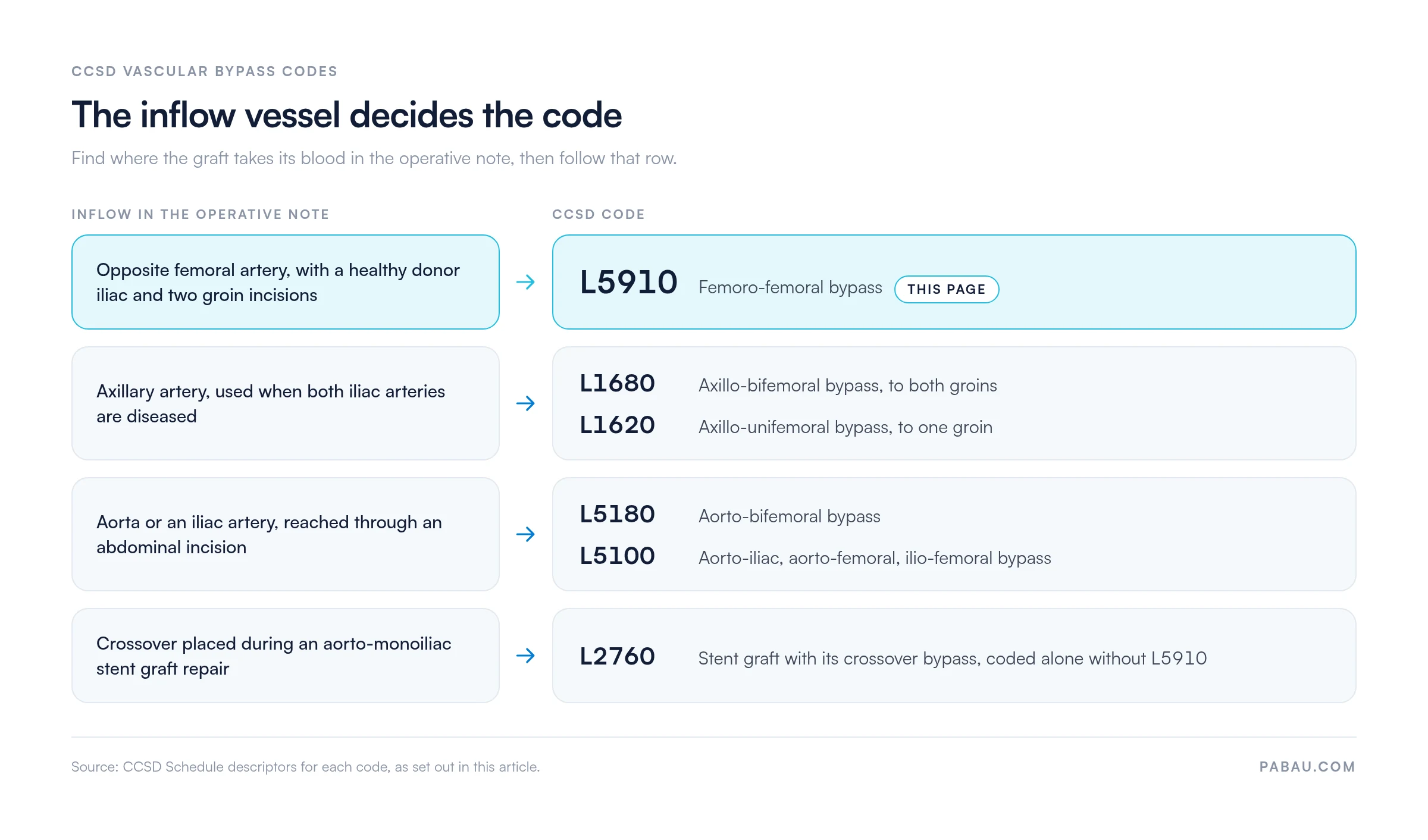
Before coding a crossover graft, find two facts in the operative note. The inflow vessel decides between L5910, L1620 and L1680, and an abdominal incision points to L5100 or L5180. A crossover placed during an aorto-monoiliac stent graft repair is L2760 alone.
The CCSD Technical Guide sets a single-code principle. One code describes the procedure from start to finish, including its routine parts and the care around it.
Included within L5910:
CCSD also lists six unacceptable combinations with L5910, so none of them belongs on the same claim:
The guide calls these lists guidelines that are not comprehensive, and each insurer sets its own contract rules for multiple codes. Ask the insurer before submitting a second procedure code from the same operation.
The CCSD Schedule has no modifiers for laterality or assistants. L5910 already involves both groins, so it is never billed twice for one operation. Whether an assistant surgeon or graft material is paid separately depends on the insurer, so check its fee rules first.
UK private insurers decide L5910 claims on the operative note and the imaging behind it. A note that leaves out the donor side invites an information request, or a query about whether an axillo-femoral code applies instead.
The operative note should confirm all of the following:
Insurers may also ask for the discharge summary and the imaging report behind the decision to operate. Keeping them beside the operative note lets the billing team answer a query the same day.
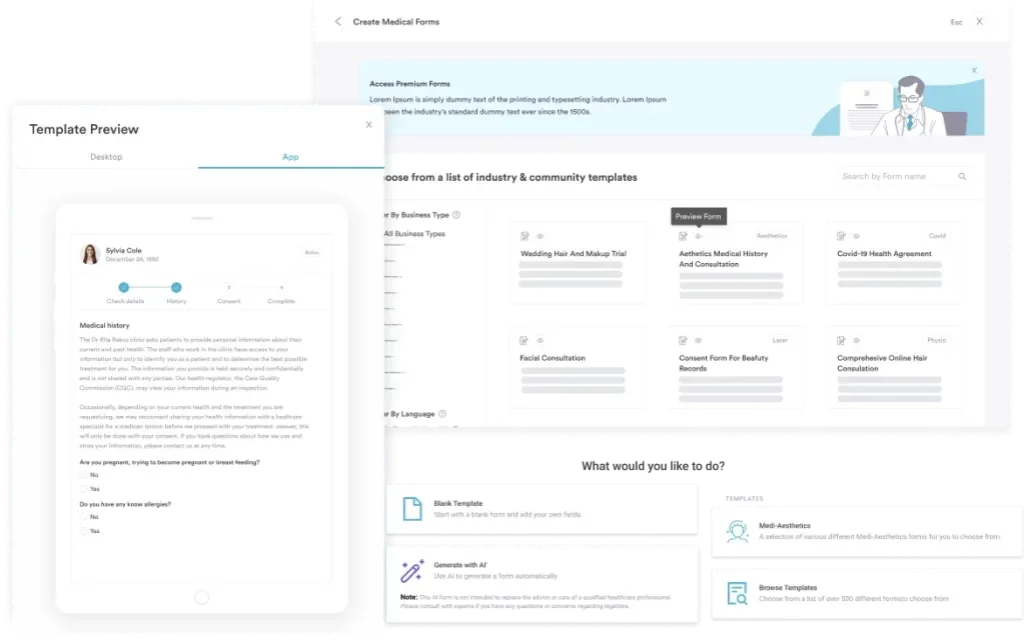
UK private medical insurers generally require pre-authorization before planned surgery, and an arterial bypass falls in that group. Bupa’s claims guidance asks members to call before treatment, then issues a pre-authorization code for the specialist. The code on the claim should match the code that was authorized.
A pre-authorization request for L5910 usually includes:
Check each insurer’s requirements on its own provider portal. Our guide to Bupa CCSD codes explains how to look a code up against Bupa’s schedule.
Acute limb ischemia is an emergency, and emergencies go to the NHS. AXA Health says private health insurance does not usually cover emergency care. Private cover may apply to follow-up treatment once the NHS has handled the emergency.
Healthcode is the main electronic billing route for UK private healthcare. A typical L5910 claim follows these steps:
UK insurers expect a WHO ICD-10 diagnosis that explains why the bypass was needed. The WHO ICD-10 browser confirms each descriptor. The pairings below are illustrative, and the surgeon’s documented diagnosis decides the code.
Embolism and thrombosis of the iliac artery is ICD-10 code I74.5, not I74.3. I74.3 is reserved for the arteries of the leg itself. The diagnosis should name the same side and lesion that the imaging report describes.
Most L5910 denials trace back to the authorization, the code choice or the operative note. The table pairs each trigger with its fix.
Send any appeal inside the deadline the insurer sets, with the corrected note or authorization attached.
In many practices the authorization, the operative note and the claim live in three places. The secretary logs the authorization number in one system, and the surgeon dictates the note into another. The billing team rebuilds the claim days later, which is when crossover and axillo-femoral codes get swapped.
Pabau holds those steps in one patient record. The authorization code, its dates and approved sessions sit on the patient’s case, and Pabau warns the team when one is missing. Through its authorization-matched claims management, Pabau sends each claim to UK insurers through Healthcode or straight to Bupa.
The outcome is fewer information requests to chase and a shorter wait between surgery and payment. Core features come with every plan, so billing and patient records sit together from day one.

Pabau sends CCSD claims through Healthcode from the same record that holds the authorization code and operative note. Your vascular team spends less time answering insurer queries.

For L5910, the donor iliac decides the claim. A note that shows one blocked iliac, a healthy donor side and a graft across both groins supports L5910. Bilateral iliac disease points to an axillo-femoral code, and an aortic inflow points to L5100 or L5180.
The fix sits before billing starts. Agree a note template with your vascular surgeons that records the donor side, the tunnel and the conduit every time. Then confirm the authorized code matches the planned operation before the surgical schedule is final.
Book a demo to see how Pabau keeps authorizations, operative notes and Healthcode claims for CCSD vascular codes in one record.

Coding a bypass that runs below the knee? CCSD code L5950 covers femoro-distal calf bypass with a prosthesis and the detail insurers check.
Billing open surgery on the iliac artery itself? CCSD code L5300 explains open operations on the iliac artery for UK private billing.
Repairing a limb artery with a vein graft? CCSD code L6840 walks through the documentation and claim for that repair.
CCSD code L5910 covers femoro-femoral bypass. The surgeon tunnels a graft under the skin from one common femoral artery to the other. The healthy side then supplies a leg starved by iliac disease. Both groins are opened, but the abdomen is not.
UK private medical insurers, Healthcode and private specialists use CCSD codes to identify procedures on claims. The Clinical Coding and Schedule Development Group maintains the schedule and publishes it at ccsd.org.uk.
A crossover graft needs a healthy donor iliac artery. When both iliac arteries are diseased, surgeons usually take inflow from the axillary artery instead. That is L1680 for a graft to both groins, or L1620 for one groin.
I70.2 (atherosclerosis of arteries of extremities) and I74.5 (embolism and thrombosis of iliac artery) are common pairings. T82.8 (other specified complications of vascular grafts) fits a thrombosed, occluded limb of an earlier graft. The surgeon’s documented diagnosis decides the code.
Usually, yes. UK private medical insurers generally require pre-authorization before planned surgery, including a femoro-femoral bypass. Emergency treatment for acute limb ischemia normally happens in the NHS, outside private cover.
CCSD lists L6000, L6300, L6530, L6710, L7010 and L9350 as unacceptable combinations with L5910. None of them belongs on the same claim. For any other second code, check how the insurer pays a second procedure first.
No. When the crossover is part of an aorto-monoiliac stent graft repair, CCSD code L2760 covers the whole operation. Adding L5910 would code the crossover twice.