

CCSD code G5100: Bypass of duodenum billing guide
CCSD code G5100 bills a bypass that leaves the duodenum in place CCSD code G5100...

Last Updated: Oct 16, 2026
Billable Code Specific Code
J0583 is the HCPCS Level II code for injection, bivalirudin, 1 mg. It covers Angiomax and therapeutically equivalent bivalirudin, given as an anticoagulant in patients undergoing percutaneous coronary intervention (PCI).
Bill the code per milligram and report the NDC. Then check the product against J0582, which covers Endo's bivalirudin, a product CMS lists as not therapeutically equivalent to J0583. Medicare Part B pays under the ASP plus 6% method, with rates updated quarterly.
Let Pabau's smart automation suggest the right codes, reduce claim denials, and keep your practice compliant—effortlessly.
Automate repetitive tasks and focus on what matters most—your patients.
Reduce coding errors and ensure compliance with the latest regulations.
Clean claims, fewer denials, and faster reimbursements.
Powerful insights and reporting to help your practice thrive.
HIPAA compliant SOC 2 certified GDPR-compliant Trusted by 4,000+ clinics worldwide

J0583 bills bivalirudin at 1 mg per unit, so report the total milligrams given and round any fraction up to the next whole unit.
J0583 covers Angiomax and therapeutically equivalent bivalirudin, while J0582 is reserved for Endo’s bivalirudin, which CMS lists as not therapeutically equivalent.
Medicaid and many commercial payers require the NDC with qualifier N4, but Medicare Part B does not generally require it on J0583 claims.
Bivalirudin comes in single-dose vials, so each Medicare line carries JW for discarded drug or JZ when none was discarded.
Pabau, our practice management and billing platform, captures the NDC, units, and modifier at documentation, which cuts first-pass claim errors.
HCPCS code J0583 is the billable Level II code with the official CMS descriptor “Injection, bivalirudin, 1 mg.” It covers Angiomax and therapeutically equivalent generic bivalirudin. Bivalirudin is a direct thrombin inhibitor that the FDA approves as an anticoagulant in patients undergoing percutaneous coronary intervention (PCI). That approval includes patients with, or at risk of, heparin-induced thrombocytopenia (HIT). CMS maintains HCPCS Level II and publishes annual updates plus quarterly updates.
J0583 covers IV bivalirudin given as an anticoagulant in patients undergoing PCI, the single indication on the current Angiomax label. That indication includes patients with HIT or HIT with thrombosis syndrome (HITTS). Each claim needs a supporting ICD-10-CM diagnosis code to establish medical necessity.
Covered indications:
Older Angiomax labels listed unstable angina in patients undergoing percutaneous transluminal coronary angioplasty (PTCA) as a separate use. The current label describes PCI broadly instead. When the team gives unfractionated heparin rather than bivalirudin, that drug bills under J1644, per 1,000 units.
Not covered under J0583:
The billing unit for HCPCS code J0583 is 1 mg. Report the total milligrams administered, rounded up to the next whole number whenever the dose includes a fraction. Rounding down underreports the drug and creates a units mismatch against the administration record.
Bivalirudin is weight-based (typically a 0.75 mg/kg bolus for PCI), so the milligram dose varies by patient. Pull the total from the pharmacy dispense record or nursing infusion log, then convert it directly to units on the claim line.
J0583 is the standard bivalirudin code, in place since 2018. It covers Angiomax and any bivalirudin product that is therapeutically equivalent to it. J0582 took effect on October 1, 2025, and reads “Injection, bivalirudin (Endo), not therapeutically equivalent to J0583, 1 mg.” Use J0582 only when the vial administered is Endo’s product, and check the NDC on that vial before you submit.
The split follows the product, not the indication. Both codes bill at 1 mg per unit, and the vial the dose came from decides which one goes on the claim. After the code, each claim line comes down to three more checks, shown below.
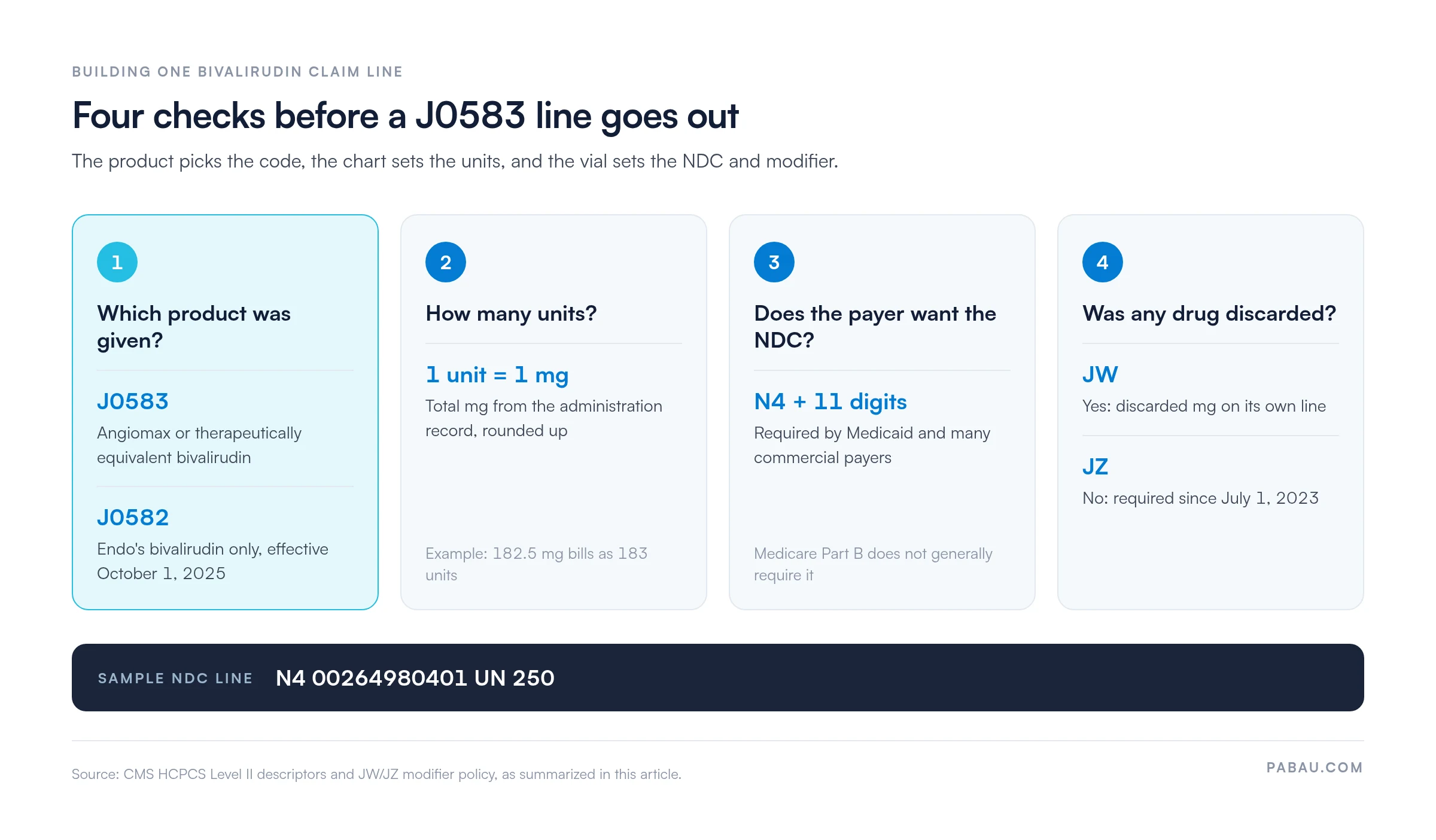
NDC reporting for HCPCS code J0583 is required by Medicaid and many commercial payers. Medicare Part B does not generally require it. Medicaid’s requirement comes from the Deficit Reduction Act of 2005, which states rely on to collect drug rebates.
Key NDC submission rules for medical billing workflows involving injectable drugs:
A correctly formatted NDC line on CMS-1500 Box 24 looks like this: N4 00264980401 UN 250 (qualifier, NDC, unit qualifier, quantity).
Always take the NDC from the vial used during the procedure. Pharmacy dispense systems often carry several bivalirudin NDCs, depending on the contracted supplier. A static code list goes stale the moment the purchasing contract changes.
Medicare Part B reimburses HCPCS code J0583 under the Average Sales Price (ASP) plus 6% methodology, established under 42 CFR 414.904. CMS publishes updated ASP payment limits quarterly (January, April, July, October). Because rates change four times per year, never hardcode a dollar amount as current. Instead, check the CMS Physician Fee Schedule lookup or the quarterly ASP drug pricing files on the CMS Part B Drug Payment Policy page.
Hospital outpatient settings (POS 22) bill J0583 under the Outpatient Prospective Payment System (OPPS). Bundling status under OPPS can change in the annual OPPS Final Rule. Verify it against that calendar year’s OPPS Addendum B before assuming separate payment. Under the Part A inpatient DRG, bivalirudin is not separately billable. Physician office buy-and-bill (POS 11) follows straight ASP+6% on the CMS-1500.
Every J0583 claim needs a supporting ICD-10-CM diagnosis code to establish medical necessity. ICD-10-CM codes update each October 1, so verify codes against the current-year code set before submitting. D75.82 has been a non-billable header since October 1, 2022, so a HIT claim needs one of its five-character codes.
Medicare Part B generally does not require prior authorization (PA) for HCPCS code J0583 in approved indications when the clinical record supports the diagnosis. Commercial payers often set their own rules.
PA rules vary by payer and plan year. Never rely on last year’s policy. Contact the payer’s provider line or check its online portal before each encounter that involves commercial insurance.
Incomplete documentation is a frequent reason claims fail on audit. The medical record must support both the indication and the dose administered.
Auditors reviewing J0583 claims look for:
A structured superbill captures the NDC, units, and supporting ICD-10 code at documentation. That lowers the chance of a mismatch between the chart and the submitted claim.
The billing form, claim type, and bundling risk for HCPCS code J0583 all depend on the care setting. Getting the place of service (POS) code wrong is a common technical denial trigger.
Two modifiers apply to J0583 claims: JW and JZ. Both apply to drugs from single-dose containers or single-use packages, and bivalirudin comes in single-dose vials. JW, which reports the discarded amount, has been required since 2017. JZ could be reported from January 1, 2023, and became required on July 1, 2023, for lines with no discarded drug.
Since July 1, 2023, every Medicare J0583 line from a single-dose vial needs JW or JZ. CMS began editing claims for these modifiers on October 1, 2023, so a line missing both is returned.
Bill wastage on a separate claim line. Report J0583 JW with the discarded quantity in units, and J0583 with no wastage modifier for the administered quantity. Some payers reject both lines if the two quantities share one line.
Most J0583 denials are preventable. The table below maps frequent denial triggers to their codes and fixes, and our guide to medical billing denial codes explains each code in full. For a broader framework, revenue cycle management at the pre-billing stage catches these issues earliest.
For a deeper look at handling denied claims, see our guide to denial management in healthcare.
Without a connected system, a billing team rebuilds each bivalirudin line by hand. The NDC comes from the pharmacy system, the milligrams from the infusion log, and the modifier from a nurse’s note.
Pabau records the drug code, NDC, administered quantity, and modifier at the point of documentation. Its claims management software then flags a missing NDC, a unit mismatch, or an absent JW or JZ before the claim leaves the practice.
Your team bills from one record per encounter, so the chart and the claim agree on the first submission.

Pabau captures the drug code, NDC, units, and modifiers at documentation, so your billing team submits every bivalirudin claim from accurate data.

Treat J0583 as the default bivalirudin code and J0582 as the exception you confirm from the vial. That one habit settles the code before units, NDC, or modifiers come into play.
The rest is record-keeping. Bill units from the administration record rather than the vial size. Give each payer the NDC it asks for, and add JW or JZ to every single-dose vial line.
The trade-off is a few extra seconds at documentation against a rework cycle later. Book a demo to see how Pabau carries the code, NDC, and modifier from the chart to a clean bivalirudin claim.

Need a clean-claim checklist for injectable drug codes? Clean claim requirements in medical billing covers the technical elements payers check before processing any drug claim.
Want to understand how clearinghouse edits catch NDC errors? Medical claims clearinghouse explained walks through how electronic validation works before a claim reaches the payer.
Looking for a structured approach to superbill design? Superbill guide explains how to structure documentation that supports both the J-code and the ICD-10 pairing on the same claim.
Billing another injectable that needs NDCs and units? HCPCS code J0694 walks through cefoxitin units, NDC reporting, and the denials that follow common errors.
Want a second worked example of JW and JZ? HCPCS code J9228 shows how wastage modifiers and NDCs apply to Yervoy claims.
HCPCS code J0583 covers injection of bivalirudin at 1 mg per billing unit, for Angiomax and therapeutically equivalent products. The drug is used as an anticoagulant in patients undergoing PCI, including patients with HIT or HITTS.
The billing unit for J0583 is 1 mg. Report the total milligrams administered, and round up to the next whole unit when the dose includes a fraction.
J0582 covers only Endo’s bivalirudin, which CMS lists as not therapeutically equivalent to J0583. J0583 covers Angiomax and therapeutically equivalent bivalirudin. The NDC on the vial administered decides which code applies.
Medicare Part B does not generally require prior authorization for J0583 in approved indications, but many commercial payers do. Check each payer’s current policy before the procedure, because PA rules change annually.
Report the NDC from the vial label in 11-digit 5-4-2 format with qualifier N4. Medicaid and many commercial payers require it, while Medicare Part B does not generally require it. Never copy a static reference NDC, because NDCs change with the supplier.
J0583 lines from single-dose vials carry JW for any discarded drug or JZ when none was discarded. JW has been required since 2017, and JZ became required on July 1, 2023.



