CPT code 63081: Vertebral corpectomy, cervical spine
CPT code 63081: official descriptor and procedure overview CPT code 63081 descri...

Last Updated: Oct 6, 2026
J9228 is the HCPCS Level II code for injection, ipilimumab, 1 mg. It covers Yervoy, the CTLA-4 blocking antibody from Bristol Myers Squibb, and each billing unit equals 1 mg of drug.
A 225 mg dose is billed as 225 units of J9228. Yervoy treats melanoma and, with nivolumab, several other cancers. Discarded drug from its single-dose vials goes on a separate line with modifier JW.
Let Pabau's smart automation suggest the right codes, reduce claim denials, and keep your practice compliant—effortlessly.
Automate repetitive tasks and focus on what matters most—your patients.
Reduce coding errors and ensure compliance with the latest regulations.
Clean claims, fewer denials, and faster reimbursements.
Powerful insights and reporting to help your practice thrive.
HIPAA compliant SOC 2 certified GDPR-compliant Trusted by 4,000+ clinics worldwide

HCPCS code J9228 covers ipilimumab (Yervoy) and is billed per 1 mg, so a 225 mg dose is reported as 225 units.
Yervoy is FDA-approved for melanoma and, with nivolumab, for kidney, colorectal, liver, lung, pleural mesothelioma and esophageal cancers.
Doses are weight-based at 1 mg/kg or 3 mg/kg depending on the indication, so the unit count changes with every patient.
Yervoy ships in 50 mg and 200 mg single-dose vials, so Medicare claims carry JW for discarded drug or JZ when none is discarded.
Pabau, the practice management platform we build, keeps the dose, vial NDC and claim details together in one patient record.
HCPCS Code J9228 is the CMS code for “injection, ipilimumab, 1 mg.”
It sits in the J-series of HCPCS Level II codes, which covers drugs administered other than by mouth. The code identifies Yervoy, the ipilimumab product made by Bristol Myers Squibb. CMS made J9228 effective on January 1, 2012, replacing the temporary hospital outpatient code C9284.
The key number in the descriptor is 1. Each billing unit equals 1 mg of ipilimumab, so the units on the claim match the milligrams infused. Billers who reach for a multiplier, as some 0.1 mg or 10 mg drug codes require, overbill or underbill the claim.
Ipilimumab is a monoclonal antibody that blocks CTLA-4, a receptor that acts as a brake on T-cell activity. By stopping CTLA-4 from binding its ligands, CD80 and CD86, the drug lets T cells activate and multiply against the tumor.
The FDA first approved Yervoy in 2011 for advanced melanoma. Its label has since grown to eight indications, and most of them pair ipilimumab with nivolumab (Opdivo). Because the drug acts on the immune system, its main risks are immune-mediated reactions in the gut, liver, skin, glands and lungs.
A diagnosis code that doesn’t match an FDA-approved or compendia-supported use is the quickest route to a J9228 denial. The table below maps each indication on the current Yervoy label to its main ICD-10-CM category.
The lung cancer and colorectal indications also depend on biomarker results from an FDA-authorized test. Keep the PD-L1, MSI-H or dMMR report in the record, because payers ask for it at prior authorization and in audits. Check the indications against the current Yervoy prescribing information, which was last revised in August 2026.
J9228 is billed per 1 mg of ipilimumab administered. To find the units, multiply the prescribed dose in mg/kg by the patient’s weight in kilograms. The milligram total is the unit count.
The worked examples below show how dose, vial choice and discarded drug land on the claim. Patient weights are illustrative.
Drawn to scale, the same four cases show how much of each opened vial ends up on a JW line.
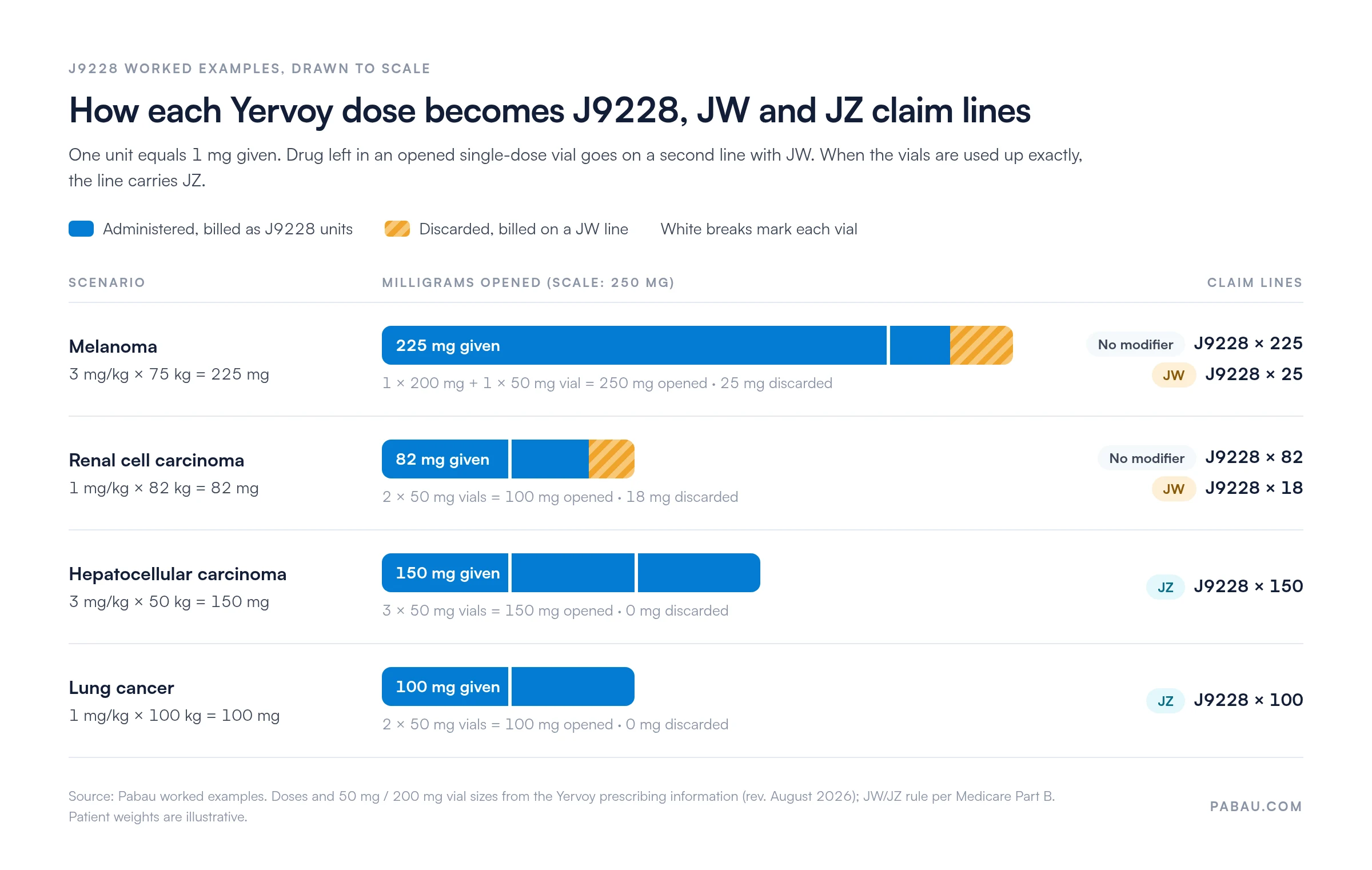
Build the vial mix into your charge capture template. Once the dose is entered, the template should pick the vials that leave the least waste and calculate the JW units. That removes the two most common J9228 errors before the claim reaches the clearinghouse.
Medicare Part B pays J9228 at the Average Sales Price (ASP) plus 6% in the physician office. CMS updates ASP payment limits every quarter, so a rate from last quarter may already be out of date.
Pull the current figure from the CMS ASP pricing files before quoting a patient or checking a remittance. Multiply the per-unit limit by the units billed, because J9228 pays per milligram.
Medicare covers anticancer drugs for their FDA-labeled uses. It also covers off-label uses supported by recognized compendia, under the Medicare Benefit Policy Manual, chapter 15, section 50.4.5. Document the compendia citation in the record for any off-label claim.
Traditional Medicare doesn’t require prior authorization (PA) for J9228, but many Medicare Advantage and commercial plans do. Check each plan before the first infusion. Some plans also authorize a set number of doses, so a new request may be needed for maintenance cycles.
Where a payer requires PA, the request typically includes:
Match the request to the wording of the payer’s own Yervoy policy, rather than sending generic office notes. Payer policies list the exact criteria, dose limits and authorization periods they apply.
A J9228 claim that survives a MAC or RAC audit needs a record that supports the diagnosis, the dose and the waste. Keeping medical billing compliance records consistent across every cycle protects the practice in post-payment review.
Capturing these fields on a structured superbill at the time of service is easier to defend than addenda written after a denial.
Ipilimumab is often given on the same day as other checkpoint inhibitors, so its code sits next to theirs on the claim. Each drug has its own code and billing unit.
Using J3490 or J9999 for Yervoy sends the claim to manual pricing and delays payment. If a payer rejects J9228, call provider relations before switching codes, because the cause is usually a modifier, unit or NDC error.
Most J9228 denials trace back to a handful of root causes, and each one has a workflow fix. Handling denial management at the code level costs less than fixing the same error at appeal every cycle.
A clean claim for J9228 gets each of these elements right on the first submission. Yervoy runs on fixed 3-week or 6-week cycles, so an uncorrected error repeats with every infusion.
Most J9228 errors start at the chair. The weight sits in the visit note, the vial NDC on the label and the waste in a nurse’s log. A biller then rebuilds the claim from all three by hand.
Pabau keeps the treatment note, dose and stock records in the same patient record. Its claims software for oncologists builds the claim from that record. The milligrams given, the waste and the vial details logged at the infusion carry through to the claim lines.
Pabau’s scheduling handles the cycle. Booking each Yervoy infusion 3 or 6 weeks out, with an automated reminder, keeps the regimen on the dates the authorization covers.

Pabau records the dose, vial NDC and discarded milligrams at the point of care. J9228 claims go out with the right units and modifiers, and the audit trail is already complete.

J9228 is simple on paper, because one unit equals one milligram. The claims that fail are the ones where waste, vial mix and NDC are rebuilt by hand after the infusion.
Set the vial logic and the JW or JZ rule once in your charge capture, and tie every claim to a labeled indication. Then each 3-week or 6-week cycle bills the same way.
To see how Pabau keeps Yervoy doses, vial records and claim lines in step, book a demo.

Want to understand how electronic remittance advice connects to denial resolution? Electronic remittance advice guide explains how to read CARC and RARC codes from the ERA to identify the correct corrective action.
Exploring how the 837P format carries NDC data? 837 file billing guide covers loop 2410 NDC reporting and how electronic claims transmit drug information to payers.
Billing the nivolumab dose on the same claim? HCPCS code J9299 covers Opdivo units, NDC reporting and how it pairs with Yervoy.
Coding the infusion that delivers the drug? CPT code 96413 explains the first-hour chemotherapy infusion code billed alongside J9228.
HCPCS Code J9228 represents ipilimumab, sold as Yervoy by Bristol Myers Squibb. It is a CTLA-4 blocking monoclonal antibody, and each J9228 unit equals 1 mg. CMS has used the code since January 1, 2012.
Report one unit per milligram administered. Multiply the mg/kg dose by the patient’s weight, and take the final figure from the infusion record. A 3 mg/kg dose for a 75 kg patient is 225 mg, or 225 units.
Yes, on Medicare Part B claims. Yervoy ships in single-dose vials, so discarded drug goes on a separate J9228 line with JW. When none is discarded, append JZ to the J9228 line.
Traditional Medicare doesn’t require prior authorization for J9228, but the use must be reasonable and necessary. FDA-labeled and compendia-supported uses meet that standard. Many Medicare Advantage and commercial plans do require it, so check before the first dose.
J9228 covers the drug only. The 30-minute infusion is usually billed with CPT 96413. When Yervoy follows a nivolumab infusion on the same day, its infusion is usually reported with 96417.
Report the 11-digit NDC of the vial used: 00003-2327-11 for the 50 mg vial or 00003-2328-22 for the 200 mg vial. Medicaid and many commercial payers require it on the claim line.
The usual causes are a missing JW or JZ modifier, units entered in the wrong measure and a diagnosis outside Yervoy’s indications. Missing prior authorization and an invalid NDC cause denials too.