CPT Code 52352: Ureteroscopic stone removal billing guide
CPT Code 52352: Official descriptor and procedure overview CPT Code 52352 descri...

Last Updated: Oct 30, 2026
G0270 is the HCPCS Level II code for individual medical nutrition therapy (MNT) reassessment and intervention after a second referral in the same year. Medicare uses it for additional MNT hours when a change in diagnosis, medical condition or treatment regimen prompts that referral. Each unit covers 15 minutes of face-to-face time with the patient, including additional hours needed for renal disease.
Common causes of G0270 claim denials include missing documentation of the second referral and ICD-10 codes that no longer match the qualifying diagnosis.
Let Pabau's smart automation suggest the right codes, reduce claim denials, and keep your practice compliant—effortlessly.
Automate repetitive tasks and focus on what matters most—your patients.
Reduce coding errors and ensure compliance with the latest regulations.
Clean claims, fewer denials, and faster reimbursements.
Powerful insights and reporting to help your practice thrive.
HIPAA compliant SOC 2 certified GDPR-compliant Trusted by 4,000+ clinics worldwide

HCPCS code G0270 covers individual MNT reassessment under a second referral, distinct from initial-year services billed under CPT 97802.
Under Medicare, registered dietitians and other qualified nutrition professionals bill G0270, and a physician referral is required.
Diabetes, non-dialysis chronic kidney disease and a kidney transplant in the past 36 months qualify, and a non-covered ICD-10 code is a common denial trigger.
Keeping the referral letter, session note and claim together makes missing referral documentation easier to catch before submission.
HCPCS code G0270 is a Level II code maintained by the Centers for Medicare and Medicaid Services (CMS) for individual medical nutrition therapy (MNT) reassessment.
It covers the reassessment and intervention that follow a second referral in the same year. That referral is prompted by a change in diagnosis, medical condition or treatment regimen. Medicare uses G0270 for these additional MNT hours, and the code has no one-to-one CPT equivalent.
The clinical scenario is specific. A patient with Type 2 diabetes has already used their initial MNT benefit in the current calendar year. Their physician then refers them again because their treatment regimen changed (say, they started insulin or a GLP-1 agonist). That second referral is what G0270 is built to capture. Without the documented second referral, the claim is invalid regardless of how well the session itself is documented.
Under Medicare, registered dietitians (RDs) and registered dietitian nutritionists (RDNs) are the usual rendering providers for HCPCS code G0270. Medicare also recognizes other qualified nutrition professionals. Physicians, nurse practitioners and physician assistants generally do not bill this code directly. A physician referral is still required before the service can take place.
State licensure requirements for dietitians vary. Confirm that the rendering RD or RDN holds the required credential in the state where the service is delivered before submitting the claim.
Medicare covers MNT services for three groups of patients: diabetes, non-dialysis chronic kidney disease, and a kidney transplant within the past 36 months. Billing G0270 with a diagnosis outside these groups is a common reason claims are denied outright.
Confirm the ICD-10 code against your Medicare Administrative Contractor’s (MAC’s) Local Coverage Determination before submission. Obesity alone does not qualify unless it’s paired with a covered condition, which matters for dietitians in weight loss and metabolic health practices.
Always verify the applicable Local Coverage Determination (LCD) issued by your MAC. LCDs specify exact ICD-10 code lists and may differ by jurisdiction.
Medicare’s MNT benefit allows up to three hours of MNT in the first benefit year and two hours in each later year. HCPCS code G0270 applies only after a second physician referral within the same calendar year. The first referral covers the initial MNT course, and a distinct clinical event must trigger the second before G0270 is valid.
Three events can trigger a second referral. Each must be documented explicitly in both the physician’s referral letter and the RD’s session note.
Where a session sits in the benefit year decides its code, and the flow below maps each stage to the codes Medicare expects.
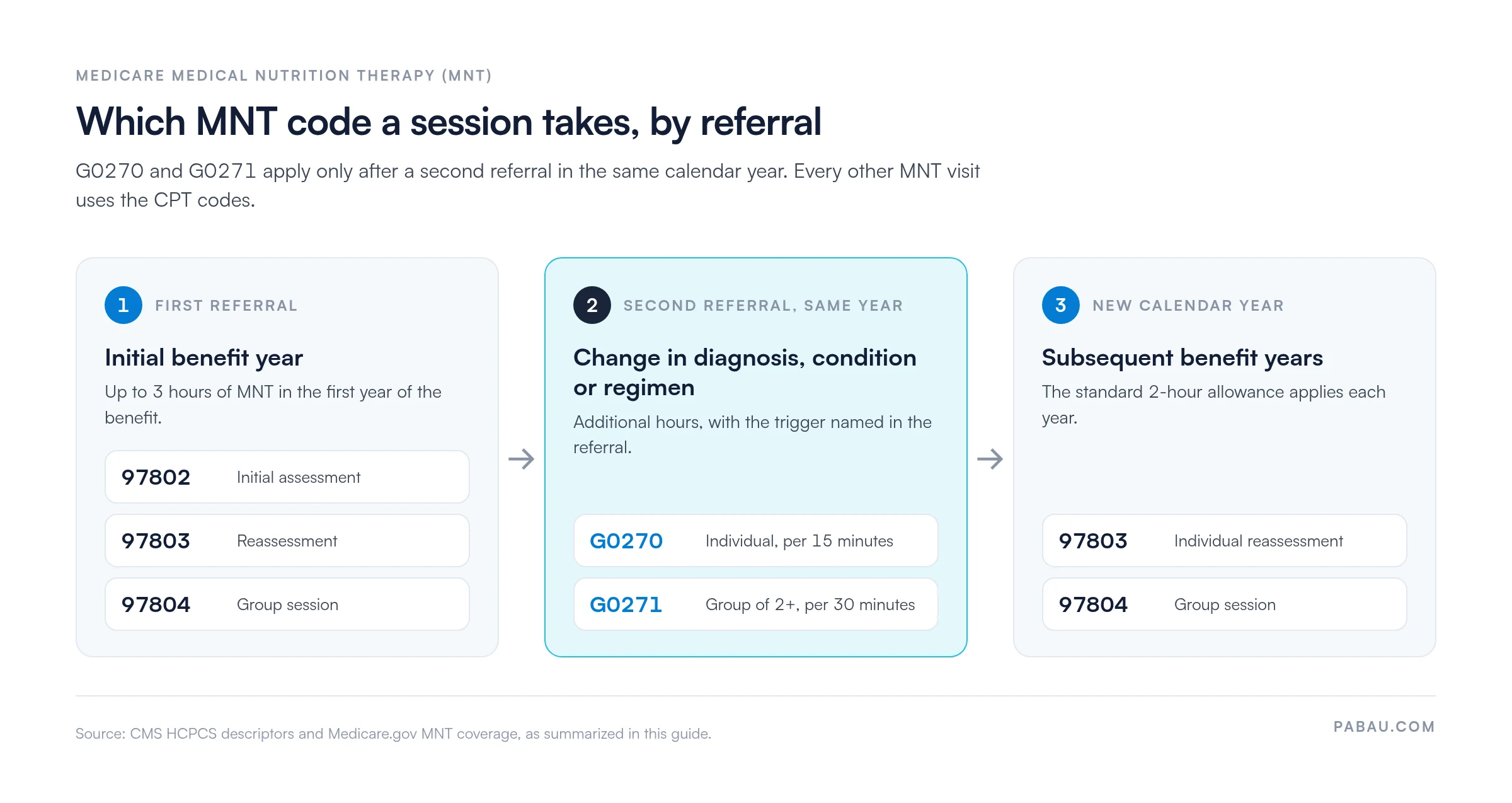
The referral date must fall within the same calendar year as the initial MNT course. A referral dated in the following calendar year is not a second referral for G0270 purposes. In a new calendar year, the standard 2-hour allowance applies, billed with 97803/97804.
Request a copy of the physician’s second referral letter at the time of scheduling. The referral should name the trigger event, whether a diagnosis, condition or regimen change. If it doesn’t, ask the referring physician to amend it before the session date. Without that detail, the claim has no proof of the second-referral event, and payment for HCPCS code G0270 stalls.
G0270 and G0271 cover the same clinical trigger (second referral, same-year MNT reassessment) but differ by session format. G0270 is for individual sessions. G0271 is the group code, defined by Medicare as two or more patients treated at the same time by the same RD.
A frequent mix-up happens when an RD runs a shared visit with two patients but bills G0270, the individual rate, for each. Medicare treats this as upcoding, so record the patient count in every session note.
Payer type and referral stage decide which code applies. Medicare bills standard MNT hours with CPT 97802 (initial assessment), 97803 (reassessment) and 97804 (group). It uses G0270 and G0271 only for extra hours after a second referral in the same year. Most commercial payers bill MNT with the CPT codes.
Medicaid programs set their own MNT coding rules, and some don’t recognize the G-codes. Verify the payer’s preferred code set before the first claim under a new payer contract.
The chart must support every element of the G0270 descriptor, or the claim has nothing to stand on if it’s reviewed. Incomplete records also leave MNT claims open to audits and recoupment. Good medical billing compliance starts at the point of care, not at the clearinghouse.
Use a standardized dietitian superbill that includes fields for all of the above. A superbill with a referral-date field and a trigger-event field makes it harder to submit a claim with missing information.
Modifier requirements vary by MAC. Always check the applicable LCD and your contractor’s billing guidelines before attaching a modifier to a G0270 claim.
Medicare Part B covers MNT services under a structured annual benefit. Knowing that structure prevents overbilling, which triggers audit flags, and underbilling, which leaves reimbursement unclaimed.
Reimbursement rates for HCPCS code G0270 vary by geographic locality and are updated annually in the Medicare Physician Fee Schedule. Use the CMS Physician Fee Schedule lookup tool to retrieve the current allowable rate for your locality. Do this before quoting patients or setting internal benchmarks. Rates stated in third-party guides go out of date within months of a fee schedule update.
Medicare Part B does not generally require prior authorization for G0270. However, the referral itself is a prerequisite, which works as a form of pre-service gatekeeping. Commercial payers frequently do require prior authorization for MNT services, and requirements differ by plan and contract year.
Before scheduling a G0270 visit for a commercially insured patient, verify benefits and authorization requirements with the payer. Conduct insurance eligibility verification at intake, not on the day of the appointment.
The denials below trace back to documentation and workflow steps your practice controls, so most can be prevented before submission. Knowing which error your practice sees most often shows where to fix the workflow first. Reviewing denial management processes across all MNT codes together often reveals one systemic cause behind several denials.
When a G0270 claim does come back, the remittance carries a reason code that tells you what to fix. The guide to medical billing denial codes explains what each code means and how to respond.
Run through this checklist before submitting any HCPCS code G0270 claim. Building it into your billing workflow reduces the time your team spends on appeals. Claims management software can automate several of these checks at the point of claim creation. For practices new to billing dietitian services, the checklist also works as a staff training reference.
Track G0270 benefit units at the patient level, not the claim level. Set a unit counter in your EHR or billing system that updates every time a G0270 unit is billed. When a patient nears the annual limit, the system should flag the account. The team can then obtain a physician order for additional hours before booking the next visit.
In many dietitian practices, the referral letter sits in one place, the session note in another and the claim in a separate billing tool. When the three drift apart, a missing trigger event goes unnoticed until the denial arrives.
Pabau, the practice management platform we build, keeps referral letters, intake forms, treatment notes and invoices in the same patient record. Your billing team can check the second-referral date and trigger against the session note before the claim goes out.
The result is fewer G0270 claims sent without the paperwork they depend on, so your team spends less time on appeals and resubmissions.

Pabau keeps referral letters, session notes and invoices in one patient record, with claims management in the same system. Your dietitian billing team can confirm the paperwork before a claim goes out.

Treat the second referral as a scheduling task, not a billing one. A missing, vague or late-dated referral is a common reason G0270 claims fail, and it’s hard to repair once the session has happened.
Checking the referral at booking takes a few minutes. Catching the problem after a denial costs an appeal, a corrected referral and a delayed payment.
Book a demo to see how Pabau keeps referral letters, session notes and claims together for your dietitian practice.

Want MNT claims accepted on the first pass? Clean claim submission standards explains the elements every compliant nutrition therapy claim must include before it leaves your practice.
Billing group MNT outside a second referral? CPT code 97804 covers group medical nutrition therapy sessions billed under the standard benefit.
Want to work denied MNT claims faster? Reading electronic remittance advice shows how to interpret ERA denial codes and prioritize which claims to work first.
Building a compliant dietitian practice from scratch? Medical billing compliance covers the documentation and audit readiness standards that protect nutrition therapy practices.
HCPCS code G0270 is the Medicare code for individual medical nutrition therapy reassessment after a second physician referral in the same calendar year. The referral must follow a change in the patient’s diagnosis, medical condition or treatment regimen. It covers one-on-one sessions billed in 15-minute units. Medicare covers it for beneficiaries with diabetes, non-dialysis chronic kidney disease, or a kidney transplant in the past 36 months.
Use G0270 when the MNT reassessment session is individual (one patient, one RD). Use G0271 when two or more patients receive the reassessment at the same time from the same RD in a group format. Both codes share the same second-referral trigger, so the session format is the only difference.
Medicare covers G0270 for three groups: diabetes mellitus, non-dialysis chronic kidney disease, and a kidney transplant within the past 36 months. Diabetes includes Type 1, Type 2 and other specified types. Patients on dialysis are excluded from the CKD benefit. Obesity alone does not qualify. Confirm the exact ICD-10 code list with your Medicare Administrative Contractor’s LCD before submitting.
No, Medicare Part B does not require prior authorization for G0270. However, a physician referral is mandatory before the service can be rendered. Commercial payers often do require prior authorization for MNT services, so check benefit requirements individually for each non-Medicare plan.
Modifier 59 (distinct procedural service) applies when G0270 is billed on the same date as another procedure. Telehealth modifiers (95 or GT) apply when the session is delivered via synchronous telehealth. Use both as directed by the MAC, and check its LCD before applying either one.
G0270 is an HCPCS Level II code for MNT reassessment after a second referral in the same year, covering the extra hours that referral allows. Medicare uses CPT 97803 for routine reassessment and CPT 97802 for the initial assessment. Most commercial payers also bill MNT with the CPT codes.
No, G0270 is only for individual sessions. Group MNT reassessment after a second referral is billed under G0271. That code uses a 30-minute unit rather than 15 minutes and pays the lower group rate.