CCSD code K4902: IVUS-guided coronary angioplasty billing guide
CCSD code K4902 covers IVUS-guided coronary angioplasty CCSD code K4902 covers p...

Last Updated: Oct 26, 2026
E0225 is the HCPCS Level II code for a hydrocollator unit, includes pads. It covers the heated water tank and the silica gel hot packs used for moist heat therapy, billed as one item.
Medicare denies E0225 as statutorily noncovered, because CMS Policy Article A52502 classes hydrocollator units as institutional equipment. Bill Medicare with the GY modifier when a claim is needed. Medicaid and commercial coverage varies by plan.
Let Pabau's smart automation suggest the right codes, reduce claim denials, and keep your practice compliant—effortlessly.
Automate repetitive tasks and focus on what matters most—your patients.
Reduce coding errors and ensure compliance with the latest regulations.
Clean claims, fewer denials, and faster reimbursements.
Powerful insights and reporting to help your practice thrive.
HIPAA compliant SOC 2 certified GDPR-compliant Trusted by 4,000+ clinics worldwide

HCPCS code E0225 bills a hydrocollator unit and its pads as one item, so standard pads never go on a separate claim line.
Medicare denies E0225 as statutorily noncovered, because CMS Policy Article A52502 classes hydrocollator units as institutional equipment.
Bill Medicare with the GY modifier, plus GX when the patient signed a voluntary ABN. KX, GA and GZ do not fit this denial.
Medicaid and commercial coverage varies by plan, so check the patient’s policy and any prior authorization rule before you dispense.
Pabau’s claims management software keeps the signed ABN, the Medicare denial and the claim in one patient record.
HCPCS code E0225 is the Level II code for a hydrocollator unit, includes pads. A hydrocollator is a temperature-controlled water tank that keeps silica gel hot packs heated for moist heat therapy.
Medicare does not pay for it. CMS Policy Article A52502 classes hydrocollator units as institutional equipment, and Medicare denies E0225 claims as statutorily noncovered.
The descriptor’s “includes pads” clause matters for every payer. The silica gel hot packs supplied with the unit belong to the same billable item as the tank. A separate line for those pads is a bundling error that payers deny or reduce.
E0225 is an equipment code. The lists below separate what it includes from the accessories and services that are billed some other way.
The treatment service causes the most confusion. When a physical therapist applies hot packs in the practice, the service is CPT 97010. Medicare bundles 97010 into other therapy services, so it is not paid separately either.
No. Medicare denies E0225 as statutorily noncovered, whatever the diagnosis or documentation. Policy Article A52502, Heating Pads and Heat Lamps, states that hydrocollator units (E0225, E0239) are institutional equipment.
The reason sits in the definition of durable medical equipment. Medicare’s DME benefit only covers equipment that is appropriate for use in the home. A hydrocollator tank is built for practice settings, so it fails that test before medical necessity is ever reviewed.
That has three practical consequences for billers:
The fee schedule for durable medical equipment, prosthetics, orthotics and supplies (DMEPOS) may still list E0225 under pricing indicator 32. You can check it in the DMEPOS fee schedule files. A fee schedule amount does not make an item payable by Medicare. It shows only that the code carries a price in CMS’s data.
Medicare does not require a claim for a statutorily excluded item. Submit one when the patient asks, or when a secondary payer needs Medicare’s denial before it will pay.
Append GY to every E0225 line you send to Medicare. GY tells the contractor that the item is statutorily excluded, so the denial makes the patient liable.
An Advance Beneficiary Notice (ABN) is not required for a statutorily excluded item. The ABN is the standard Medicare waiver form, and many suppliers still give one voluntarily so the patient sees the cost in writing before delivery. Add GX alongside GY when a voluntary ABN is on file.
GA and GZ are easy to reach for by habit on DME claims. On E0225 they signal a medical necessity question, which a statutory exclusion never raises.
E0225 is a DMEPOS code, so Medicare claims go from an enrolled DMEPOS supplier to the DME Medicare Administrative Contractor. A physical therapy practice cannot send it under its therapy provider number. Practices that refer patients to a separate supplier do not bill E0225 at all.
Before you dispense a hydrocollator to a Medicare patient, quote the cash price and collect a signed voluntary ABN. If the patient has Medicaid or another secondary payer, send the GY claim first so that payer receives Medicare’s denial.
The patient pays when Medicare is their only coverage. Agree on the price and payment terms before the unit leaves the supplier.
Medicaid and commercial coverage varies by plan. Aetna’s Clinical Policy Bulletin 0540 restates the Medicare exclusion, and other plans set their own DME rules. Check the patient’s policy before you dispense. The diagram below maps the three billing routes by the patient’s coverage.
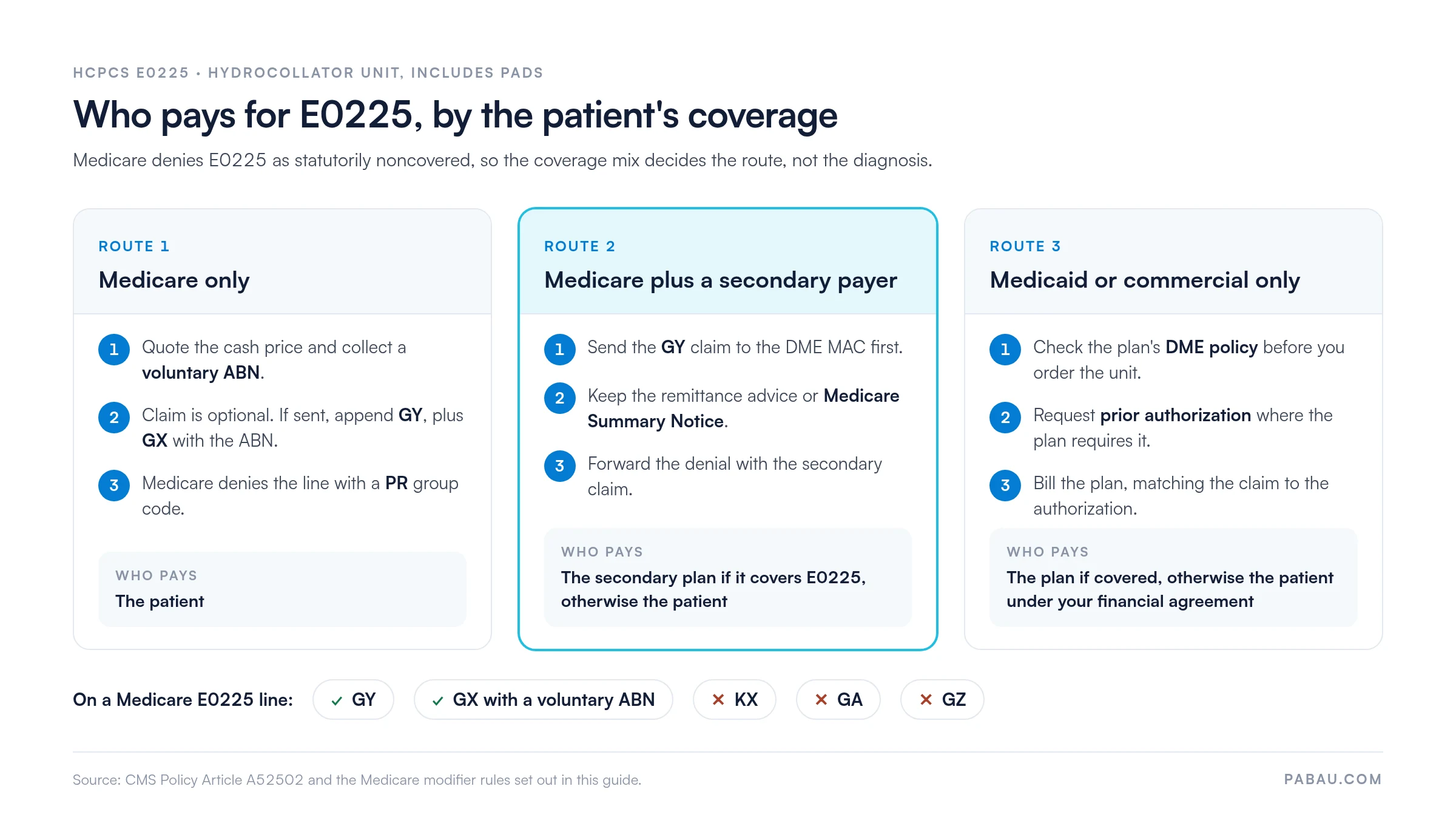
Medicare has no prior authorization pathway for E0225, because no approval can make a statutorily excluded item payable. Prior authorization matters only for Medicaid and commercial plans.
The paperwork for E0225 protects your right to collect from the patient or a secondary payer. Keep these records for every unit dispensed.
Keeping these records together makes a secondary payer request or an audit quick to answer. Pabau’s claims management software links clinical documentation to billing, so the order, the ABN and the denial sit in one patient record. The same medical billing compliance rules apply to noncovered DME. The invoice, the ABN and the delivery receipt should name the same item and date.
The heat therapy section of the HCPCS Level II code set holds several neighboring codes for different devices. Choosing the wrong one creates a descriptor mismatch, even when the equipment looks similar.
E0239 is easy to confuse with E0225. If the device is a portable hydrocollator, E0239 is the correct code, and Medicare denies it on the same statutory grounds. E0210 and E0215 describe electric heating pads, which heat by electricity rather than hot water, so the codes are not interchangeable.
A Medicare denial on E0225 is expected, so the work is routing it correctly rather than overturning it. Sound denial management workflows start with the root cause. Each remittance line carries a group code and a reason code from the standard list of denial codes. The table maps the common E0225 denials to the next step.
Appealing a statutory exclusion wastes staff time. No clinical documentation changes the outcome, because the item sits outside the Medicare benefit. Clean claim submission for E0225 means the right modifier and the right payer order on the first pass.
Read the group code on Medicare’s remittance before you act. A PR (patient responsibility) denial on a GY line is the result you want. A CO (contractual obligation) denial leaves the cost with the supplier, so check the modifiers.
No ICD-10-CM code makes E0225 payable by Medicare, so no accepted diagnosis list exists. Every claim still needs a valid diagnosis, taken from the treating clinician’s notes.
For Medicaid and commercial claims, the diagnosis should match the plan’s policy and any prior authorization. The conditions below often appear on heat therapy orders. They are examples, not a coverage list.
Code to the highest specificity the notes support. An unspecified code is valid, but a plan reviewing a prior authorization request may ask for the specific site.
Noncovered DME billing runs on paperwork. The signed ABN, the delivery receipt, the Medicare denial and the secondary claim often end up in separate folders. One missing form leaves an invoice unpaid.
Pabau, the practice management platform we build, keeps forms, clinical notes and billing in one patient record. Patients can sign a notice like the ABN as a digital form, and the signed copy is stored on their file.
When a secondary payer asks for Medicare’s denial, your team finds it in the same record as the claim. That shortens the time between dispensing the unit and getting paid.

Pabau stores signed forms, clinical notes and billing records in one patient record. Your team can answer a secondary payer or an auditor without searching separate systems.

E0225 is a valid HCPCS code that Medicare does not pay. Treat every Medicare claim for it as a routing step. Put GY on the line, keep a voluntary ABN on file and forward the denial where it is needed.
The larger risk is billing it like covered DME. A KX modifier or a medical necessity appeal on E0225 misstates the claim and spends staff time with no chance of payment.
Check Medicaid and commercial policies before you dispense, and quote the cash price to Medicare patients up front. Book a demo to see how Pabau keeps ABNs, denials and claims together for physical therapy practices.

Need the HCPCS codes for other equipment you dispense? Durable medical equipment list is a free DME template with the HCPCS code for each item.
Want to understand how denial management works across all claim types? Denial management in healthcare explains root-cause analysis and appeal strategies for common payer rejections.
Need a primer on the medical billing cycle before coding DME claims? What is medical billing walks through the end-to-end revenue cycle from claim creation to payment posting.
Want to read the group and reason codes on a GY denial? Electronic remittance advice shows how to read an 835 line by line.
Billing Medicare for more than noncovered DME? Medicare billing for practices follows a claim from appointment to payment.
HCPCS code E0225 covers a hydrocollator unit, including its pads. That means the heated water tank and the silica gel hot packs used for moist heat therapy. Standard pads are part of the code and are not billed separately.
Yes. The official descriptor reads “Hydrocollator unit, includes pads,” so the standard silica gel packs supplied with the unit belong to E0225. A separate claim line for those pads is a bundling error that payers deny or reduce.
No. CMS Policy Article A52502 classes hydrocollator units as institutional equipment and denies E0225 as statutorily noncovered. No diagnosis, order or modifier changes that. Bill Medicare with GY when a claim is needed, and the patient is liable for the cost.
Not for Medicare, because no approval can make a statutorily excluded item payable. Medicaid and commercial plans set their own rules. Check the patient’s plan before you order the equipment, and request authorization where the plan requires it.
E0225 is a hydrocollator unit with pads, while E0239 is a portable hydrocollator unit. Code the device the patient receives. Medicare denies both as statutorily noncovered institutional equipment under Policy Article A52502.
Only through an enrolled DMEPOS supplier number, never a therapy provider number. Even then, Medicare denies E0225 as statutorily noncovered. A practice that dispenses a hydrocollator collects from the patient or bills a plan that covers it.