



CCSD code G5100: Bypass of duodenum billing guide
CCSD code G5100 bills a bypass that leaves the duodenum in place CCSD code G5100...

Last Updated: Oct 16, 2026

CPT Code 97010 covers the application of hot or cold packs as a supervised physical medicine modality, billed once per session.
97010 is a general supervision code, so the therapist does not need to be in constant attendance during the application.
CCI edits bundle 97010 with several same-day codes, and billing both without a valid modifier is a leading denial cause.
Practice management software like Pabau validates CCI edits before submission, which cuts 97010 bundling denials.
CPT Code 97010 covers the application of hot or cold packs to one or more body areas. It is one of the most commonly billed physical medicine modality codes, and one of the most frequently denied. Almost every denial traces back to two fixable errors. One is bundling, the other is thin documentation.
The American Medical Association’s CPT code set defines CPT Code 97010 as: Application of a modality to one or more areas; hot or cold packs. It sits within the Physical Medicine and Rehabilitation section (97010-97799).
The code is classified as a supervised modality, so the treating clinician need not be continuously present while the pack is applied.
Unlike timed codes such as 97110 (therapeutic exercise), CPT Code 97010 is reported per session, not per 15-minute unit. You bill it once, however long the pack stays in place. The Medicare 8-minute rule that governs timed codes never applies here, and that is where new billers most often go wrong.
Hot and cold packs are two distinct therapeutic tools, both captured under CPT Code 97010. Their separate clinical uses explain why the documentation has to name the modality that was applied.
Hot packs (thermotherapy) are applied to increase local blood flow, relax muscle spasm, and reduce pain before manual or exercise therapy. Common conditions include muscle strains, chronic low back pain, and osteoarthritis.
Cold packs (cryotherapy) reduce inflammation and acute pain, typically in post-injury or post-surgical care. Common applications include acute ankle sprains, post-operative swelling, and tendonitis flare-ups.
Both modalities are preparatory, so they are usually applied before the main therapeutic intervention. Payers expect the visit note to state that rationale, rather than only the fact that a pack was applied.
CPT Code 97010 may be billed by a range of provider types, depending on state scope of practice rules and individual payer contracts. Confirm your eligibility before you bill, so a credential-based denial never reaches the ERA.
Eligibility also depends on the billing setting. Hospital outpatient departments, private outpatient practices, skilled nursing facilities (SNFs), and rehabilitation centers are all common settings.
Always verify that your payer recognizes your provider type for this code before submitting. State practice acts can further restrict or expand who may apply and bill supervised modalities.
One of the most misunderstood aspects of CPT Code 97010 is its supervision requirement. Getting it wrong creates compliance risk as well as denials.
Under Medicare guidelines, CPT Code 97010 requires only general supervision. A support staff member or aide can apply the pack while the therapist attends to another patient. Some state licensure boards and private payers require direct supervision. Read your state practice act and payer contract before you rely on the Medicare standard.
The constant-attendance codes listed above work the other way. 97033, iontophoresis, is timed in 15-minute increments, so the 8-minute rule sets its units and the therapist stays with the patient throughout.
Missing or thin documentation is the biggest single cause of 97010 denials. Every visit note supporting the code needs the elements below to demonstrate medical necessity and survive a payer audit.
For Medicare claims, the note must show that the pack was medically necessary rather than routine or comfort care. Auditors look for specificity. “Hot pack applied to back” is unlikely to survive a review.
Write it like this instead: “Moist hot pack to lumbar paraspinals for 15 minutes, to reduce muscle guarding before manual therapy at L4-L5.”
CPT Code 97010 carries one of the lower reimbursement amounts in the physical medicine section. That reflects its supervised status and its per-session billing structure. Rates also vary by geographic payment locality.
The CMS Physician Fee Schedule is the authoritative source for current Medicare rates. Use the look-up tool to retrieve the exact non-facility or facility rate for your MAC jurisdiction. The figures below are national unadjusted approximations for 2026, so verify them against your locality before billing.
For RVU-based calculations, the FastRVU 2026 RVU lookup tool lists work, practice expense, and malpractice values adjusted by location. Because the amount per session is so small, practices normally bill 97010 alongside higher-value timed codes rather than on its own.
Medicare Part B covers CPT Code 97010 under its Physical Medicine and Rehabilitation benefit, but coverage is not automatic. Four conditions decide whether the line gets paid.
These four conditions stack. A 97010 line can be denied on the therapy cap, on an LCD restriction, or on the supervision standard. That holds even where the modality itself was clinically appropriate. Checking all four before submission is far cheaper than unpicking the denial afterwards.
Bundling violations are the most common source of 97010 denials. The Centers for Medicare and Medicaid Services publishes Correct Coding Initiative (CCI) edit tables every quarter. Those tables define which code pairs cannot be billed together without a qualifying modifier.
CPT Code 97010 is bundled with several other physical medicine codes under CCI. If you bill it on the same date of service as a bundled code, Medicare denies one of the two. The tables change quarterly, so verify the current pair before you assume it is payable.
A same-day paraffin bath is one pair to screen first, because CPT Code 97018 applies superficial heat the same way a hot pack does.
Where a CCI edit exists between 97010 and another code, a modifier such as 59 or XU may allow separate billing. That applies only where CMS or your MAC permits it, and where the two services are genuinely distinct and separately documented. Never append a modifier purely to clear an edit.
The sequence below is the check to run before the claim leaves your office.
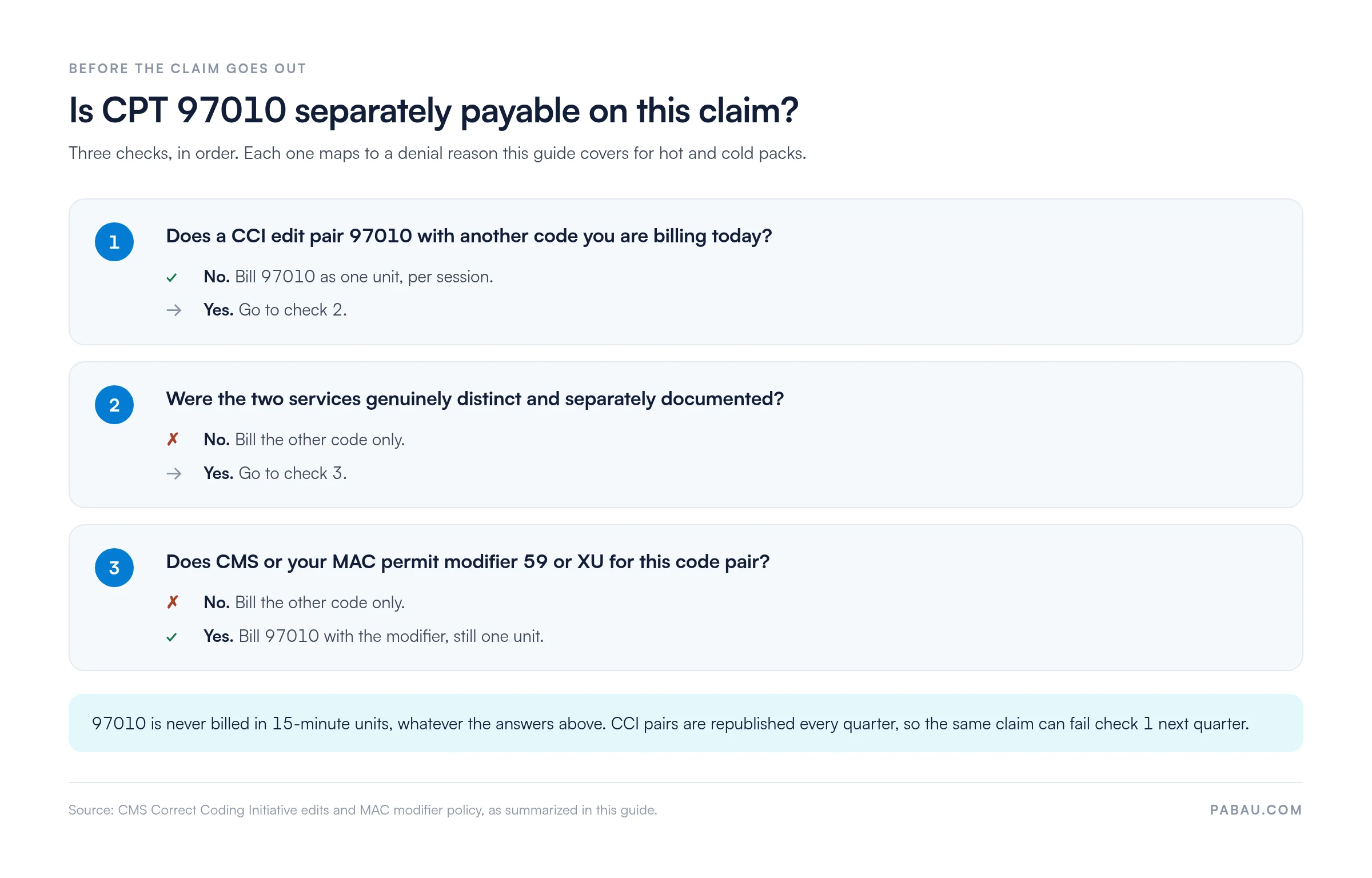
Check the CMS CCI edit tables quarterly. Bundling pairs change every quarter, and a code combination that was payable in January may be bundled by April. Build a quarterly CCI review into your billing compliance calendar to catch changes before they generate systematic denials.
Knowing why 97010 gets denied is the fastest way to protect the revenue attached to it. These five patterns generate the most denials in physical therapy billing, each with the corrective action next to it.
97010 is not the only code where the descriptor decides the unit. HCPCS code G0127 reports one unit for trimming dystrophic nails, whether the podiatrist trims two nails or ten.
Correct billing for CPT Code 97010 follows a short workflow. These steps apply to most outpatient physical therapy settings billing Medicare and the major commercial payers.
Clearing the claim on the first pass matters more here than on a high-value code. Every rework cycle for a $3 to $4 reimbursement costs more in staff time than the line returns. Reading an ERA against the full set of denial reason codes is how a biller tells a bundling problem from a modifier problem.
Automating the CCI check and the documentation prompts pays for itself quickly in practices billing modality codes at volume.
Most 97010 billing errors repeat. A practice that misbills the code once tends to misbill it on every similar visit, until an audit finds the pattern. Practice management software like Pabau enforces the billing rules at the point of entry instead, where a correction still costs nothing.
Pabau’s pre-submission claims management builds CCI edit validation into the billing workflow. Before a 97010 claim reaches the clearinghouse, the system checks for code pairs that would trigger a bundling denial and flags them for review. Your billing team sees the problem before the payer does.
Pabau also connects to the Claim.MD clearinghouse network, which processes electronic claims against thousands of US payers. Real-time eligibility checks and ERA receipt come with it, for 97010 and for the rest of your physical medicine codes.
Three capabilities make the difference for modality-heavy practices:
The AAPC’s CPT code reference is a useful second check on code definitions. Read it alongside the code logic built into your practice management system.

Pabau validates CCI edits automatically before claims go out. Your physical therapy and rehabilitation team spends less time on rework and more time with patients.

The economics of 97010 are lopsided. The code returns roughly $3 to $4 per session, while a single rework cycle costs more than that in staff time. Prevention is the only approach that pays for itself.
Run the three payability checks before submission, document the modality rather than the act of applying it, and re-read the CCI table each quarter. Do that consistently and 97010 stops generating denials, which is all a $4 line should ever ask of your billing team.
Pabau brings the CCI check, the note template, and the denial reporting into one workflow for practices billing modality codes at volume. Book a demo to see how the checks run in a physical medicine setting.

Need the compliance framework behind the documentation? Medical billing compliance sets out the rules that govern how services like 97010 are recorded and claimed.
Working through a stack of ERAs? Denial management in healthcare covers how to triage, appeal, and prevent the denials that modality codes generate.
Want your first-pass acceptance rate to climb? Clean claim explains what payers require before a claim is accepted without a rework cycle.
Managing claims across a physical therapy practice? What is revenue cycle management explains how RCM connects clinical documentation, billing, and reimbursement into one workflow.
Looking at the wider billing software market? Best medical billing software in the US compares platforms built for physical medicine and outpatient rehabilitation settings.
CPT Code 97010 bills the application of hot or cold packs to one or more body areas. Hot packs (thermotherapy) address muscle spasm and chronic pain. Cold packs (cryotherapy) address acute inflammation and post-injury swelling. The code is billed once per session, not per 15-minute unit.
Medicare Part B covers CPT Code 97010 when medical necessity is documented. Coverage is not guaranteed for comfort-only applications. MACs may issue Local Coverage Determinations (LCDs) that further restrict coverage. Always verify with your specific MAC before billing, as Palmetto GBA and other MACs have issued specific modality bundling guidance.
CCI edits bundle CPT Code 97010 with certain other modality codes when billed on the same date of service. The specific pairs and whether a modifier can override the edit change quarterly. Always check the current CMS CCI edit tables before submitting a multi-code claim that includes 97010. Billing a bundled pair without documentation support for a modifier is a leading cause of claim denial.
The four common denial reasons are bundling violations, thin documentation, wrong billing units, and unsupported modifiers. A bundling violation means 97010 was billed same-day with a code CCI bundles it with. The unit error means more than one unit was billed for a per-session code. Pre-submission CCI checks and structured note templates resolve most of these.
CPT Code 97010 is a general supervision (supervised) modality under Medicare guidelines. The treating clinician does not need to be in constant attendance while the hot or cold pack is applied. By contrast, codes such as 97032 (electrical stimulation, manual) and 97035 (ultrasound) require constant attendance. State practice acts and some private payers may impose stricter supervision requirements, so verify locally before relying on the Medicare standard alone.



