

HCPCS code E0198: Water pressure pad billing guide
HCPCS code E0198 is a water pad for a standard mattress HCPCS code E0198 is the ...

Last Updated: Oct 13, 2026
C1895 is the HCPCS Level II code for lead, cardioverter-defibrillator, endocardial dual coil (implantable).
Let Pabau's smart automation suggest the right codes, reduce claim denials, and keep your practice compliant—effortlessly.
Automate repetitive tasks and focus on what matters most—your patients.
Reduce coding errors and ensure compliance with the latest regulations.
Clean claims, fewer denials, and faster reimbursements.
Powerful insights and reporting to help your practice thrive.
HIPAA compliant SOC 2 certified GDPR-compliant Trusted by 4,000+ clinics worldwide

HCPCS Code C1895 reports an implantable cardioverter-defibrillator lead placed endocardially with two defibrillation coils.
C1895 is billed under Medicare’s Outpatient Prospective Payment System, and coverage follows National Coverage Determination 20.4 for implantable automatic defibrillators.
A clean claim needs a matching ICD-10-CM diagnosis, bill type 13X with revenue code 278, and the device identifiers in the operative note.
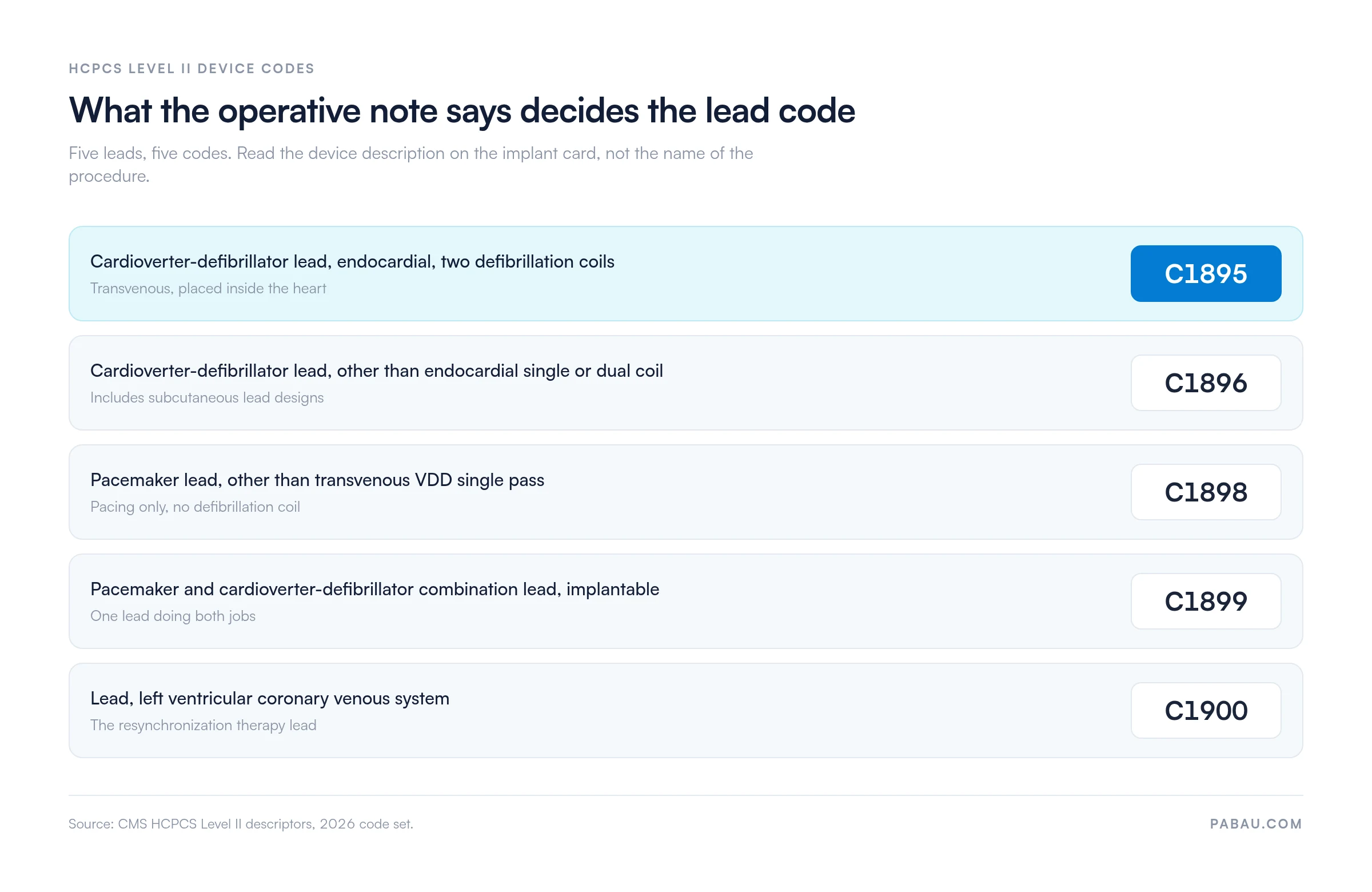
C1896 is the code that gets confused with C1895, and it covers defibrillator leads that are neither endocardial single nor dual coil.
Practice management software like Pabau keeps device documentation on the patient record, so the professional claim goes out complete.
HCPCS Code C1895 is the Level II code assigned by the Centers for Medicare & Medicaid Services (CMS) to report a specific implantable cardiac device component. According to CMS, the official descriptor is:
The “C” prefix identifies this as an HCPCS Level II code maintained by CMS for hospital outpatient settings. Unlike CPT codes, which describe procedures, C-codes describe the devices used during them. They ride on the UB-04 claim alongside the procedure code.
The endocardial dual coil lead is a transvenous lead placed inside the heart, and it carries two defibrillation coils. One coil typically sits in the right ventricle. The second sits in the superior vena cava or the right atrium.
That architecture lets the ICD generator deliver defibrillation energy across a broader cardiac volume than a single-coil lead can. The two designs are different devices, which is why they carry separate HCPCS codes.
Coverage for C1895 follows National Coverage Determination (NCD) 20.4, Implantable Automatic Defibrillators, which CMS implements through Billing and Coding Article A56340. Medicare covers ICD implantation, and the leads that go with it, when the documented clinical indications are met. Several of those indications turn on left ventricular ejection fraction, or LVEF.
Key Medicare coverage requirements under NCD 20.4 include:
Patients must not have irreversible brain damage, a life expectancy under one year, or an incessant VT or VF condition. Article A56340 sets out what the medical record has to carry before the C1895 claim is considered.
Billing HCPCS Code C1895 requires an accompanying ICD-10-CM code that establishes medical necessity. The diagnosis code supports the claim but does not carry it on its own, which is why complete clinical documentation matters.
These are the diagnoses most often billed alongside C1895. Note that I47.2 is a parent code and cannot be submitted, so the claim needs a billable subcode such as I47.20 or I47.29. Article A56340 carries the full covered-code list, and CMS revises it every year.
C1895 is reimbursed under the Medicare OPPS, so payment follows an Ambulatory Payment Classification (APC) assignment rather than a fixed national fee. Those rates are updated annually through the CMS OPPS final rule, published each November for the following calendar year. Check the current OPPS Addendum B to confirm how the code is treated for the year you are billing.
Device pass-through status under OPPS runs for a limited period, typically two to three years. It applies while a new device is not yet reflected in OPPS cost data. During that window, Medicare pays the device separately from the procedure APC. Once the window closes, the device cost is packaged into the procedure APC.
Pass-through status is granted per device category, so each code needs its own check. Check the current Addendum B before you assume C1895 or another device code such as C1825 still holds it. Last year’s notes will not answer that.
Check the CMS OPPS Addendum B each November when the final rule publishes. Confirm C1895’s APC assignment and pass-through status for the new calendar year before billing claims in January. Using a prior year’s rate or status is one of the fastest routes to an OPPS denial.
C1895 is billed only on a UB-04 institutional claim by hospital outpatient departments. Device C-codes sit on the institutional side of medical billing, so the claim form matters as much as the code itself. Electronic claim submission through the 837I is the standard for Medicare OPPS, and a CMS-1500 submission is rejected outright.
Billing teams should confirm revenue code requirements with their Medicare Administrative Contractor (MAC). Revenue code 278 is standard for implantable devices, though some MACs ask for more specificity. Capture the device manufacturer, model number, and lot number in the record before the claim goes out.
Documentation is where most C1895 denials start. Medical billing compliance for device codes means the record has to prove two separate things: that the patient qualified, and which device went in.
Required documentation elements include:
One missing element is enough to trigger a medical necessity denial. The device model and lot number and the documented LVEF are the two that go missing most often. Build a pre-submission checklist into the billing workflow for every C1895 claim.
The most consequential coding decision on an ICD lead is choosing between C1895 and C1896. Both describe cardioverter-defibrillator leads, but not the same device. The wrong choice bills for a device the patient never received, which is a compliance problem rather than a simple denial.
The distinction sits in the lead design. C1895 is specific to endocardial leads, placed transvenously inside the heart, with two defibrillation coils. C1896 picks up the leads that miss that description, subcutaneous ICD leads included. The introducer sheath used to place the lead has its own device code, C1893.
Denial patterns for C1895 repeat often enough that a billing team can see them coming. Six account for most of the rejections.
Pairing a pre-submission audit with denial tracking is what stops the same error repeating. A denial management process shows which of these six a team keeps making, and the remark codes behind each rejection are listed under denial codes.
Audit your last 20 C1895 claims. Flag every one denied for missing device identification or for medical necessity not established. Those two reasons cover most C1895 rejections, and both trace back to details the record never captured.
C1895 has been active as a CMS Level II code for hospital outpatient device reporting, and it remains active for the 2026 billing year. C-codes are assigned and updated by CMS through the annual OPPS rulemaking cycle. Verify the current status and any descriptor revision through CMS’s HCPCS code release page, which publishes the Level II update each fall.
Mid-year HCPCS changes are rare for established C-codes. They happen when CMS issues a correction notice, or revises a descriptor because a new device category needs one.
For programmatic lookups, the NLM Clinical Tables HCPCS API gives free access to the current code set. That is the cheapest way to validate a device code at the point of entry rather than at the point of denial.
C1895 itself belongs to the hospital, on the UB-04. The cardiology practice that performed the implant still bills its own professional claim. That claim leans on the same operative note, the same LVEF measurement, and the same implant card.
Practice management software like Pabau keeps those documents on the patient record instead of scattered across a shared drive. The note, the consent, the device photo, and the payer details sit in one file. When a payer asks for the implant detail 11 months later, nobody has to go hunting for it.
Claims then go out through the Claim.MD integration, our US clearinghouse connection, and each remittance posts back against the same record. Pabau’s claims management tools submit and track what the record already holds. A denial lands next to the patient and the code that caused it.
The same workflow carries over to any specialty that bills Medicare for documentation-heavy visits. A physical therapy practice tracking plan-of-care recertification and a regenerative medicine clinic billing device-heavy procedures both live or die by the same record-keeping.
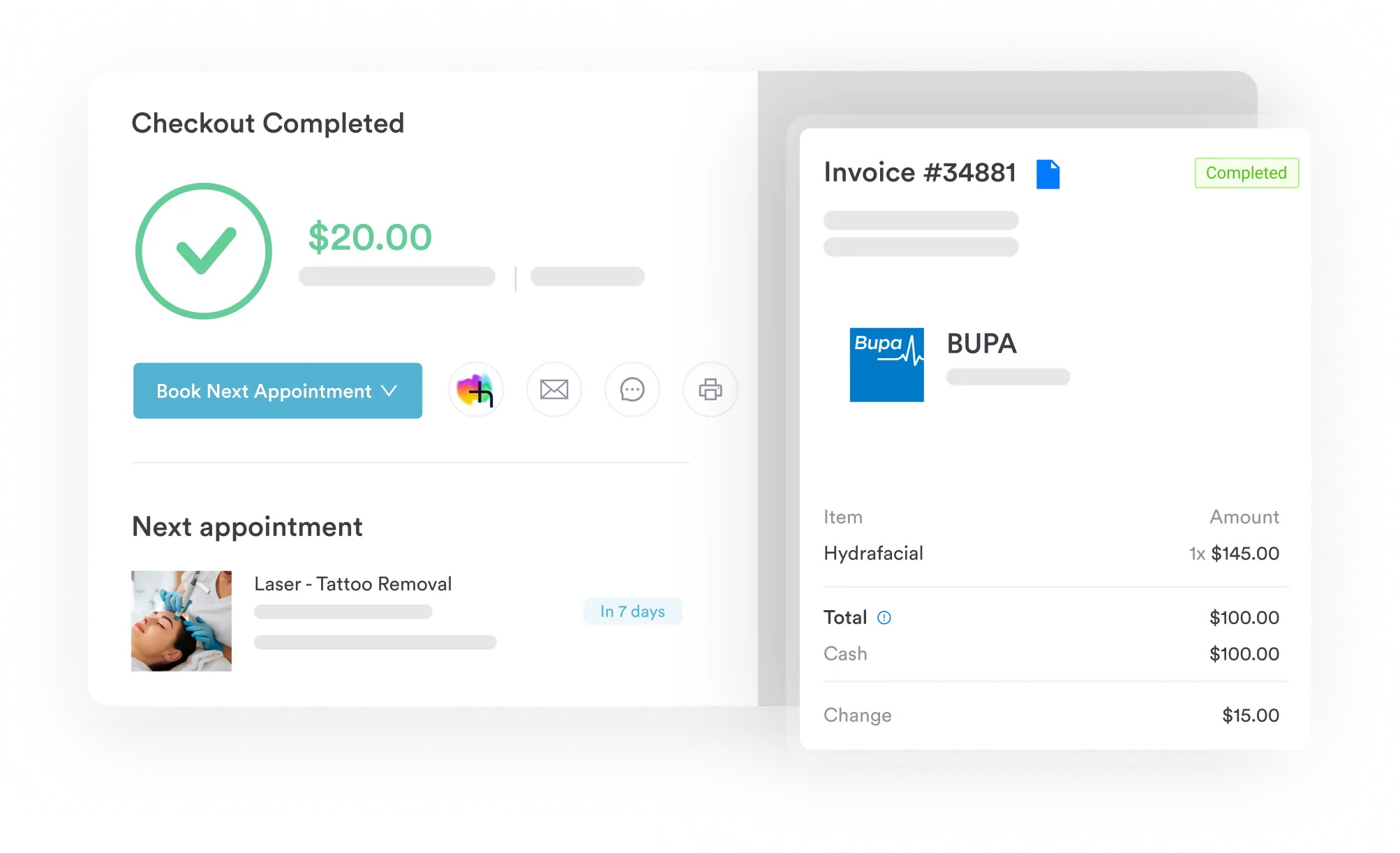

Pabau stores the operative note, device details, and consent on the patient record, then submits the claim through Claim.MD and posts the remittance back. Fewer denials start from paperwork nobody can find.

The operative note decides whether a C1895 claim pays. If it names the lead as endocardial with two coils, and carries the model and lot number, the coding part is close to mechanical. If it doesn’t, no amount of appeal work will invent the detail after the fact.
The part worth remembering is that C1895’s payment treatment is not a fixed fact about the code. It moves with each annual final rule, so a January look at Addendum B costs less than a rebilling cycle in March.
Get the record right at the point of care and the claim follows from it. Book a demo to see how Pabau keeps device documentation and claim submission on one patient record.

Coding a supply item rather than an implant? A4755 walks through blood tubing billing, including which claim form and revenue code apply.
Facing a payer that wants authorization first? K0843 shows how coverage criteria and prior authorization work on a high-cost device code.
Billing blood products in the same outpatient department? P9010 covers whole blood transfusion billing, from the revenue code to the diagnosis pairing.
HCPCS Code C1895 reports a lead, cardioverter-defibrillator, endocardial dual coil, implantable device on a Medicare OPPS claim. Hospital outpatient departments submit it on a UB-04 alongside the ICD implant procedure code.
C1895 covers endocardial, transvenous, dual coil defibrillator leads only. C1896 covers the other cardioverter-defibrillator leads, including subcutaneous ICD leads. Confirm the configuration and placement route from the operative note and implant card before you pick a code.
Medicare covers the ICD implant, and its leads, under National Coverage Determination 20.4. Qualifying indications include prior cardiac arrest from VF or VT, or documented sustained ventricular tachycardia. An LVEF of 35% or less with NYHA Class II or III heart failure also qualifies. CMS Billing and Coding Article A56340 carries the full criteria and the exclusions.
Pass-through status for C1895 is time-limited and changes with each CMS annual final rule. Verify the current status against the CMS OPPS Addendum B for the calendar year you are billing. Do not assume prior-year status still applies.
CMS sets the APC assignment for C1895 under the OPPS and publishes it in Addendum B alongside the annual final rule. The APC group reflects whether the device is packaged or paid separately that year. Pull the current Addendum B each January before claims go out.
Revenue code 278, medical/surgical supplies and devices, implantable, is the standard revenue code for C1895 on a UB-04 claim. Confirm with your Medicare Administrative Contractor, since some MACs specify more for device-intensive cardiology procedures.



