CCSD Code B2710: Radical mastectomy including block dissection
CCSD Code B2710: Definition and clinical scope CCSD Code B2710 is the UK private...

Last Updated: Nov 13, 2026
C1778 is the HCPCS Level II code for lead, neurostimulator (implantable). It reports the electrode implanted as part of a spinal cord, deep brain or peripheral nerve stimulation system. Trial leads use C1897, and the generator has its own code.
Hospital outpatient facilities report C1778 on institutional (UB-04/837I) claims under OPPS. Its status indicator is N, so the lead is paid inside the procedure payment rather than on its own line.
Let Pabau's smart automation suggest the right codes, reduce claim denials, and keep your practice compliant—effortlessly.
Automate repetitive tasks and focus on what matters most—your patients.
Reduce coding errors and ensure compliance with the latest regulations.
Clean claims, fewer denials, and faster reimbursements.
Powerful insights and reporting to help your practice thrive.
HIPAA compliant SOC 2 certified GDPR-compliant Trusted by 4,000+ clinics worldwide

HCPCS Code C1778 reports an implanted neurostimulator lead, whether spinal cord, deep brain or peripheral nerve, and no other part of the system.
Hospital outpatient departments report C1778 on the UB-04 or 837I under OPPS, while ASCs and physician claims get no separate payment for it.
C1778 carries status indicator N, so the lead is paid inside the J1 procedure payment rather than on its own claim line.
Trial leads use C1897, and the pulse generator is C1767, C1820 or C1822, depending on the battery type.
Medicare coverage for spinal cord stimulation follows NCD 160.7 and your MAC’s LCD, which typically requires a successful trial first.
HCPCS Code C1778 is the Level II code for “Lead, neurostimulator (implantable),” the electrode left in place as part of a neurostimulation system. CMS’s October 2026 OPPS Addendum B lists it with status indicator N, so its payment is packaged into the procedure that implants it.
Hospital outpatient departments report C1778 on institutional claims, the UB-04 or its electronic version, the 837I. An ambulatory surgery center (ASC) gets no separate payment for the lead, because its cost is already inside the procedure payment. Physician claims do not use the code at all.
C1778 reports implanted neurostimulator leads, including spinal cord, deep brain and peripheral nerve leads. Trial leads use C1897 instead. Report one unit per lead, so a two-lead spinal cord implant carries two units of C1778.
The rest of the system has its own codes, and each one gets its own claim line:
C1778 is typically packaged into the procedure’s Ambulatory Payment Classification (APC) rather than paid on its own line. Every lead procedure carries status indicator J1, a comprehensive APC. Under J1, Medicare pays one rate for the primary procedure and packages the device into it.
That puts the procedure code in charge of the money. The same lead is paid inside $6,511.03 on a percutaneous implant and inside $19,820.31 on a paddle implant.
Packaged does not mean optional. CMS sets future APC rates from the device charges hospitals report, so keep the C1778 line and its charge on every claim. Pass-through payment is unlikely for a code this established, but confirm the current status indicator in the quarterly OPPS Addendum B.
Check C1778 and its paired procedure codes in the January Addendum B each year. A changed APC or status indicator on the procedure moves the lead’s payment, even when the lead itself has not changed.
Five C-codes describe the hardware around a neurostimulation case. Reporting C1778 for a generator, or dropping a component, leaves device charges off the claim.
A full spinal cord stimulator system implanted in one session usually puts C1778 and either C1767 or C1820 on the same UB-04. Each lead and the generator get their own line, with units matching the device log.
A payable claim pairs a CPT procedure code for the surgery with C1778 for the lead. The CPT code carries the payment, and C1778 carries the device charge. Submitting one without the other leaves the claim incomplete.
C1778 belongs with the procedures that place or replace a lead. Generator procedures such as 63685 need it only when a new lead goes in during the same session. Lead revisions use 63663 for a percutaneous array and 63664 for a paddle.
Set side by side, those national rates show where the lead’s cost lands on a hospital claim.
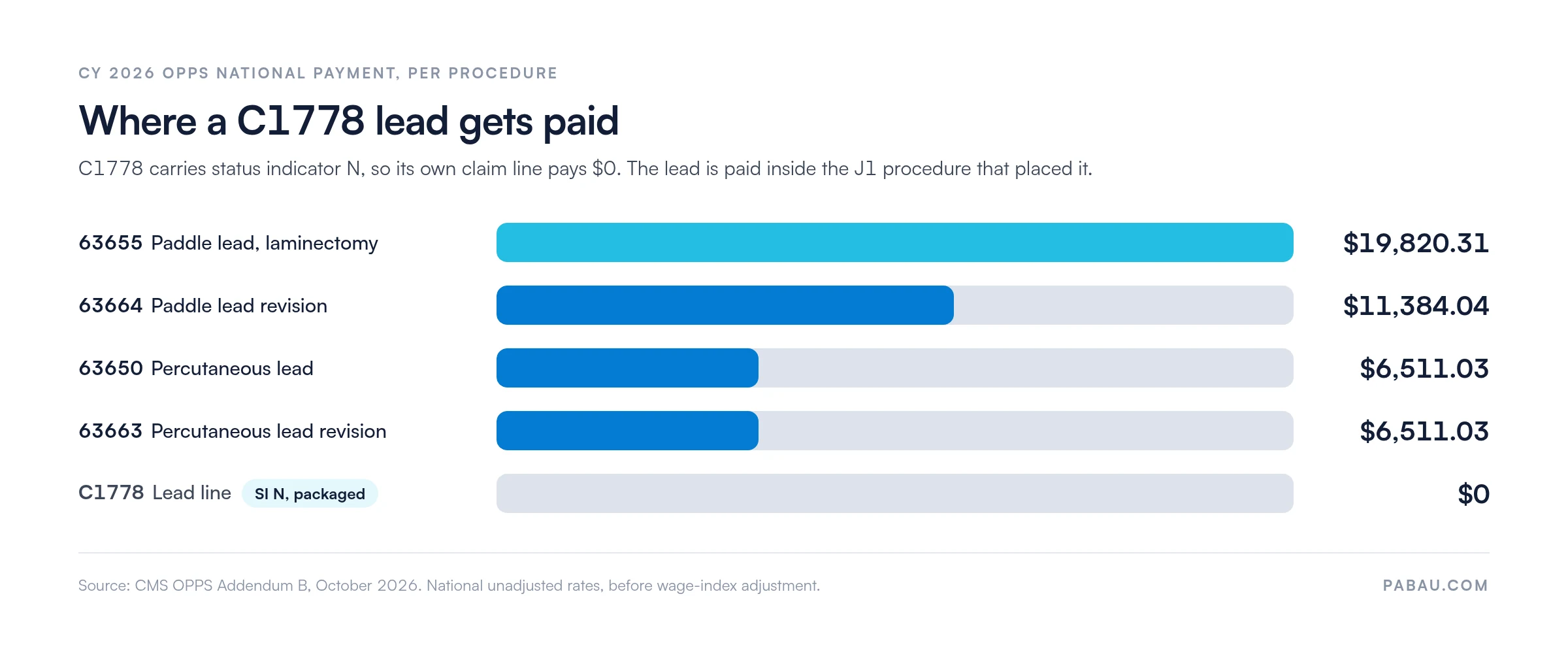
These are national unadjusted rates, before the wage index moves them for your hospital. Validate each pairing against current AMA CPT guidance, and use the AAPC Codify HCPCS lookup to check descriptors.
Medicare covers spinal cord stimulation under NCD 160.7, and each Medicare Administrative Contractor (MAC) publishes a Local Coverage Determination (LCD) with its criteria. Original Medicare also requires prior authorization for some implanted spinal neurostimulator procedures in the hospital outpatient department. Commercial payers set their own rules, so verify each one before the procedure date.
A prior authorization request for a neurostimulator implant typically includes:
LCD numbers and criteria differ by MAC jurisdiction. Palmetto GBA’s L37632, Spinal Cord Stimulators for Chronic Pain, is one example, and it requires a positive trial before permanent implantation. Check the LCD for your own MAC, because meeting one contractor’s criteria does not guarantee coverage under another.
Payers expect the chart to name the exact lead on the claim. The operative report should record the lead type, the implant site, and the manufacturer and model number. A device sticker or invoice in the record ties the claim line to the chart.
Meeting billing compliance requirements for implants means the record is complete when the claim goes out. Rebuilding it after a denial costs far more time. A defensible C1778 claim rests on these records:
C1778 usually needs no modifier on a hospital outpatient claim. Some payers ask for RT or LT on a unilateral implant, such as a peripheral nerve lead. Treat both as optional and payer-specific, and append them only when the payer’s policy asks.
Denials on C1778 claims cluster around a handful of avoidable errors. Each one below comes with the fix that prevents it. The top 20 CARC codes guide shows how to read the reason code a payer sends back.
The workflow below runs from the pre-procedure check to payment posting. Each step closes off one point where C1778 claims fail.
Assign a biller to neurostimulator implant cases before the procedure date. Confirm authorization in advance and collect the device sticker in the operating room. Then check the model number against the operative report that day. A mismatch caught on the day of surgery costs minutes, while one caught after a denial costs weeks.
Hospital outpatient departments report C1778 for OPPS payment, on the UB-04 or 837I. The institutional claim carries a type of bill, such as 13X, rather than a place-of-service code.
Ambulatory surgery centers get no separate payment for the lead, because its cost is packaged into the procedure payment. Professional claims on the CMS-1500 do not use C1778, since the implanting physician bills only the procedure.
Inpatient implants follow a different route. Device costs for an inpatient stay are paid through the MS-DRG, not through HCPCS C-codes.
C1778 sits on the hospital’s claim, but the implanting practice runs its own billing around the same patient. The physician’s claim for the trial and the implant goes out on a CMS-1500, separate from the hospital’s device lines.
Pabau, the practice management platform we build, includes medical billing software that submits those professional claims and tracks each one to payment. Eligibility checks run before the trial, and remittances post back against the patient record.
Digital forms capture consent and the pain scores recorded before and after the trial. That keeps the evidence an LCD asks for in the same patient record as the claim, so nobody rebuilds it when a payer asks.

Pabau submits and tracks your practice’s professional claims, with eligibility checks and remittances on the patient record. See how it fits a pain or neurosurgery practice’s billing day.

On a hospital claim for a stimulator implant, the procedure gets paid and the lead rides along inside it. Treat C1778 as a charge-capture line: one unit per lead, the right J1 procedure beside it, and the charge never left at zero.
The bigger risk sits upstream, in the trial results and the LCD evidence behind the authorization. Get those right and the device line becomes routine. Get them wrong and the packaged payment for the whole case is at stake.
Pabau’s claims management helps billing teams submit and track claims for the practice side of these cases. Book a demo to see how it fits a pain or neurosurgery practice’s billing workflow.

Billing a paddle lead placed through a laminectomy? CPT code 63655 covers the procedure that most often carries a C1778 paddle lead.
Revising or removing the generator instead? CPT code 63688 explains the generator revision code and when a lead line belongs on the claim.
Working with a radiofrequency system? HCPCS code C1816 covers the implanted receiver or transmitter that replaces a battery-powered generator.
Connecting the lead with an extension? HCPCS code C1883 covers the adaptor or extension between a neurostimulator lead and its generator.
Dealing with high denial rates on device claims? Denial management in healthcare covers root-cause analysis, appeal workflows, and prevention for facility billing teams.
HCPCS Code C1778 is the Level II HCPCS code for a lead used with an implantable neurostimulator. It covers the electrode lead component only, not the pulse generator, receiver, or transmitter, and not the surgical procedure used to implant it.
C1778 covers the implantable neurostimulator lead (the electrode), while C1767 covers the implantable non-rechargeable pulse generator. When both components are implanted in the same operative session, both codes appear as separate line items on the UB-04.
No. C1778 is reported by hospital outpatient departments on institutional UB-04 or 837I claims under OPPS. Physician claims on the CMS-1500 do not use it, and ambulatory surgery centers get no separate payment for the lead.
No. C1778 carries status indicator N, so the lead’s cost is packaged into the J1 payment for the procedure that implants it. Keep the charge on the C1778 line anyway, because CMS uses device charges to set future rates.
Often, yes. Medicare coverage follows NCD 160.7 and your MAC’s Local Coverage Determination, and many commercial payers require prior authorization for neurostimulator implants. Confirm authorization before the procedure date and record the approval number on the claim.
Usually none. Laterality modifiers RT and LT may apply when the implant site is unilateral and the payer’s policy asks for them. Check individual payer policies before you append either one.
Hospital outpatient departments report C1778 on institutional claims under OPPS. Ambulatory surgery centers get no separate payment for it, because the lead’s cost is packaged into the procedure payment. Inpatient implants are paid through the MS-DRG and do not use HCPCS C-codes.