

HCPCS code E0198: Water pressure pad billing guide
HCPCS code E0198 is a water pad for a standard mattress HCPCS code E0198 is the ...

Last Updated: Oct 13, 2026
C1883 is the HCPCS Level II code for adapter/extension, pacing lead or neurostimulator lead (implantable). It covers the connector or extension cable, not the lead itself.
Coders often reach for C1883 when the implanted item is actually the lead, and that is where most neuromodulation and cardiac pacing denials start. Under the CY 2026 OPPS Addendum B, C1883 carries status indicator N, so its cost is packaged into the procedure's APC rate.
Let Pabau's smart automation suggest the right codes, reduce claim denials, and keep your practice compliant—effortlessly.
Automate repetitive tasks and focus on what matters most—your patients.
Reduce coding errors and ensure compliance with the latest regulations.
Clean claims, fewer denials, and faster reimbursements.
Powerful insights and reporting to help your practice thrive.
HIPAA compliant SOC 2 certified GDPR-compliant Trusted by 4,000+ clinics worldwide

HCPCS code C1883 covers the adapter or extension that joins a pacing or neurostimulator lead to its generator, not the lead itself.
C1883 is a facility code reported on the UB-04 claim form in outpatient hospital and ASC settings.
CMS assigns C1883 status indicator N for CY 2026, so payment is packaged into the procedure’s APC rate.
The operative note must name the device as an adapter or extension, which is where most denials on this code start.
Pabau’s claims tools structure device-code submissions, so outpatient facilities catch a missing code before the claim goes out.
HCPCS code C1883 covers an adapter or extension for an implantable pacing lead or neurostimulator lead.
Its official descriptor reads “Adapter/extension, pacing lead or neurostimulator lead (implantable)”. The code describes the connecting hardware, so the lead and the pulse generator are reported separately.
C1883 belongs to the C-code series within HCPCS Level II codes. The Centers for Medicare and Medicaid Services (CMS) maintains that series for devices and supplies reported in hospital outpatient and ambulatory surgical center settings. C-codes began as temporary codes tied to device pass-through payment, and CMS revises or retires them in the annual update.
The table below captures the code attributes for C1883 as of 2026.
Coders working with neuromodulation or cardiac pacing implants should confirm C1883 against the current CMS HCPCS Alpha-Numeric file before each claim cycle. The CMS HCPCS resource page carries the annual file and the quarterly updates.
C1883 covers the accessory that connects or extends an implantable pacing or neurostimulator lead. It does not cover the lead. Reporting the lead body under C1883 causes more edit failures on these claims than any other single error.
The code applies across two broad device categories:
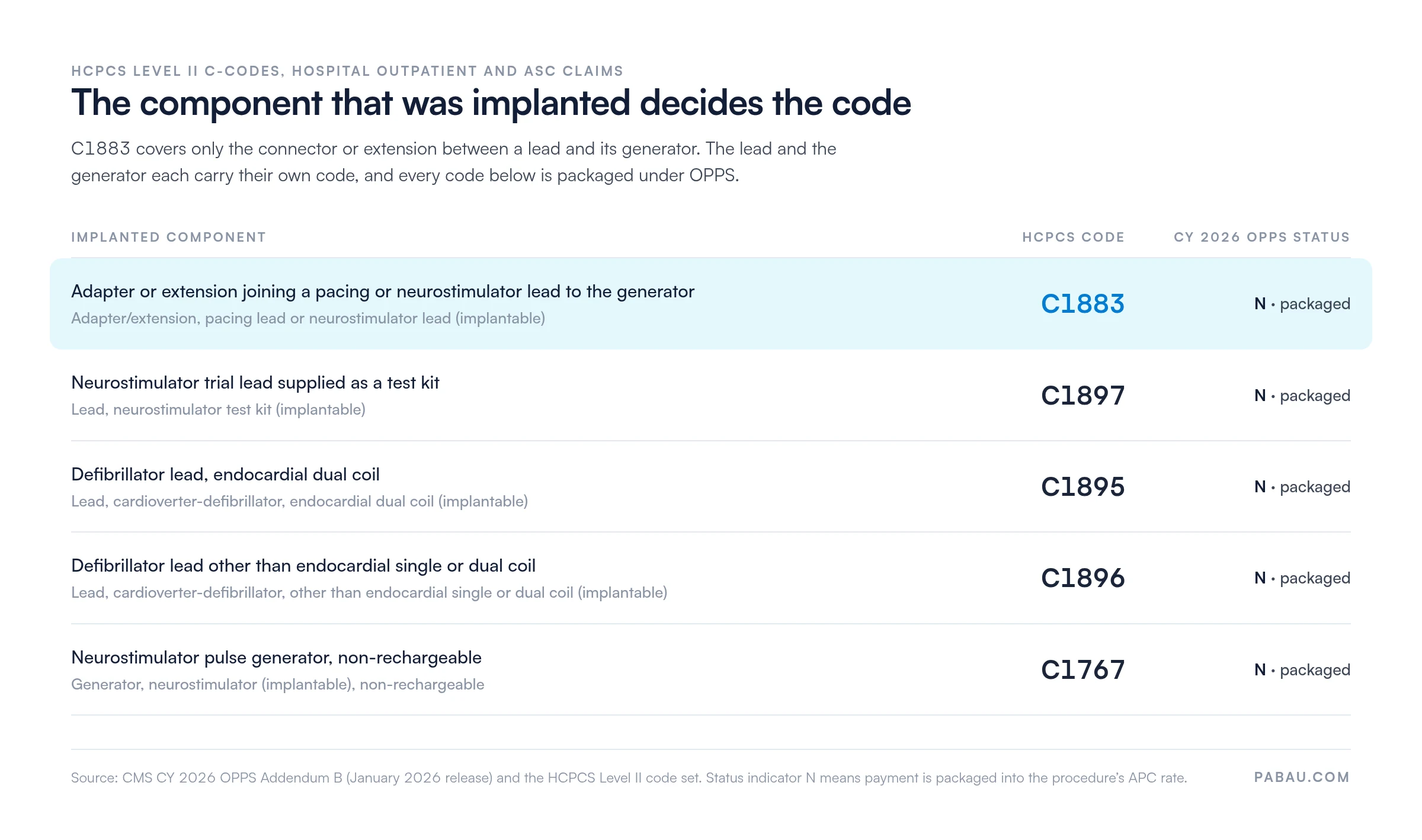
Each component of a pacing or neurostimulation system carries its own code, and the codes sit close enough together to be mistaken for one another.
Sacral nerve stimulation (SNS) is a notable billing context for C1883. Local Coverage Determinations for sacral neuromodulation reference C-codes for implantable device components. An SNS lead extension falls within C1883’s scope when it is separately implanted. Coverage criteria for SNS devices vary by contractor, so check the LCD for the applicable MAC jurisdiction first.
C1883 follows the standard billing rules for HCPCS Level II C-codes under the Outpatient Prospective Payment System (OPPS) and the ASC payment system. The elements below are the ones that decide whether the line clears the payer’s edits.
A clean claim for C1883 depends on the operative note naming the device as an adapter or extension. Notes that refer only to “lead components” draw audit attention. Practice management software like Pabau includes claims software for facilities, which flags a device code with no matching documentation before the claim is submitted.
C1883 carries OPPS status indicator N for calendar year 2026. Payment for the adapter is packaged into the ambulatory payment classification (APC) rate for the procedure that placed it. The code has no APC assignment of its own and generates no separate payment.
That status is worth re-checking each year, because CMS republishes Addendum B quarterly. C1883 does not appear on the CY 2026 list of active device pass-through categories, so no add-on payment is available for it. The quarterly OPPS addenda carry the current status indicator for every HCPCS code.
Reporting a packaged code is still worth doing. CMS uses the claims data behind packaged lines to set future APC rates. An omitted C1883 line understates the cost of the procedure it belongs to. Revenue cycle teams should reconcile at the line level anyway, because an expected-payment figure sitting on a packaged line will not match the 835 remittance.
Pull every C1883 line from the last four quarters and check what your billing system expected it to pay. Under status indicator N the correct answer is zero. An expected-payment figure sitting on those lines inflates accounts receivable, then turns into a write-off that nobody can explain at month end.
Modifiers on a C1883 line tell the payer something about the circumstances of the implant. Supplier modifiers such as RB and NU belong on DMEPOS claims, so they are not appended to implantable device C-codes on a UB-04. The table below covers the modifiers that do apply to facility claims.
A missing modifier is a common cause of C1883 denials. Consult the applicable MAC’s modifier policy before final submission, and confirm the operative documentation supports whichever modifier is appended.
C1883 sits among the C-codes for implantable neurostimulation and cardiac pacing components. Choosing the wrong one from this group is the specificity error payers catch most often in neuromodulation billing. The table below maps C1883 against its closest neighbors so coders can separate them by device type.
For a broader reference on HCPCS Level II code structure, the AAPC Codify HCPCS lookup provides searchable descriptions with crosswalk data. The NLM HCPCS API offers a free programmatic lookup that revenue cycle teams can wire into pre-submission checks.
Medicare covers C1883 when the adapter or extension is implanted as part of a covered device procedure in an outpatient hospital or ASC setting. Coverage depends on two things. The underlying procedure must satisfy the applicable NCD or LCD, and the adapter itself must be medically necessary for that procedure.
Key coverage requirements to verify before billing:
Five errors account for most preventable C1883 rejections. Each one is visible either in the operative note or on the claim line, before the claim goes out.
Quarterly compliance reviews catch these before they become a pattern in payer data. A denial management workflow that tracks C1883 rejections by reason code shows whether the cause is documentation, a modifier, or packaging.
Track C1883 as its own category in your denial reporting. The code straddles cardiac pacing and neurostimulator billing, so its denials route to different clinical service lines. Centralizing that data surfaces patterns that stay invisible while each department reviews its own rejections.
In most practices a device code travels a long way before it reaches the claim. A coder reads the operative report in one system, looks the code up in a reference, and types it into the billing system by hand. The code and the documentation that has to support it end up in separate places.
Pabau keeps the clinical record and the claim in a single system. The device implanted during the procedure is recorded against the patient’s note, and the charge is built from that record instead of retyped from it. Claims leave with the device code and its supporting documentation already matched.
For an outpatient facility running neuromodulation or cardiac pacing implants, that shortens the distance between the operative note and the submitted line. Problems that would otherwise surface weeks later at remittance get caught while the claim is still being built.

Pabau’s claims management workflows help outpatient facilities structure HCPCS device code submissions, track modifiers, and reconcile remittance data. C1883 and similar device codes land correctly the first time.

C1883 will not pay on its own, and for CY 2026 that is settled rather than uncertain. Its job on the claim is descriptive. It tells the payer what was implanted and supports the procedure line that does carry payment.
So the work sits upstream of the claim. Get the operative note to name the adapter, and get the coder to read that wording before the line is built. The edits stop there, and the denial reports stop filling up with a code that was never going to pay anyway.
Pabau keeps the operative record and the claim line in the same system, so a device code carries its documentation with it. Book a demo to see how Pabau handles device-code billing for outpatient facilities.

List Item #1
List Item #2
HCPCS code C1883 describes an adapter or extension for an implantable pacing lead or neurostimulator lead. It covers the accessory that connects or extends the lead to a pulse generator, not the lead body itself. The code is used in Medicare outpatient hospital and ASC billing.
Bill C1883 on a UB-04 institutional claim for outpatient hospital or ASC settings. Report one unit per device implanted, include the applicable revenue code (typically 278), and append any required modifier such as KX. Do not report C1883 on a CMS-1500 professional claim.
C1883 has no separate payment rate for 2026. The CY 2026 OPPS Addendum B assigns it status indicator N, so payment is packaged into the APC rate for the implant procedure. The same packaging applies in the ASC setting.
Modifiers used with C1883 on facility claims include KX, GA, GZ, RT or LT for laterality, and EY. Supplier modifiers such as RB and NU belong on DMEPOS claims and are not appended to implantable device C-codes. Confirm applicability against your MAC’s policy before submission.
Yes. Medicare covers C1883 when the adapter or extension is implanted during a covered pacing or neurostimulator procedure. The setting must be an outpatient hospital or an ASC. Coverage depends on the underlying procedure satisfying the applicable NCD or LCD, and on the adapter being documented as medically necessary.
C1883 covers the adapter or extension, not the lead. C1897 covers a neurostimulator test kit lead, C1895 and C1896 cover cardioverter-defibrillator leads, and C1767 covers a non-rechargeable neurostimulator generator. Reporting C1883 for the lead itself is the most frequent specificity error on these claims.



