

HCPCS code E0198: Water pressure pad billing guide
HCPCS code E0198 is a water pad for a standard mattress HCPCS code E0198 is the ...

Last Updated: Oct 13, 2026
C1897 is the HCPCS Level II code for lead, neurostimulator test kit (implantable). Hospitals report it for the temporary lead placed during a neurostimulator trial, before a permanent system is implanted.
It pairs with trial procedures such as CPT 63650, 64561 and 64555 on the outpatient facility claim. For CY 2026, CMS assigns it status indicator N, so the lead's cost is packaged into the procedure payment. A permanent lead is C1778, and a guide wire is C1769.
Let Pabau's smart automation suggest the right codes, reduce claim denials, and keep your practice compliant—effortlessly.
Automate repetitive tasks and focus on what matters most—your patients.
Reduce coding errors and ensure compliance with the latest regulations.
Clean claims, fewer denials, and faster reimbursements.
Powerful insights and reporting to help your practice thrive.
HIPAA compliant SOC 2 certified GDPR-compliant Trusted by 4,000+ clinics worldwide

HCPCS Code C1897 reports a neurostimulator test kit lead, the temporary lead placed for a trial before a permanent implant.
It is a hospital outpatient device code reported on the UB-04 alongside CPT 63650, 64561 or 64555.
CMS assigns C1897 status indicator N for CY 2026, so the lead is packaged into the trial procedure’s comprehensive APC payment.
A permanent neurostimulator lead is C1778, and a guide wire is C1769, a separate code with a separate descriptor.
Medicare requires prior authorization for 63650 trials in the hospital outpatient department, and the trial’s tracking number carries to the permanent claim.
HCPCS Code C1897 is the Level II device code for “Lead, neurostimulator test kit (implantable).” Hospitals report it for the temporary lead placed during a neurostimulator trial, before a permanent system is implanted.
According to the Centers for Medicare & Medicaid Services (CMS), C-codes are temporary codes for the Hospital Outpatient Prospective Payment System (OPPS). Hospitals report them on the institutional claim to identify the devices used in a procedure.
The trial is the reason this code exists. Medicare’s national coverage determination for electrical nerve stimulators requires pain relief with a temporarily implanted electrode before permanent implantation. C1897 is how the hospital tells Medicare which lead that trial used.
The table below summarizes the billing attributes for C1897. The status indicator comes from the CY 2026 OPPS Addendum B, which CMS republishes every quarter.
C1897 covers a neurostimulator lead that the manufacturer supplies as a test kit for trial stimulation. The lead is placed percutaneously and tests whether stimulation relieves the patient’s symptoms.
Reported with C1897:
Not reported with C1897:
Match the code to what the manufacturer shipped. Device labeling and the manufacturer’s C-code guidance say whether a lead is a test kit or a permanent implant. The decision path below sorts each device on a trial claim to its code.
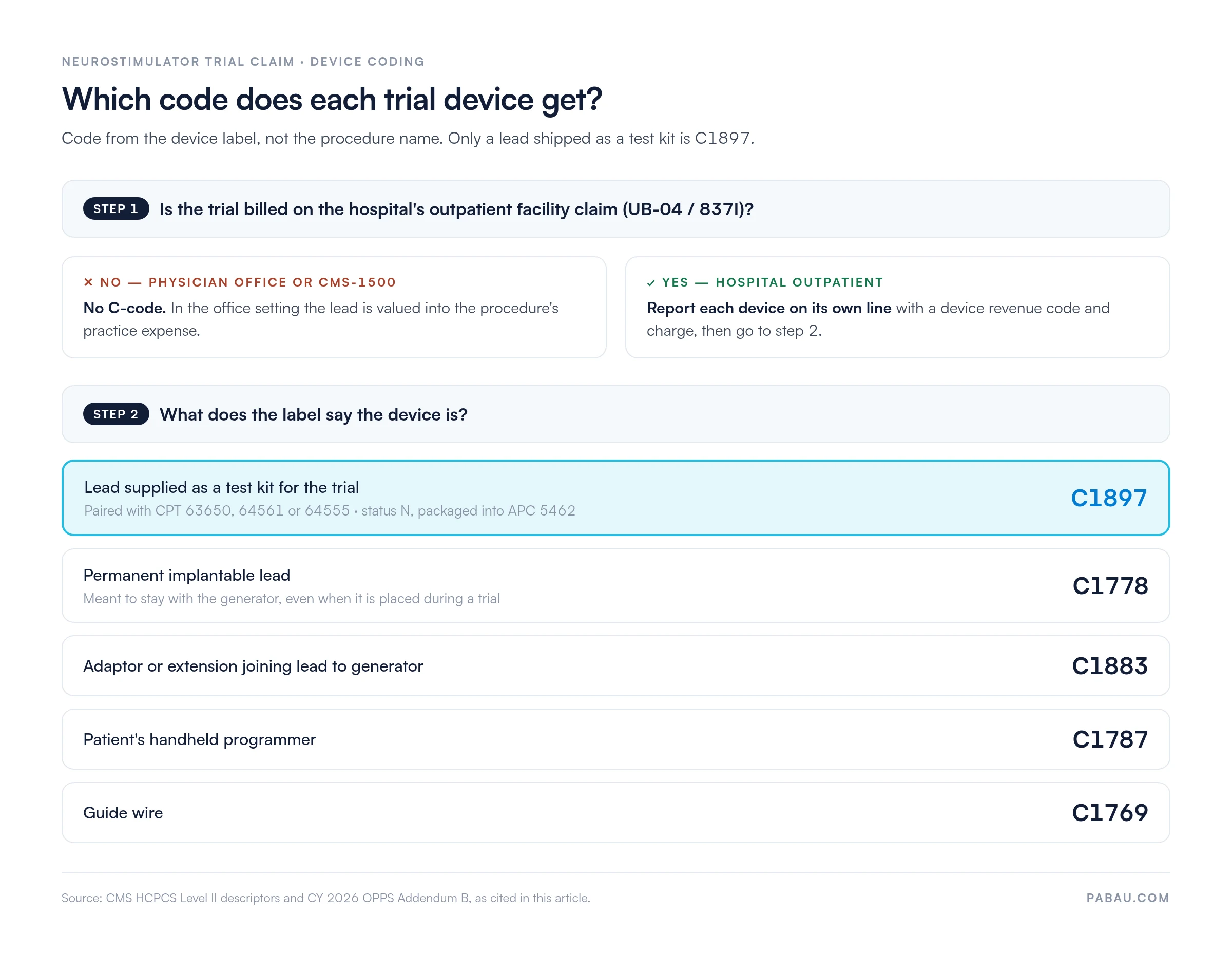
C1897 never pays on its own line, so the procedure code carries the payment. Three percutaneous lead placement codes cover the common neurostimulator trials. Each maps to APC 5462 under the CY 2026 OPPS Addendum B.
Status J1 means a comprehensive APC. Medicare makes one payment for the encounter, and the test lead and other adjunct items are paid inside it.
Each of these CPT codes represents a single lead. Medicare’s medically unlikely edits allow two units of 63650 on one date of service. For two sacral test leads, Medicare permits 64561 with bilateral modifier -50 and one unit.
Removing a temporary trial lead is part of the original 63650 placement, according to the AMA. Code 63661 applies to removing permanent leads, so it is never billed for pulling a trial lead.
Medicare makes no separate payment for C1897 in 2026. The CY 2026 OPPS Addendum B lists the code with status indicator N and no APC, so its cost is packaged into the trial procedure.
Report the line anyway, with the hospital’s charge for the lead. Medicare uses device charges on claims to set future OPPS payment rates. A trial claim without its lead understates what the procedure costs the hospital.
Status indicators and procedure rates can change each quarter. Check the current file on the CMS OPPS quarterly Addendum B page before you rely on a figure. Sound revenue cycle management builds that check into the start of every quarter.
C1897 coding errors usually involve a neighboring neurostimulator device code. The table below lists the codes coders mix up with it and what separates each one.
Some sacral nerve trials start with a tined lead that can stay in place if the test succeeds. Read the device label before you code it. A lead supplied as a test kit is C1897, while a permanent implantable lead is C1778.
C1897 itself needs no prior authorization, but a spinal cord stimulator trial often does. Medicare has required prior authorization for CPT 63650 in the hospital outpatient department since July 1, 2021.
When the trial and the permanent implant both use 63650 in the outpatient department, only the trial needs prior authorization. CMS then expects the trial’s unique tracking number on the permanent implant claim too. A missing number on either claim leads to a denial.
A C1897 line needs a record that proves a trial took place and identifies the lead. Confirm these elements before the claim leaves the billing queue. Good medical billing compliance means the record is complete before submission.
C1897 problems usually show up on the trial claim as a whole, because the lead line pays nothing alone. Good denial management for device codes starts at charge capture.
Expect a zero payment on the C1897 line, and keep it out of the denial work queue. Status indicator N packages the lead, so its payment arrives on the procedure line.
For a Medicare fee-for-service denial, the first level of appeal is a redetermination request to your MAC. File it within 120 days of receiving the remittance notice.
Include the claim, the denial reason, the procedure note, the device record and any prior authorization number. If redetermination fails, the next levels are reconsideration by a Qualified Independent Contractor and then an Administrative Law Judge hearing. Read the denial codes on the remittance first, because each one calls for a different argument.
Build a trial checklist into your scheduling workflow. Before a neurostimulator trial goes ahead, confirm the authorization number, the documented screening and the test kit lead in the implant log. Those three checks cover the most common C1897 claim problems.
A neurostimulator trial touches several teams before the claim is built. Scheduling books the trial, someone chases the authorization, and the coder reads the procedure note in another system. The device code often gets typed in by hand at the end.
Pabau, the practice software we build for clinical teams, keeps the clinical record and the claim in one place. Its claims management software builds the charge from the record, so the lead code and its documentation travel together.
That way, a missing authorization number or an unlabeled lead gets caught while the claim is still in draft. Your team spends less time on resubmissions after the remittance arrives.

Pabau’s claims management software builds device code lines from the clinical record and tracks claim status and denials in one dashboard. See how it fits your outpatient billing workflow.

C1897 adds no payment to a neurostimulator trial claim in 2026. The line still earns its place, because it tells Medicare which lead the trial used and feeds the cost data behind future OPPS rates.
The payment risk sits with the trial procedure. Secure the authorization for a 63650 trial, document the screening, and code the lead from its label. A claim built that way rarely comes back.
Pabau keeps the procedure record and the claim line in the same system, so the device code carries its evidence with it. Book a demo to see how Pabau handles device code billing for outpatient procedures.

Need a broader overview of the denial management process? Denial management in healthcare walks through the end-to-end workflow for preventing, tracking, and appealing claim denials.
Looking to understand revenue cycle fundamentals? What is revenue cycle management explains the full patient-to-payment cycle and where device codes fit within it.
Want to see how Pabau handles medical billing compliance? Medical billing compliance covers the documentation and audit-readiness practices that support clean claim submission.
HCPCS Code C1897 covers a neurostimulator lead supplied as a test kit for a trial before permanent implantation. Hospitals report it on the UB-04 with the trial procedure, such as CPT 63650, 64561 or 64555.
No. The guide wire code is C1769. C1897 is “Lead, neurostimulator test kit (implantable)” and applies only to neurostimulator trial leads.
No. The CY 2026 OPPS Addendum B gives C1897 status indicator N, so its cost is packaged into the trial procedure. Payment comes through the procedure’s comprehensive APC, which is APC 5462 for 63650, 64561 and 64555.
C1897 is the test kit lead used for a temporary trial. C1778 is the permanent implantable neurostimulator lead. Code from the device label, because some trials use a lead built to stay in place.
Yes, when Medicare patients have the trial with CPT 63650 in a hospital outpatient department. Only the trial needs authorization, but its tracking number must also appear on the permanent implant claim.
No. The AMA treats removal of a temporary trial lead as part of the original 63650 placement. Code 63661 is for removing permanent leads and does not apply.



