HCPCS code G0257: Unscheduled or emergency dialysis billing guide
HCPCS code G0257: Official descriptor and code overview HCPCS code G0257 is defi...

Last Updated: Oct 27, 2026
B4158 is the HCPCS Level II code for a nutritionally complete pediatric enteral formula with intact nutrients, given through an enteral feeding tube. The formula supplies proteins, fats, carbohydrates, vitamins and minerals, may include fiber and/or iron, and is billed at one unit per 100 calories.
B4158 is the pediatric counterpart of B4150, the adult code for a standard intact-nutrient formula. Its pediatric siblings split off by formula type. B4159 is soy-based, B4160 is calorically dense at 0.7 kcal/mL or more, B4161 is hydrolyzed, and B4162 covers inherited metabolic disease. Medicare pays for B4158 only as tube feeding, never as oral nutrition.
Let Pabau's smart automation suggest the right codes, reduce claim denials, and keep your practice compliant—effortlessly.
Automate repetitive tasks and focus on what matters most—your patients.
Reduce coding errors and ensure compliance with the latest regulations.
Clean claims, fewer denials, and faster reimbursements.
Powerful insights and reporting to help your practice thrive.
HIPAA compliant SOC 2 certified GDPR-compliant Trusted by 4,000+ clinics worldwide

HCPCS Code B4158 is the pediatric code for a nutritionally complete enteral formula with intact nutrients, given through a feeding tube.
Its adult equivalent is B4150, and its pediatric siblings are B4159 (soy), B4160 (calorically dense), B4161 (hydrolyzed) and B4162 (inherited metabolic disease).
Bill one unit per 100 calories, calculated from the order’s daily volume, caloric density and days supplied.
Medicare has required no CMN or DIF since January 1, 2023, so the standard written order and medical record now carry the claim.
Medicare covers tube-fed formula only, and formula taken by mouth takes the BO modifier and is denied as no benefit.
HCPCS Code B4158 is the code for a pediatric enteral formula that is nutritionally complete and made with intact nutrients. It covers formulas that supply proteins, fats, carbohydrates, vitamins and minerals, and that may include fiber and/or iron. The formula is given through an enteral feeding tube, and each 100 calories counts as one unit.
In practice, B4158 is the standard tube-feeding formula for children, the pediatric counterpart of adult code B4150. A formula moves to a different pediatric code when it is soy-based, calorically dense, hydrolyzed, or built for an inherited metabolic disease. The code describes the product, so confirm what the formula is before you confirm who it is for.
The medical record also has to show why the child needs tube feeding at all. It should name the condition that prevents adequate nutrition by mouth and the feeding tube in place. It should also explain why diet changes or oral supplements are not enough.
The enteral formula codes run from B4149 to B4162, and the series has no B4151 or B4156. B4149 to B4157 are the codes without a pediatric descriptor, and B4158 to B4162 are the pediatric set. Most B4158 coding errors involve either the adult equivalent, B4150, or the pediatric siblings B4159 and B4160.
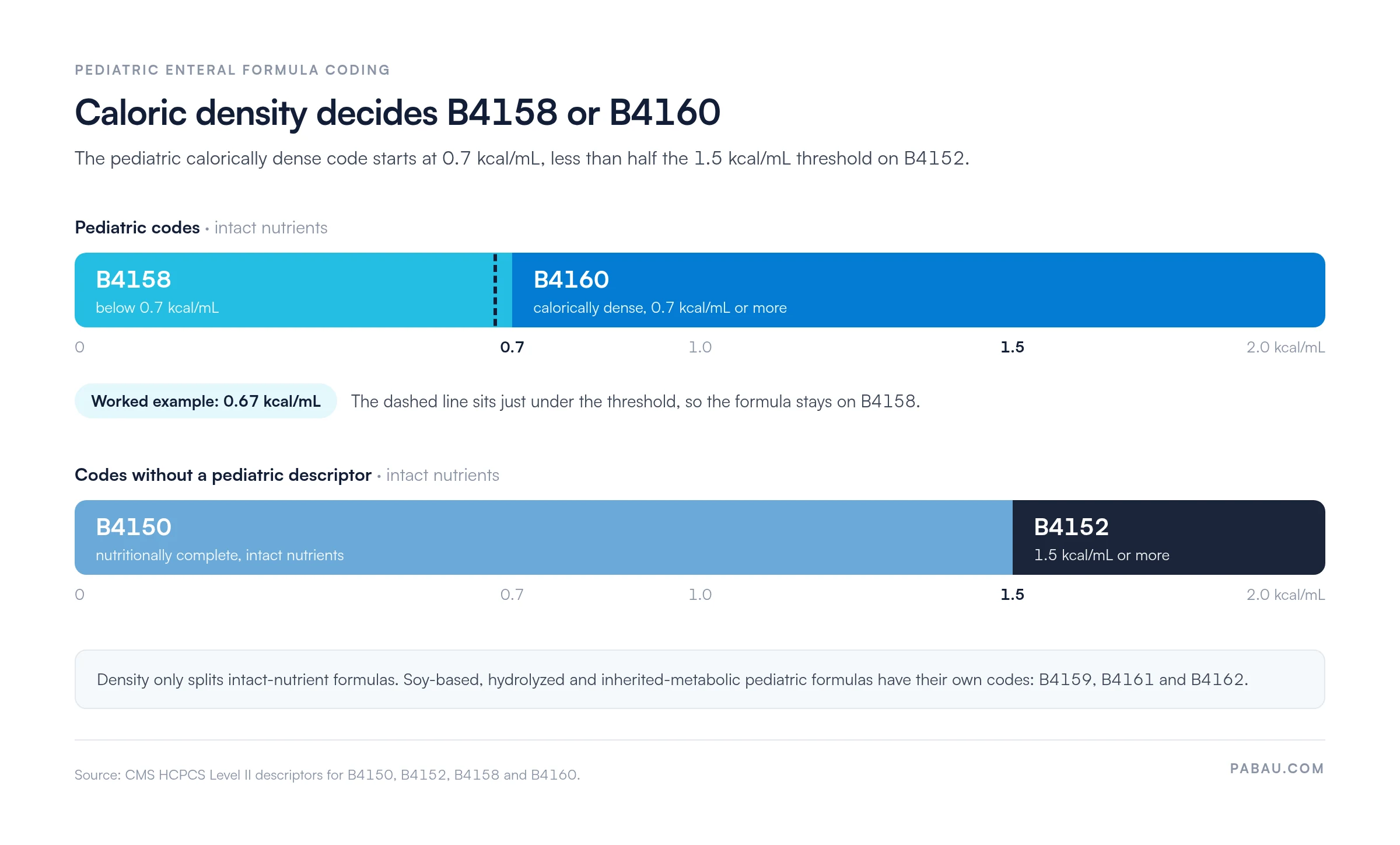
The B4160 threshold deserves a second look. The adult calorically dense code starts at 1.5 kcal/mL, but the pediatric code starts at 0.7 kcal/mL.
A pediatric intact formula at or above 0.7 kcal/mL therefore matches the B4160 descriptor rather than B4158. The scale below shows how low that line sits. Check the product’s kcal/mL and its PDAC listing before you assign either code.
Medicare covers enteral nutrition under the Part B prosthetic device benefit. CMS retired National Coverage Determination 180.2 effective January 1, 2022, and the durable medical equipment Medicare administrative contractors (DME MACs) now set coverage. They do it through the Enteral Nutrition local coverage determination (LCD L38955) and its policy article (A58833).
The beneficiary must need feeding through an enteral access device to maintain weight and strength, and the condition must be permanent. Permanence means the treating practitioner judges the impairment to be of long and indefinite duration. Adequate nutrition must also not be possible through diet changes or oral supplements.
Coverage applies to tube feeding only, and formula taken by mouth is denied as non-covered with no benefit. Most children who need B4158 are covered by Medicaid or a commercial plan rather than Medicare, so check that payer’s own policy.
If durable medical equipment, prosthetics, orthotics and supplies (DMEPOS) claims are new to your team, start with how medical billing works end to end.
Check the beneficiary’s residence before billing B4158. Part B pays nothing for enteral nutrition during a Part A covered skilled nursing facility stay. In that case, the SNF bills the formula under Part A.
Every B4158 claim needs a standard written order, a medical record that supports tube feeding, and proof of delivery. Medical billing compliance for enteral nutrition depends on having all three on file before the claim goes out, not after a denial arrives.
CMS eliminated the enteral Certificate of Medical Necessity (CMN) and DME Information Form (DIF) for dates of service on or after January 1, 2023. The standard written order now carries the prescription details, and the treating practitioner’s notes carry the medical necessity.
Those notes should show the qualifying condition, the feeding tube, the expected duration, and growth or weight data. A dietitian assessment strengthens the record where one exists.
The ICD-10-CM code on a B4158 claim must show a condition that prevents the child from taking in enough nutrition by mouth. A vague or non-specific diagnosis is a common audit finding, and it can lead to denial or post-payment recoupment.
Use the most specific code available, and pair a symptom code such as R13.12 with the underlying condition. Payers expect the diagnosis to explain why the child needs a tube and why this formula type fits that need.
B4158 is billed at one unit per 100 calories, as the code descriptor states. The same rule applies to every enteral formula code. It also causes the most common math error, which is billing per can or per case instead of converting to calories.
To calculate units, multiply the daily volume in mL by the caloric density in kcal/mL. Multiply that by the days supplied, then divide by 100.
A child on 1,000 mL a day of a 0.67 kcal/mL formula for 30 days generates 201 units (1,000 x 0.67 x 30 / 100 = 201). Enter that figure in the units field of the CMS-1500 claim form or its electronic equivalent.
Place of service code 12 (home) is standard for home enteral nutrition. Suppliers billing for patients in assisted living facilities should verify the facility type against CMS place-of-service definitions before assuming POS 12 applies.
Traditional Medicare fee-for-service does not require prior authorization for HCPCS Code B4158. The DME MAC decides coverage when it processes the claim, based on the documentation. Medicare Advantage plans and commercial payers handle the same code differently.
Medicare Advantage plans often require prior authorization for enteral nutrition, and the clinical details they want vary by plan. Most requests for B4158 need the standard written order, recent notes on growth or dysphagia, and the product’s formulation details.
Medicaid rules differ by state, and some programs route enteral formula through the pharmacy benefit rather than DME. For children under 21, Medicaid’s Early and Periodic Screening, Diagnostic and Treatment (EPSDT) benefit may cover formula that adult rules would not. Confirm the active plan’s policy before supplying the product.
Enteral nutrition claims draw more medical review than many DMEPOS categories, because of the documentation rules and frequent coding errors across the formula family. Effective denial management strategies for B4158 start with checks before submission rather than appeals afterward.
Run these checks before every B4158 claim goes out. Confirm the product’s formulation and kcal/mL against B4158 and B4160. Confirm the standard written order and supporting medical record are on file. Add KX, or GA, GY or GZ where a denial is expected. Recalculate units as volume x kcal/mL x days / 100. Use a specific ICD-10 code, and verify POS 12 and the beneficiary’s residence.
The Pricing, Data Analysis and Coding (PDAC) contractor, run by Palmetto GBA for CMS, keeps the Product Classification List for DMEPOS items, including enteral formulas. A written PDAC Coding Verification Review is mandatory only for B4149, B4153, B4154, B4155, B4157, B4161 and B4162.
B4158 is not on that list, but the classification list is still the quickest way to see which code a product carries.
Search for the product on the Palmetto GBA PDAC website through its DMECS product lookup. Where the manufacturer holds a coding verification letter, keep a copy with the order and medical record, since reviewers may request it. Then check the current CMS HCPCS quarterly update to confirm the code is active and its descriptor has not changed.
Submitting a clean claim for B4158 needs four items ready before billing. They are the standard written order, the supporting medical record, proof of delivery, and the product code check. Missing any one of them turns the claim into a likely medical review candidate.
A pediatric feeding practice usually orders B4158 rather than billing it, because the DME supplier submits the claim. That claim still depends on your notes, so a missing growth chart or tube detail comes back to you as a documentation request.
Pabau, the practice management and EHR platform we build, keeps those details in one patient record. Custom forms capture the tube type, the formula’s kcal/mL and the daily volume. The treating practitioner’s notes sit beside them, ready to send when a supplier or payer asks.
For services your practice bills itself, Pabau’s claims management software submits claims built from the codes and modifiers your team enters. It then tracks each claim to payment. Your coders still choose the code and modifiers, and Pabau keeps the submission and its status in one place.
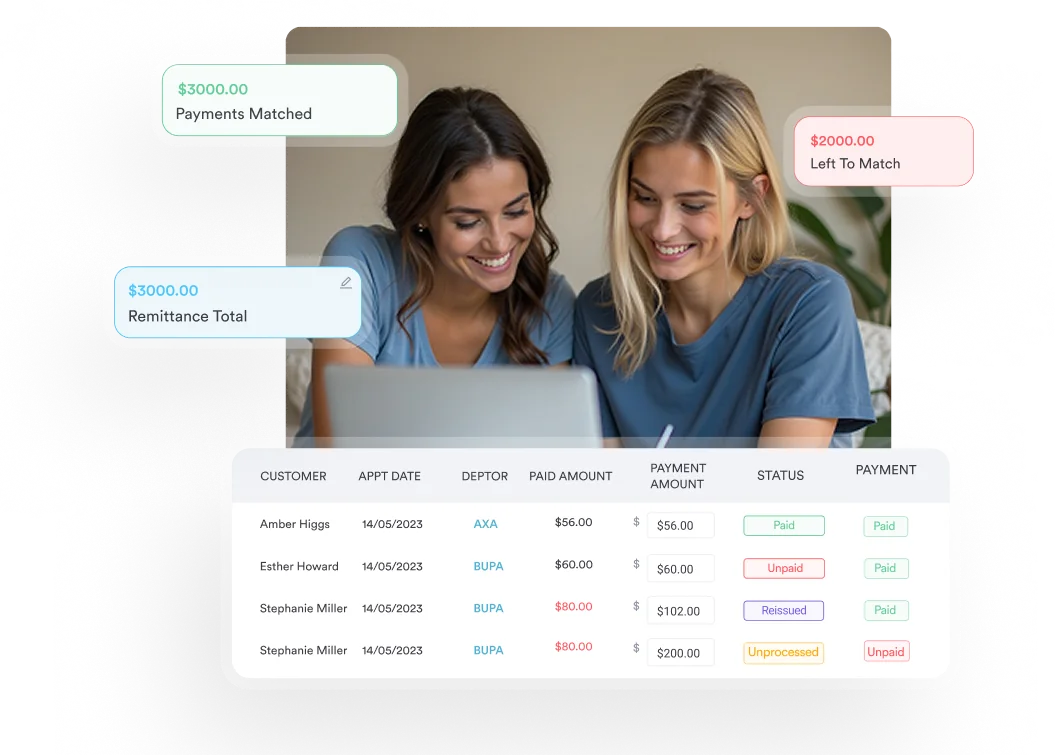

Pabau keeps feeding orders, clinical notes and claim status in one patient record, so your team can answer supplier and payer documentation requests quickly.

The costly mistake on B4158 is treating it as a generic enteral code. It is the pediatric standard formula, and the first check on every claim is whether the product belongs under B4159, B4160, B4161 or B4162 instead.
Once the code is right, the claim stands on the written order and the medical record, now that the CMN is gone. Tube feeding is the only covered route, so a record that never mentions the tube will not hold up at review.
Pabau keeps the order details, notes and claim status in one patient record, so your team can answer supplier and payer requests without chasing paper. Book a demo to see how it fits your pediatric feeding workflow.

Need to understand how clearinghouse submission works for DMEPOS claims? Medical claims clearinghouse guide explains how electronic claim routing reduces adjudication delays on DME submissions.
Want to reduce denial rates across your billing team? Revenue cycle management overview covers the end-to-end claim lifecycle from eligibility check to ERA posting.
Handling electronic remittance and ERA reconciliation? Electronic remittance advice (ERA) guide explains how to read and act on 835 remittance files for faster payment reconciliation.
Billing a soy-based pediatric formula instead? HCPCS code B4159 covers the soy-based sibling code, with its own units and documentation rules.
Is the formula made with hydrolyzed proteins? HCPCS code B4161 explains the pediatric hydrolyzed formula code and when it applies instead of B4158.
HCPCS Code B4158 is the Level II code for a nutritionally complete pediatric enteral formula with intact nutrients, given through a feeding tube. It may include fiber and/or iron, and each 100 calories of formula is one billing unit.
Multiply the daily volume in mL by the caloric density in kcal/mL, then by the days supplied. Divide the total by 100. Each unit equals 100 calories, so never bill per can, container or case.
Yes, when the criteria in the DME MACs’ Enteral Nutrition LCD (L38955) are met. The child must need tube feeding because of a permanent condition, with a standard written order and supporting medical record on file. Lines that meet the criteria carry the KX modifier, and formula taken by mouth is not covered.
The most frequent cause is a missing KX, GA, GY or GZ modifier. Close behind are a medical record that does not support tube feeding and a diagnosis that does not explain the need. Unit errors, oral formula billed as tube feeding, and the wrong code in the formula family also recur. So does Part B billing during a covered SNF stay.
Traditional Medicare does not require prior authorization for B4158, and the DME MAC decides coverage when it processes the claim. Medicare Advantage, Medicaid and commercial plans often require it, and their criteria vary, so confirm the plan’s rules before supplying the product.