HCPCS Code G0163: Skilled nursing observation and assessment
What is HCPCS Code G0163? HCPCS Code G0163 is a deleted Level II code for skille...

Last Updated: Oct 15, 2026
B4161 is the HCPCS Level II code for enteral formula, for pediatrics, hydrolyzed/amino acids and peptide chain proteins, includes fats, carbohydrates, vitamins and minerals, may include fiber, administered through an enteral feeding tube, 100 calories = 1 unit.
The formula includes fats, carbohydrates, vitamins, and minerals, and it may include fiber. It is administered through an enteral feeding tube, and one unit equals 100 calories.
DME suppliers, pediatric dietitians, and billing teams meet this code on tube-feeding claims filed under Medicare's durable medical equipment benefit. Three errors cause most B4161 denials. Suppliers miscalculate the units, submit without a Certificate of Medical Necessity, or pick an adult formula code by mistake.
Let Pabau's smart automation suggest the right codes, reduce claim denials, and keep your practice compliant—effortlessly.
Automate repetitive tasks and focus on what matters most—your patients.
Reduce coding errors and ensure compliance with the latest regulations.
Clean claims, fewer denials, and faster reimbursements.
Powerful insights and reporting to help your practice thrive.
HIPAA compliant SOC 2 certified GDPR-compliant Trusted by 4,000+ clinics worldwide

HCPCS Code B4161 applies to pediatric patients only, which separates it from adult formula codes such as B4150 and B4153.
Billing units are calculated as 100 calories per unit, whatever the volume or concentration of formula dispensed.
Medicare coverage requires a functioning GI tract, medical necessity for tube feeding, and a valid Certificate of Medical Necessity.
At least one covered ICD-10 diagnosis code must appear on the claim to support the need for hydrolyzed or elemental formula.
Practice management software like Pabau supports HCPCS code entry, DME documentation workflows, and denial tracking.
The official CMS descriptor names the patient population, the protein source, the route, and the billing unit. It reads:
Enteral formula, for pediatrics, hydrolyzed/amino acids and peptide chain proteins, includes fats, carbohydrates, vitamins and minerals, may include fiber, administered through an enteral feeding tube. 100 calories = 1 unit.
Every clause in that descriptor maps to an eligibility condition or a documentation requirement. The table below breaks the code into the fields a biller checks before submitting.
The “hydrolyzed/amino acids and peptide chain proteins” clause is what defines B4161. These are elemental or semi-elemental formulas for pediatric patients with impaired digestion or absorption. Severe food allergies, short bowel syndrome, and eosinophilic GI disorders are the usual reasons.
Standard polymeric pediatric formulas use intact proteins and bill under B4158 instead. Choosing B4161 for an intact-protein formula is a coding error, and the claim will be denied.
The “may include fiber” language means fiber content does not change the applicable code. B4161 remains correct with or without fiber, provided the rest of the descriptor is met.
Only Medicare-enrolled DME suppliers may bill B4161 to Medicare. Hospitals, physician offices, and outpatient practices do not bill this code directly under Part B DME, though they often supply the documentation behind it.
DME billing runs on a different clock than professional or facility billing. The supplier ships the formula, documents delivery, and submits the claim, sometimes months after the prescribing physician wrote the order.
Unit calculation is where most billing errors start. The arithmetic is simple, but it is easy to apply to the wrong number.
The unit count must reflect the calories delivered, not the prescribed daily maximum. Suppliers should reconcile dispensed calories against delivery records before each claim goes out. Billing the prescription when tolerance issues or a formula change reduced the delivered volume is overbilling.
Before submission, confirm that the place of service, the supplier NPI, and the beneficiary’s Medicare ID are all populated correctly on the CMS-1500 form.
Medicare covers enteral nutrition under the DME benefit only when specific medical necessity criteria are met, per CMS Medicare Benefit Policy Manual Chapter 15. Coverage does not extend to oral nutritional supplements, so tube feeding is required. The criteria are:
B4161 carries one extra condition. The formula ordered must contain hydrolyzed or elemental protein rather than intact protein. A pediatric patient who needs tube feeding but tolerates standard polymeric formula falls under a different B-series code.
Verifying eligibility before the formula is dispensed keeps the supplier from shipping product against a claim that Medicare will not pay.
Medicare audits of B4161 claims focus heavily on documentation. The DME MAC expects a complete file in the supplier’s records before the claim is submitted, not assembled after a post-payment audit request. The package should contain:
CMN requirements are standard for this category, but CMS revises the forms periodically. Check the current form version with your DME MAC before submission rather than reusing a saved template.
Each B4161 claim must carry at least one ICD-10-CM diagnosis code explaining why the pediatric patient needs hydrolyzed or elemental formula through a feeding tube. The diagnosis has to reflect a condition severe enough to impair absorption of intact proteins, or to rule out oral intake. Commonly supported diagnoses include:
This list follows current CMS LCD guidance for enteral nutrition, and it is not exhaustive. The ICD-10-CM diagnosis codes directory carries the full descriptors if you need to confirm a fourth or fifth character.
Covered diagnosis lists are updated annually and vary by DME MAC jurisdiction. Build a pre-claim review step that confirms each submitted code is still on the active covered list for the current year.
Medicare reimburses B4161 through the DMEPOS fee schedule, which covers durable medical equipment, prosthetics, orthotics, and supplies. It is not paid from the Physician Fee Schedule. Rates are set per 100-calorie unit and published by DME MAC jurisdiction.
Because those rates vary by jurisdiction and change each January, pull current figures from the CMS DMEPOS fee schedule rather than a third-party site. The official HCPCS code set is the matching reference for descriptors. Reimbursement for B-series enteral codes works like this:
After payment, read the remittance advice to confirm the allowable was applied correctly. Adjustment reason codes there will flag any partial or zero payment before it ages out of appeal.
Pull the current DMEPOS fee schedule file directly from cms.gov each January. It downloads as a ZIP and imports into most billing systems. Allowable rates are then current before the first claims of the new year go out. Cached rates from the prior year produce incorrect expected reimbursement figures and can hide underpayments for months.
Selecting the correct B-series code means matching the patient’s age, the formula’s protein type, and its caloric density against the descriptor. B4161 sits in a family spanning B4149 through B4162. The table below shows the codes most often confused with it.
The most consequential distinction is adult versus pediatric. Using an adult code such as B4149, B4150, or B4153 for a pediatric patient is both a coding error and a compliance risk.
Age is not the only split inside the pediatric codes. A child fed a formula built for an inherited metabolic disorder belongs under B4162, not B4161. Age and protein source settle the rest of the family, as the grid below shows.
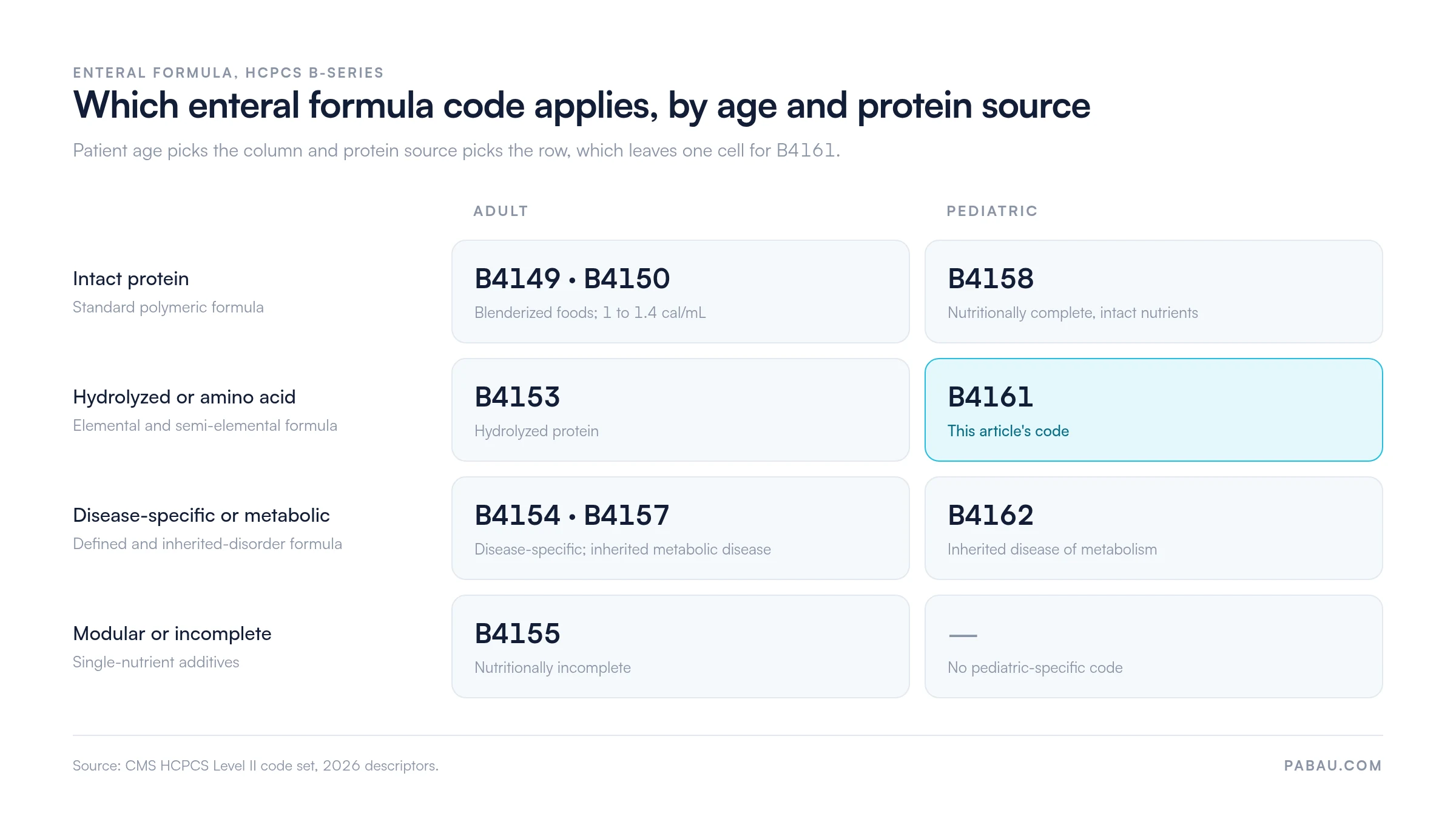
The AAPC HCPCS code lookup carries the full descriptor text for each B-series code. That is worth checking when a manufacturer’s label does not state the protein source plainly.
Eligibility and documentation requirements stack on top of each other for B4161, so a claim can fail on a point nobody checked. These are the denial triggers worth designing out of the submission process:
A structured pre-claim audit that checks all six before each submission cycle cuts denial rates sharply. Tracking denial reason codes by claim type matters just as much. It surfaces a systemic coding error long before one-claim-at-a-time appeals reveal it.
Set a calendar reminder 60 days before each patient’s CMN duration-of-need end date. That window gives the ordering physician time to complete a renewal before the current CMN expires. Billing B4161 after expiry is one of the most avoidable denial causes in enteral nutrition. Most DME MAC jurisdictions will not let you correct it retroactively.
Manual B4161 workflows leave suppliers exposed to the errors listed above. A biller checks the CMN date in one folder, the delivery note in another, and the unit math in a spreadsheet. The checks that would have caught the denial then happen only after it arrives.
Practice management software like Pabau moves those checks to the point of claim preparation. Billing teams attach HCPCS codes, the physician order, and the CMN to the patient record. Pabau’s claims management software then tracks each claim through submission and remittance.

Keeping clinical documentation and DME billing in one system also makes an audit request routine rather than disruptive. Billing reports show denial patterns by HCPCS code. A team can then tell whether B4161 rejections cluster around unit calculation, diagnosis selection, or a missing CMN. The same record-keeping rules that govern patient data apply to DME suppliers holding these files.

Pabau stores CMNs, physician orders, and clinical notes alongside the patient record. DME billing teams can confirm a claim is complete before it is submitted. Denial tracking by HCPCS code then shows where the remaining rejections come from.

B4161 rewards a supplier who treats it as four separate checks rather than one code. Patient age, protein source, delivered calories, and a current CMN each have to hold on their own. Any one of them failing takes the whole claim with it.
Recurring denials almost always trace back to the same place: the CMN renewal cycle, the unit reconciliation, or the diagnosis code on the claim. Fix the process rather than the individual claim, and the appeal volume falls with it.
Documentation is what makes that possible, and it has to live where the biller works. Book a demo to see how Pabau keeps orders, CMNs, and delivery records attached to the claim they support.

Billing Medicare for enteral nutrition more broadly? Medicare billing explains how Part B claims are structured, from eligibility checks through to remittance.
Need the adult equivalent of this code? HCPCS Code B4153 explains how hydrolyzed protein formula is billed for adult patients under the same DME benefit.
Need to understand what drives enteral nutrition denials? Denial management in healthcare covers the upstream causes of DME claim rejections and how to build a systematic response workflow.
Wondering how the broader billing cycle connects to HCPCS submissions? What is revenue cycle management explains how enteral nutrition billing fits into end-to-end claims management for DME suppliers.
HCPCS Code B4161 is the Medicare DME billing code for pediatric enteral formula containing hydrolyzed or amino acid proteins. It is administered through a feeding tube and billed per 100 calories. It applies only to pediatric patients who cannot tolerate intact protein formulas, because of conditions such as food protein-induced enteropathy or severe malabsorption.
B4161 is billed in units of 100 calories, so 100 calories of formula dispensed equals one billable unit. A pediatric patient receiving 1,000 calories per day for 30 days generates 300 units. Units must reflect calories delivered, not the maximum prescribed caloric intake.
A B4161 claim requires a physician order naming the formula type and daily caloric volume. A Certificate of Medical Necessity signed by the treating physician must accompany it. The file also needs supporting clinical notes, covered ICD-10-CM codes, and signed proof of delivery for each dispensing period.
Medicare requires a functioning GI tract and an inability to maintain adequate nutrition by mouth. Tube feeding must be the primary nutritional source, supported by a chronic or long-term condition. The formula must contain hydrolyzed or amino acid proteins rather than intact protein, which is what separates B4161 from B4158.
B4150 and B4153 are adult codes, while B4161 is pediatric-only. B4158 is the pediatric code for intact protein formula, and B4161 covers hydrolyzed or amino acid formula. Billing an adult code for a child, or B4158 for a hydrolyzed formula, produces a coding error that will be denied.
B4161 is covered under Medicare Part B as a DME benefit and administered through the patient’s DME MAC, based on their geographic service area. Coverage criteria and covered ICD-10 diagnosis lists come from Local Coverage Determinations issued by each DME MAC, so the rules vary slightly by jurisdiction.