

HCPCS code E0198: Water pressure pad billing guide
HCPCS code E0198 is a water pad for a standard mattress HCPCS code E0198 is the ...

Last Updated: Oct 13, 2026
A4722 is the HCPCS Level II code for peritoneal dialysis solution in bags of more than 1,999 cc up to 2,999 cc. Any dextrose concentration qualifies.
The code is reported once per bag, so a 2,000 cc bag is A4722 while a 3,000 cc bag moves up to A4723. Since January 1, 2011, Medicare has paid for home dialysis supplies through the ESRD prospective payment system. The patient's dialysis facility furnishes A4722, and a DME supplier cannot bill Medicare for it separately.
Let Pabau's smart automation suggest the right codes, reduce claim denials, and keep your practice compliant—effortlessly.
Automate repetitive tasks and focus on what matters most—your patients.
Reduce coding errors and ensure compliance with the latest regulations.
Clean claims, fewer denials, and faster reimbursements.
Powerful insights and reporting to help your practice thrive.
HIPAA compliant SOC 2 certified GDPR-compliant Trusted by 4,000+ clinics worldwide

HCPCS code A4722 reports one bag of peritoneal dialysis solution holding more than 1,999 cc and up to 2,999 cc, in any dextrose concentration.
Bag volume picks the code. A4721 stops at 1,999 cc, so a 2,000 cc bag is A4722, and a 3,000 cc bag moves up to A4723.
Since January 1, 2011, Medicare has paid for home peritoneal dialysis supplies through the ESRD prospective payment system (PPS), not as separate Part B items.
CMS lists A4722 on its ESRD PPS consolidated billing list as a supply not payable to DME suppliers, so the patient’s dialysis facility furnishes it.
The errors to watch are band errors: A bag reported under the wrong volume code, or units counted in liters instead of bags.
HCPCS code A4722 describes peritoneal dialysis solution in a fluid volume greater than 1,999 cc but no more than 2,999 cc. Any dextrose concentration qualifies, and each bag in that range is reported as one unit.
For Medicare patients, A4722 is part of the dialysis facility’s bundled ESRD PPS payment and is not paid on its own. The code still matters, because it records which volume band each bag falls in.
A4722 covers the dialysate itself, the dextrose-based fluid that fills the peritoneal cavity during an exchange. Any dextrose concentration qualifies, so a bag’s strength never changes the code. Only its volume does.
A4722 does not cover these items:
Each of those items has its own HCPCS code. Folding one into an A4722 line misstates what the patient received.
CMS splits dextrose dialysate for peritoneal dialysis into seven codes by fluid volume. Each code covers one band, and the volume of the bag supplied decides which band applies.
Each band starts one cc above the ceiling of the band below it. That is why the boundaries read 1,999 and 2,999 rather than round numbers, and why round-number bags land one band higher than many billers expect.
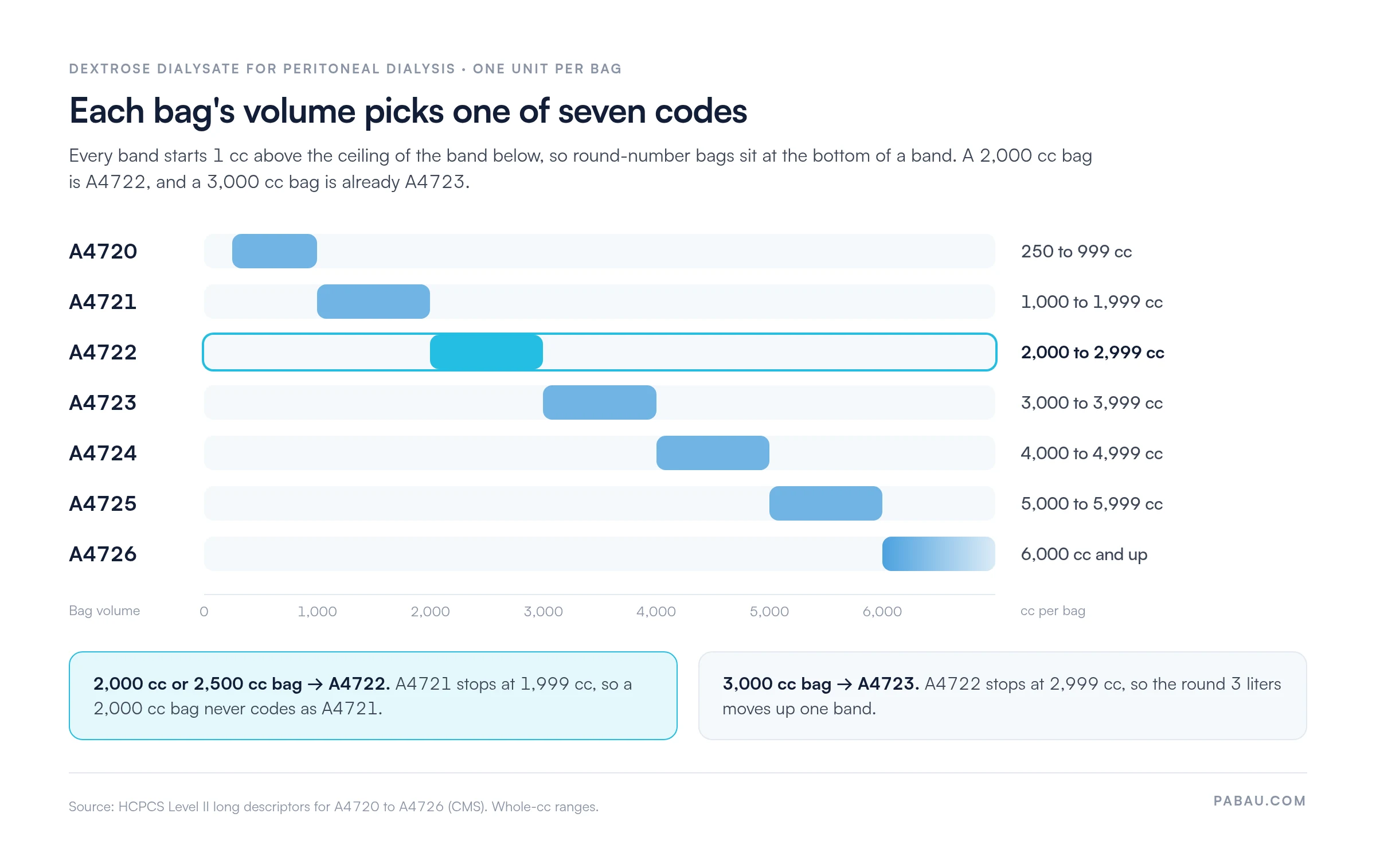
Bands come from the HCPCS long descriptors for A4720 to A4726. The code follows the bag that was delivered, so the delivery record is the document that settles the band.
Use A4722 for a bag holding 2,000 to 2,999 cc and A4721 for a bag holding 1,000 to 1,999 cc. The two codes describe the same solution in neighboring bands, so bag size alone decides between them.
One patient can need both codes. If a shipment mixes bag sizes, each size is reported under its own band, with units equal to the number of bags of that size.
Peritoneal dialysis (PD) uses the patient’s peritoneal membrane as a filter. Dialysate is infused into the peritoneal cavity, left to dwell, and then drained. That cycle removes waste products and excess fluid without a trip to a dialysis center.
Two home PD modalities draw on these supply codes:
Both modalities use dextrose solution, and both draw on the same volume band codes. What changes is the bag size a regimen calls for, which is why one patient’s supplies can span more than one code.
Medicare does not pay A4722 as a separate supply. Since January 1, 2011, home dialysis supplies have been part of the ESRD prospective payment system, under which the dialysis facility receives a bundled payment.
The same change ended Method II. Before 2011, a home patient could deal directly with a DMEPOS supplier, and Medicare paid that supplier separately. Now the ESRD facility furnishes all home dialysis equipment and supplies, directly or under arrangements, as the Medicare Benefit Policy Manual, Chapter 11 sets out.
CMS also places A4722 on its ESRD PPS consolidated billing list, under supplies not payable to DME suppliers. A DME supplier therefore cannot be paid separately by Medicare for A4722 furnished to a patient under the ESRD benefit.
Here is what that means for each party:
Medicare Advantage, Medicaid and commercial plans set their own rules for dialysis supplies, including any prior authorization. Reviewing billing compliance requirements against each plan contract shows whether the plan follows the Medicare bundle or pays supplies another way.
Under the bundle, the facility’s records show which supply each home patient received and why. Accurate medical billing documentation for A4722 rests on five records:
These diagnosis codes establish the ESRD status behind home dialysis supplies. Confirm the patient’s current codes with the treating nephrologist before the claim goes out.
Before each month closes, compare the bag volumes on the delivery records against the codes on the claim. A shipment that mixes 2,000 cc and 3,000 cc bags needs two lines, A4722 and A4723, each with its own bag count.
Medicare does not pay a separate amount for A4722 when the patient is covered under the ESRD benefit. The supply’s cost sits inside the facility’s ESRD PPS payment, which CMS sets in its annual ESRD PPS rule.
Other payers vary. Some fold dialysis supplies into a bundled dialysis rate, while others pay supply lines individually under the contract. Check the plan contract for how A4722 is paid before setting expectations for a remittance.
Denials on A4722 trace back to who billed it, which band was used, and how units were counted. Denial management for this code centers on these causes:
Each rejected A4722 line comes back on the remittance with denial codes that name the cause. Match those codes to the rows above before you recode and resubmit the line.
A4722 sits in a family of peritoneal dialysis supply codes. Every code below appears on the CMS ESRD PPS consolidated billing list, so for Medicare ESRD patients each one is part of the facility bundle.
Descriptors are abridged from the HCPCS Level II code set maintained by CMS.
Set up one supply line per bag size in your billing system, labeled with its band. When a prescription changes fill volume, the biller then picks a new line instead of editing a code by hand.
A home dialysis program codes the same patients’ supplies month after month. When a nephrologist changes the fill volume, a patient can move from A4722 to A4723 while last month’s claim template stays the same.
Pabau, the practice management platform we build, keeps each patient’s prescription, diagnosis codes and claim history in one record. With claims management software in that record, the biller sees the current order next to the claim before it goes out.
The result is fewer band errors and less time spent reworking supply claims that came back.

Pabau keeps each patient’s dialysis prescription, diagnosis codes and claim history in one record, so supply claims match the current order.

Treat A4722 as a volume code first. The labeled volume of the bag decides the code, and A4722 covers only 2,000 to 2,999 cc.
For Medicare ESRD patients, the next question is who furnishes the bag. The dialysis facility does, under the ESRD PPS, and a DME supplier cannot claim it from Medicare separately. With the band and the billing party settled, A4722 stops producing rework.
Pabau puts the prescription and the claim side by side, so the band check happens before submission. Book a demo to see how it fits your dialysis billing workflow.

Need a framework for managing recurring supply claim denials? Denial management in healthcare covers the systematic approach to tracking, appealing, and preventing recurring supply claim rejections.
Want to understand how dialysis supply billing fits into the broader revenue cycle? Revenue cycle management explained walks through the full claims lifecycle from order to payment posting.
Looking for a clean-claim checklist before submitting supply codes? Clean claim requirements outlines the fields and documentation that must be complete before a claim is transmitted.
Billing the band below A4722? HCPCS code A4721 covers dextrose dialysate bags of 1,000 to 1,999 cc, reported one unit per bag.
Working with the largest dialysate bags? HCPCS code A4726 covers bags of more than 5,999 cc and how Medicare pays for them.
HCPCS code A4722 covers one bag of peritoneal dialysis solution, in any dextrose concentration, holding more than 1,999 cc and up to 2,999 cc. Tubing, cycler sets and dialysis equipment are reported under their own codes.
The difference is bag volume. A4722 covers bags of 2,000 to 2,999 cc, and A4721 covers bags of 1,000 to 1,999 cc. Both describe dextrose dialysate for peritoneal dialysis, reported per bag.
No, not for a patient covered under the Medicare ESRD benefit. CMS lists A4722 on its ESRD PPS consolidated billing list as a supply not payable to DME suppliers. The dialysis facility furnishes it, either directly or under arrangements.
Report one unit per bag in the 2,000 to 2,999 cc band. Count bags, not liters, and report bags of any other volume under their own band code.
Keep the nephrologist’s dialysis prescription, the labeled volume of each bag delivered, proof of delivery, and an ESRD diagnosis such as N18.6. Together, those records show the band and the patient’s place in the home dialysis program.
N18.6, end stage renal disease, is the primary diagnosis. Z99.2, dependence on renal dialysis, is often added as a secondary code.
Medicare does not pay a separate amount for A4722 when the patient is covered under the ESRD benefit. The supply’s cost sits inside the facility’s ESRD PPS payment, which CMS updates every calendar year.
A4723 covers it. A 3,000 cc bag exceeds A4722’s 2,999 cc ceiling, so it moves into the next band, which runs up to 3,999 cc.



