CCSD code S0923: Billing, documentation, and funder guide
CCSD code S0923: Official descriptor and procedure overview CCSD code S0923 is a...

Last Updated: Nov 19, 2026
90947 is the CPT code for a dialysis procedure other than hemodialysis that requires repeated evaluations by a physician or other qualified health care professional. It covers peritoneal dialysis, hemofiltration and other continuous renal replacement therapies, with or without a substantial revision of the dialysis prescription.
Report it once per dialysis day, not per month. A single evaluation goes to 90945, and hemodialysis uses 90935 and 90937. Monthly ESRD management falls under 90951-90970, and Medicare pays 90947 only for inpatient dialysis.
Let Pabau's smart automation suggest the right codes, reduce claim denials, and keep your practice compliant—effortlessly.
Automate repetitive tasks and focus on what matters most—your patients.
Reduce coding errors and ensure compliance with the latest regulations.
Clean claims, fewer denials, and faster reimbursements.
Powerful insights and reporting to help your practice thrive.
HIPAA compliant SOC 2 certified GDPR-compliant Trusted by 4,000+ clinics worldwide

CPT code 90947 reports a dialysis procedure other than hemodialysis, such as peritoneal dialysis or CRRT, with repeated physician evaluations.
It is reported per dialysis day, with one evaluation going to 90945 and repeated evaluations going to 90947.
Monthly ESRD management belongs to 90951-90970, and hemodialysis belongs to 90935 and 90937, so neither family overlaps with 90947.
Medicare pays 90947 only when the place of service is inpatient hospital and the physician was present during the dialysis.
The diagnosis follows the clinical picture, such as acute kidney injury for CRRT in the ICU, rather than N18.6 by default.
CPT code 90947 reports a dialysis session other than hemodialysis in which the physician evaluates the patient more than once. The Medicare Claims Processing Manual, chapter 8 groups it with 90935, 90937 and 90945 as the physician codes for inpatient dialysis. In practice that means peritoneal dialysis, hemofiltration or continuous renal replacement therapy (CRRT) on a hospital ward or in the ICU.
The full descriptor reads:
Dialysis procedure other than hemodialysis (eg, peritoneal dialysis, hemofiltration, or other continuous renal replacement therapies), requiring repeated evaluations by a physician or other qualified health care professional, with or without substantial revision of dialysis prescription
CPT code 90947 descriptor, American Medical Association
Three phrases in it decide most coding questions. “Other than hemodialysis” rules out intermittent hemodialysis. “Repeated evaluations” separates it from its single-evaluation partner. “Prescription” tells you the evaluations can include changing the dialysis order, though they don’t have to.
The unit of service is the dialysis day. A patient on CRRT for four days can generate four lines, one per date, each coded on what happened that day.
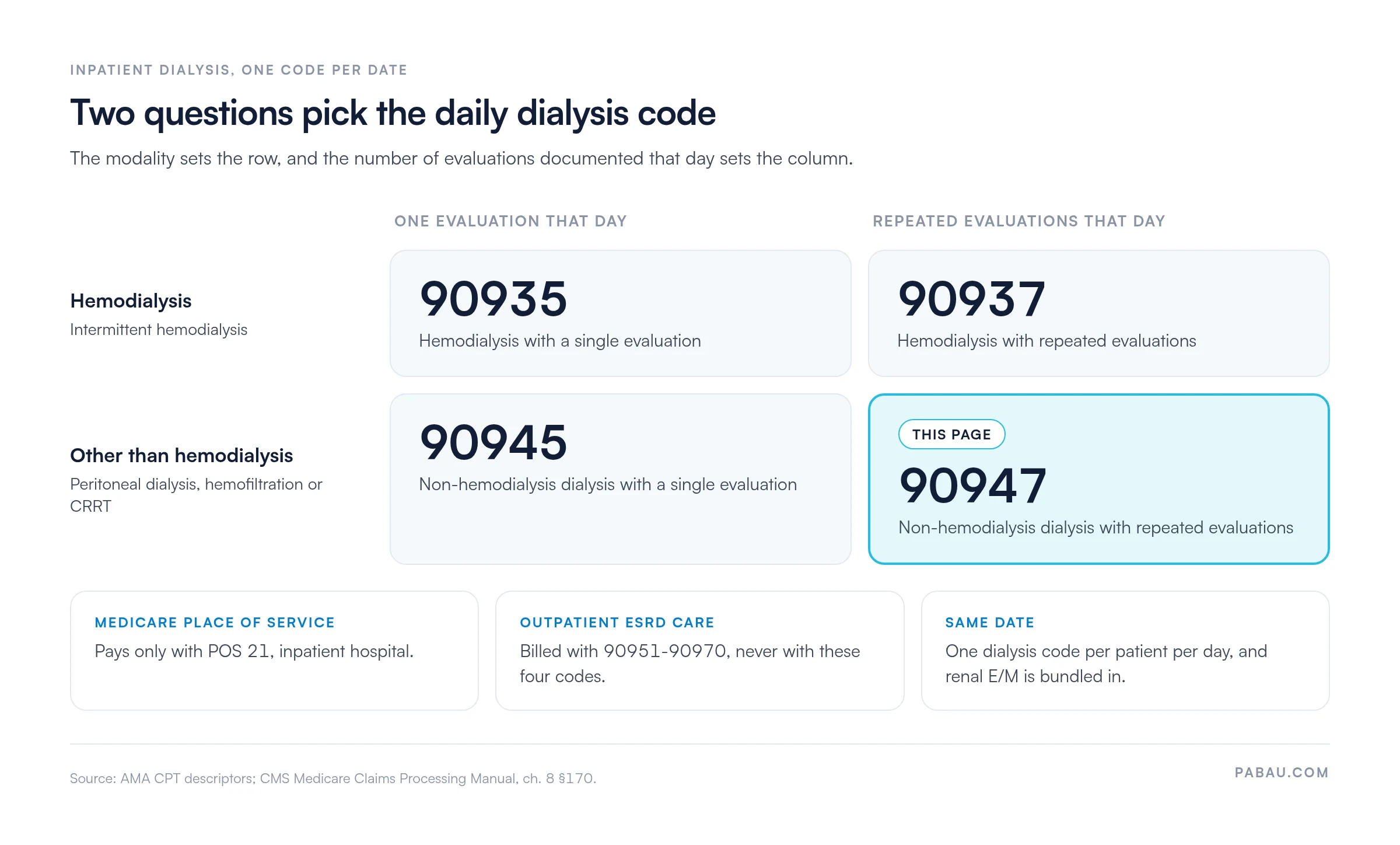
One evaluation on the date goes to CPT code 90945. Two or more go to 90947. The descriptor sets no number beyond “repeated,” so the note has to show separate evaluations, each with its own time and findings. The grid below sets that choice beside the matching hemodialysis pair.
The rest of the dialysis family sits next door, and mixing them up is where most coding errors start. Here’s how the neighbors split:
So a patient on hemodialysis never gets 90947, however many times you see them. Their days go to 90935 or 90937 instead. And outpatient management of a stable ESRD patient lives in the monthly codes, such as CPT code 90966 for an adult on home dialysis.
Medicare treats 90947 as an inpatient code. CMS tells contractors to pay the dialysis procedure codes only when the place of service is inpatient hospital. That is POS 21 on the professional claim. Outpatient renal-related physician work is already paid through the monthly capitation payment.
Four more Medicare rules shape the claim:
Commercial and Medicaid plans write their own policies, and some follow Medicare closely while others don’t. Check the plan’s dialysis policy before you assume either way.
No single diagnosis code goes with 90947. List the condition that made dialysis necessary during that stay, then the conditions that shaped the day’s evaluations.
A claim coded N18.6 for a patient whose kidneys failed three days ago is a mismatch an auditor will notice. The note and the diagnosis have to tell the same story.
The dialysis codes include every evaluation and management service related to the patient’s renal disease on that date. Writing up the morning rounds as a hospital visit and the CRRT adjustment as 90947 is double billing.
An E/M can still go on the claim when it covers a problem unrelated to the renal disease. On Medicare, it also must not be something you could have handled during the dialysis. Append modifier 25 to the E/M code, not to 90947, and make the note show the separate problem.
Medicare also limits which E/M codes can sit beside an inpatient dialysis code. Its claims manual allows only initial hospital care (99221-99223), discharge management (99238-99239), inpatient consultations (99251-99255) and critical care (99291-99292). A subsequent hospital visit, 99231-99233, isn’t payable alongside 90947, and any other E/M code is denied.
Procedures follow different rules. CMS says physicians’ surgical services, such as catheter insertion, are generally billed under their own procedure code. Check the current NCCI edits for the specific pair first.
Say a 64-year-old is admitted to the ICU with sepsis and acute kidney injury, and the nephrologist starts continuous venovenous hemofiltration (CVVH). The AMA’s CPT Assistant confirms that CVVH is reported with 90945 or 90947.
Each date stands alone. Day 2 doesn’t become 90947 because Days 1 and 3 did. Day 3’s E/M is payable because the rash is unrelated to renal care and the code is on Medicare’s allowed list. Billed as a subsequent hospital visit, it would be denied.
Pair this with your usual clean claim checks on demographics, NPI and eligibility, since those sink dialysis claims as often as coding does.
When a denial does come back, read the adjustment reason before you resubmit. Our guide to denial codes in medical billing explains how to decode them.
Inpatient dialysis billing breaks down when daily notes and claim lines live in different places. A biller then rebuilds each date from memory or a spreadsheet, and the evaluation count drifts.
Pabau, a practice management platform with built-in billing, keeps the claim next to the record. Its claims management software pre-fills the CMS-1500 from the patient’s record and code libraries. It also checks that required claim fields are complete before the claim can be sent.
US practices submit through the Claim.MD clearinghouse, with eligibility checks before submission and remittances posted back automatically. Claim status tracking then shows which dialysis days are paid, pending or denied.

Pabau pre-fills claims from the patient record, checks required fields before sending and tracks each claim through Claim.MD. Your team spends less time chasing dialysis denials.

Treat 90947 as a daily inpatient code, and most of the errors around it disappear. Ask three questions for each date. Was it non-hemodialysis dialysis, how many evaluations did the note record, and was the patient an inpatient?
If your team still bills dialysis by the month, audit the last quarter’s 90945 and 90947 lines first. That’s where recoupments tend to come from.
Book a demo to see how Pabau builds each dialysis claim from the record and tracks it until it’s paid.

Only one evaluation on the dialysis day? CPT code 90945 covers non-hemodialysis dialysis with a single evaluation.
Billing intermittent hemodialysis instead? CPT code 90935 explains the single-evaluation hemodialysis code and how it differs from 90937.
Managing a home dialysis patient for the month? CPT code 90966 covers monthly ESRD services for adults on home dialysis.
Coding acute kidney injury behind a CRRT start? ICD-10 code N17.9 explains when the unspecified acute kidney failure code applies.
Need to send dialysis claims electronically? 837 file format guide walks through the EDI transaction behind professional claims.
CRRT is reported with 90945 when the physician evaluates the patient once that day, and 90947 when there are repeated evaluations. Both are dialysis procedures other than hemodialysis, reported per day.
The descriptor says “physician or other qualified health care professional,” so nurse practitioners and physician assistants can report it within their scope. Payer enrollment and state rules still apply.
No. Monthly management of a patient on home dialysis uses the home dialysis codes, 90963-90966, chosen by the patient’s age. Codes 90967-90970 cover less than a full month.
Not by itself. Medicare’s manual says a patient dialyzed continuously for an extended period doesn’t justify payment above the average weekly allowance for hemodialysis physician services.