HCPCS code P9058: Red blood cells, leukocytes reduced, CMV-negative, irradiated
HCPCS code P9058: Official descriptor and key attributes HCPCS code P9058 report...

Last Updated: Oct 26, 2026
A4766 is the HCPCS Level II code for dialysate concentrate, solution, additive for peritoneal dialysis, per 10 ml. One unit equals 10 ml of liquid concentrate added to peritoneal dialysis solution.
A4766 is a peritoneal dialysis dialysate additive supply that Medicare generally bundles into the ESRD PPS facility payment. Its cost sits inside the dialysis facility's per-treatment rate, and Part B sets no separate fee for it.
Let Pabau's smart automation suggest the right codes, reduce claim denials, and keep your practice compliant—effortlessly.
Automate repetitive tasks and focus on what matters most—your patients.
Reduce coding errors and ensure compliance with the latest regulations.
Clean claims, fewer denials, and faster reimbursements.
Powerful insights and reporting to help your practice thrive.
HIPAA compliant SOC 2 certified GDPR-compliant Trusted by 4,000+ clinics worldwide

HCPCS code A4766 describes a liquid dialysate concentrate added to peritoneal dialysis solution, and one unit equals 10 ml.
A4766 is on the CMS CY 2026 ESRD PPS consolidated billing list, so Medicare bundles it into the dialysis facility’s per-treatment payment.
Part B pricing indicator 00 means Medicare sets no separate fee, and CMS lists A4766 among ESRD supplies not payable to DME suppliers.
Home peritoneal dialysis patients get the additive through their ESRD facility, because supplier Method II billing ended when the ESRD PPS began in 2011.
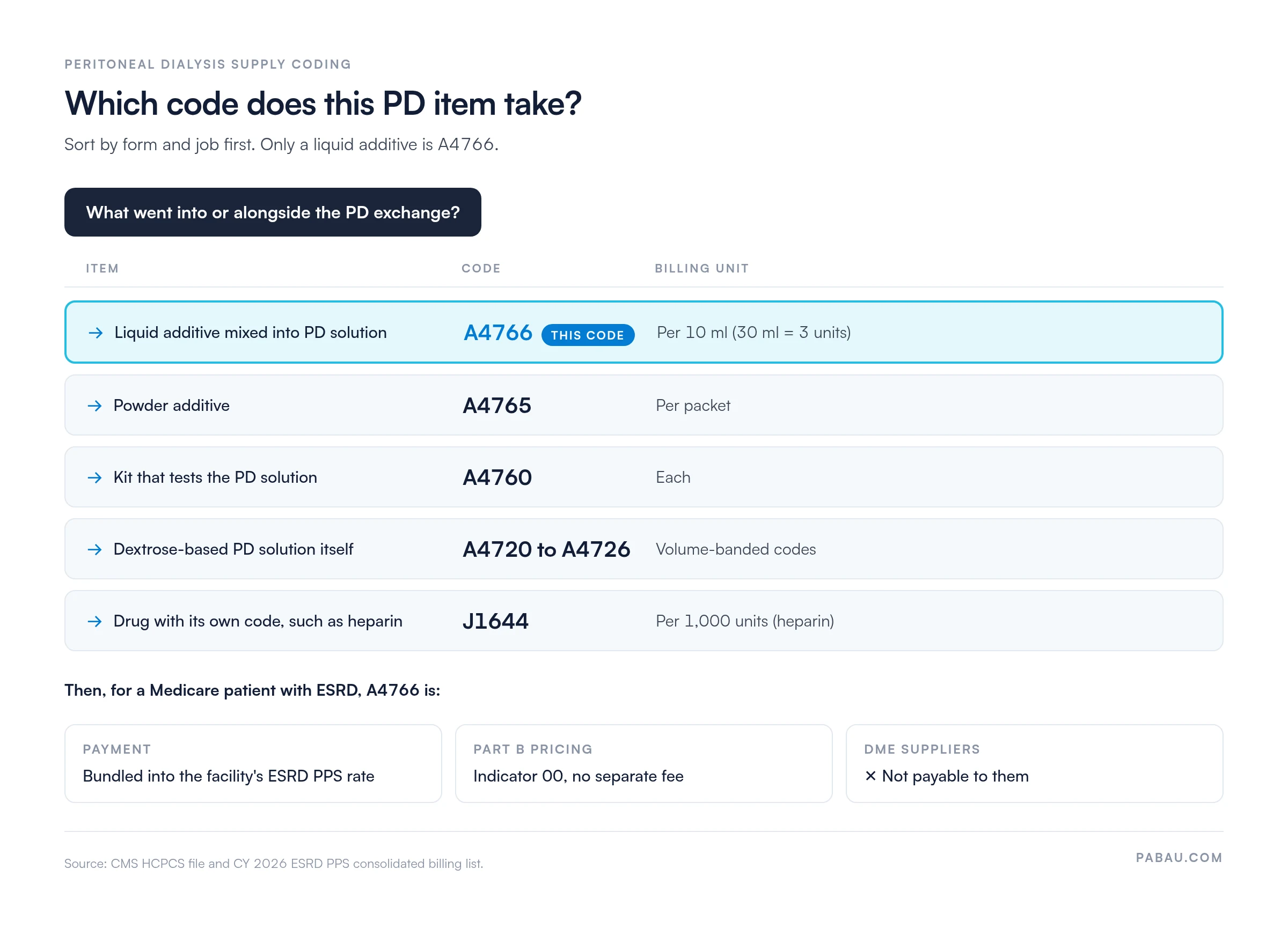
Code the liquid additive as A4766 and the powder form as A4765, and report a drug that has its own HCPCS code under that code.
HCPCS code A4766 is the Level II code for dialysate concentrate, solution, additive for peritoneal dialysis, per 10 ml. It describes a liquid concentrate mixed into peritoneal dialysis (PD) solution before an exchange. Each unit covers 10 ml, so a 30 ml additive is three units.
For a Medicare patient with end-stage renal disease (ESRD), A4766 is not separately paid. Its cost sits inside the dialysis facility’s bundled ESRD prospective payment system (PPS) rate.
CMS publishes the descriptor in its HCPCS quarterly update files. Check the file that matches your date of service, since CMS can revise or retire codes each quarter.
In peritoneal dialysis, a sterile solution dwells in the abdomen and draws waste and excess fluid out of the blood. Clinicians sometimes add a substance to that solution before an exchange. Heparin, which helps keep fibrin from blocking the catheter, and antibiotics for PD peritonitis are common examples.
A4766 reports the liquid additive supply, counted in 10 ml units. Several nearby items belong under other codes:
Under the ESRD PPS, Medicare pays the dialysis facility one bundled rate per treatment. That rate covers the drugs, laboratory tests, supplies and services used to treat ESRD.
A4766 appears on the CMS CY 2026 ESRD PPS consolidated billing list. It sits next to A4765 in the table of ESRD supplies not payable to DME suppliers.
The HCPCS file backs this up. A4766 carries Part B pricing indicator 00, which CMS defines as a service not separately priced. No DMEPOS fee schedule amount applies to it.
For a Medicare patient with ESRD, only the dialysis facility is paid for A4766, and only through its bundled per-treatment rate. The facility furnishes the additive for in-center and home PD patients alike.
Home PD offers no route around the bundle. Before 2011, a home patient could choose Method II and get supplies from a supplier who billed Medicare directly. That option ended when the ESRD PPS began on January 1, 2011.
Outside Medicare ESRD care, the payer’s rules decide. A Medicaid program or commercial plan may bundle PD supplies into its own dialysis rate or pay some separately, so check the contract first.
Because A4766 is bundled for Medicare ESRD patients, most of the work is keeping it off a separate payable claim line. Six checks keep it there.
A4766 sits in a run of ESRD supply codes within the A-code section of HCPCS Level II codes. Every code below appears on the CY 2026 consolidated billing list. The table lines up the neighbors you are most likely to confuse with it.
The quick test is form and job. A liquid added to PD solution is A4766, a powder packet is A4765, and a kit that tests the solution is A4760. The chart below runs the same test across the PD solution and drug codes too.
Most A4766 denials trace back to the bundle or to a unit or form mix-up. Effective denial management in healthcare starts by flagging every consolidated billing code in your charge setup.
A4766 rarely earns its own payment, but the additive still needs a record. Good medical billing compliance for PD supplies means keeping these items on file.
Keep these records for the period your state rules and payer contracts require.
Medicaid rules for A4766 vary by state. Some programs follow the Medicare bundle and pay dialysis per treatment, while others publish their own supply rules. Check the state manual rather than assuming the Medicare treatment carries over.
Commercial and Medicare Advantage plans usually pay dialysis under a contracted rate. Before you bill A4766 to one of them, confirm these points:
Flag every code on the current CMS consolidated billing list in your charge setup, including A4765 and A4766. Refresh the flags each January when CMS publishes the new list, so bundled supplies stay off payable claim lines.
In many dialysis and nephrology practices, supply codes live in one tool, claims in another and stock in a spreadsheet. Whoever builds the claim can miss that an additive is bundled, so A4766 lands on its own line.
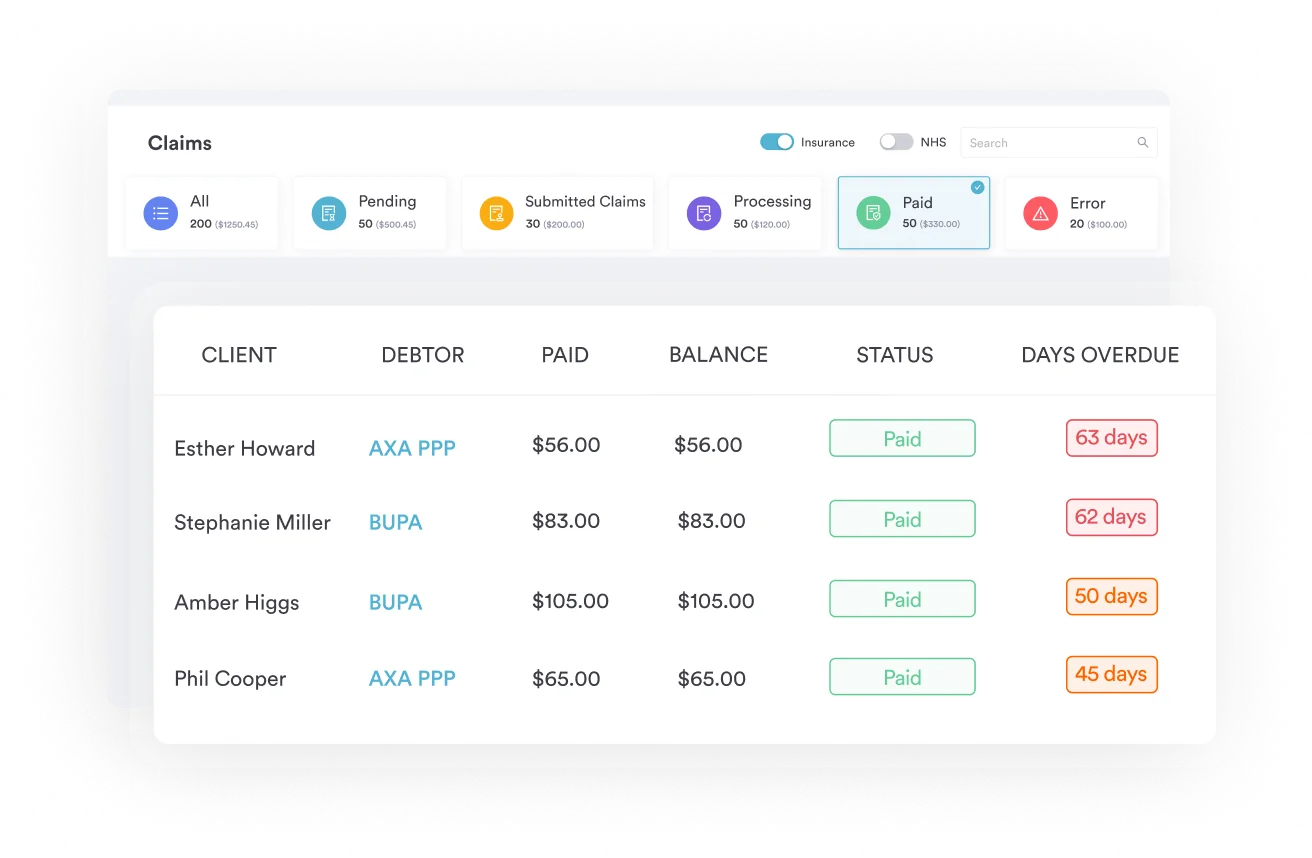
Pabau is practice software that holds patient records, claims and stock in one account. In the US, its claims management software submits the claims your team builds and tracks each one to payment. Your coders still choose the codes, and the status view shows quickly which claims came back with an error.
Pabau’s inventory management tracks consumables such as dialysate additives, so you can reorder before stock runs short. Those usage records then support the supply costs on your cost report.

Pabau keeps claims tracking, patient records and stock together, so your team can follow each dialysis claim to payment and log every supply it uses.

One rule decides how A4766 is handled. For a Medicare ESRD patient, the liquid PD additive belongs to the facility’s bundled payment and never earns a separate fee.
Build your charge setup around that rule and most A4766 denials never happen. The trade-off is that a bundled supply only shows up in your numbers if your team logs it, and those logs back the cost report.
If you want claims tracking and supply records in one system, book a demo to see how Pabau supports dialysis supply billing.

Want a framework for catching bundling denials early? Denial management in healthcare walks through the root-cause methods practices use to stop avoidable denials before they reach the payer.
Want to understand the billing process behind supply codes? What is medical billing covers the claim lifecycle from patient encounter to payment posting.
Looking to tighten your billing compliance program? Medical billing compliance outlines the documentation standards and audit-ready habits that protect practices during payer reviews.
HCPCS code A4766 is the Level II code for dialysate concentrate, solution, additive for peritoneal dialysis, per 10 ml. It describes a liquid concentrate mixed into PD solution, and one unit equals 10 ml.
No. A4766 has Part B pricing indicator 00, so Medicare sets no separate fee. It is on the CMS ESRD PPS consolidated billing list, and its cost sits inside the dialysis facility’s per-treatment payment.
No. No local coverage determination governs A4766, so there are no coverage criteria for a KX modifier to attest. Purchase and rental modifiers such as NU, RR and RA don’t fit a consumable additive either.
No. CMS lists A4766 among ESRD supplies not payable to DME suppliers. Supplier Method II billing ended when the ESRD PPS began in 2011, so the facility furnishes home PD supplies within its bundled payment.
Both codes describe an additive for peritoneal dialysis solution. A4765 is the powder form, billed per packet, and A4766 is the liquid form, billed per 10 ml.
Keep the patient’s ESRD status and PD prescription, the additive order, and the volume added per exchange. Add supply usage logs with lot numbers, plus the purchase and usage records behind the Medicare cost report.