CPT code 56501: Simple destruction of vulvar lesion
CPT code 56501: official descriptor and procedure overview CPT code 56501 is def...

Last Updated: Oct 21, 2026
A4723 is the HCPCS Level II code for peritoneal dialysis solution with any concentration of dextrose. It covers a fluid volume greater than 2999 cc but less than or equal to 3999 cc.
CMS lists A4723 on the ESRD PPS consolidated billing list as a supply not payable to DME suppliers. Medicare pays for it inside the dialysis facility's bundled payment, so the code has no separate fee schedule amount. A DME supplier claim for the code is denied.
Let Pabau's smart automation suggest the right codes, reduce claim denials, and keep your practice compliant—effortlessly.
Automate repetitive tasks and focus on what matters most—your patients.
Reduce coding errors and ensure compliance with the latest regulations.
Clean claims, fewer denials, and faster reimbursements.
Powerful insights and reporting to help your practice thrive.
HIPAA compliant SOC 2 certified GDPR-compliant Trusted by 4,000+ clinics worldwide

HCPCS code A4723 is peritoneal dialysis solution with any dextrose concentration, in a fluid volume above 2999 cc and up to 3999 cc.
The code is one of seven volume bands, A4720 to A4726, so the bag’s labeled fill volume decides which code applies.
CMS lists A4723 among the ESRD supplies not payable to DME suppliers, so Medicare pays for it inside the dialysis facility’s bundled payment.
A separate DME claim for A4723 is denied, and no fee schedule amount, KX modifier or competitive bidding price applies to it.
A4724 is the next dialysate band. Equipment cleaning chemicals are A4674.
HCPCS code A4723 describes peritoneal dialysis solution with any concentration of dextrose. Its fluid volume is greater than 2999 cc but no more than 3999 cc. The code is a Level II code maintained by the Centers for Medicare and Medicaid Services (CMS).
The descriptor turns on two facts: the solution contains dextrose, and its fluid volume falls inside one band. Strength is irrelevant, so a 1.5% and a 4.25% dextrose bag of the same volume share the code.
Check the descriptor each January against the annual CMS HCPCS release. Read the current year of the consolidated billing list too, because CMS revises it every year.
CMS splits dextrose-containing peritoneal dialysis solution into seven codes by fluid volume. A4723 is the fourth band. A separate code covers non-dextrose solution.
Each band starts one cc above a round number. That means a bag labeled with a round volume always sits at the bottom of a band, as the chart below shows.
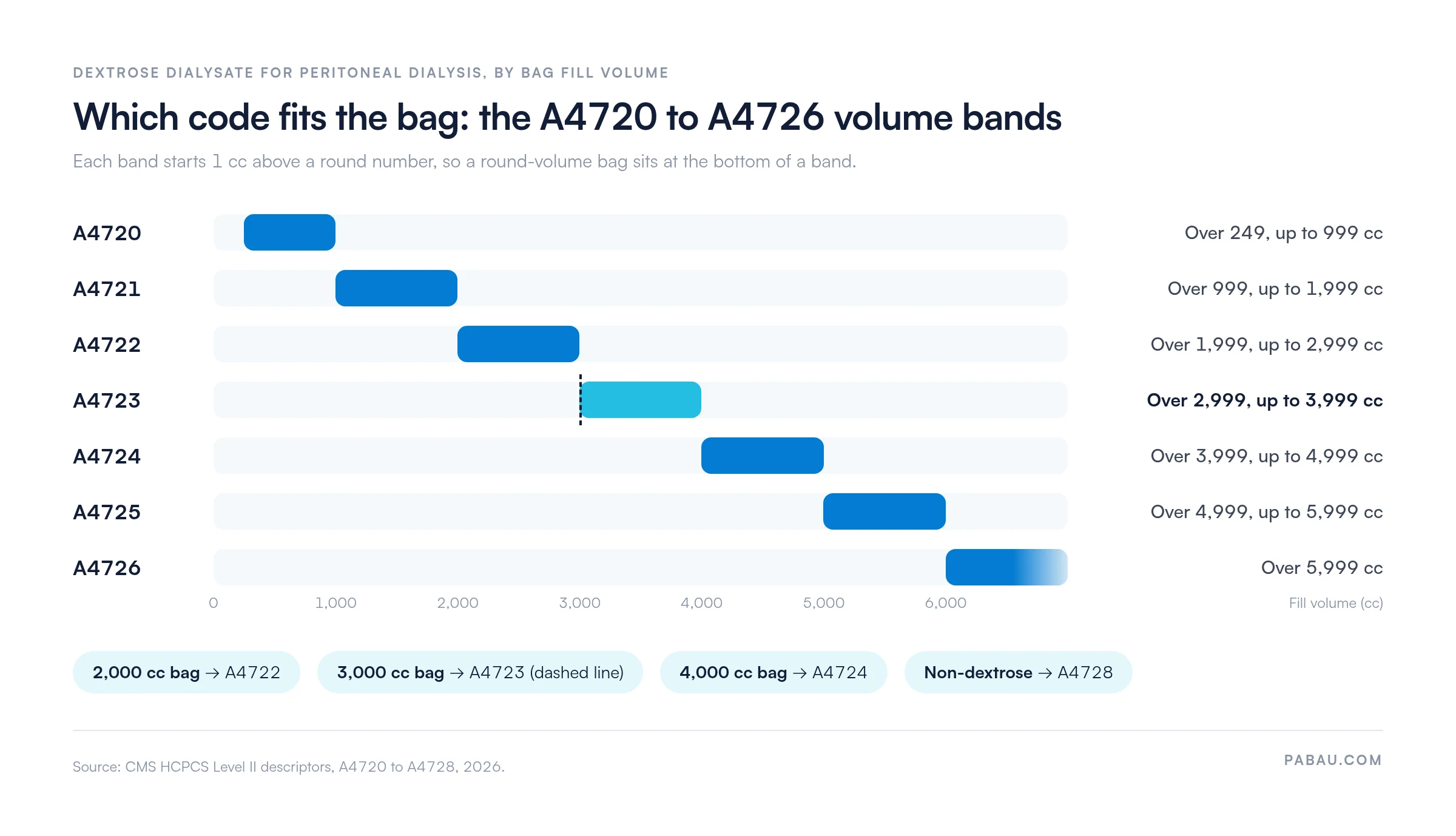
Read the fill volume from the product label, not from the prescribed exchange volume. A 2,500 cc exchange drawn from a 3,000 cc bag still describes a 3,000 cc supply.
A4724 is the next dialysate band. Equipment cleaning chemicals are A4674.
Medicare pays for A4723 inside the dialysis facility’s bundled payment, not as a separate supply line. The ESRD prospective payment system covers the drugs, laboratory tests, supplies and equipment a facility furnishes to treat ESRD.
CMS publishes the affected codes each year in Attachment B of its ESRD PPS consolidated billing list. The attachment splits the supply codes into two groups. A4723 sits in the group headed DME ESRD supply HCPCS not payable to DME suppliers.
Home peritoneal dialysis works the same way. The ESRD facility that manages the patient’s home program furnishes the solution, and its payment covers it. Other suppliers look to that facility for payment rather than billing Medicare themselves.
The facility’s payment comes from the ESRD PPS base rate, adjusted for patient and facility factors. None of that amount is tied to A4723, which is why a fee schedule lookup for the code returns nothing useful.
A DME supplier claim for A4723 is denied under the ESRD PPS consolidated billing edits. More documentation does not change the outcome, because the code has no separate Medicare payment route.
Separate Medicare payment is not at stake, but the record still has to support the dialysis care behind the supply. Billing compliance requirements apply to the facility claim that carries the payment.
A post-payment reviewer looks for these records on the facility side. A supply invoice on its own does not show the clinical need.
Medicare is the primary payer for most patients with ESRD. Medicaid and commercial plans sit alongside it for some patients, and their policies on dialysis supplies vary.
Before you code a peritoneal dialysis supply order, read the fill volume printed on each bag. A 3,000 cc bag is A4723 and a 4,000 cc bag is A4724, even when both carry the same dextrose strength.
Most A4723 errors trace back to treating the code as an ordinary DMEPOS supply. These are the ones that recur.
Dialysis supply questions usually arrive months after the bags were shipped. By then, the prescription, the delivery record and the home treatment log often sit in three different places. Someone then spends an afternoon matching them up.
Pabau, the practice management and EHR platform we build, keeps those records on one patient file. The order, the treatment notes and the forms your team completes attach to the patient they belong to. Pabau does not choose or check the code for you.
Where a payer does accept a claim, Pabau’s claims tools for billing teams submit it through the Claim.MD integration. It then tracks the claim status and the remittance that comes back. The coding decisions in this guide stay with your billing team.

Pabau keeps the dialysis order, treatment notes and forms on one patient record. Where a payer accepts a claim, it submits it through Claim.MD and tracks the status.

A4723 is a narrow code with a simple test. The bag holds dextrose dialysate for peritoneal dialysis, and its fill volume sits above 2999 cc and up to 3999 cc. If either fact fails, a neighboring code applies.
The payment question is settled before any claim is built. Medicare pays the ESRD facility, and a DME supplier claim for A4723 is denied. The effort belongs in the facility record and in each non-Medicare payer’s supply policy.
Peritoneal dialysis programs generate a lot of paperwork per patient, and the record is where the time goes. Book a demo to see how Pabau keeps orders, notes and claim tracking on one patient record.

Coding the next bag size down? A4722 covers dextrose dialysate above 1999 cc and up to 2999 cc.
Coding the next bag size up? A4724 covers dextrose dialysate above 3999 cc and up to 4999 cc.
Working with non-dextrose solution? A4728 applies the same bundling rule to non-dextrose dialysate.
Billing peritoneal dialysis tubing? A4719 explains how consolidated billing treats the Y set tubing code.
Cleaning dialysis equipment? A4674 is the code for chemicals and antiseptic solution used on dialysis equipment.
HCPCS code A4723 describes dialysate solution for peritoneal dialysis with any concentration of dextrose. The fluid volume must be greater than 2999 cc and no more than 3999 cc, which in practice means a 3,000 cc bag.
Both codes describe dextrose dialysate for peritoneal dialysis, in different volume bands. A4723 covers above 2999 cc up to 3999 cc. A4724 is the next dialysate band, above 3999 cc up to 4999 cc. Equipment cleaning chemicals are A4674.
No. CMS lists A4723 among the ESRD supplies not payable to DME suppliers. Medicare pays for the solution inside the ESRD facility payment, so a separate DME claim is denied.
No. The code carries pricing indicator 00, so Medicare does not price it separately. The facility is paid through the ESRD PPS base rate, which CMS updates each January 1.
A 2,000 cc bag of dextrose dialysate codes to A4722, because 2,000 cc is greater than 1999 cc. A4723 starts at 3,000 cc, since its band begins above 2999 cc.
No. Those apply to DMEPOS items paid on the DME fee schedule. A4723 has no separate Medicare payment, so neither a KX modifier nor a certificate of medical necessity changes how it is paid.