

HCPCS code E0198: Water pressure pad billing guide
HCPCS code E0198 is a water pad for a standard mattress HCPCS code E0198 is the ...

Last Updated: Oct 13, 2026
A4344 is the HCPCS Level II code for indwelling catheter, foley type, two-way, all silicone or polyurethane, each.
Medicare Part B pays it as a durable medical equipment (DME) urological supply. Coverage applies when a patient needs long-term urinary drainage and the order satisfies Local Coverage Determination L33803.
Three requirements decide whether the claim pays. You need the KX modifier, an ICD-10-CM code from the LCD's covered list, and a signed physician order that predates fulfillment.
Let Pabau's smart automation suggest the right codes, reduce claim denials, and keep your practice compliant—effortlessly.
Automate repetitive tasks and focus on what matters most—your patients.
Reduce coding errors and ensure compliance with the latest regulations.
Clean claims, fewer denials, and faster reimbursements.
Powerful insights and reporting to help your practice thrive.
HIPAA compliant SOC 2 certified GDPR-compliant Trusted by 4,000+ clinics worldwide

HCPCS Code A4344 covers an indwelling catheter, Foley type, two-way, all silicone or polyurethane, each. Medicare Part B pays it as a DME urological supply.
Coverage requires documented medical necessity under LCD L33803, and the supplier must be DMEPOS-enrolled and accredited.
The KX modifier is required when medical necessity is documented, and misapplied modifiers are a leading cause of A4344 denials.
Only ICD-10-CM codes on the LCD L33803 covered list support the claim, however accurate an unlisted code may be clinically.
Practice management software like Pabau keeps the physician order, diagnosis, and delivery record on one patient file for audits.
A4344 has a single, precise long description: Indwelling catheter, Foley type, two-way, all silicone or polyurethane, each. Every word in it carries billing weight.
Under the CMS HCPCS Level II coding system, A4344 sits in the A-code range for medical and surgical supplies. It falls under the Durable Medical Equipment, Prosthetics, Orthotics and Supplies (DMEPOS) benefit and is billed to Medicare Part B.
Medicare Part B covers A4344 when a beneficiary requires long-term urinary drainage and the treating physician has documented medical necessity. Coverage is governed by Local Coverage Determination L33803 (Urological Supplies), which sets out the qualifying diagnoses and the records a supplier must retain. Confirm those criteria before the order is fulfilled, because there is no way to repair the sequence afterwards.
LCD L33803 requires a chronic condition that causes urinary retention or incontinence and cannot be managed another way. The physician order must specify the catheter type, the French size, and the replacement frequency. It also has to be signed inside the timeframe the LCD sets.
Suppliers that bill A4344 without the physician order and the supporting clinical notes carry recoupment risk during audits. CMS contractors routinely pull urological supply claims for post-payment review, which makes documentation the first line of defense.
Medicare reimburses A4344 at the DMEPOS fee schedule rate, which CMS updates every year. Rates vary by MAC jurisdiction and payment locality, so verify the current figure against the published CMS DMEPOS fee schedule for your region. The table below shows the rate structure rather than a dollar amount. Reimbursement depends on jurisdiction, assignment status, and whether the supplier participates in competitive bidding.
Suppliers in the competitive bidding program must hold a contract for the applicable product category in their service area. Billing A4344 outside your awarded area without that contract can lead to denial and compliance exposure.
Modifier selection is where A4344 claims most commonly go wrong. Each modifier carries a specific meaning that has to match the claim’s clinical and billing circumstances. The wrong modifier, or a missing required one, triggers an automatic denial or an audit flag. Tracking the denial codes in medical billing tied to modifier errors surfaces patterns that point back to one step in your workflow.
The KX modifier carries legal weight. Appending it certifies that the supplier holds documentation proving medical necessity. Applying KX without that documentation is a false certification under Medicare’s program integrity rules. It can lead to audit recoupment or a referral to the Office of Inspector General.
Run a quarterly modifier audit on all A4344 claims. Pull the claims where KX was applied and cross-check each one against the corresponding physician order in your records system. If a claim lacks a signed order predating fulfillment, flag it for a corrected claim or a voluntary repayment review before the MAC finds it.
Only ICD-10-CM diagnosis codes listed in LCD L33803 establish medical necessity for A4344. A code that is not on the covered list draws an automatic denial, however accurate it is clinically. The table below lists commonly covered diagnoses. Check the current LCD for the complete list, because covered codes change with the annual updates.
When a patient carries several applicable diagnoses, list the condition driving catheter use first on the claim. Specificity matters here. R33.9 (retention, unspecified) is covered, but coding the documented underlying cause improves audit defensibility. The CMS Urological Supplies policy article carries the covered diagnosis list that pairs with LCD L33803.
Getting the diagnosis code right is necessary but not sufficient. A claim for A4344 also needs a compliant workflow from order to submission. Suppliers that pass audits tend to run that sequence inside their claims management software rather than from memory. The elements below apply in every MAC jurisdiction, though some MACs add local policy on top of the national LCD.
The indwelling catheter family in HCPCS Level II splits on three variables: catheter type, lumen count, and material. Those are the same three fields the physician order has to name, so a complete order tells you the code. Work through them in a fixed sequence and the choice stops being a judgment call.
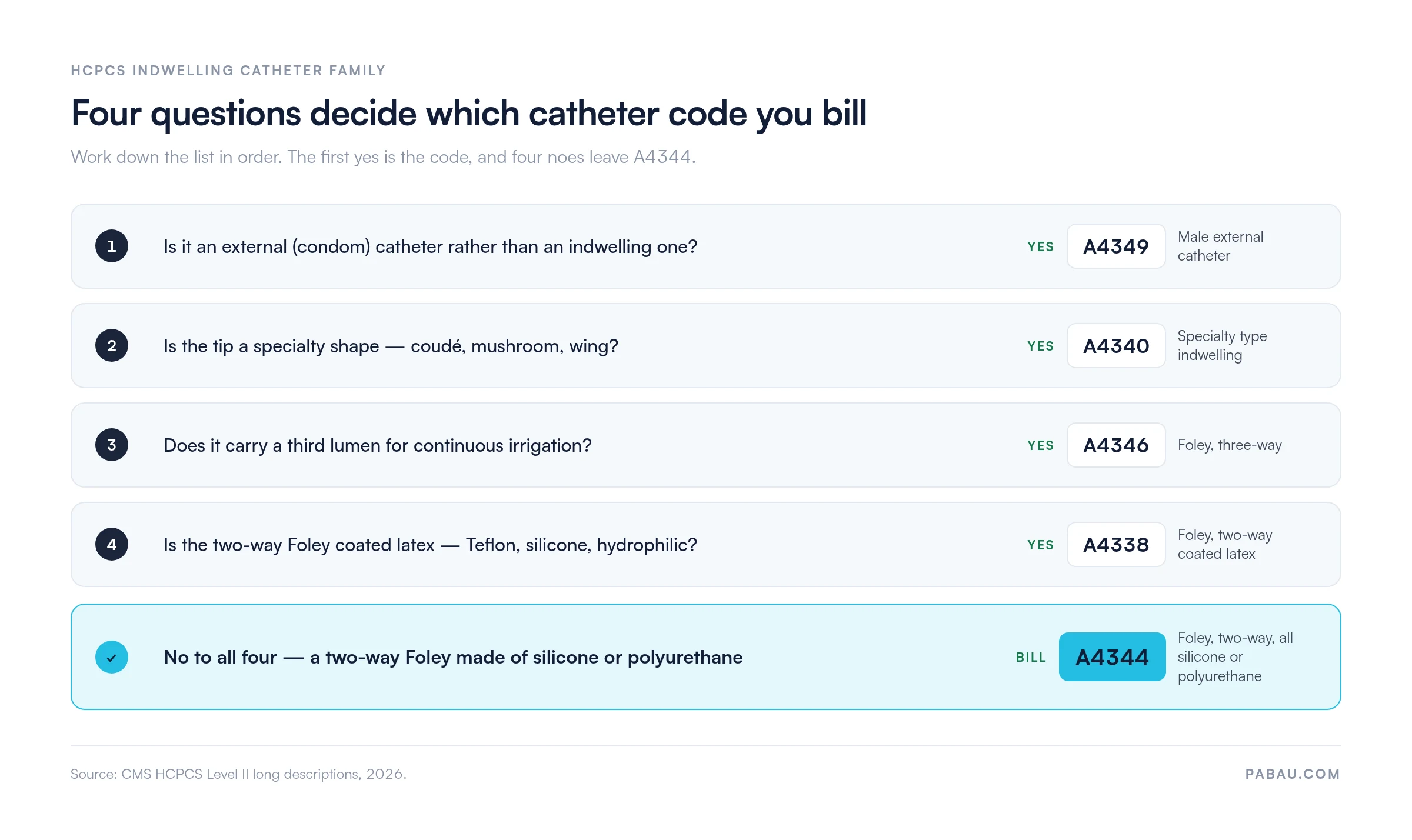
The material test is the one that catches suppliers out. “All silicone or polyurethane” describes the whole catheter, not a silicone coating over a latex body. A coated-latex Foley is A4338, so checking material at the point of fulfillment is what keeps the two codes apart.
The A4344 versus A4346 question comes up most in post-surgical urology billing. A4346 adds a third lumen for continuous bladder irrigation, which suits patients after transurethral resection of the prostate (TURP) or with significant hematuria. Billing A4344 when a three-way catheter was dispensed understates the item and raises questions in the other direction. Bill the code that matches what was dispensed and what the physician ordered.
When the Foley is dispensed inside an insertion tray with a drainage bag, the kit code covers the supply, and A4314 is one example. Billing the catheter alone for a product that shipped as a complete tray is the kind of mismatch DME audits look for.
Foley catheter billing under Medicare draws a disproportionate share of DME audit activity relative to the dollars involved. The patterns below are what pull urological supply claims into MAC review, with the fix for each one.
Catching those before submission is what builds a clean claim submission process for A4344. A pre-billing checklist tied to order intake catches most of them at the earliest stage, before the claim is formatted and sent.
Build a mandatory pre-billing checklist into your A4344 order intake process. Check four items: order date against fulfillment date, ICD-10 match to the LCD L33803 covered list, KX documentation, and quantity against current limits. Clearing all four before submission removes most preventable A4344 denials.
Most DME suppliers hold the A4344 sequence in three places at once. The physician order sits in a scanned folder, the diagnosis lives in the patient chart, and the claim gets keyed into a separate billing tool. Every handoff is a chance to lose the order date or drop the modifier.
Practice management software like Pabau puts those pieces on one patient record. Insurer details sit on the record itself, so the claim is built from the same file that holds the order and the treatment note. In the US, claims go out to Claim.MD from inside Pabau, so nothing gets re-keyed on the way.
Pabau also checks each claim for missing details before it goes out, and keeps billing and claims in step. For an A4344 claim, that means the modifier, the diagnosis, and the order are all in one place when a MAC asks to see them.

Pabau brings insurer details, physician orders, and treatment notes onto one patient record, then sends claims out from the same place. Missing details get caught before they turn into rejections.

A4344 is a simple code with a demanding paper trail. One catheter, one unit, one material specification. The claim pays only when the order, the diagnosis, and the modifier line up behind it.
So the work is front-loaded. Tighten the order intake step and the modifier review, and the denials mostly stop arriving. Leave both to the billing team at submission time and every claim turns into a small investigation.
Start with the order date, since it is the one element you cannot repair later. Book a demo to see how Pabau keeps the order, the diagnosis, and the claim on one patient record.

Need a complete overview of how HCPCS billing fits into DME revenue cycles? What is revenue cycle management explains how the billing cycle connects from patient encounter to final payment.
Want to see where errors enter a HCPCS claim? Medical billing workflows covers the operational steps where mistakes most commonly slip into the claim lifecycle.
Looking for a billing platform that handles DME claims? Medical billing software for US practices outlines what to look for before you commit to one.
HCPCS Code A4344 bills Medicare Part B for a single two-way indwelling Foley catheter. The catheter must be made of all silicone or polyurethane. Coverage applies when a patient requires long-term urinary drainage and the claim meets LCD L33803 criteria.
The modifier most often required on A4344 is KX, which certifies that documented medical necessity meets LCD L33803 criteria. NU marks new equipment. GY marks an item Medicare does not cover, used when an ABN is in place. RR marks a rental, which rarely applies to a disposable catheter. Apply a modifier only when the condition it represents is present and documented.
Yes. A4344 is covered under Medicare Part B as a DMEPOS urological supply, subject to three conditions. The supplier must be DMEPOS-accredited, the patient’s diagnosis must appear in LCD L33803, and the physician order must be signed before the supply is dispensed. Medicare pays 80% of the allowable rate, and the beneficiary owes the remaining 20% coinsurance after the annual deductible.
A4338 is a two-way Foley catheter in coated latex rather than all silicone or polyurethane. A4346 is a three-way Foley with a lumen for continuous irrigation, used post-TURP or for bladder hemorrhage. A4349 is a male external (condom) catheter, not an indwelling device. Billing A4344 for any of those is a coding error, so match the billed code to the product supplied.
You need a signed physician order that predates fulfillment and names the catheter type, French size, and replacement frequency. You also need medical records supporting the ICD-10-CM diagnosis, evidence of DMEPOS accreditation and Medicare enrollment, and a retained delivery confirmation. If coverage is uncertain, an Advance Beneficiary Notice must be on file before the item is dispensed.
LCD L33803 (Urological Supplies) is the Local Coverage Determination governing Medicare coverage for A4344 and related indwelling catheter codes. It sets the covered ICD-10-CM diagnosis codes, the documentation requirements, the utilization limits, and the medical necessity criteria. Check the current version in the CMS Medicare Coverage Database, since the covered code list is updated periodically.



